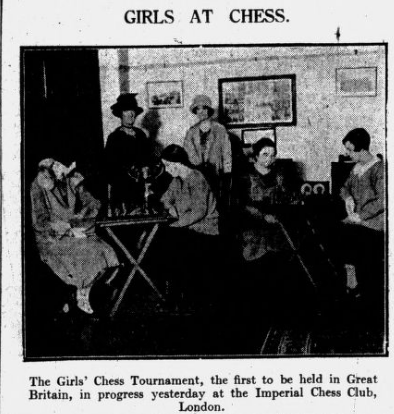
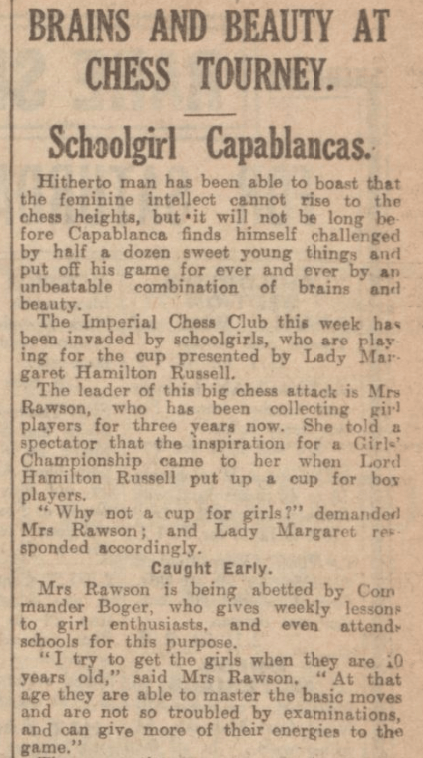
I left you last time at the end of 1925, with Mrs Arthur Rawson proposing to run a tournament for girls under the age of 21.
The reasons for promoting chess for girls were, in one sense, not a lot different for those given for promoting chess for very much younger children today: ‘teaching foresight, caution, concentration, and logic’.
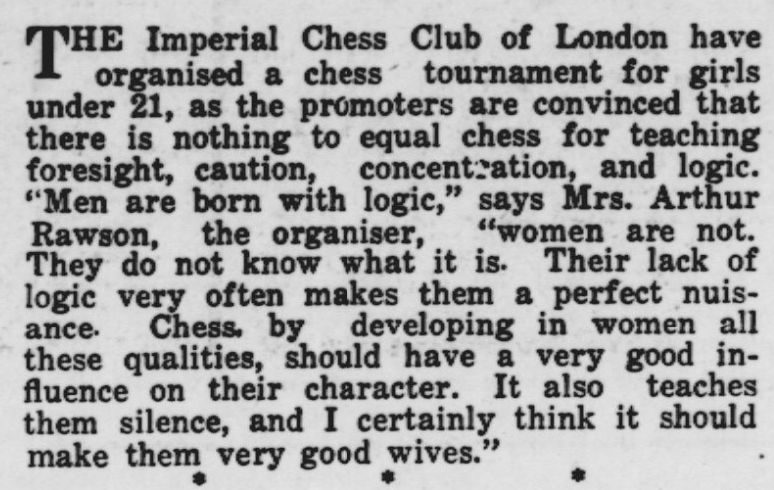
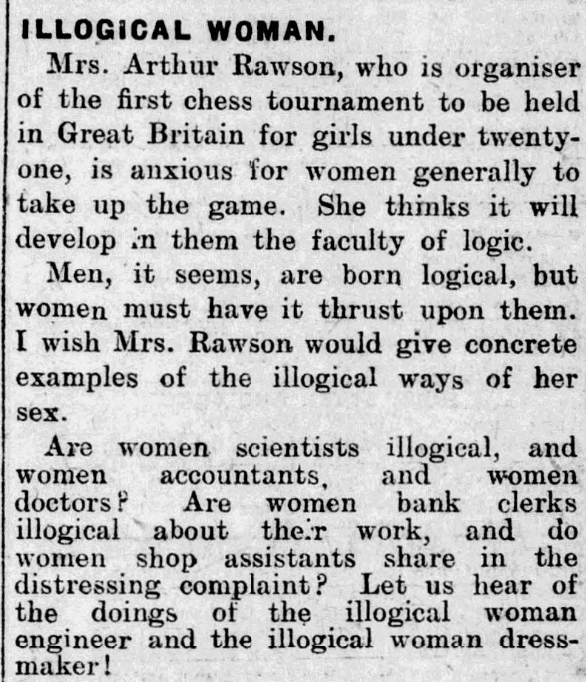
Her subsequent comments, though, would be considered inappropriate today. Even a century ago, some were unhappy with stereotyping girls as being illogical.
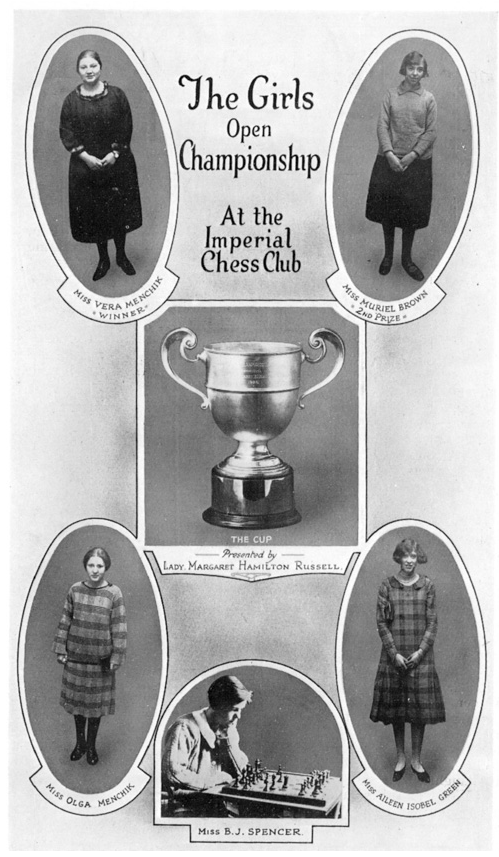
The tournament, which started on 12 January, attracted only five players, including the Menchik sisters, Vera and Olga, resident in Hastings, who will need no introduction to most of my readers.
Here they all are, as portrayed in the February 1926 British Chess Magazine (taken from BritBase, where John Saunders has a most informative page about girls’ tournaments in the 1920s and 1930s).
As expected, Vera Menchik, who had already been established as a strong player for a couple of years, had no difficulty taking first place.
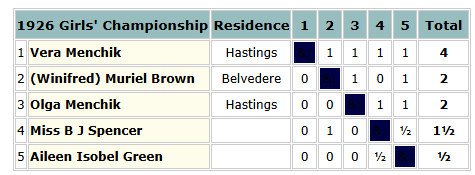
We really ought to meet her opponents, whose backgrounds were not quite what you’d expect.
Winifred Muriel Brown, known by her middle name (1906-1995) was the only child of a chess playing marine engineer and had been born in West Cowes on the Isle of Wight, the family having moved to Belvedere (Erith) since the 1921 census. Muriel married Walter Charles Pond in 1932 and their only son, John, was born the following year. It seems like the marriage may not have lasted long: by 1939 Walter was farming near Ashford, Kent, while Muriel was living with her mother and young John in Andover. She had, however, been playing chess back in Erith earlier that year, and also played in the 1938 British Ladies’ Championship in Brighton.
Next we have Miss Boden Joyce Spencer (1904-1988), usually known as Joyce. Her unusual first name had been given for family reasons: her Spencer family intermarried with a family named Boden at several points. Since you asked, there’s no connection, as far as I can tell, with Samuel Standidge Boden.
Joyce had been born in Burton on Trent, where her father Percy worked as a Mechano-Therapathist (today he’d probably be described as a physiotherapist), but by now she was living in Hampstead, where she would later study French and Philosophy at London University. Later records tell us she was sharing a large semi-detached house just south of Hampstead Heath and Parliament Hill Fields with a cousin, Raymond Spencer Boden, and two other young women, perhaps friends. There’s not a lot of information available, but she may have moved there after her father died in 1917. Her occupation was given as ‘Domestic Duties’ in the 1939 Register. She never married and there’s no indication of any employment: perhaps her family was sufficiently affluent to enable her to live a life of leisure.
Finally, there was Aileen Isabel Green, known as Judy (1907-1983). The 1921 census found her also in Hampstead, but in the slightly less upmarket area of Cricklewood, along with her parents and brother. Her father, another chess player, Enos Green, was a musician, a cellist with the Royal Mail Steam Packet Company (a connection here), playing in bands in onshore functions. Back in 1911, she, along with her mother and brother, had been living with Enos’s brother Arthur, a railway clerk: their father had been a domestic gardener. In 1939 she was still at home, working as a clerk for the Regimental Pay Masters, doing her part for the war effort. Aileen/Judy, who never married, later lived in Esher before moving to a residential home in Devon.
You’ll surely be aware that the Menchik sisters, who lost their lives in tragic circumstances in 1944, both married, but neither had children. Of the five competitors, then, only Muriel Brown would give birth to a child.
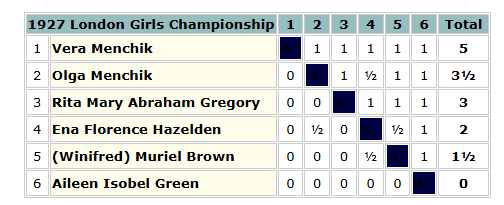
The girls, or rather young women, were back again the following year. Joyce Spencer was now over age, but not (contrary to some contemporary reports) Vera Menchik. She and Olga had returned along with the colourful duo of Muriel Brown and Aileen Green.
Eight players were expected, but two had to withdraw due to an accident to their father. The two newcomers were Rita Gregory, from Kent, and Ena Hazelden, from Hastings, who took third and fourth places respectively behind the Menchik sisters.
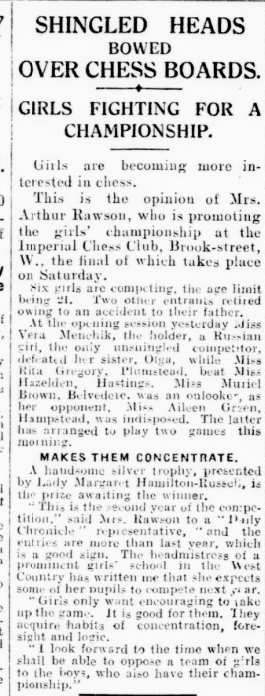
Shingled hair – a shorter hair style – was popular with fashionable suburban girls at the time. Vera Menchik, however, even at a young age, was notable for her matronly appearance.
Rita Mary Abraham Gregory (Abraham and Gregory are hyphenated in some records) (1910-2000), was from Plumstead, not very far from Muriel Brown, and was also the daughter of a chess player. Charles Abraham Gregory, born in York, was working as a writer for the Royal Arsenal in 1911, living with his wife, a son named Luttrell, and Rita. By 1921 he was unemployed, but had previously worked for what might have been a construction company.
Rita, who never married, was living with her parents and working as a government clerk at the time of the 1939 Register. She must have been proud of her chess achievements, which were mentioned in her death notice.
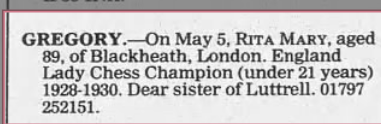
Rita had lived a modest and uneventful life, never moving far from her place of birth, but, thanks to the efforts of Mrs Arthur Rawson, more than 75 years earlier she had been a national champion.
Ena Florence Hazelden (1906-2000) came from an even more modest background than Rita. She was born in Robertsbridge, Sussex, the daughter of a general labourer, but by 1921 the family had moved to Hastings, where her father had found employment as a carter for a gas company. Her older brother was a bioscope operator (projectionist) in a local cinema.
Perhaps it was moving to Hastings that got Ena interested. She soon immersed herself in the local chess culture, joining the club and playing for their 3rd and 4th teams.
Their 1927 AGM reported that she was in a triple tie with WA Winser and AE Dobell for the Keeble Trophy, and had won her section of the Bradley Martin Cup. AE Dobell might possibly have been a misprint for HE Dobell as I can find no one with those initials in his immediate family. The tie with (William) Arthur Winser might have been resolved by a chess match, but it eventually turned into a love match: they married in the fourth quarter of 1928. Arthur also came from a relatively humble background: in 1921 his father was working as a furniture packer for Pickfords.
The 1939 census found them still in Hastings, with Arthur working as a poulterer and dairyman. Their only child, a son named Rodney, was born in 1941. They later divorced, and Ena married Harvey Pendleton in 1974.
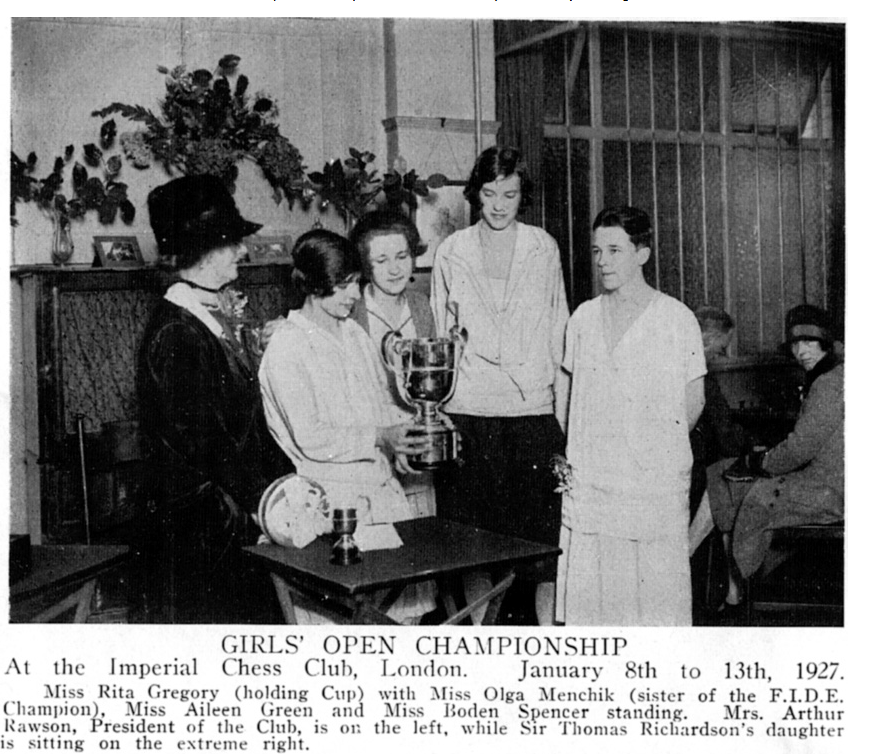
Here are the players. with their mostly shingled hair, along with Mrs Stevenson (about whom much more another time) and Mrs Rawson, from the March 1927 issue of the British Chess Magazine.
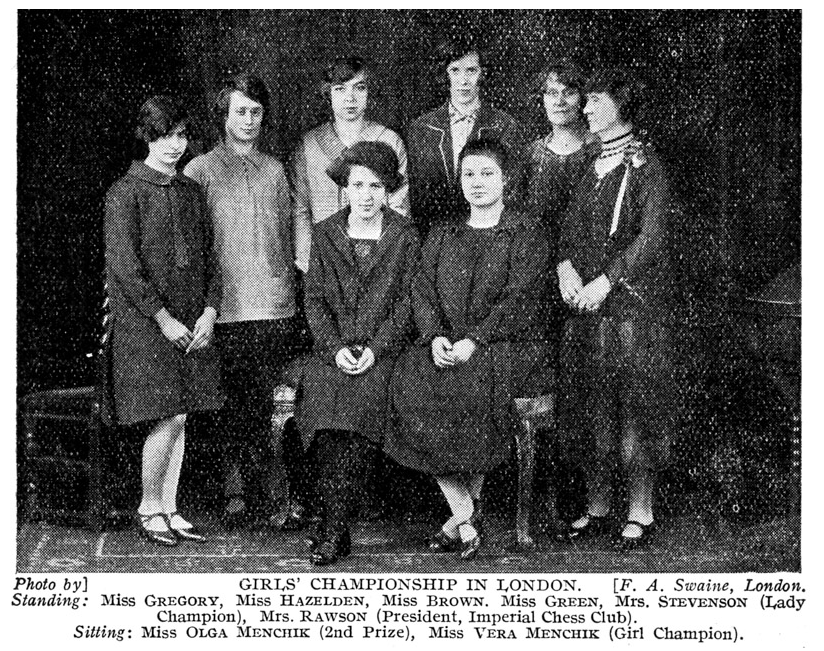
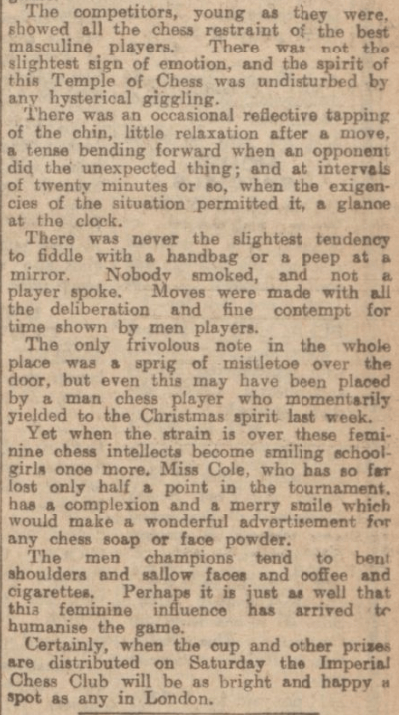
It’s certainly notable that most of the girls in these early tournaments came from very different circumstances to those of the members of the Imperial Chess Club.
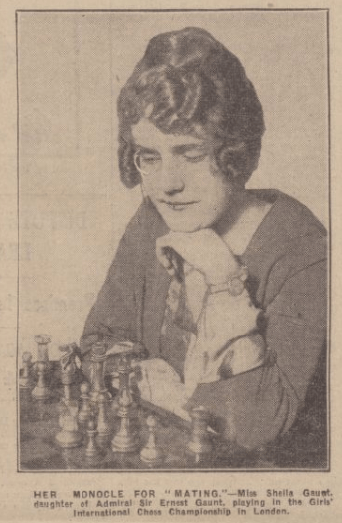
It appears that the 1928 renewal only attracted four players. Rita Gregory took the title ahead of Olga Menchik. Third place was shared between Aileen Green and the sole newcomer, Sheila Gaunt, who attracted considerable press attention.
The daughter of Australian born Admiral Ernest Frederic Augustus Gaunt, Sheila, who could hardly have been considered modest or humble, must have been right at home in the Imperial Chess Club.
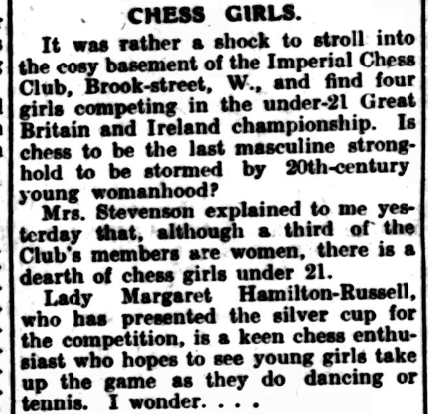
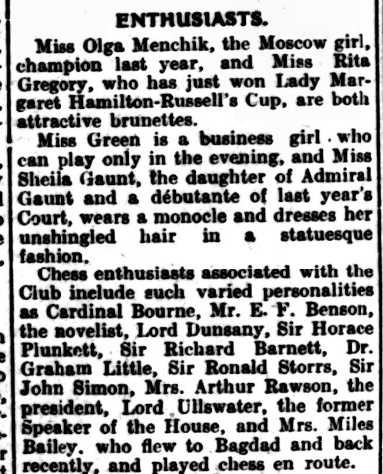
Here she is, complete with her monocle and statuesque hair.
She’s missing from this photograph from the British Chess Magazine (March 1928), which managed to get the year wrong. You’ll notice that Boden Joyce Spencer had turned up to watch.
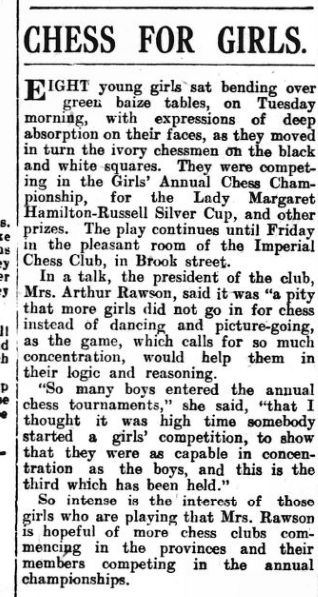
In 1929 there was a record entry of eight girls, taking part in an activity which, in the opinion of Mrs Arthur Rawson, was much better for them than ‘dancing and picture-going’.
Rita Gregory, the 1928 champion, was the only returning competitor. She required a play-off to retain her title.
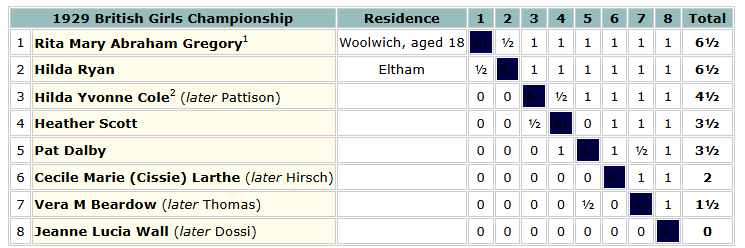
Her rival was Hilda Annie Ryan (1910-1996?), another girl from a less affluent background, living, like Rita, in Plumstead. Her father was a tram conductor in 1911, but had graduated to a tram driver in 1921. They must already have known each other very well, and both played chess for Royal Arsenal.
In 1936 Hilda married a man with an Old French name: Leroy (the king) Arthur Beaufoy (good faith). The Beaufoy family were from Meriden in Warwickshire (my mother entered this world in Meriden Workhouse 15 years earlier), but I can find no immediate connection. Leroy’s father was an insurance agent whose job briefly took him to Kenosha, Wisconsin, where his son was born (the name Leroy was very popular in America at the time).
The marriage wasn’t successful: in 1939 Leroy, who remarried in 1960, was lecturing in engineering in Bristol, while Hilda was living in North London working as a shorthand typist.
Third place was taken by another Hilda. Hilda Yvonne Cole (1911-1994) was the daughter of the strong amateur Henry Holwell Cole (not to be confused with his unrelated contemporary Harold Godfrey Cole), whom I really ought to write about at some time. She married John Henry Pattison, a widower more than twice her age, in 1931, the marriage producing three children.
Heather Scott raises an interesting question. Lady Margaret Hamilton-Russell, had, in her day, been, as Margaret Scott, a famous golfer, winning the first three Ladies’ Amateur Championships between 1893 and 1895. She came from a golfing family, notably her youngest brother, Michael, who had a daughter, Heather Alice Cecily Scott, born in Australia on 16 June 1908, which would have made her 20 at the time of the tournament. She died, unmarried, on the Isle of Wight in 1965. Heather ‘s mother divorced Michael in 1919, and in 1921 married the celebrated First World War cartoonist (Charles) Bruce Bairnsfather. They had a daughter, Barbara, the following year, who certainly played chess. Given the family connections, I assume this was her, although there was another Heather Scott of the right age around at the same time.
Pat Dalby (1912-2001) is something of a mystery. I believe she was born Agnes Patricia Dalby in Marylebone in 1912, her parents presumably being William J Dalby and Margaret Lynch, who had married in the fourth quarter of 1911. There’s a death record for Frances M V Dalby aged 36 in Marylebone in 1917 which may well be her mother, an Irish Catholic you’d guess. Pat later added Mary Frances to her name in the Catholic tradition. I can’t find any obvious death record for William.
By 1921 she was in an orphanage, with both her parents apparently dead. She married Edwin Eustace Ball in 1939, and, by the time of the Register she was in St Albans, rather grandly describing herself as a business executive. Edwin became a lieutenant in the Royal Artillery, sadly dying in combat in Italy in 1943. Perhaps he met my father, who also served in the Royal Artillery in Italy, there.
If Pat really was an orphanage girl scoring 50% in a chess tournament of this nature, that would be quite a story.
Cecile Marie Larthe (1911-1995) came from a large family, her mother English and her father, an insurance claims assessor, French. They had been living in Acton in 1911, but, ten years later, had moved to Penge. In 1939 she was working as a children’s hairdresser, and later joined the Land Army. She married Ernst Hirsch in Bromley in 1941: I believe he, a carpenter and joiner by trade, had been in Kitchener Camp, Richborough in 1913 along with Alexander Distler.
Vera Mavis Beardow (1911-1976) was the daughter of a doctor from Battersea, who, having been a male nurse in 1911, was training in medical gymnastics and massage in 1921. She married Harry Valentine Thomas in Brighton in 1943, later emigrating to Canada.
Jeanne Lucia Wall (1913-1996) is another mystery. She was born into an Irish family, the second of three children, with an older sister, Mary (1911), and a younger brother, Joseph (1916). Her father’s name was Michael Wall, and his mother was Margaret Lynch – yes, the same name as Pat Dalby’s mother. Mary was born in August 1911, Jeanne in December 1913, and Pat in January 1912, so just a coincidence. At the time of the 1911 census, Michael was a traveller (a travelling salesman) working in church furnishing. The family must have hit hard times, as by 1921 Jeanne and Joseph were both boarding at St Joseph’s Roman Catholic Poor Law School in Southall. This was a school educating children of parishioners from St Marylebone who would otherwise have ended up in the workhouse.
By 1939 the whole family had turned their lives around. Now living in Kensington, Michael was running a funeral furnishings business, assisted by Margaret. Mary and Jeanne were both in the Civil Service, Mary a typist and Jeanne a shorthand typist, while Joseph was an undertaker’s assistant, a coffin and cask maker and a ‘beautiful embalmer’.
In 1941 Jeanne married Luigi Enrico Dossi, from an Italian Swiss family, part of the Ticinese community who were involved in running cafés and restaurants in London for many years. I’ll have a lot more to tell you about this in a future Minor Piece.
You wonder how eight girls from such diverse backgrounds ended up playing chess in the Imperial Chess Club. Mrs Arthur Rawson’s energy would have had much to do with it.
Rita was the daughter of a chess player, and may have known Hilda Ryan from school, chess club or both. Hilda Cole, whose father was a very strong player, was a natural participant. Vera may possibly have learnt chess at school. Cecile might perhaps have encountered Rita or Hilda Ryan through South East London connections. But how, one wonders, did Pat and Jeanne, both from struggling families with Irish connections, both with mothers named Margaret Lynch, find out about chess? I’d guess that by that time they were both pupils at St Vincent’s School, run by the Daughters of Charity of St Vincent de Paul for girls from impoverished Catholic families, one of the schools where Mrs Rawson had introduced chess.
This article provides some information concerning Mrs Rawson’s policy of schools outreach.
In this photograph we see Commander Boger, who was coaching the girls.
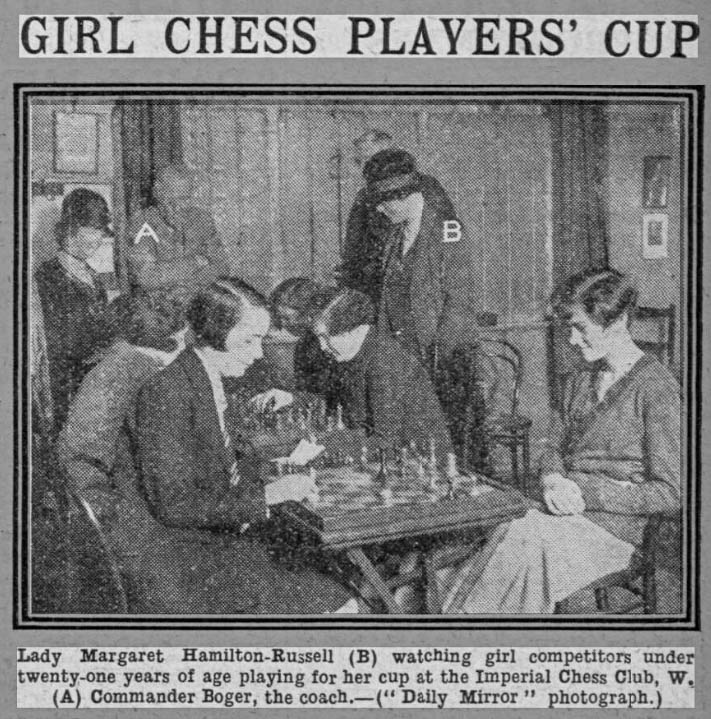
Commander Henry Otway Boger (1867-1950: he died just five days before my birth), born in Ryde on the Isle of Wight, was a retired naval officer, a lifelong bachelor who devoted his long retirement to voluntary work, including promoting girls’ chess. He wasn’t himself a very strong player, so I’m not sure how much he was able to teach them.
The following year, the format changed. The championship section, for stronger players, only comprised the two leading 1929 players, Rita Gregory and Hilda Ryan, who played a 4-game match, Rita winning three games to Hilda’s one.
There was also a Secondary Tournament, with, perhaps, 15 players. It was split into three sections with each player playing two games against her rivals.
I’ll quote from John Saunders in BritBase here:
In the Secondary Tournament, Section I fell to Vera Shearman, 7 out of 8, after a tie with V(era) Beardow. Neither of these played Honor Bullen, who won 5 out of 6, but was absent one day. Irma Branca won all her 8 games in Section II, Ena Shearman being second with 5½. In Section III Hilda Wyatt scored 7 out of 8, Mary Bleach and Muriel Ballard tying for second with 5. All three section winners and most of the other prize-winners, were members of the Oratory Central School, Chelsea.
The Oratory Central School in Chelsea, a highly regarded private Catholic school for girls, but which also offered free places for those from less advantaged backgrounds, was now promoting chess, with our old friend Charles Dealtry Locock offering lessons.
The British Chess Magazine of February 1930 offered some photographs.
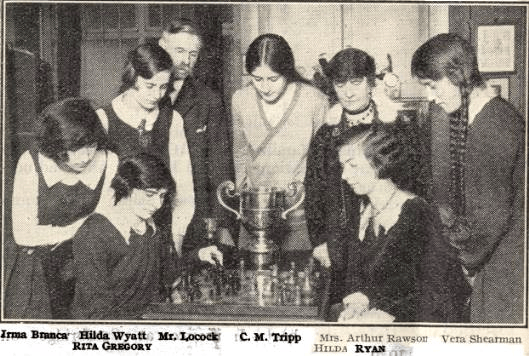
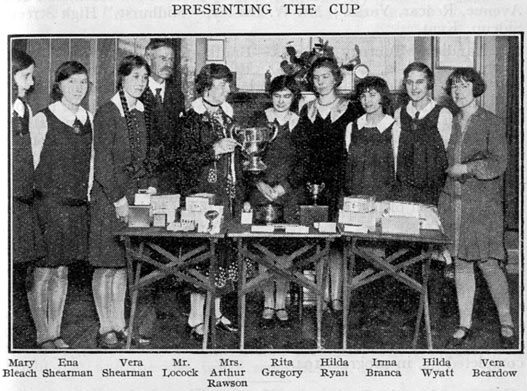
Too many names to consider all of them, but Irma Esterina Maria Branca (1915-2001: originally Brancaleone) was from a large Italian catering family, originally from Parma. She married twice, to Arthur Kind, and then to Nicholas Norman.
The 1931 edition found five players in the older section, although the standard was not high.
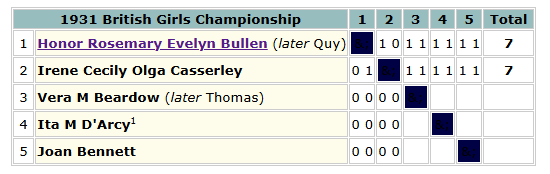
John Saunders: Ita M D’Arcy (9 January 1910 – 1984). By an astonishing coincidence, which I have only just discovered, she was my infants class teacher when I first went to school in Loudwater, Buckinghamshire, in January 1958 – JS, 27 April 2023. Photo of Ita D’Arcy on Flickr.
Honor Bullen (1914-2007), the daughter of a bank official from a prominent Irish family, later gave up chess for tennis, the highlight of her career being a match against Helen Wills Moody in 1938. She married a man named Quy late in life, but a marriage record hasn’t been found.
Irene Casserley (1914-1995), was the daughter of a former stockbroker’s clerk from Tottenham. Her paternal grandmother, Olga Gregory, was Russian, married to a schoolmaster.
Honor was successful in the play-off, and here she is.
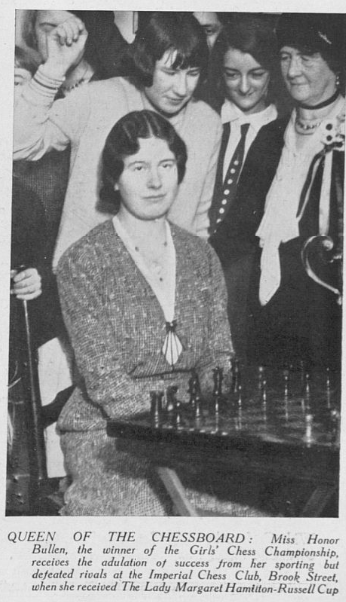
The second section was, for the first time, restricted to girls under the age of 16. There were 18 entries, but two failed to show up. Muriel Ballard beat Patsy Kemp in the play-off between the winners of the two sections.
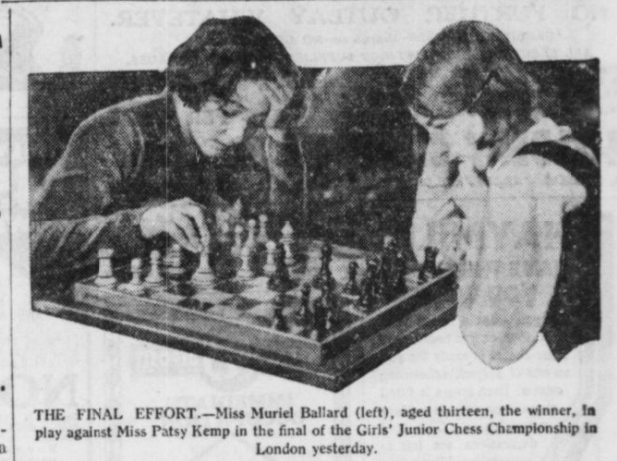
I haven’t yet been able to identify Muriel with any certainty. If she was 13 at at the start of 1931 she’d have been born in 1917, but nothing obvious has yet come to light. I also have nothing about Patsy Kemp. Assuming she was Patricia, there were several girls of that age born at the right time.
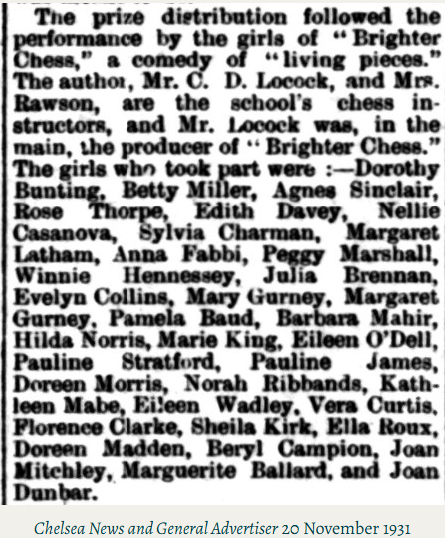
The 1931 London Oratory Chelsea prizegiving featured a chess play: many of the girls taking part also played in the championship tournaments.
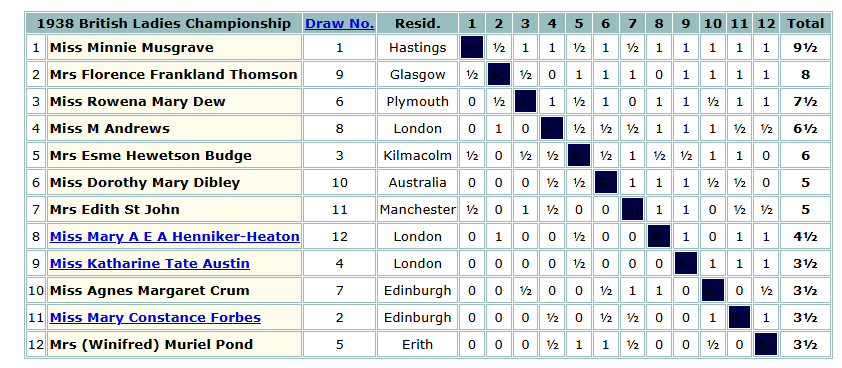
The 1932 tournament took place over three weekends, to enable both business girls and boarding school pupils to take part. Hilda Cole, now Mrs Pattison (how strange for a married woman to play in a girls’ tournament) returned, but lost her decisive last round encounter with Honor Bullen.
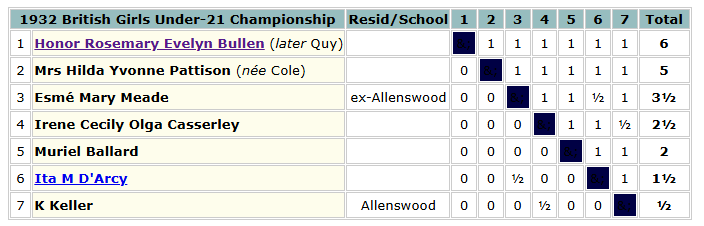
Several girls from Allenswood, a progressive girls’ boarding school in Wimbledon whose former pupils included Eleanor Roosevelt, Megan Lloyd George and several Stracheys (including, I presume, the chess playing Marjorie), took part. Esmé Mary Meade (1915-1999), had been born in India, but it appears her father died in Sussex early in 1916.
The report in the British Chess Magazine names a number of competitors for the Junior (under 16) Cup. Time and space preclude my telling all their stories, but there are a few names that stand out.
Renée Withers (1917-1963) of St Vincent’s School had only been playing two months but still shared 2nd place in her section. The daughter of a navvy from Notting Hill, she was working as a shop assistant in 1939, marrying Richard Mackenzie, a farm hand, in 1941. Yes, there were farm hands living in Notting Hill in 1941.
Of course there’s no choice but to introduce the wonderfully named Nellie Mary Casanova. The 1921 tells us she was born in Gazzada (now part of Gazzada Schianno), Italy in 1916, and had a 14 year old sister named Ancilla, who had been born in Fulham, where they now lived. Her mother was apparently a widow and working as a clothes sorter and packer at a laundry. As Nellie’s father was from close to the Swiss border it’s a reasonable guess that he worked in the catering industry. She married a man named Charles Upton in 1936, after which I have no more definite information.
Nellie could hardly be more different from Penelope Ellison Otto (1916-2007) of Allenswood School, mentioned in the same sentence. Penny, as she was later known, was the third of four daughters of a very well connected Scottish family. Her father was a barrister, and her maternal grandfather, Sir James Rankin, a Conservative MP who was later created a Baronet.
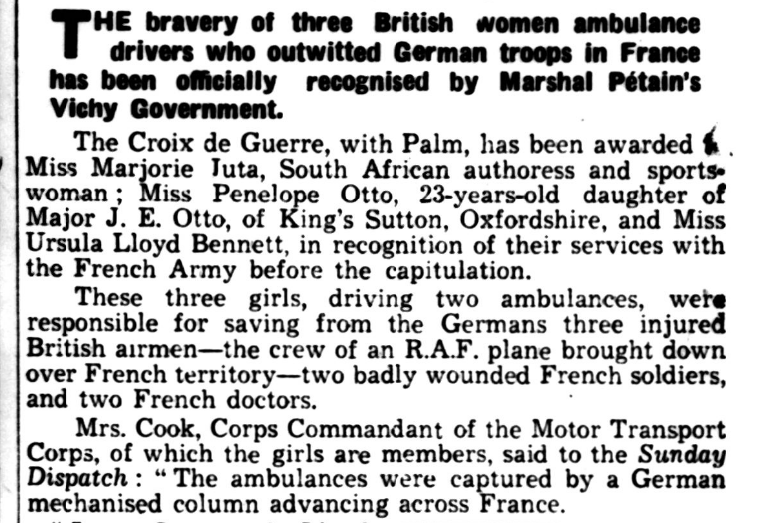
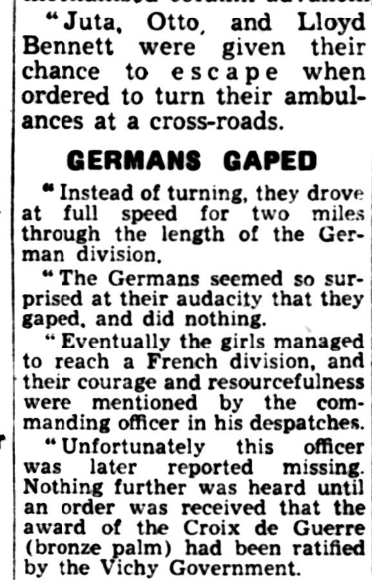
Penny was an ambulance driver during the Second World War, and, while serving in France was captured by German forces. Heroically, she and two colleagues were able to escape, saving seven lives in the process. She was later awarded the Croix de Guerre with Palm.
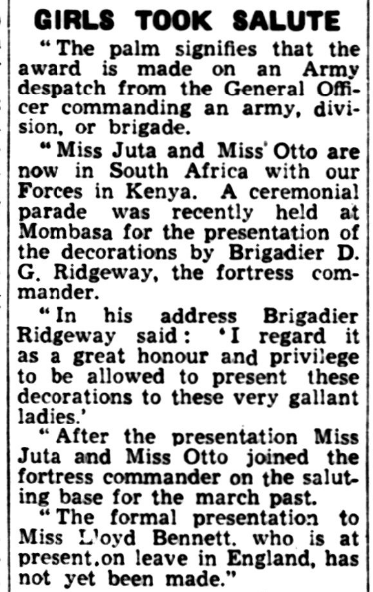
What an extraordinary story. I wonder if the she found the skills she learnt playing chess useful.
But that wasn’t all.
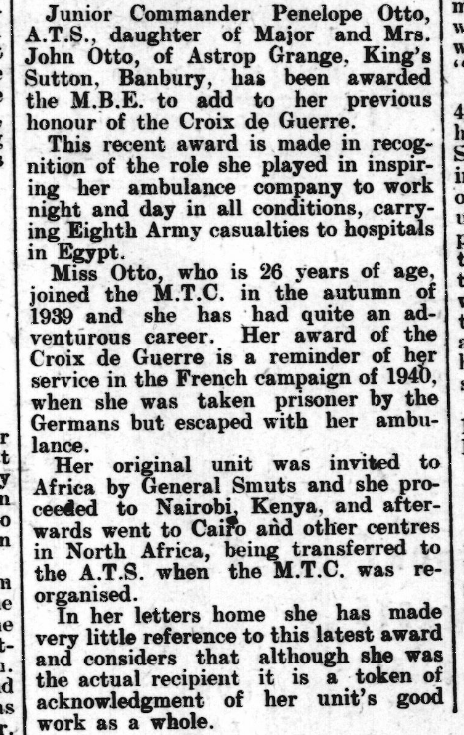
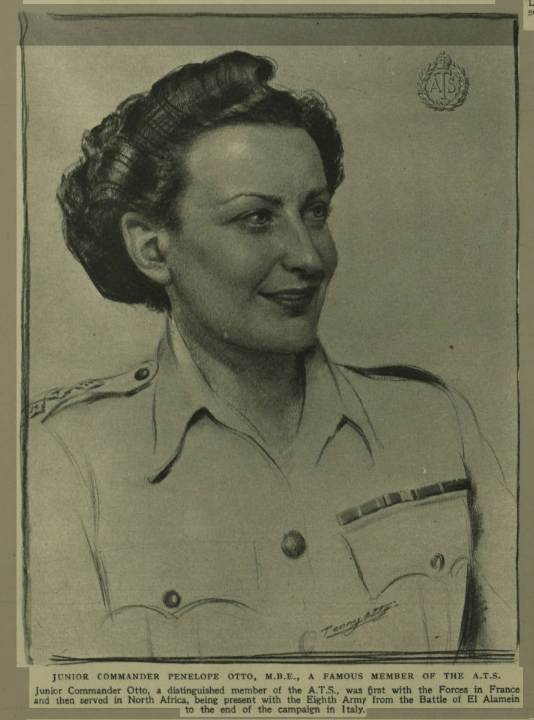
In 1947 Penelope Otto was appointed Conservative Party Agent for Kettering, and in 1949 she married a widowed army officer, James Wilfrid Phillips (known as Godfrey), and had three children.
Finally, there was ‘by far the most promising player’, 9-year-old Barbara Bairnsfather (1922-2013), making her first appearance, whose connection with Lady Margaret has been mentioned earlier.
She never did fulfil that promise, playing for only a few more years. In 1939 she was living in Frederick Hamilton Russell’s household.
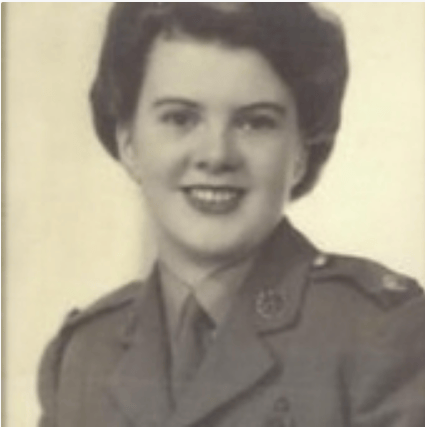
An online obituary takes up the story.
In the winter of 1941, Barbara enlisted in His Majesty’s Auxiliary Territorial Service and was assigned to the Royal Signal Corps, stationed at Bletchley Park, England. This was the site of the British Armed Forces cryptography operations, where cyphers and codes of several Axis countries were decrypted, most importantly the cyphers generated by the German Enigma and Lorenz machines. Rising to the rank of Second Lieutenant, Barbara was a Special Operator in the Y Signals Group, expertly trained to receive wireless Morse-coded radio intercepts for processing and decryption. In July of 2009 Prime Minister Gordon Brown awarded her an HM Armed Forces Veterans Badge from The Government Code and Cypher School, for vital service performed during World War II.
There had been some good news for her in 1942.
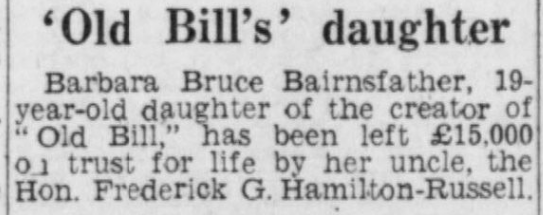
In 1946 Barbara emigrated to the United States, where she married in 1948.
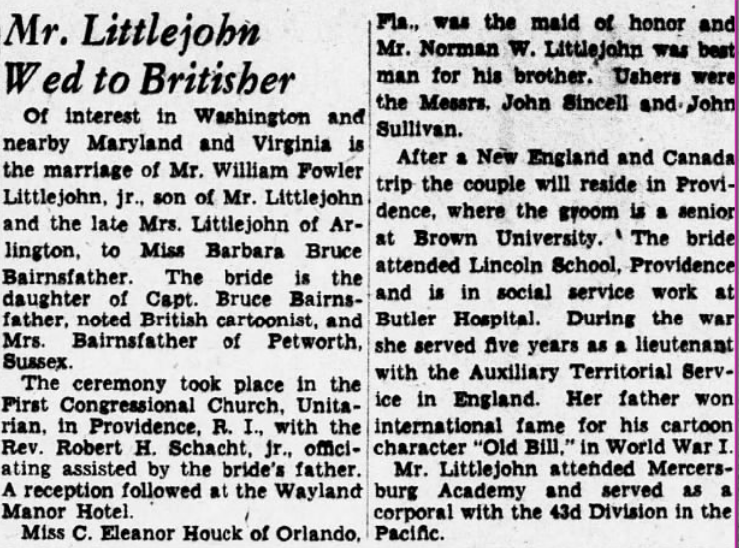
By 1950 she was living in Arlington, Virginia, engaged in clerical work for the Indian Government: she and William later had six children.
We’ll stop, for the moment, here, but with a quick note again from John Saunders, who includes the winners in his list of British Champions:
Girls’ Championships prior to 1933 are not recorded in the official BCF/ECF champions list though they are sometimes recorded as World Girls’ Championships.
Some of the earlier participants came from chess playing families, but the Imperial Club’s school outreach programme (as we’d now call it) brought in girls from a much wider range of backgrounds
At this point, the girls from the London Oratory School dominated proceedings, but later in the 1930s the Twickenham prodigy Elaine Saunders and the slightly older Rowena Dew, travelling up from Devon, would transform the event again. Perhaps I’ll consider them further in future Minor Pieces.
By looking at these stories we see a disparate group of girls from very different backgrounds brought together through chess, and through the efforts of Mrs Rawson, Lady Hamilton Russell and their colleagues at the Imperial Chess Club.
It’s notable, perhaps, that many of these girls lived into their 80s and 90s, but surprisingly few of them married or had children.
While several of the daughters of chess players maintained their interest, I suspect that, for the girls who had learnt at school, the game’s attraction was predominantly social, but there’s no harm in that, is there? It might also, who knows, have taught them ‘foresight, caution, concentration and logic’, qualities that Barbara Bairnsfather would have needed while at Bletchley Park. For some of them, too, chess must have had a therapeutic effect, just as for the blind boys at school in Worcester and the naughty boys at Desford Approved School.
The next generation would tacitly recognise the importance of hobbies for teenagers as a means of bringing young people from different backgrounds together, united by a shared passion. Here, the trend was just starting. Through these tournaments, girls from aristocratic backgrounds, debs with statuesque hair and monocles, future war heroes and code breakers, could mix with the daughters of middle-class chess enthusiasts, girls from impoverished backgrounds, even orphanage children, all equal over the chessboard. The first three quarters of the last century was a time of great social mobility, promoted, in a small way, by initiatives such as this.
Sources and Acknowledgements
My main source again was John Saunders’ excellent BritBase article here, which saved me a lot of work looking through old BCMs and elsewhere.
Other sources:
ancestry.co.uk
findmypast.co.uk/British Newspaper Archive
findagrave.com
British Chess Magazine


Leave a comment