Last time I introduced you to a Jewish chess player who fled the Holocaust.
Here’s another story on the same theme, one I hope you’ll find inspirational. The story of Hans Hermann Cohn. (In some records he has other first names as well: Hans Israel Hermann Cohn or Hans Hermann Martin Cohn, and by the end of his life, Hermann had lost its final ‘n’.)
Hans was born in Berlin on 6 May 1923, the only child of a successful Liberal Jewish lawyer whose clients included Marlene Dietrich. One day in September 1934, he witnessed another Jewish boy in his class at school being attacked by a bully wearing the brown uniform of the Hitler Youth, the son of a prominent Nazi official. Caught in the resulting scuffle, he was punched in the eye, resulting in a detached retina.
Because of his religion and his assailant’s father’s high position, surgeons refused to operate, and eventually he was sent off to Utrecht, where he was operated on by the Dutch Royal Family’s eye surgeon. The surgery was unsuccessful, but worse was to follow. A year later he lost the sight in his other eye due to sympathetic ophthalmia, leaving him totally blind.
As he said much later: “All my spare time seemed to be taken up acquiring new skills, such as learning and practicing Braille and typing, so I had no time to get depressed.”. By 1937, with the political situation worsening, his parents decided he should attend a special school for the blind, and, as German schools wouldn’t take him, in May 1938 he and his mother moved to England, where he was enrolled as a pupil at Worcester College for the Blind.
This was at the point when GC Brown, their brillians but flawed chess-playing headmaster, was just embarking on his final term, and young Hans was not impressed. He was put into a dormitory with much older boys, who bullied him mercilessly. For him, this bullying was much harder to deal with than his blindness.
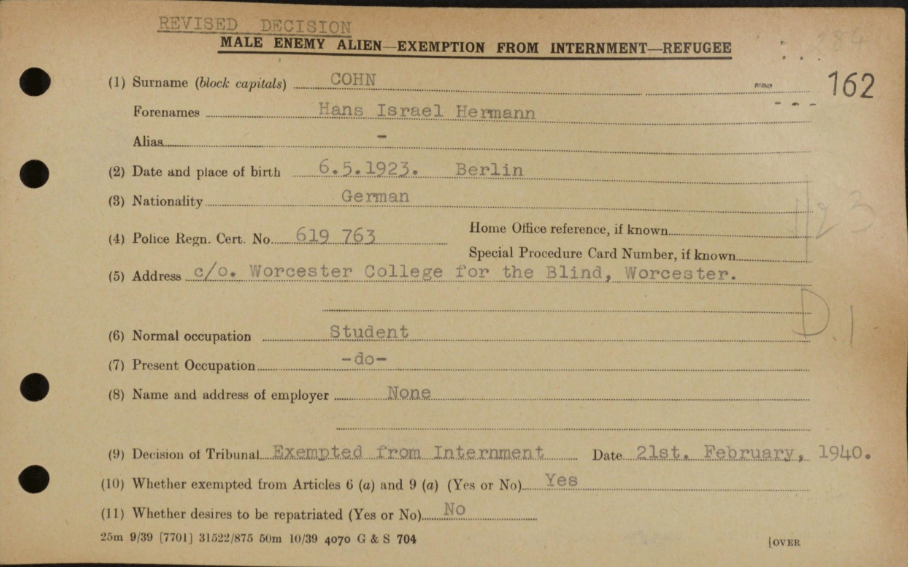
In 1939 his mother came over to England on a permanent basis, but his father had to remain in Germany and continue working in order to pay his school fees. In 1940 it was decided that, although he was a ‘male enemy alien’, as a refugee he was exempted from internment.
In 1941 his father was transported to Theresienstadt, where he died the following year ‘from the consequences of a medical experiment’.
Hans remembered his father fondly: He was a wonderful man with a wide humanist education; he used to quote Homer in the original Greek and went on several archaeological digs in Greece as a student.
His mother was only able to find work as a housemaid, but later became the matron of one of the Kindertransport 2 hostels.
On completing his scholastic education he settled in Willesden, North West London, in 1942, training as a physiotherapist and joining the local chess club. He may well have learnt the game as a boy in Berlin, and he would certainly have had the chance to hone his skills in Worcester. But that year he had another health setback. His hearing had never been perfect, and he lost much of what was left after an attack of measles.
Hans Cohn also joined the Braille Chess Association in 1945, and would be involved in the administration of blind chess for the rest of his life.
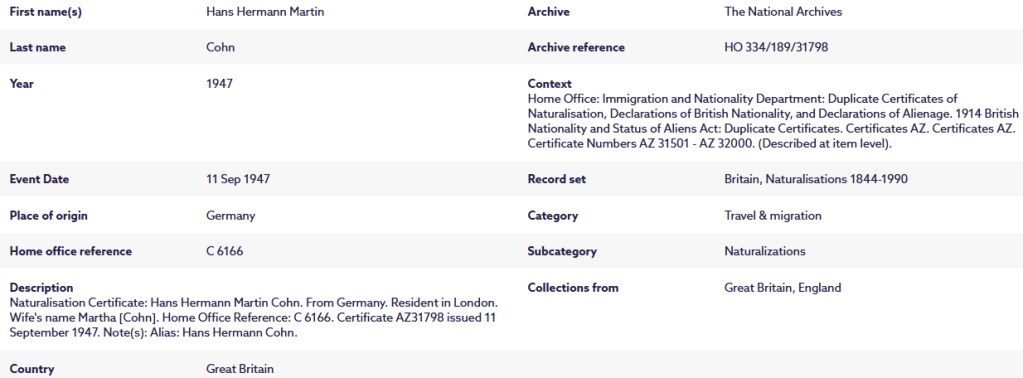
In 1947 Hans married Martha Rossner, from Vienna, and, in the same year, became a naturalised British citizen.
Hans and Martha’s marriage didn’t work out, and they separated ten years later. In 1961 he married Stefi Steinhart, like him from Berlin. Stefi suffered from retinitis pigmentosa, eventually becoming almost totally blind herself.
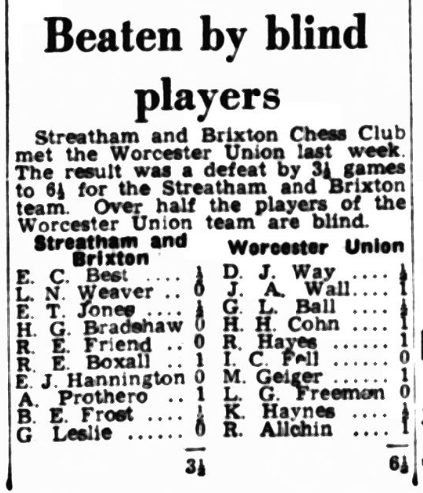
He was now getting more and more involved in chess. I presume his team here had some connection with his old school.
In 1961 the first Blind Chess Olympiad took place at Meschede in West Germany. Hans played on fourth board for the Great Britain team (Bonham was on top board), winning three games, drawing one and losing three.
Here’s one of his wins, against the gold medallists, Yugoslavia.
[Event “1st Blind Olympiad R3”]
[Site “Meschede GER”]
[Date “1961.??.??”]
[White “Cohn, Hans Hermann”]
[Black “Sakic, Milutin”]
[Result “1-0”]
1. d4 Nf6 2. c4 c5 3. d5 d6 4. Nc3 g6 5. e4 Bg7 6. f4 O-O 7. Nf3 Na6 8. Bd3 Nb4 9. Bb1 Na6 10. O-O Nc7 11. e5 Nd7 12. Re1 a6 13. Bd3 Rb8 14. a4 a5 15. h3 dxe5 16. fxe5 e6 17. d6 Ne8 18. Bf4 f6 19. exf6 Bxf6 20. Qd2 e5 21. Bh6 Bg7 22. Bxg7 Kxg7 23. Nb5 Qf6 24. Be4 Ra8 25. Rad1 Ra6 26. Re3 Qf4 27. Re2 Qg3 28. Qg5 Qxg5 29. Nxg5 Rf6 30. Red2 Kh6 31. h4 Kg7 32. Bf3 h6 33. Nh3 Rf7 34. Bg4 Nef6 35. Be6 Rf8 36. Nf2 Re8 37. Bxd7 Bxd7 38. Nc7 Rb6 39. Nxe8+ 1-0
The second Blind Chess Olympiad took place three years later, in Bad Kühlungsborn, on the Baltic coast of East Germany. Cohn was again on board 4, losing his first three games, but winning the remaining five, along with a bronze medal for the third best performance on his board.
He played some brilliant moves in England’s encounter with the Irish team.
[Event “2nd Blind Olympiad R7”]
[Site “Bad Kuehlungsborn GER”]
[Date “1964.03.31”]
[White “Cohn, Hans Hermann”]
[Black “McElroy, Ernest”]
[Result “1-0”]
1. Nf3 d5 2. c4 e6 3. g3 Nf6 4. Bg2 c5 5. cxd5 Nxd5 6. Nc3 Nc6 7. O-O Be7 8. d4 cxd4 9. Nxd5 Qxd5 10. Nxd4 Qd7 11. Nxc6 bxc6 12. Qa4 Bb7 13. Rd1 Qc8 14. Be3 O-O 15. Rac1 Rd8 16. Rxd8+ Bxd8 17. Bxc6 Bb6 18. Bg2 Qb8 19. Bf4 e5 20. Bxb7 Qxb7 21. Bxe5 Qe7 22. Bd4 Qxe2 23. Bxb6 Re8 24. Be3 Kf8 25. Qa3+ Kg8 26. Qe7 Rb8 27. Qb7 Re8 28. Qd7 Rf8 29. Rc8 Qe1+ 30. Kg2 Qb4 31. Re8 h6 32. Qe7 Qc4 33. Rxf8+ Kh7 34. Qxf7 Qe4+ 35. Kh3 Qh1 36. Qf5+ 1-0
The first IBCA Individual blind world championship was played in Bad Timmendorf, West Germany in 1965. I haven’t been able to find the complete results, but three of Cohn’s game, a win and two defeats, are available.
The Dorset resort of Weymouth played host to the third Blind Chess Olympiad in 1968. This event was part of the celebrations for the centenary of the RNIB, with Cohn obtaining sponsorship from the likes of Sir Isaiah Berlin and Simon Marks, who paid the Israeli team’s fares, and also persuading the Soviet Union to enter for the first time. Hans played on top board for the Executive team, made up of administrators, losing five games, drawing one and winning three, including this miniature against his Dutch opponent.
[Event “3rd Blind Olympiad R1”]
[Site “Weymouth”]
[Date “1968.03.29”]
[White “Van Gelder, Jan”]
[Black “Cohn, Hans Hermann”]
[Result “0-1”]
1. d4 d5 2. e3 Nf6 3. c4 dxc4 4. Bxc4 e6 5. Nc3 c5 6. Nf3 a6 7. a4 Nc6 8. O-O Be7 9. Qe2 O-O 10. Rd1 Qc7 11. dxc5 Bxc5 12. e4 Ng4 13. Rf1 Nd4 0-1
This tactical idea, if you haven’t seen it before, is well worth remembering.
The second IBCA Individual blind world championship took place in the Dutch town of Ermelo. Cohn scored 5/11, defeating the Swiss representative with a neat sacrificial finish.
[Event “IBCA blind Wch02 R3”]
[Site “Ermelo”]
[Date “1970.04.30”]
[White “Willy, Otto”]
[Black “Cohn, Hans Hermann”]
[Result “0-1”]
[ECO “D27”]
1. d4 d5 2. c4 dxc4 3. Nc3 a6 4. a4 Nf6 5. e3 e6 6. Bxc4 c5 7. Bd3 Nc6 8. Nf3 Be7 9. O-O O-O 10. b3 cxd4 11. Nxd4 Nxd4 12. exd4 Bd7 13. Be3 Bc6 14. Rb1 Nd5 15. Nxd5 Qxd5 16. f3 f5 17. Qe2 b5 18. Bf2 Bf6 19. Kh1 Rfe8 20. axb5 axb5 21. Qc2 Rec8 22. Qd1 Bxd4 23. Bxd4 Qxd4 24. Bxf5 Qf6 25. Be4 Rd8 26. Bxh7+ Kxh7 27. Qc2+ Qg6 28. Qxc6 Rd2 29. g3 Rxh2+ 30. Kxh2 Ra2+ 0-1
By now the weekend tournament circuit was being established in London, and Hans was keen to take part whenever he could. Two of his games from the 1973 Bayswater Open made the tournament bulletin.
There was another miniature, against an experienced tournament player.
[Event “3rd Bayswater Open R3”]
[Date “1971.06.12”]
[White “Cohn, Hans Hermann”]
[Black “Morrey, Peter”]
[Result “1-0”]
1. c4 f5 2. Nc3 Nf6 3. d4 e6 4. g3 Be7 5. Bg2 O-O 6. Nf3 d5 7. cxd5 exd5 8. O-O c6 9. Ne5 Nbd7 10. Bf4 Nh5 11. e3 Qe8 12. Nxd7 Bxd7 13. Be5 g5 14. Nxd5 Bd8 15. Qb3 Be6 16. Qxb7 Ba5 17. Ne7+ Kf7 18. Nxc6+ 1-0
But, playing his favourite Accelerated Dragon, he lost this game against my friend Ken Norman.
[Event “3rd Bayswater Open R5”]
[Date “1971.06.13”]
[Round “5”]
[White “Norman, Kenneth Ian”]
[Black “Cohn, Hans Hermann”]
[Result “1-0”]
[ECO “B36”]
1. e4 c5 2. Nf3 Nc6 3. d4 cxd4 4. Nxd4 g6 5. c4 Nf6 6. Nc3 Nxd4 7. Qxd4 d6 8. Be3 Bg7 9. f3 O-O 10. Qd2 Be6 11. Be2 Qa5 12. Nd5 Qxd2+ 13. Kxd2 Nxd5 14. cxd5 Bd7 15. Rac1 Rfc8 16. b3 b6 17. Ba6 Rxc1 18. Rxc1 Kf8 19. Rc7 Ke8 20. Bb7 Rb8 21. Ba6 Ra8 22. Bb7 Rb8 23. Bc6 Bxc6 24. dxc6 Kd8 25. Rxa7 Rc8 26. Bxb6+ Ke8 27. c7 Kd7 28. Rb7 Bh6+ 29. Kd3 f5 30. Rb8 f4 31. Rxc8 Kxc8 32. a4 1-0
Pula in Yugoslavia (now Croatia) was the host for the 4th Blind Olympiad in 1972. Cohn wasn’t selected for the British team, but played on Board 4 for Switzerland, who must have been a player short. (Yes, Hans Cohn is a very common German Jewish name, but we can tell from the openings he played that it must have been our man.)
With increased participation, this was the first time the event had been played using a group system. Cohn scored one win out of four games in the preliminaries, but outclassed his four opponents in the final Group C.
Here’s his win from the preliminary group, against a Dutch opponent.
[Event “4th Blind Olympiad R3.4”]
[Site “Pula”]
[Date “1972.04.08”]
[Round “3.4”]
[White “Cohn, Hans Hermann”]
[Black “Van Driest, Thierry”]
[Result “1-0”]
[ECO “E68”]
1. c4 Nf6 2. g3 g6 3. Bg2 Bg7 4. Nf3 O-O 5. O-O d6 6. d4 Nbd7 7. Nc3 Nh5 8. e4 e5 9. Be3 exd4 10. Nxd4 Ne5 11. b3 Ng4 12. Bc1 Ne5 13. h3 Bd7 14. Be3 Nc6 15. Nde2 a6 16. Qd2 Rb8 17. Rad1 Ne7 18. c5 Nc8 19. Bg5 Qe8 20. Nd5 c6 21. Nc7 Qe5 22. cxd6 f5 23. f4 Qc5+ 24. Kh2 fxe4 25. Bxe4 Nf6 26. Bf3 Nb6 27. Rc1 Qa3 28. Nc3 Qb4 29. Rfd1 Rf7 30. a4 Nc8 31. Ne4 Qxb3 32. Nxf6+ Bxf6 33. Be2 Bxg5 34. Bc4 Qxa4 35. Bxf7+ Kxf7 36. fxg5 Kg7 37. Qb2+ Kg8 38. Ra1 Qe4 39. Qb3+ Kg7 40. Qb2+ Kg8 41. Re1 Qf5 42. Re8+ Bxe8 43. Nxe8 Qf7 44. Nf6+ Kf8 45. Rf1 1-0
The third IBCA Individual blind world championship was held in the West German town of Bad Berleburg in 1975. Hans Cohn again took part, again scoring 5/11.
Here, his Norwegian opponent should have captured the knight on move 16: perhaps both players missed something.
[Event “IBCA blind Wch03 R3”]
[Site “Bad Berleburg”]
[Date “1975.02.20”]
[White “Cohn, Hans Hermann”]
[Black “Fesche, Svein Tore”]
[Result “1-0”]
[ECO “E69”]
1. c4 Nf6 2. Nf3 g6 3. g3 Bg7 4. Bg2 O-O 5. d4 d6 6. O-O c6 7. Nc3 Nbd7 8. e4 e5 9. h3 Qc7 10. Be3 Re8 11. Re1 exd4 12. Nxd4 Nc5 13. Qc2 a5 14. Rad1 Qe7 15. Bf4 Nh5 16. Nxc6 Qc7 17. Ne7+ Qxe7 18. Bxd6 Qe6 19. Bxc5 Qxc4 20. Be3 Be6 21. g4 Nf6 22. Rd4 Qc7 23. Qd2 Rad8 24. Rxd8 Rxd8 25. Nd5 Bxd5 26. exd5 Ne8 27. Rc1 Qe5 28. Qxa5 Bf6 29. Qc3 Qe7 30. Qc5 Nd6 31. Qb4 Be5 32. Bb6 Re8 33. Re1 Qf6 34. Bc5 Rd8 35. Re2 g5 36. Be3 Re8 37. Qd2 Nc4 38. Bxg5 Qa6 39. Qe1 Qd6 40. Bf4 f6 41. Bxe5 fxe5 42. b3 1-0
The following year he lost this London League game, which is remarkably similar to his earlier defeat against Ken Norman.
[Event “Richmond & Twickenham 2 v Willesden”]
[Date “1976.02.06”]
[White “James, Richard”]
[Black “Cohn, Hans Hermann”]
[Result “1-0”]
[ECO “B36”]
1. Nf3 c5 2. c4 Nc6 3. d4 cxd4 4. Nxd4 Nf6 5. Nc3 g6 6. e4 Nxd4 7. Qxd4 d6 8. Be2 Bg7 9. Bg5 h6 10. Be3 O-O 11. Qd2 Kh7 12. f3 Be6 13. Rc1 Qa5 14. Nd5 Qxd2+ 15. Kxd2 Nxd5 16. cxd5 Bd7 17. Rc7 Rfd8 18. Rxb7 Rab8 19. Rxb8 Rxb8 20. b3 a5 21. Rc1 a4 22. Bd1 axb3 23. Bxb3 Rc8 24. Rxc8 Bxc8 25. Kd3 Kg8 26. a4 Kf8 27. Bc4 Ke8 28. Bb5+ Bd7 29. Kc4 h5 30. a5 Bxb5+ 31. Kxb5 Kd7 32. Kb6 Kc8 33. a6 Kb8 34. a7+ Ka8 35. Kc7 f5 36. Kd7 Bf6 37. exf5 gxf5 38. Ke6 f4 39. Bxf4 Kxa7 40. Bxd6 1-0
The 6th Blind Olympiad, in Noordwijkerhout in the Netherlands, was Hans Cohn’s last appearance in this event. Playing on the reserve board, he won two games in the preliminary section, drawing two and losing one in the finals. His score of 3/5 was again enough for a bronze medal.
Here’s his win against Finland.
[Event “6th Blind Olympiad R4.4”]
[Site “Noordwijkerhout”]
[Date “1980.08.16”]
[White “Cohn, Hans Hermann”]
[Black “Riikonen, Tapio”]
[Result “1-0”]
[ECO “A39”]
1. c4 c5 2. Nc3 Nc6 3. Nf3 Nf6 4. g3 g6 5. Bg2 Bg7 6. O-O O-O 7. d4 cxd4 8. Nxd4 Qa5 9. Nb3 Qh5 10. e4 Qxd1 11. Rxd1 d6 12. c5 dxc5 13. Nxc5 b6 14. e5 Nxe5 15. Bxa8 Bg4 16. Re1 Rxa8 17. Rxe5 bxc5 18. Rxe7 Re8 19. Rxe8+ Nxe8 20. Be3 Bd4 21. Na4 Bxe3 22. fxe3 c4 23. Nc5 Nd6 24. Rc1 Kf8 25. Kf2 Ke7 26. Rc2 Kf6 27. Rd2 Ke5 28. Rd4 h5 29. Ke1 g5 30. Kd2 Bc8 31. b3 c3+ 32. Kc2 Bf5+ 33. Nd3+ Ke6 34. Ra4 Nb5 35. Ra5 Nc7 36. Kxc3 1-0
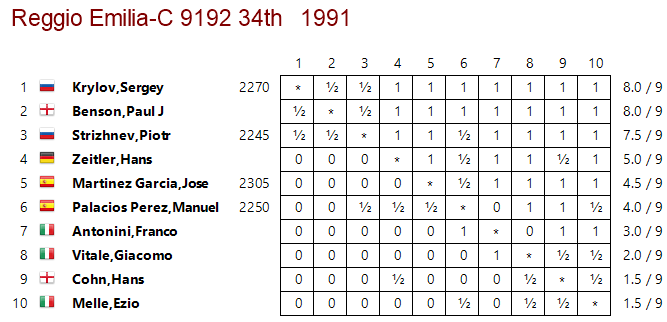
He took an all-play-all tournament for blind players in the Italian town of Reggio Emilia in 1991. Now in his late 60s, Hans found the competition tough, although he would no doubt have been delighted that his compatriot Paul Benson shared first place.
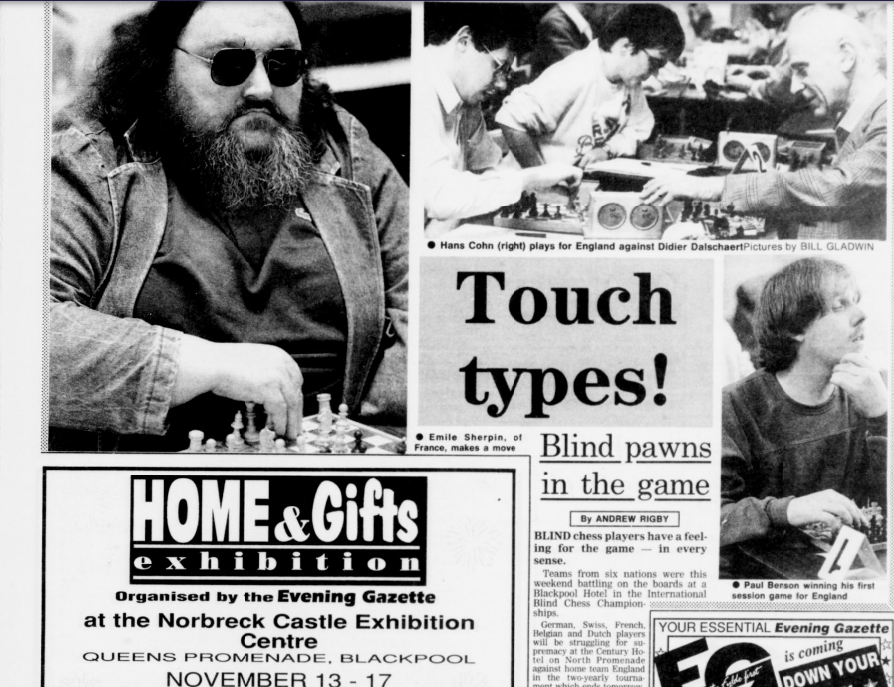
In the same year, the Six Nations Blind Team Chess Tournament took place in Blackpool, where Hans was photographed for the local paper.
Cohn continued playing into old age, playing some 4NCL games in 2003 and 2005, with his last rating published in 2007.
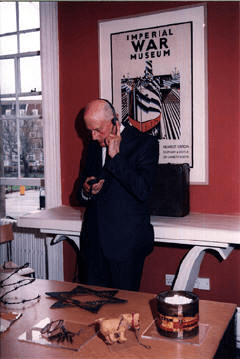
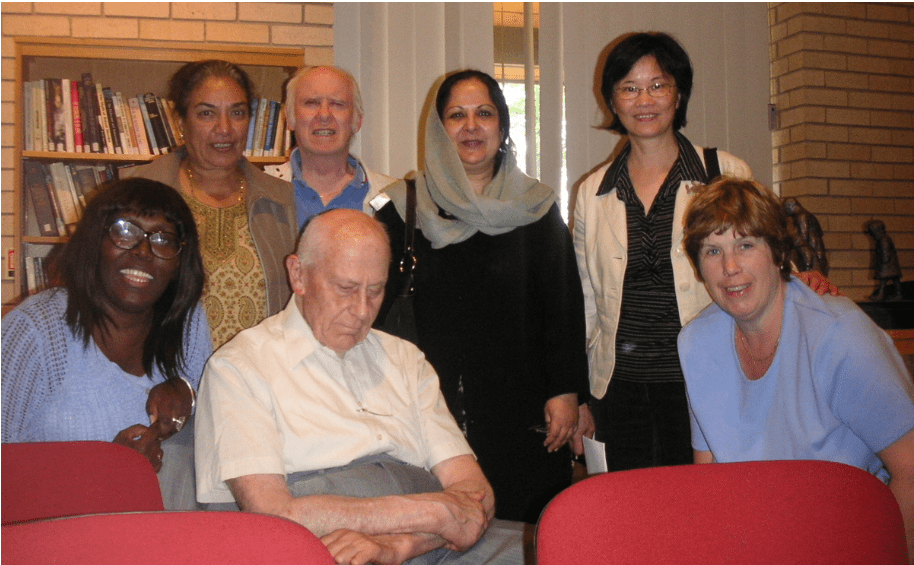
In a competitive career lasting 65 years, Hans Cohn was, for most of that time, a solid 1800+ strength player, slightly above average club standard, a highly creditable rating for anyone even with full sight of the board.
But chess was far from his only interest. He had a great love of literature and would pay regular visits to the Alps for cross-country skiing, only terminated when he broke his hip at the age of 89.
Hans Cohn wasn’t just a player, he was an administrator as well, becoming secretary of the Braille Chess Association in the mid-1960s and editing a chess magazine from 1980-2000. He also became secretary of the International Blind Chess Association in 1964 and their president in 1985. In 1995 he was awarded an MBE for his work for the blind and disabled communities.

This comes from a feature in the AJR (Association of Jewish Refugees) Journal from right at the end of his life, which you can read in full here.
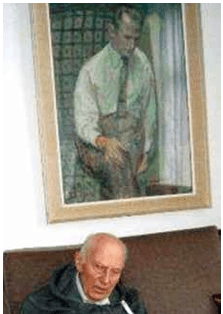
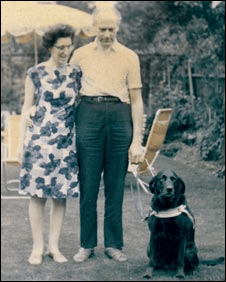
earlier days by a friend.
He died at the great age of 94 on 23 January 2018, much respected and missed by all in the international blind chess community, as well as by his many friends in chess and elsewhere. His beloved wife Stefi had died the previous year.
Several obituaries are available online.
Here, from the Worcester Royal College for the Blind website, including an autobiography.
Here, from the RNIB website.
Here, from the Jewish Chronicle.
Hans Hermann Cohn was an extraordinary man who had an extraordinary and well-lived life. He had a long and successful career as a physiotherapist, played chess regularly at a high level both nationally and internationally for many decades, but, perhaps more importantly, devoted much of his spare time to the welfare of those with visual disabilities and to ensuring remembrance of the Holocaust.
His story is a tribute to the resilience of the human spirit.
Don’t forget to join me again soon for some more Minor Pieces.
Acknowledgements and Sources
ancestry.co.uk
findmypast.co.uk/British Newspaper Library
Wikipedia
British Chess News (John Saunders)
ChessPublishing.com (BritBase+ database)
ChessBase 26/Megabase 2026
OlimpBase.org (Results and games of IBCA competitions)
Obituaries and other articles referenced above


Leave a comment