Meet Adam Foster. Adam was born in Widnes, not far from Liverpool, on 30 October 1875. His father, also Adam, was originally from Middlesbrough, while his mother was Irish, from County Kildare. By 1891 the family had moved to Accrington, where young Adam had joined his father as a labourer in a charcoal works. At some point that decade he spent time in the army, but by 1901 was back at home, working as a navvy. Life must have been hard: his father, now 72, was still employed, as a labourer in an iron foundry.
Adam, like others in his family, struggled with his mental health. For several years he had a relationship with a young woman named Mary (known as Polly) Lowe, fathering a child. He was sent to prison for a time, having failed to provide maintenance. Shortly after his release, in August 1902 he snapped. He took his sweetheart for a walk in the fields, got out a penknife, told her he was going to kill her, and then kill himself, and stabbed her in the throat and the hand. Leaving her for dead, he didn’t kill himself, but instead went on the run. Mary eventually recovered, but Adam was still nowhere to be found.
A year later he reappeared, handing himself in to the police in nearby Blackburn. He pleaded insanity at the time of the attack: this was accepted and he was detained as a criminal lunatic.
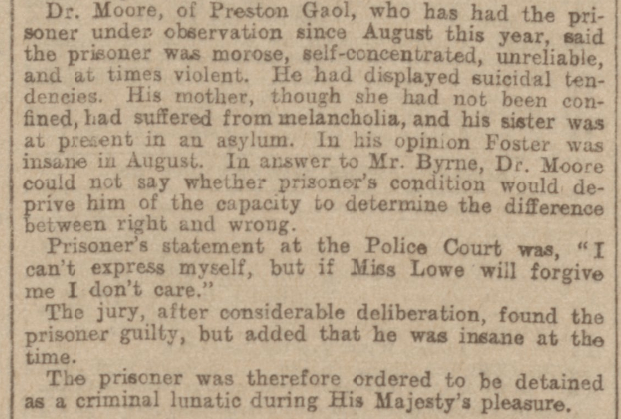
Morose, unreliable and violent. I’d guess Adam Foster wasn’t someone you’d have wanted to meet. Let’s try again.
Meet Walter Stephens. A man from a very different background. His birth registered in the second quarter of 1858, he was the fourth and youngest child of Alfred Stephens, a physician, growing up in a comfortable upper-middle class family in Liverpool. By 1885 he was in London, where he married Edith Eliza Hewitt, a fellow Lancastrian, from Manchester.
The 1891 census found them in a boarding house in Bedford Place, right by the British Museum, she an actress, he an actor. They had also spent time in America, which may have been either before or after this date.

But their acting careers didn’t work out, and nor did their marriage. Walter took to drink and, in 1895, was confined as a lunatic in a hospital in Jersey.
By 1901 they were in Liverpool, close to where Walter had been brought up. He was now a commercial traveller and she a telegraphist.

By 1905 Walter and Edith were back in London, living in Honeybrook Road, Clapham Park, not far from the common. Edith took a solo holiday in Great Yarmouth, and, on her return on 25 August, found Walter waiting at the front door, brandishing a revolver he’d just bought. He shot his wife four times: she died in hospital a few days later.
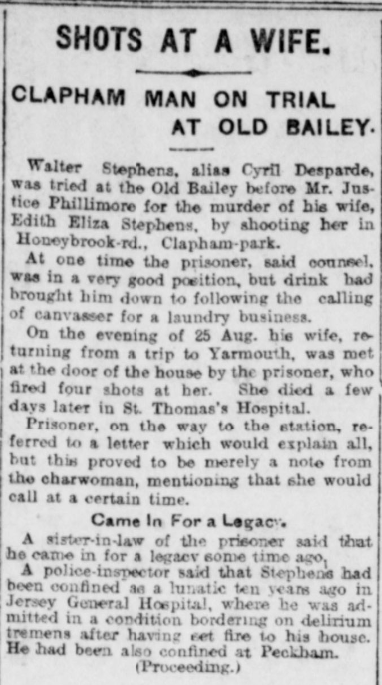
Cyril Desparde sounds like the name of a rakish matinée idol, doesn’t it? Perhaps it was his stage name, although newspaper searches have revealed nothing. There was no doubt that Walter had killed Edith: the only question was whether or not he was sane at the time. The first trial was inconclusive (you can, if you’re so inclined, read the transcript here), but the second trial reached the conclusion that he was insane
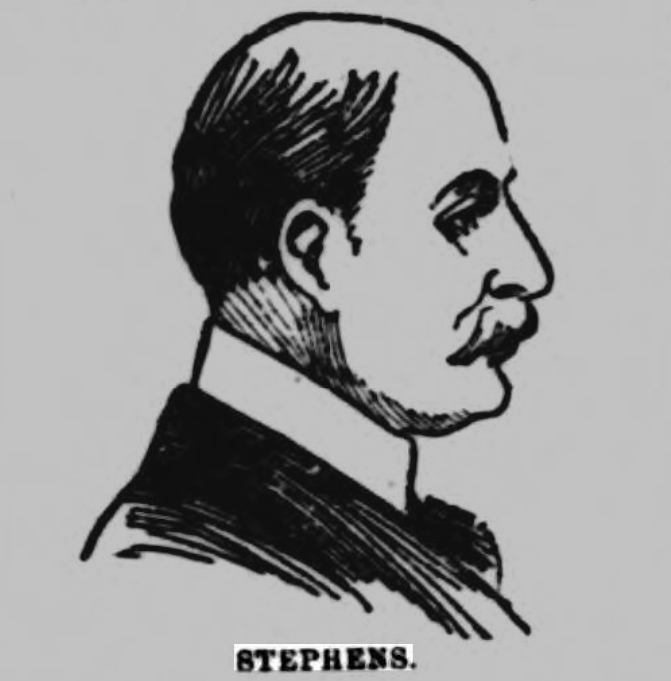
He was detained at His Majesty’s pleasure, and removed to Broadmoor, which is where he met Adam Foster.
Two very different men, of different ages, from very different backgrounds, but who, as a result of insanity (we’d use different language today) committed terrible, and strikingly similar, crimes.
But, confined to what was then called a lunatic asylum for the rest of their lives, they became firm friends.
They had their stories, as we all do. There are more stories to be told. Let’s jump forward twenty years.
Meet Bertie Midwinter. Who wouldn’t want to meet someone with such a wonderful name?
Bertie was born in Sheffield on 3 January 1903. We can pick him up in the 1911 census, which tells a story of family tragedy.

William, his father, was working as a guard on the Midland Railway, and we’re told that only two of his six children were still alive: Frank, born at about the time of their marriage, and young Bertie. The household was completed by Sarah Littlewood, Sarah Ann’s daughter, who must have been born out of wedlock five years before the marriage.
(On the assumption that all Sheffield Littlewoods are related, that would connect the family with the famous chess and bridge playing Littlewoods.)
It’s hardly surprising that Bertie grew up to be a troubled young man.
In 1919, adding two years to his age, he joined the Royal Army Service Corps (Mechanical Transport), giving his occupation as a turner: a lathe worker whose skills would be useful in that sphere. He didn’t last long, though, enlisting on 2 August only to be discharged on 23 October. On 2 January 1920 he was sentenced to a month in prison for embezzlement. He rejoined the army on 6 May 1920, still giving his date of birth as 3 January 1901, but now giving his occupation as a clerk. This time he enlisted in the Royal Army Ordnance Corps, declaring to the doctor who examined him that he wasn’t subject to fits of any description. On 14 August 1920 he was discharged as unfit for service, the reason given being epilepsy. (In those days, epilepsy was a very vague diagnosis, so this could have meant any number of things, including some types of mental health problem.)
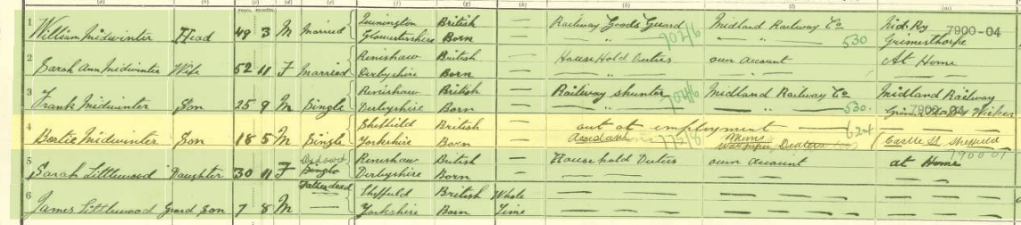
By the 1921 census he was at home, but unemployed, the household having been augmented by the younger Sarah’s presumably illegitimate son, whose father probably wasn’t dead at all. (This was quite typical for the time, to hide the stigma of illegitimacy: my mother’s half brother Arthur, who was born out of wedlock, also appears in the 1921 census as ‘father dead’ when he almost certainly wasn’t.)
On 25 June 1924 Bertie was sentenced to another month in jail, this time for stealing money.
And then, the following year, this happened.
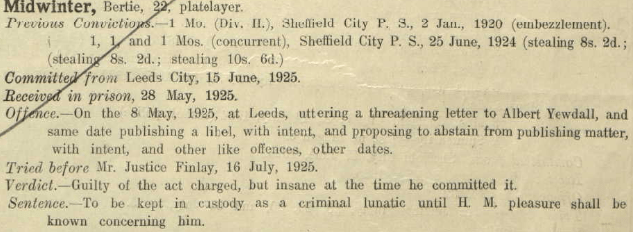
Albert Yewdall, a Russian immigrant (no relation to Francis Yewdall, sometime of Richmond Chess Club), was a general dealer specialising in jewellery.
Kept in custody as a criminal lunatic meant, in those days, being sent to Broadmoor.
There, although Walter Stephens was old enough to be his grandfather, and Adam Foster old enough to be his father, he became friends with both of them.
Walter, Adam and Bertie had another friend, or perhaps rival, as well: LC Hallam. I haven’t been able to discover what he was doing in Broadmoor, but, as there were not so many LC Hallams around at the time, I think I can identify him.
Meet Laurence Cyril Angersbach Hallam. His friends all only had one Christian name, but, although he was later to drop the Angersbach, he more than made up for them.
Laurence’s birth was registered in Nottingham in the first quarter of 1891, the son of Laurence Vernon Hallam, a wholesale millinery buyer, and Flora Otilda Angersbach, the daughter of German immigrants. Their only other child, Lily, had previously died in infancy. The family were reasonably well off, employing a general servant as well as a nurse to look after baby Laurence. By 1901 Laurence senior’s occupation had changed to Straw Hat and Flower Dealer, and by 1911 he’d moved to Birmingham, where he was a Fancy Draper.
I haven’t been able to locate Laurence Cyril in the 1911 census: it’s quite possible he was studying abroad.
Here he is in 1921.

He was married to Emma Maria Stephanie, from Buffalo, NY, his civilian occupation an East India Merchant, but at the time living in Cologne, working as an interpreter for the British Army of the Rhine. Specifically, he was working for the the Inter-Allied Military Commission of Control (IAMCC), a multinational military/diplomatic organization tasked with ensuring Germany completely disarmed, dismantled its fortifications, and reduced its army size as agreed at the Treaty of Versailles. This sounds like a pretty important and sensitive job.
I haven’t been able to locate anyone with the forenames Emma Maria Stephanie born in Buffalo in about 1887, so I have no idea who she was.
We can pick Laurence up again on 2 February 1925 arriving in Southampton on board the Windsor Castle, having sailed from South Africa. There’s no sign of Emma and his occupation is, unexpectedly, a Music Hall Artist.
By 1926 we find him in Broadmoor, though whether as a patient or as an employee I can only speculate. With their backgrounds in the theatre and music hall, he and Walter Stephens would have had much to talk about.
So there we have four friends, of different ages and from very different backgrounds, brought together in part by (for at least three of them), mental health problems resulting in criminal behaviour.
But, confined in Broadmoor, they also bonded over a shared interest. An interest in the recondite world of chess problems. They were all keen solvers, two of them winning prizes in solving competitions, and having access to a wide range of publications. More than that, they were all published (and in three cases award-winning) problem composers, whose work was widely published for several years in the late 1920s.
This story starts, though, with Walter Stephens.
In December 1924 the Dundee Weekly News featured an article by John Richards, Ronald True‘s personal attendant and valet, about his first year in Broadmoor.
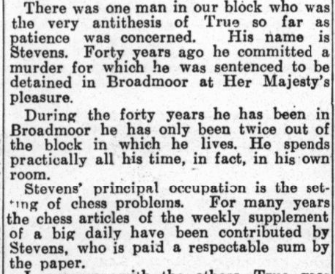
There’s very much wrong with this report. Walter’s name was Stephens, not Stevens, and he’d been in Broadmoor for 19, not 40 years. Nor was it true that he’d been writing chess articles for many years. His first problems seem to have appeared just two years earlier, in 1922, mostly in the Daily Telegraph. He may well have been paid a small amount for these contributions.
Here’s one of them. Like all the problems in this article, it’s White to play and mate in 2 moves, against any defence. You’ll find the solutions at the end of the article.
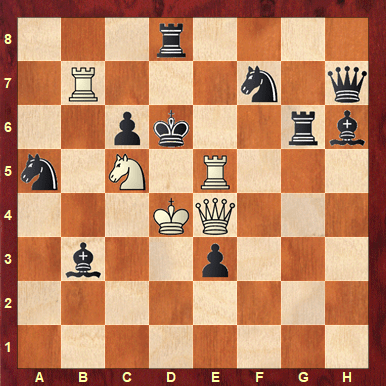
Daily Telegraph 01-07-1922
In 1924 he sent ‘several useful problems’ to the Oxfordshire Weekly News, including ‘one by Mr Allan Foster’, who must have been his friend Adam Foster. A few months later some more ‘useful and interesting problems’ by the same two composers were again received.
One of Foster’s most favoured outlets at the time was The Referee, a weekly paper specialising in sports news.
Here’s an example.
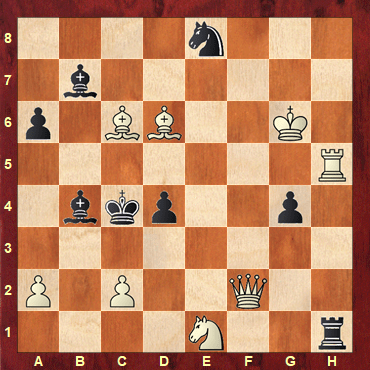
The Referee 01-03-1925
It appears that, at this point, Stephens was leading the way, and had been, perhaps for some time, teaching Foster to solve and compose problems as well.
Growing up the son of a wealthy doctor, it’s quite likely that he learnt to play chess in his teens. Given his lifestyle, it’s not surprising that I’ve found no record of his playing competitively.
I’d imaging he taught Foster to play – and to solve problems. As the son of a labourer, and in a family with mental health problems, it’s unlikely that he would have learnt at home.
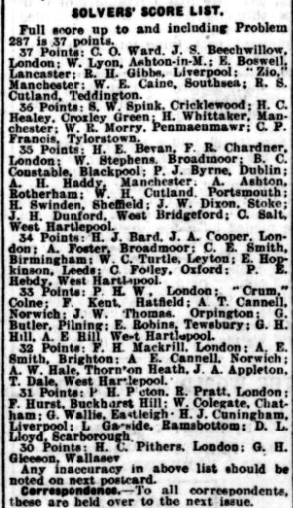
Here’s a list of solvers from 1926. You’ll see Walter on 35 points, one ahead of Adam, which suggests they were solving separately.
There are several other interesting names there, for instance the young W Ritson Morry on 36 points. Richard Stanley Cutland (37 points) from Teddington, was a shipwright, originally from Portsmouth, where his brother William Henry Cutland (35 points) still lived. He’d have been working in the Admiralty Research Laboratory.
Also on 37 points were two of the most important figures in popularising chess problems in England at the time. William Edmund Caine, a tailor (making naval uniforms), was also from Portsmouth, where he probably knew the Cutland family. Edward Boswell, a member of the famous Boswell Romany family, was a labourer from Lancaster whom I really ought to write about at some point.
At this point the Broadmoor interest in the chess problem art was redoubled when Laurence Hallam arrived, with Bertie Midwinter also making an appearance.
Another list of solvers, from a different publication the following month:
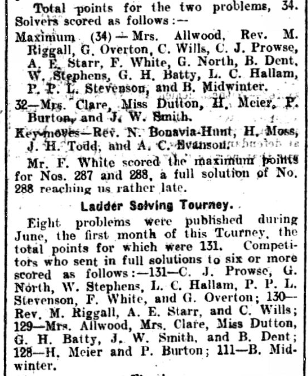
Stephens and Hallam were both on 100%, with Midwinter also making an appearance, but no sign of Foster. I’d like to learn more about Mrs Allwood, Mrs Clare and Miss Dutton, but without even initials there’s no obvious way to track them down.
From June 1926 onwards, problems composed by LC Hallam started appearing regularly in The Referee and other publications, with occasional compositions also from B Midwinter.
There’s a strange story here. A few years ago, chess historian, collector (and much else) Bob Jones acquired bound copies of the British Chess Magazine from 1926 to 1929, which had previously belonged to Walter Stephens, and then acquired by Edward Boswell. Included are some cuttings concerning problems from 1926 and 1927. In September the Lancaster Guardian (Boswell) published a problem composed by Stephens which had been anticipated by Nikolai Maximov (in 1903, but subsequently republished several times elsewhere). He might have seen this problem, or independently come up with the same idea. Curiously, in January 1927 Boswell published an almost identical problem composed by Hallam. It seems almost unbelievable that a columnist as knowledgeable as him wouldn’t have noticed this. For further information I’ll refer you to Bob’s article in the January 2019 edition of CHESS.
A charitable interpretation might be that Stephens had subconsciously reproduced Maximov’s idea, and Hallam, as a very inexperienced composer, didn’t realise that he was committing plagiarism. I should add the the MESON chess problem database doesn’t flag anticipations for any of the problems of Stephens, Foster or Hallam.
I’d imagine, though, that Hallam, although a rookie composer, had learnt the game either as a teenager or a young man, and may already have been a proficient solver. Perhaps he taught young Midwinter, whose background doesn’t suggest an early introduction to chess.
I’ve chosen an example for you to solve here.
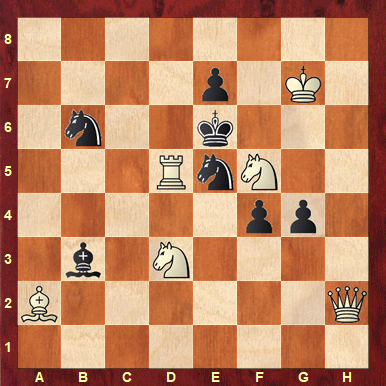
The Referee 12-09-1926
Stephens and Hallam may or may not have been guilty of deliberate plagiarism, but the case against Bertie Midwinter is rather stronger. MESON includes two of his problems from this period, including this lightweight.
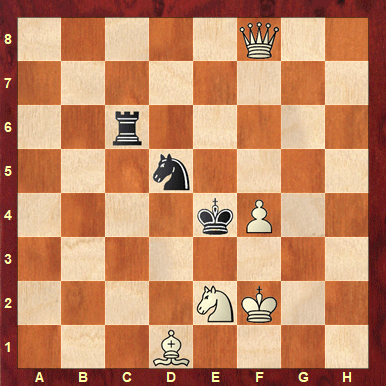
The Referee 28-11-1926
This is a mirror image, with a black knight instead of a black bishop, of a problem by Benjamin Glover Laws (British Chess Magazine 1918), which was itself composed as a more economical version of a problem by Kurschner, published in 1881 and reprinted in an 1890 book by James Rayner. Laws would have read Rayner, and Stephens, we know, was an avid BCM reader.
Over Christmas 1926 the chess players of Falkirk and Linlithgowshire were regaled with a humorous short story, culminating in a problem. (Note that the Falkirk Herald and Linlithgowshire Gazette shared the same chess column, but on different days of the week.)
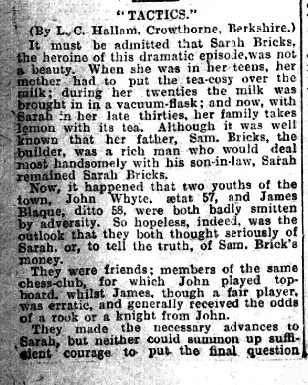
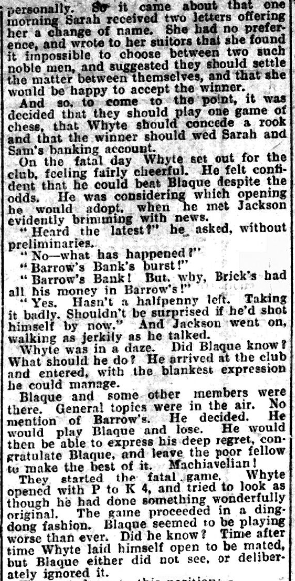
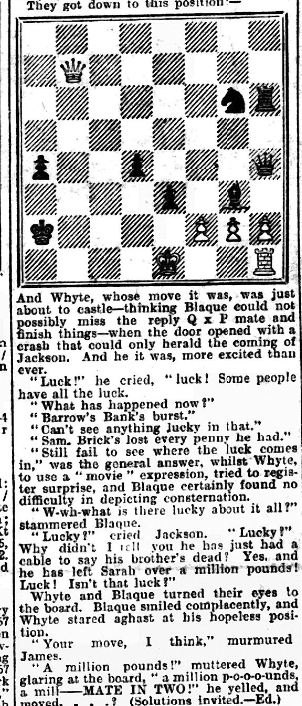
White (or Whyte) was giving QR odds, and according to the odds rules in use at the time, he could castle queenside with the phantom rook, so he played Kc1, with mate by Qb2 or Qb1 next move.
A fortnight later he was back with some more tricks. (Rowell Bosland is an amalgation of Edward Boswell’s surname with the Christian name of Rowland Pratt, another prominent problem enthusiast of the time.)
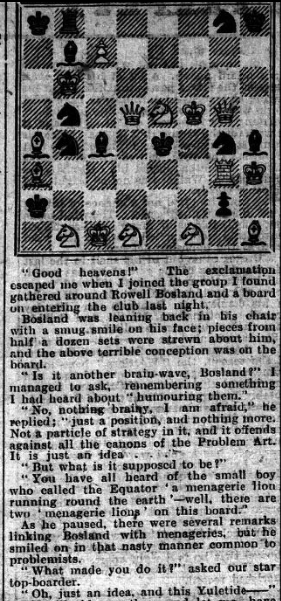
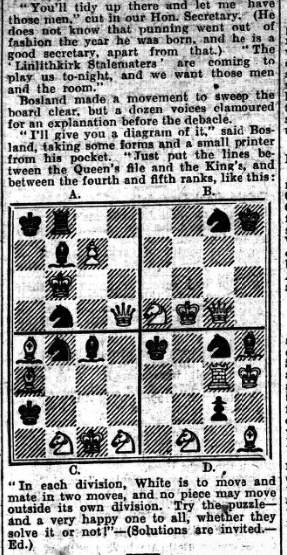
The solution was published later, with the point being that the mating positions provided the new year: 1927. Very clever.
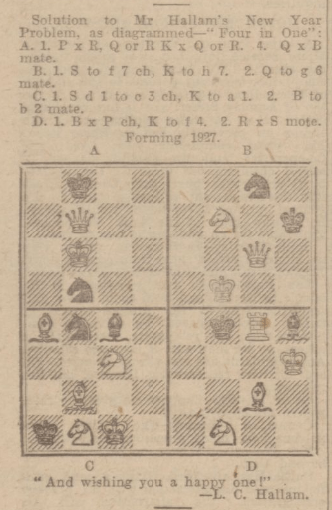
From what we see here, LC Hallam was a man of culture, creativity and wit, and, seemingly addicted to the world of chess compositions.
Here, two months later, we see Hallam sharing first place in a solving tourney, just ahead of Stephens and winning chess books to the value of 8s.
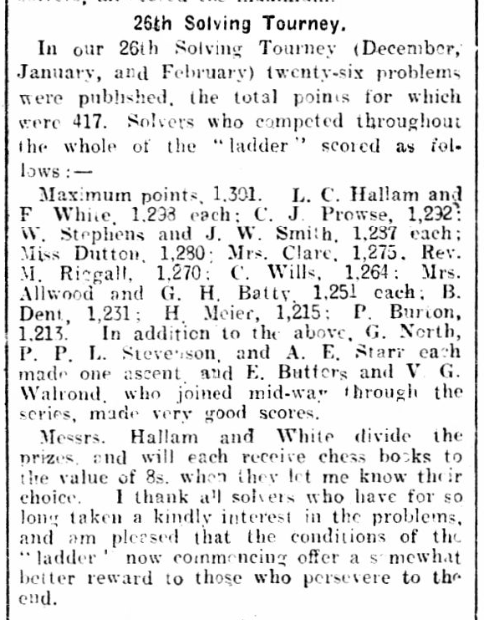
Throughout 1927 and 1928 our Broadmoor problemists were producing many problems, both on their own and in collaboration with others.
Stephens and Boswell were occasional collaborators, as witnessed here.
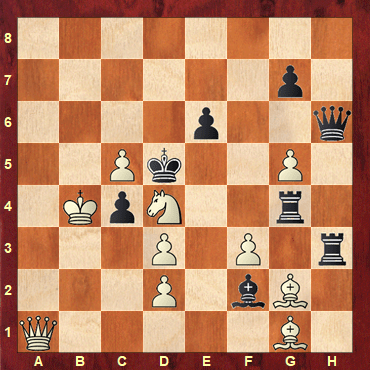
Western Morning News 07-05-1927
In 1929 Hallam won 5th prize in a ‘difficulty tourney’ run by the Falkirk Herald, with this problem. Will it also be difficult for you to solve?
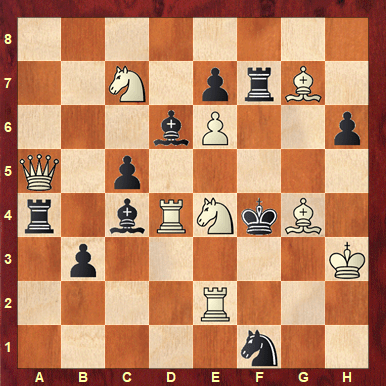
5th Pr Falkirk Herald (Difficulty Ty) 1929
By May 1929 Hallam had left Broadmoor, relocating in Liverpool, from where he was still for a short time, composing fairly obsessively. But back inside, chess composition seems to have come to a sudden conclusion. It’s possible Midwinter had also left at about the same time. Whether Stephens and Foster had lost interest or the authorities had intervened I don’t know.
But there was good news for them in 1930, when a joint composition by Foster and Stephens won an honourable mention restricted to composers who had not previously won a prize in a composing tournament.
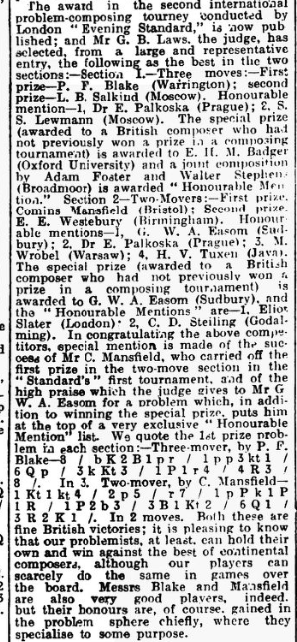
This might possibly have been the successful composition. Note that this, unlike the other problems in this article, is a mate in 3 moves.
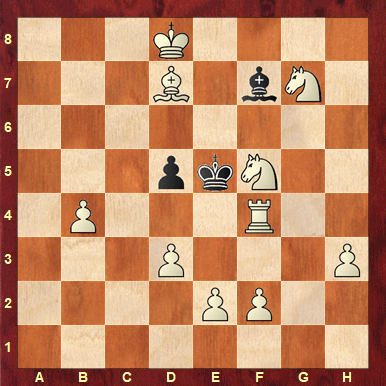
Western Morning News 08-06-1929
There was just one more problem, appearing in the March 1930 issue of The Problemist as part of a birthday tribute to Alain Campbell White, immediately above a composition from William Edward Lester.
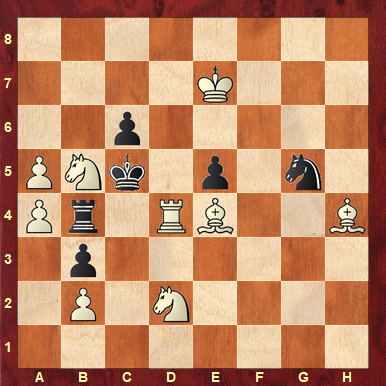
The Problemist March 1930
Of course you’ll want to know what happened next. In contrast to the mystery concerning his earlier life, we know quite a lot about Laurence Hallam’s final years. By December 1930 he had moved to his home town of Nottingham, winning another prize in a solving competition, and giving his address as 38 Nottingham Road, not far from where he grew up. He was probably now living with his mother, at which point he decided it was time to move on with his life, find a job and put his chessboard away.
In 1935 he was awarded probate on the death of an aunt.

I think Ida Hallam was a cousin of Laurence Vernon Hallam.
In 1939 he was still living with his mother, giving his marital status as ‘married’ and his job as a wholesale merchant – food and chemical importer.

He had a brush with the law in 1940, being find £1 for being in breach of the wartime regulations concerning motor car lights.
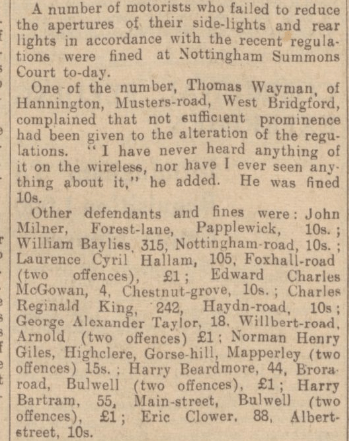
Laurence Cyril Hallam died on 8 April 1945, at the age of 54, his heartbroken mother survived him by only six weeks.


After his death, Emma resurfaced, apparently marrying George Fullard (whom I haven’t been able to identify for certain) in Peterborough in 1948, and dying in Barnstable in 1960.
Hallam was the second of the Broadmoor problemist quartet to die. Adam Foster been checkmated by death in 1941 – registered in Windsor, so it’s likely he died either in Broadmoor on in a nearby hospital.
Walter Stephens made a brief return to composing, submitting a problem to the BCM to celebrate what he claimed was his 84th birthday in 1941. It was actually his 83rd birthday, and the problem was unsound, having two alternatives to the intended solution. But, at that age, who was counting? He died, again registered in Windsor, in the third quarter of 1947, at the great age of 89 (the BMD record incorrectly, probably based on information supplied by Broadmoor, gives his age as 87).
Bertie Midwinter returned to composition, or rather plagiarism, much later. MESON offers a problem from a local paper in 1947, and one from The Problemist in 1948, flagging anticipations in both cases. His death was registered in Rotherham in 1962. Cricket historians will be aware of another B Midwinter, who also spent time in an asylum. The two were not, as far as I can tell, related.
It’s an extraordinary story, I’m sure you’d agree. Four very different men all united by a shared love of chess problems as well as confinement in an asylum for the criminally insane.
Three of them, at least, seem to have been competent composers as well as solvers. Their problems lacked depth, it’s true, but they were just what was wanted for casual newspaper readers. Today we might solve a crossword, a sudoku, or even get a quick Wordle fix with our morning coffee, but back in the 1920s, solving a chess problem would, for many, be the order of the day.
You’ll find a lot of their problems in Brian Stephenson’s MESON database, and online newspaper searches will uncover many more. No doubt there are plenty of others still to be discovered, along with more information, perhaps, about their lives. I’d still like to know why Laurence Cyril Hallam ended up at Broadmoor. The failure of his marriage, along with his career changes (East India merchant to interpreter to Music Hall artist) suggest a fragility which might have led to mental health problems, but who knows?
I’m very grateful to have read two excellent articles by Martin Smith, the first telling the story of Stephens and also mentioning Foster, the second in response to Bob Jones’s article in CHESS introducing Hallam and, along with Jones, asking whether he and Stephens might have been the same person. My researches suggest not, partly because they were making different scores in solving competitions, but more because we can trace Hallam from his early years Nottingham back home again via Broadmoor.
Now it’s possible to identify Foster and (almost certainly) Hallam) as well as introducing Midwinter. Their lives were touched by mental health problems and tragedy, but solving and composing chess problems must have brought them some comfort and friendship.
Previous Minor Pieces have introduced the blind boys at school in Worcester, the disabled ex-servicemen in Richmond, the naughty boys in Desford Approved School, the members of the Leicester Cripples Guild and the prisoners in Parkhurst. Here we have another story of how chess helped those with a wide range of disadvantages in the inter-war years. As I never tire of saying, chess is much more about friendship and community than prodigies and grandmasters.
Coming up soon, more about chess in Broadmoor, and another blind boy at school in Worcester. Make sure you don’t miss out.
Acknowledgements and Sources
ancestry.co.uk
findmypast.co.uk/British Newspaper Library
Wikipedia
MESON chess problem database: Stephens/Foster/Hallam/Midwinter.
Yet Another Chess Problem DataBase (YACPDB)
British Chess Problem Society website/The Problemist
Streatham & Brixton CC & Lost on Time blogs (Martin Smith)
British Chess Magazine
CHESS January 2019 (Bob Jones)
Problem Solutions
Problem 1. Qf4
Problem 2: c3
Problem 3: Qc2
Problem 4: Qd6
Problem 5: Qa6
Problem 6: Kh4
Problem 7: Nd6
Problem 8: Nc7


Leave a Reply