Last time I told the story of two East European immigrants whose mental health problems led to the committal of terrible crimes.
In this and the next article we have some slightly happier stories about Jewish immigrants who fled Nazi Germany and settled in England. In both cases there’s quite a lot of biographical information available online, and they have something else in common as well.
In the first few decades of the 20th century chess flourished among the Jewish intelligentsia, and in the coffee houses of central Europe. Alexander Distler (later known as Alex to his London friends) was perhaps the epitome of the coffee house player. Distler was born into a Jewish family in what was then Lemberg, in Poland (now Lviv in Ukraine) on 17 March 1897. He later moved to Vienna, perhaps to continue his studies as a civil engineer and architect.
On 8 November 1925 he seems to have played on a lower board in a match in Győr between Austria and Hungary, winning his game against Barna Dalmy.
This must also have been him, bringing up the rear in the 1932 Vienna Club Championship.
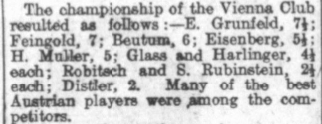
This suggests that he wasn’t the strongest of players: someone who enjoyed social games over a coffee but didn’t take part very often in competitive chess.
In 1939 Distler fled Austria for England, where he was placed in Kitchener Camp, in Richborough, near Sandwich, Kent.
You can see him here, one of many, mostly middle-class, Jewish refugees, including a Fischer and a Flohr.
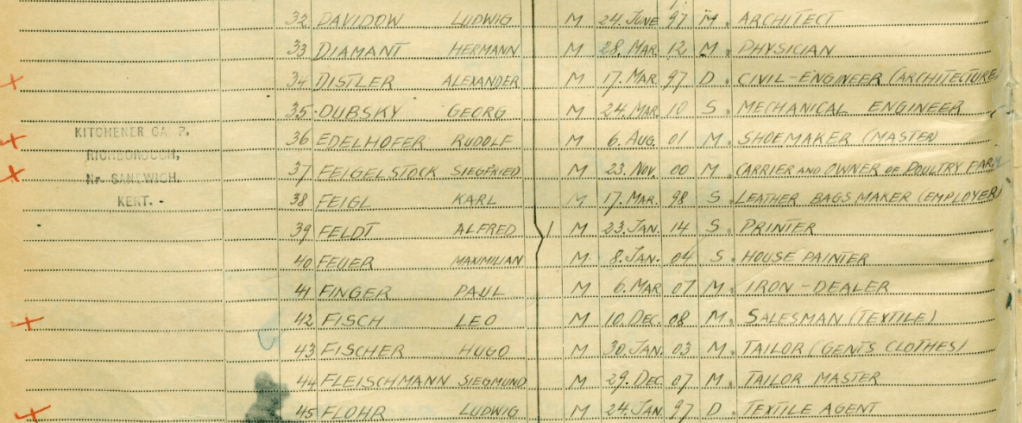
The understanding was that they would eventually settle in other English speaking countries. After Dunkirk in 1940 public sentiment turned against German Jewish refugees: carrying a certificate describing him as “Male Enemy Alien- Exemption From Internment” he sailed for Canada on 4 July, ending up in refugee camps in Ottawa and Quebec.
Remarkably, several letters to Alex Distler from his family and friends have survived.
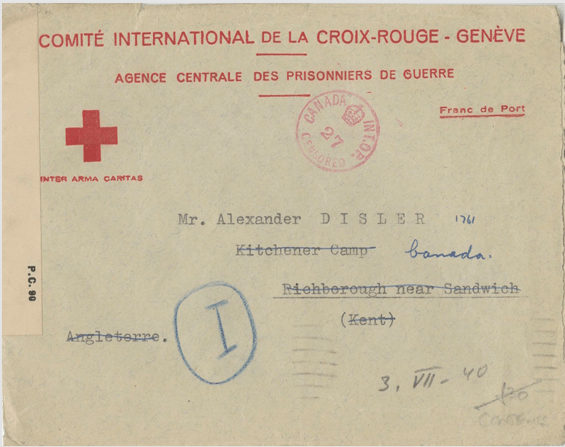
Here’s a Red Cross letter sent by his mother, Franziska, addressed to Kitchener Camp but to his first refugee camp in Ottawa.
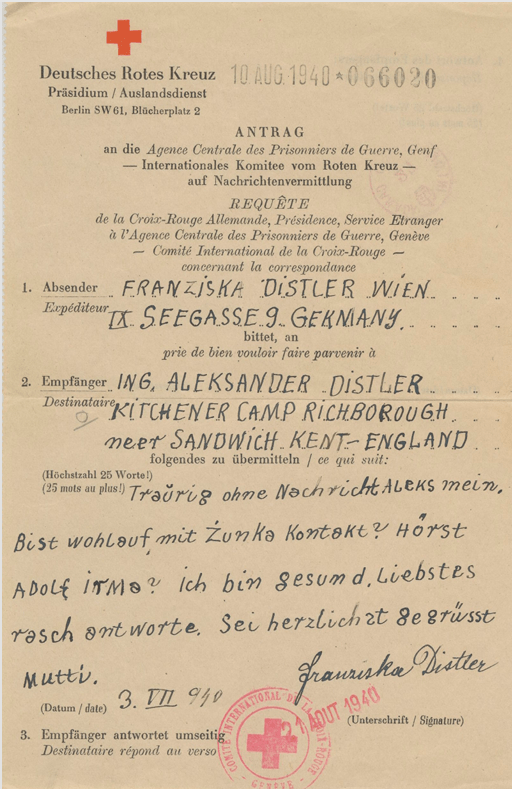
She expresses concern that she hasn’t heard from him and sends him her best wishes.
You’ll find more in the Bulmash Family Holocaust Collection held by the Chalmers Library at Kenyon College, Gambier, Ohio and online here. When her letters stopped arriving, Alexander made enquiries and discovered that she’d been deported to Theresienstadt in 1942 on Transport 29, where we presume she perished.
By 1943 the political situation had improved, and Distler was able to return to England, sailing from Halifax to Liverpool on board the Mauretania.
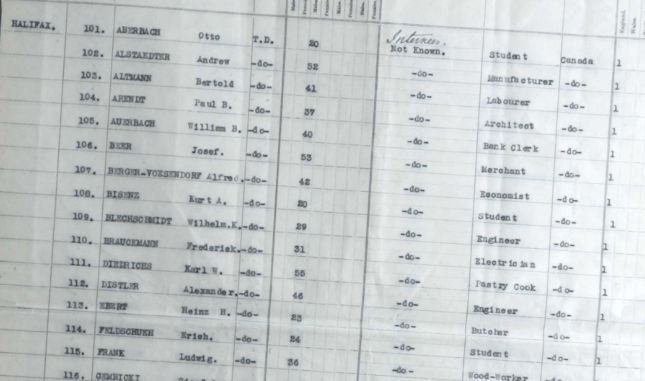
(21 years earlier, Louisa Padbury had also returned from North America on the same ship, sailing from New York to Southampton, instructed by her family to help raise her feckless sister Florence’s illegitimate children. If she hadn’t done so you wouldn’t be reading this now, but that’s another story.)
Alexander Distler soon settled in London, living in a boarding house near Notting Hill. Here he found his natural chess home in the Mandrake Club, a private chess club in Soho run by Bulgarian emigré Boris Watson and endgame expert Harold Lommer. The Mandrake Club attracted a range of chess addicts, eccentrics and Central European refugees, including future Richmond Chess Club stars Michael Franklin and Walter Veitch, alongside Bernstein, Mieses, Winter, Wade and the cartoonist ‘Vicky’.
Several years later, in 1951, Chess Review would report that “one of the most amusing characters and players in the Mandrake is Alexander Distler. Usually a crowd of kibitzers gathers to enjoy his witty remarks that accompany his witty play”.
Thanks to Gerard Killoran for providing the full article, from Bruce Hayden (whom I should write about at some point).
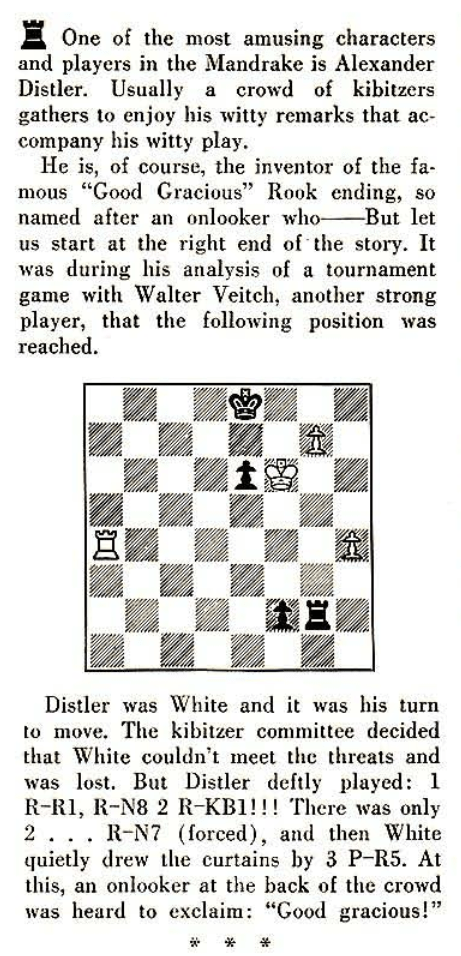
However, in this position, Rf4 also wins for White: I suspect the white rook should be on a5 rather than a4.
But, back in 1945, Distler entered the London Championship, one of the first competitive events to take place after the end of hostilities. He wasn’t the only witty player there: the tournament achieved legendary status due to the participation and reportage of the Badmaster himself, Geoffrey Harber Diggle.
The format was unusual, but, given the circumstances, understandable. 128 players of varying strengths entered a knockout tournmant, with the final eight being joined in an all-play-all tournament by three invited masters, JM Aitken, Sir George Thomas and Paul List, an earlier Jewish emigré.
In this fluctuating game he knocked out the strong Scottish player James Gilchrist.
[Event “London Championship Preliminary KO”]
[Date “1945.??.??”]
[White “Distler, Alexander”]
[Black “Gilchrist, James”]
[Result “1-0”]
1. d4 Nf6 2. Nf3 c5 3. c3 cxd4 4. cxd4 d5 5. Nc3 Nc6 6. Qb3 g6 7. Bg5 e6 8. e3 Be7 9. Rc1 O-O 10. Bd3 Kg7 11. O-O h6 12. Bh4 Nh7 13. Bg3 Bd6 14. Ne2 Bxg3 15. hxg3 f5 16. Rc3 Nf6 17. Rfc1 Ne4 18. R3c2 g5 19. Nd2 Rf7 20. f3 Nxd2 21. Rxd2 Na5 22. Qa3 b6 23. b4 Nb7 24. Rdc2 Nd6 25. b5 Bb7 26. Qa4 Rc8 27. Rxc8 Nxc8 28. Qc2 Nd6 29. a4 Ne8 30. Kf2 Qd6 31. Qb3 Nf6 32. Bb1 Rc7 33. Rh1 Bc8 34. g4 Qe7 35. Ng3 f4 36. exf4 gxf4 37. Ne2 e5 38. g3 exd4 39. gxf4 Rc3 40. Nxc3 Qe3+ 41. Kg2 Nxg4 42. fxg4 Bxg4 43. Qxd5 1-0
William Winter, reporting in the BCM, described Distler’s play as ‘impetuous’ and ‘enterprising’, launching a ‘violent attack’ against List, a ‘wild attack’ against Thomas and an ‘ingenious attack’ against Gabriel Wood (whom I’ve been meaning to write about for years), all of which proved unsuccessful. Just what you’d expect, I suppose, from a coffee-house player. You can get away with playing like that at lower levels, but it’s not going to work against master standard opposition.
Here’s the tournament chart.
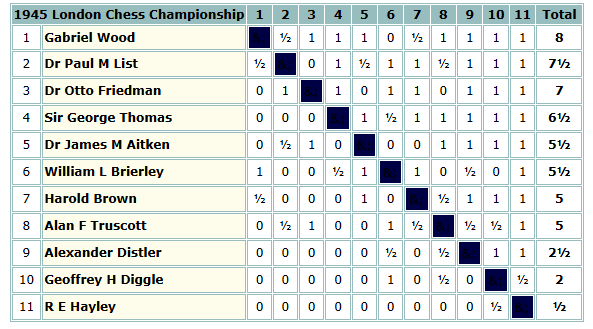
Three of Distler’s games have survived: losses against Wood, Friedman and Aitken.
Here’s the ingenious attack against Wood. His 38th move was witty, but insufficient.
[Event “London Championship Round 11”]
[Date “1945.10.23”]
[White “Wood, Gabriel Jacquin”]
[Black “Distler, Alexander”]
[Result “1-0”]
1. d4 Nf6 2. c4 e6 3. Nc3 Bb4 4. e3 O-O 5. Bd3 d5 6. Nge2 a6 7. O-O dxc4 8. Bxc4 b5 9. Bd3 c5 10. Ng3 cxd4 11. exd4 Bb7 12. Nh5 Nbd7 13. Bg5 Be7 14. Be3 Qa5 15. a3 b4 16. Nxf6+ Nxf6 17. axb4 Qxb4 18. Qe2 a5 19. Ra4 Qb6 20. d5 Qd8 21. dxe6 fxe6 22. Bg5 Qd7 23. Rd1 Qc6 24. f3 Bb4 25. Bb5 Qb6+ 26. Be3 Qc7 27. Bd4 Qf7 28. Bc4 Rfe8 29. Raa1 Rac8 30. Bb6 Bc5+ 31. Bxc5 Rxc5 32. Bb5 Rec8 33. Rd6 Nd5 34. Rd7 Nf4 35. Qd2 Qf6 36. Rxb7 Rg5 37. Bf1 Nh3+ 38. Kh1 Qxf3 39. Qxg5 Qxb7 40. Qe3 Rf8 41. Qxh3 Qxb2 42. Re1 Qd2 43. Qxe6+ Kh8 44. Qe7 Qf2 45. Qxf8+ Qxf8 46. Bb5 1-0
Against Friedman he played an unsound tactic in the ending, and against Aitken the endgame was again his downfall, making a one-move blunder in a position rook ending he might have held.
When league chess started up again, Distler was to be found playing for the historic Athenaeum Chess Club, winning this scintillating sacrifical game in a match against Wood Green.
[Event “Athnaeum v Wood Green London League”]
[Date “1948.11.??”]
[White “Wosner, Leo”]
[Black “Distler, Alexander”]
[Result “0-1”]
1. e4 c6 2. d4 d5 3. e5 Bf5 4. Nf3 e6 5. Bd3 Bg6 6. O-O Nd7 7. b3 Rc8 8. Re1 c5 9. Ba3 Nh6 10. Bxg6 hxg6 11. h3 Nf5 12. dxc5 Bxc5 13. Bxc5 Nxc5 14. Nbd2 Qa5 15. a3 Qc3 16. Ra2 Nd7 17. Nf1 Nh4 18. Re3 Nxf3+ 19. Qxf3 Qc7 20. Qe2 Rh5 21. f4 Qb6 22. Kh2 Qd4 23. g3 Ke7 24. Qd2 Qc5 25. Qe2 d4 26. Rd3 Qd5 27. c4 Rxh3+ 28. Kxh3 Rh8+ 29. Kg4 f5+ 30. Kg5 Nf8 31. cxd5 Rh6 0-1
His opponent, Leo (Elozar Elye) Wosner (1925-2015), was another Jewish refugee, from a Viennese rabbinical family, who must have arrived in London as a young man. His parents both lost their lives in Auschwitz in 1944. His son, Jonathan (Yochonan) (1961-2025) became a rabbi in Montreal.
Alex Distler was less successful in this London League game, this time finding himself on the wrong side of a queen sacrifice, and getting mated in only 16 moves.
[Event “London League”]
[Date “1949.??.??”]
[White “Distler, Alexander”]
[Black “Eriksen, John Erik”]
[Result “0-1”]
1. d4 d5 2. c4 e6 3. Nc3 f5 4. Nh3 Nf6 5. f3 c6 6. e3 Bd6 7. Bd2 O-O 8. c5 Bc7 9. f4 Ne4 10. Nxe4 fxe4 11. Ng5 h6 12. h4 hxg5 13. hxg5 Qxg5 14. fxg5 Bg3+ 15. Ke2 Rf2+ 16. Ke1 Rxg2#
We also have another game against Aitken, from a National Club Championship match between Lud Eagle and Athenaeum, in which Distler misdefended against a powerful attack.
As well as Athenaeum he was playing for West London, and for Middlesex in county matches. At this point he was very much involved in the London chess scene.
But, like the refugees we met last time, he also suffered from mental health problems, spending 15 months as an inpatient in Netherne Hospital from June 1952. According to their records he had been married and divorced at this time, but I’ve been unable to find any further information so assume this must have been back in Vienna. Netherne was famous for its programme of art therapy: perhaps he met Phil Poyser there.
After his recovery he was soon back to playing chess again, now living in a boarding house in Maida Vale. In the 1954 BCF Grading List he was graded 3a – the equivalent of 209-216 in old BCF/ECF grades or about 2300 Elo, alongside former Minor Piece subjects Alf Lenton and Reggie Noel-Johnson (there are one or two other future Minor Piece subjects there as well). There were only 26 players in the country with higher grades: although now in his late 50s and having recently returned from a long stay in hospital, he was clearly very much stronger now than in the past.
His grade then dropped to 4a (193-200, about 2150-2200 Elo), where it remained for a few years until he appeared to drop out of competitive chess. Around this time he was often changing addresses: he was in Streatham in 1956 and Clapham in 1958 before returning to the Maida Vale area.
Distler made a brief comeback a decade or so later, when, now in his seventies, he took part in the Hammersmith Easter Congress of 1970, where we met over the board in the first round: one of the small number of my opponents born in the 19th century. I suffered a humiliating defeat, allowing a standard tactic, which should have been familiar to me even then, as early as my fifth move and then blundering again on move 16.
[Event “Hammersmith Open R1”]
[Date “1970.03.27”]
[White “Distler, Alexander”]
[Black “James, Richard”]
[Result “1-0”]
1. d4 g6 2. Nf3 Bg7 3. Bf4 d6 4. e3 Nd7 5. Bc4 Ngf6 6. Bxf7+ Kxf7 7. Ng5+ Kg8 8. Ne6 Qe8 9. Nxc7 Qd8 10. Nxa8 b6 11. Qf3 e5 12. Bg3 e4 13. Qe2 Bb7 14. Nc3 Bxa8 15. Bxd6 Qc8 16. Qb5 a6 17. Qb3+ 1-0
A coffee-house player to the end, tricky and tactical, Alex Distler’s games sometimes ended, as here, in a swift victory, but also sometimes in a rapid defeat.
Players like him were quite common at the time: if you faced a middle aged Central or East European opponent you’d know they’d learnt their chess in this sort of environment, and you’d be pretty sure what sort of game you’d get. They’re all long gone now, and the chess world is all the poorer for their passing.
Distler himself died in early 1978, shortly before his 81st birthday. Like my two Broadmoor opponents, and like his London League opponent Leo Wosner, he was a man who fled a tyrannical regime, finding friendship and community through the wonderful game of chess.
I have another story to tell, of another opponent from a similar background. You won’t want to miss it so be sure you come back soon.
My thanks to my friend Paul Barasi, who suggested some time ago that I should write something about Alexander Distler.
If you know of anyone else who might make an interesting subject, do get in touch.
Acknowledgements and Sources
ancestry.co.uk
findmypast.co.uk/British Newspaper Library
Wikipedia
British Chess News (John Saunders)
ChessPublishing.com (BritBase+ database)
ChessBase 26/Megabase 2026
EdoChess (Rod Edwards: Distler here)
Chess Notes (Edward Winter)
Bulmash Family Holocaust Collection (Kenyon Digital Library)
Lost Hospitals of London

 Minor Pieces
Leave a comment