One of the most important things you need to know about me is this.
My grandfather spent time in Leicester Gaol.
My uncle spent time in an approved school.
My father spent time in Feltham Borstal.
I was in Broadmoor on three occasions, twice winning fights against murderers.
Let me explain.
In his teens, way back in 1877, my grandfather read a book about Robin Hood. He liked the idea of robbing the rich to give to the poor, so, along with a friend, he broke into a church in the next village, removed a chest containing the parish registers, panicked and dropped it. They were soon arrested and did six months in Leicester Gaol for sacrilege.
One of his sons from his first marriage was difficult to control, and was sent to what was then Desford Industrial School, later Desford Approved School, which you can read about here. Both were naughty boys: perhaps it ran in the family.
His first wife bore him twelve children, and after her death he remarried, having six children by his second wife, of whom my father was the youngest.
At the time I was born, my father, who wasn’t himself a naughty boy, was working as an instructor, teaching painting and decorating to the naughty boys in Feltham Borstal, preparing them for a possible future career that would set them on the straight and narrow.
And, as for me, I played in three matches between Richmond & Twickenham Chess Club and Broadmoor (a lunatic asylum when Walter Stephens and his friends were solving and composing problems there, a hospital for the criminally insane when I visited, now a high security psychiatric hospital).
You might have read about how my friend Phil Poyser organised these matches. These friendly encounters were part of his story, and part of my story as well. Indirectly, they were also part of the stories of Walter Stephens and Adam Foster, Laurence Cyril Hallam and Bertie Midwinter, all of whom you read about last time.
When we visited we made sure not to ask our opponents why they were there, what terrible crimes they had committed. But now, knowing their names, and with access to the British Newspaper Archive and other sources, we can find out.
On my first visit, in 1972, my opponent was Günther Wiora, a man whose tragic story deserves to be told.
He was born in Poland in 1922 as Ginter Wiora, but later used the German version of his first name (spelt in various ways: the first vowel could be ü, ue if you don’t have an umlaut, u if you’re lazy, and the h after the t is optional). His death record would provide a middle name, Arnold.
He and his cousin George, a year older, served their country in Italy during the second world war. They were captured, later serving in General Anders’ army in the Polish unit. He may well have been at Monte Cassino in 1944, where he might even have seen my father, who was serving in the Royal Artillery at the time.
Anders later worked for the Polish government in exile in London, and many members of the Polish unit, including the Wiora cousins in 1946, followed him. Ginter, as he then was, was described by George as being a quiet and hard-working man with an interest in art and music.
By 1957 he was working as a dispatch clerk, living in lodgings in Leinster Square, Bayswater with his common-law wife Shirley Allen, who knew him as Peter.
He was concerned about Shirley’s friendship with a Frenchman, believing he wanted her to work as a pornographic model. On 4 May he suddenly snapped, stabbing her to death with a samurai sword, also stabbing their housekeeper and finally himself. He also slit his wrists with a bread knife and turned the gas on.
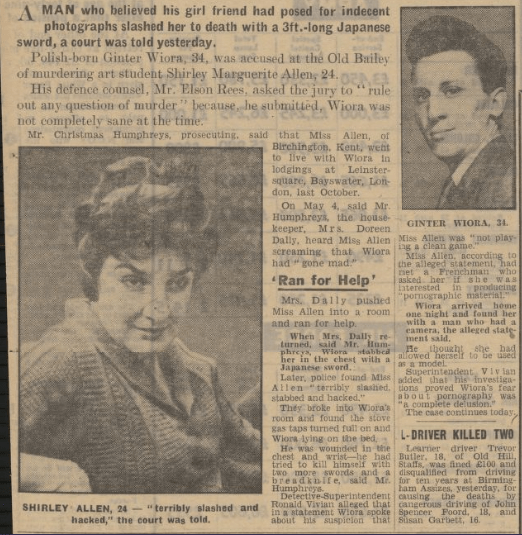
He and his housekeeper recovered from their wounds, and in July he was found guilty of manslaughter, being sentenced to twelve years imprisonment. Many of the leading legal experts of the day were involved in the trial, which garnered much press interest. On passing sentence the judge told him “You must have obviously been suffering from some mental disturbance that caused you to do it”.
Not guilty of murder, then, because of diminished responsibility caused by temporary insanity: schizophrenia was mentioned as a possible diagnosis. It’s very similar in some respects to the story of Adam Foster you’ll have read last time: killing his girlfriend and trying to kill himself.
He would have been assessed again in prison, where it was decided that he should be removed to Broadmoor for an indefinite period.
Like many East Europeans, Wiora was a keen chess player. The days of the Broadmoor problemists in the 1920s were long gone, but social chess was played and there were competitions between the more serious players.
In September 1962 the Broadmoor Chronicle, the hospital’s in-house magazine, which occasionally published chess news, gave the moves of a game played three years earlier, in which Wiora lost to another patient whose initials were FJC.
[Event “Broadmoor”]
[Date “1959.??.??”]
[White “C, F J”]
[Black “Wiora, Günther”]
[Result “1-0”]
1. e4 e5 2. Nf3 d6 3. d4 exd4 4. Qxd4 Nc6 5. Qd1 Bg4 6. h3 Bxf3 7. Qxf3 Qe7 8. Nc3 Nf6 9. Bg5 O-O-O 10. O-O-O Qe6 11. Nd5 Be7 12. Nxe7+ Nxe7 13. Bxf6 gxf6 14. Qg4 f5 15. exf5 Qh6+ 16. Kb1 Nc6 17. g3 Ne5 18. Qe4 c6 19. Qd4 Kb8 20. f4 Nd7 21. Qxd6+ Qxd6 22. Rxd6 Nb6 23. Rxd8+ Rxd8 24. Bd3 Rd6 25. Re1 Rf6 26. b3 Kc8 27. a4 Kd7 28. c3 Nd5 29. Kc2 h5 30. c4 Nb4+ 31. Kc3 Nxd3 32. Kxd3 Rxf5 33. Re5 Rxe5 34. fxe5 Ke6 35. Ke4 f6 36. exf6 Kxf6 37. Kf4 Kg6 38. Ke5 1-0
From the evidence of this game, FJC seems to have been a solid and competent exponent of the game, and Günther of rather lower club standard.
Martin Smith takes up the story:
Then in 1961 he wins one, loses one, against FC in a Block 5 v Block 2 match on Christmas afternoon, and around the same time he beat KW to win the Block 5 championship “after a classic and extended tussle in which three games were drawn and the other two won by GW”, as the Chronicle reported.
He contributed to the Chronicle’s chess column on and off through 1963 and 1964, and he showed himself to be a well-read student of the game, giving games by Tal and Fischer, using a test exercise from Euwe (in German) in one article, and acknowledging Baruch H Wood’s Chess Notes in yet another.
We now jump forward to 1969, when Broadmoor started inviting club teams to visit them for informal matches. It’s extraordinary, given today’s concerns with safeguarding, that one of their matches was against a school team.
Between 1970 and 1975, Richmond & Twickenham Chess Club teams organised by Phil Poyser played five (I think) matches against Broadmoor. My first appearance was in 1972, where we played this game.
[Event “R&T v Broadmoor”]
[Date “1972.11.25”]
[White “Wiora, Günther”]
[Black “James, Richard”]
[Result “0-1”]
1. e4 g6 2. d4 Bg7 3. Nc3 d6 4. Nf3 a6 5. Bf4 Nd7 6. h3 b5 7. a3 Bb7 8. Be2 c5 9. d5 b4 10. axb4 cxb4 11. Na4 Ngf6 12. Bd3 Nc5 13. Nxc5 dxc5 14. Rb1 c4 15. Bxc4 Nxe4 16. Qd3 Nd6 17. Bxd6 Qxd6 18. O-O O-O 19. Rfe1 Rfd8 20. Red1 Rac8 21. Ng5 Qf4 22. Ne4 e6 23. Ng3 Qxc4 24. Qxc4 Rxc4 25. dxe6 Rxd1+ 26. Rxd1 fxe6 27. Rd8+ Bf8 28. Rd7 Bd5 0-1
He played a solid opening, but lost material in the middlegame tactics, soon resigning.
Martin’s account offers further insights into Wiora which merit repeating here.
In response to a rooftop protest earlier in 1972:
GW entered the fray and joined the debate in the Chronicle espousing a more social-democratic approach. He was an advocate of gradualism having, by now, nigh on fifteen years experience of the ways things worked in Broadmoor. He agreed with the RACB’s aims, but argued that “goals must be achieved by democratic and non-violent means”.
In 1974:
He made an appeal for support for the Arbours Association, whose modern day website says is “an internationally renowned registered charity with 40 years experience providing psychotherapeutic support for individuals with serious emotional problems.”
A longer extract:
The following year, in June 1975, Gunter wrote long critique of an article by a certain Robin Knight in the US News and World in which Knight took a poke at Britain and its way of doing things. Here is a short extract in which GW firstly reveals a little about his past – he may have spent his late teens/early twenties in war-torn mainland Europe – and then even more about his present:
I arrived in this country, as a young man, in 1946 and, in the last two decades at least, I have been a deeply interested observer of the British scene, of life and customs in this country…Since my admission to Broadmoor especially, I have been able and fortunate in increasing very considerably my circle of friends…
About a year ago 30 patients in Gloucester House, and a few patients in other houses formed, with the kind permission of the Physician-Superintendent, a charitable organisation called Helpmate, with the aim of helping those outside who perhaps are in greater need than we are…We have saved £108 from wages, plus £15 from the sale of articles. Two charitable institutions and one needy individual (a sick child) have profited from our effort.
The following month a further Helpmate (note the chess reference) report identified the two institutions as the Harts Leap Cheshire home in Canterbury, and the National Society for Autistic Children. Then: in October Helpmate reported that some patients were making jewelry for sale; in November that a representative of the NSAC had visited; and finally in December that the Home Secretary, Roy Jenkins had written to commend their efforts (as did Maggie Thatcher, then Opposition Leader, and even Norman Tebbit, which was nice, I suppose).
Gunter Wiora had a review of a book, evidently read in German, in the same issue of the Chronicle which, perhaps with a little irony, he titled Quo Vadis? Homo Sapiens. There’s another mention of him again in November 1977, still doing good work with Helpmate, but that’s maybe the last reference to Gunter, that I noticed anyway. By then he would have been about 54 years old, and would have been in Broadmoor for around twenty years.
Of course, these edited highlights of chesser Gunter Wiora’s life in Broadmoor may not tell the whole story, or give a full picture, of his illness, but on the above evidence he was clearly a cultured and compassionate man, with an interest in outside affairs, and a lack of bitterness towards a country that considered it necessary to curtail his liberty for so long.
Wiora’s death at the age of 69 was registered in Lambeth in October 1991. There’s no evidence that he ever recovered his freedom: he may well have died in a London hospital. His cousin George died in 2015 at the age of 94.
My opponent in my other two visits to Broadmoor was another East European, László Varga, originally from Hungary.
Although we know why he was there, we don’t know much about his background. Hungary has a relatively small number of both first names and surnames, and there are very many men of his name around.
It seems quite likely he was part of the Hungarian diaspora that found themselves homeless following the 1956 revolution.
On 10 June 1966 a man named Fred Bradshaw was stabbed to death in his secretarial agency in Whitehall. Like Yates, he was Fred, although referred to as Frederick in the press, and aged 52, not 51 or 50 as claimed by many papers, having been born to a working class family in Atherton, Lancashire in 1913. Fred was single, described as a quiet, church-going man with no interest in women. His assailant made a rooftop escape, leaving behind a packet of cigarettes and lighter, both with fingerprints. It appeared they’d been talking, perhaps about job opportunities, when the fatal attack suddenly occurred. A bloodstained knife was also found on a tube train.
Almost 18 months later the Met finally had their man, due to a tip-off from Interpol. László Varga, a sailor on a ship somewhere near Gibraltar had been found, and officers flew out to Spain to arrest him.
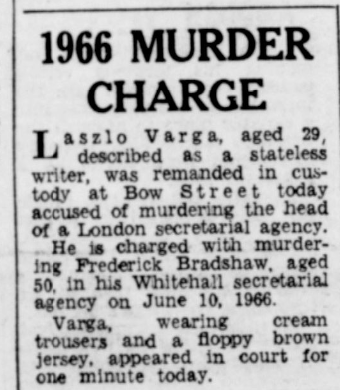
(Fred, aged 52, not Frederick, aged 50.) You’ll note that Varga was described as a ‘stateless writer’ here, but a ‘Hungarian sailor’ elsewhere.
The case went to trial in May, but Varga had ‘attractive 26-year-old Monique’ on hand to provide an alibi.
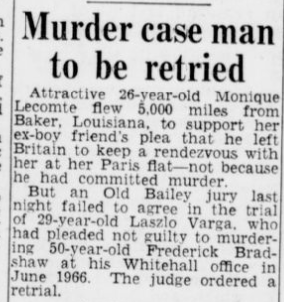
The jury couldn’t agree, and a retrial took place a few weeks later.
This time, Varga was found guilty and sentenced to life imprisonment. In 1972, with worsening mental health problems, he was sent to Broadmoor, which is where I met him the following year.
The game resulted in a short and amicable draw.
[Event “R&T v Broadmoor”]
[Date “1973.11.??”]
[White “James, Richard”]
[Black “Varga, László”]
[Result “1/2-1/2”]
1. d4 d5 2. c4 e6 3. Nc3 Nf6 4. Nf3 c5 5. cxd5 exd5 6. Bg5 Nc6 7. Bxf6 gxf6 8. e3 Be6 9. Bd3 c4 10. Bb1 Qb6 11. Qe2 O-O-O 12. O-O h5 13. Nh4 Bd6 14. Nf5 Bf8 15. h3 Kb8 16. Qd2 Ne7 17. Nxe7 Bxe7 18. e4 dxe4 1/2-1/2
The computer tells me I chose the wrong plan on move 9, and was virtually lost in the final position. His draw offer was certainly generous.
The match scheduled for the following November eventually took place in March 1975, and again I had the white pieces against the same opponent.
This time I managed to win.
[Event “R&T v Broadmoor”]
[Date “1975.03.22”]
[White “James, Richard”]
[Black “Varga, László”]
[Result “1-0”]
1. c4 f5 2. Nc3 Nf6 3. g3 g6 4. Nf3 Bg7 5. Bg2 O-O 6. d4 d6 7. O-O Qe8 8. b3 a6 9. Ba3 Bd7 10. Rc1 Nc6 11. d5 Nd8 12. Qd3 b5 13. Nd4 Rb8 14. cxb5 axb5 15. Nb1 b4 16. Bb2 c5 17. dxc6 Nxc6 18. Nxc6 Rb6 19. Qc4+ e6 20. Nxb4 d5 21. Qd4 Rb7 22. Nxd5 Nh5 23. Qd2 Bxb2 24. Qxb2 exd5 25. Bxd5+ Be6 26. Bxb7 f4 27. Rc7 Qb5 28. Nc3 Qb6 29. Rc6 Qxb7 30. Rxe6 Qa7 31. Nd5 fxg3 32. hxg3 Rf7 33. Re8+ Rf8 34. Rxf8+ Kxf8 35. Qh8+ Kf7 36. Qxh7+ Ng7 37. Rc1 1-0
A curious game in that he appeared to forget the en passant rule on move 16, after which the game was, in effect, over. The opening of this game, as well as the previous game, though, suggest a more than competent player with a fair amount of book knowledge.
This, I believe, turned out to be our last match against Broadmoor, Phil Poyser wrote at the time that the date of the following match had already been agreed, but it didn’t take place. Perhaps the Broadmoor authorities had clamped down on visits of this nature, or perhaps they’d just lost interest. A few years of passionate immersion coming to a sudden halt was very much what happened to chess problems there 45 years or so earlier.
There’s more news of László Varga, though. He was later moved to a secure unit which was part of St Bernard’s Hospital in Southall, suggesting he was seen as recovering or at least being less dangerous. It didn’t prove to be so secure, though.
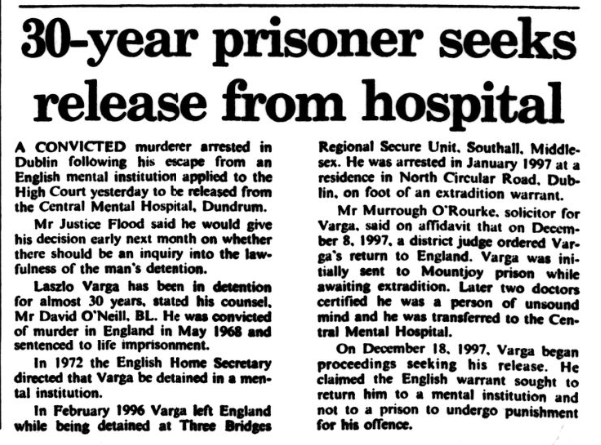
I’m not sure why he chose Dublin: perhaps he had relations or friends there. It wouldn’t be the last time.
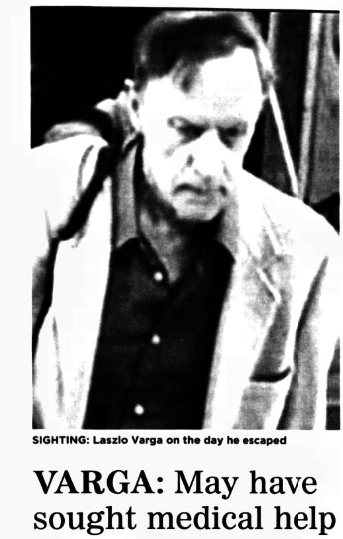
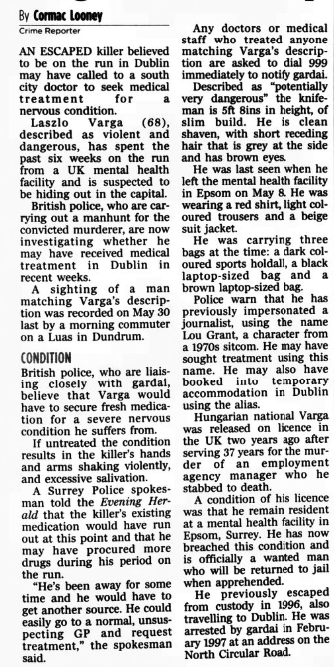
Note the name of the reporter: Cormac Looney. You couldn’t make it up, could you? This suggests Varga had returned to Broadmoor after his first escape, and remained there until 2005, when he was released to one of the mental health facilities in Epsom. He would presumably have been returned to Broadmoor, rather than a jail, when he was captured. Which he soon was, but not in Ireland.
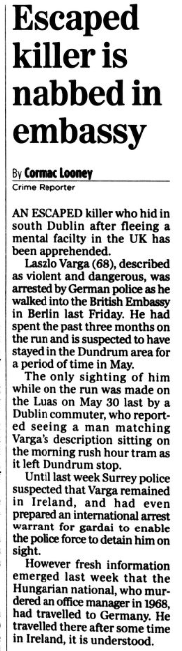
02 August 2007
I’ve found nothing further about what happened to Varga after that. He may still be alive: I have no idea.
Here, then, we have two East European chess players, both cultured men, both of whom developed mental health conditions, perhaps partly as a result of their experiences being caught up in the mid 20th century fight against totalitarianism. In both cases, their horrific crimes cost an innocent person’s life. Both, perhaps, found some solace in playing chess in Broadmoor, and, just maybe, gained some satisfaction from their games against visitors from Richmond & Twickenham Chess Club.
They weren’t the only refugees I encountered over the chessboard. There were many Jewish players who fled Nazi persecution in the late 1930s, some ending up in England. I met a couple of them, and you’ll meet them yourself soon.
Be sure not to miss it.
Acknowledgements and Sources
ancestry.co.uk
findmypast.co.uk/British Newspaper Library
Wikipedia
Streatham & Brixton CC blog (Martin Smith)


Leave a Reply