Mrs Rawson and Miss Lawson. Two chess players with similar names whose lives would become entwined. You’ve met the former: now meet the latter.
Let’s start with the story of Septimus Lawson.
Septimus was, as you might have guessed, the seventh son of a large family. Born in 1838, he came from West Burton, near Aysgarth in the beautiful Yorkshire Dales, where his father was a grocer and draper. You’d struggle to find a draper, or even a grocer anywhere near there these days. But grocery wasn’t for Septimus. By 1861, at the age of 23, he was working as an organist.
The day before the census, he’d placed his first advertisement in the press.
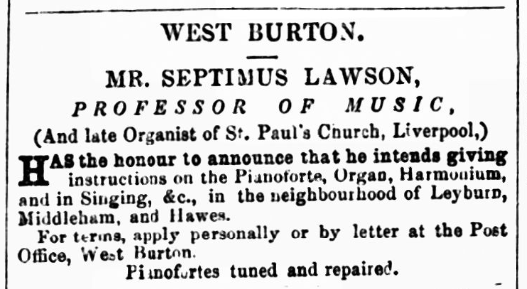
St Paul’s Church Liverpool wasn’t as grand as it sounds: it was situated near the docks, serving a largely working class community. Septimus can’t have been there very long before returning home to Yorkshire, but he would make sure it was never forgotten.
By December 1863 he had another organist job, at the Wesleyan Chapel in Stockton on Tees. Switching from Anglican to Methodist.
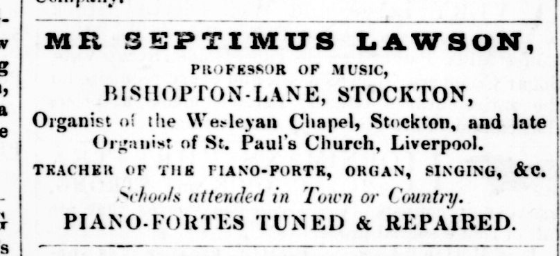
It was in Stockton that he found more than just employment. In the third quarter of 1865 he married Mary Catherine Bradley, only just seventeen, the daughter of a local butcher.
Their first child, Thomas Michael, was born early in 1867, followed by a daughter, Mary Elizabeth, who sadly died aged only five weeks.
The 1871 census recorded the family living with Mary’s parents and three sisters, the oldest two of whom were employed as milliners and dressmakers. Another daughter, Edith, was born later that year.
In 1872 the family found their own place, and Septimus a new job, in the industrial port town of Hartlepool. He was soon adverising his services there.
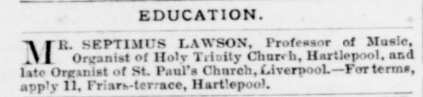
Holy Trinity would have had a very similar profile to St Paul’s Liverpool, serving the booming dockyard industry. There, more children were born: Agnes in 1873, later taking her mother’s maiden name as a middle name, Arthur in 1877, Frederick in 1879 and Ada in 1880.
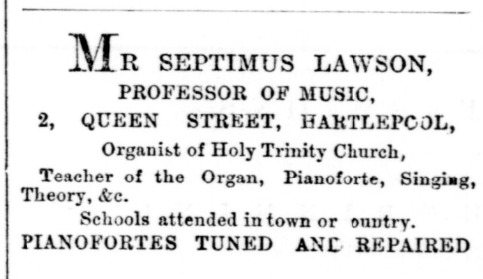
But earlier that year the family had hit financial problems. In April he had a preliminary meeting concerning the liquidation of his affairs. By the end of the year he had to pull his daily advertisements (see above) in the local press, and in March 1882 the Commercial Gazette announced the sale of his chattels.
He remained in Hartlepool until at least January 1885, when he was called on as an expert witness in a case concerning the value of a harmonium, but at some point thereafter disappeared, seemingly off the face of the earth.
Life must have been very hard for Mary, struggling to feed a large family without a breadwinner, and perhaps with debts to pay off.
By 1891 she was describing herself as married – perhaps she was still in touch with Septimus. The older children were now working: Thomas as an engineer’s draughtsman, with William as an apprentice in the same trade, Edith and Agnes as elementary schoolteachers, and Arthur as an office boy. Frederick and Ada were still at school, and Mary’s nephew Charles Bradley was also at home.
Given the family’s precarious situation it’s likely there was no opportunity for the girls to seek husbands. They had to go out to work as well as help with the housework.
They may or may not have been aware that Septimus had turned up on the other side of the world.
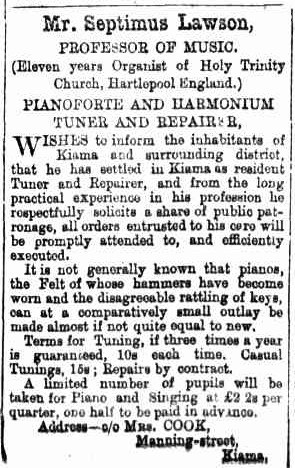
He’d remain in Kiama for the remainder of his life. You’ll spot that St Paul’s Church had now become (an understandable mistake) St Paul’s Cathedral.
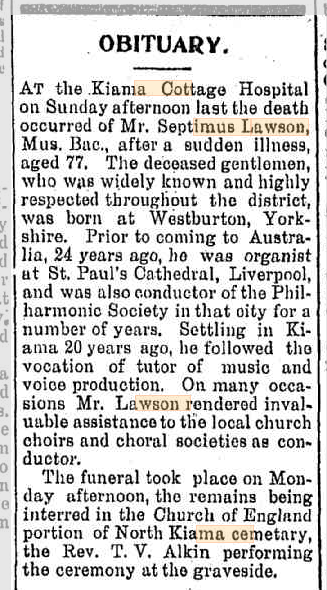
Agnes, fortunately, had another interest to pass her time. She had taken up the game of chess, representing the West Hartlepool club dominated by the Birks family against her mother’s home town. One wonders how she discovered the game: I can’t find any evidence that her father had played competitively, although he probably knew the moves. She may well have been inspired by reading about the London Ladies’ Chess Club, some of whose members she would later meet.
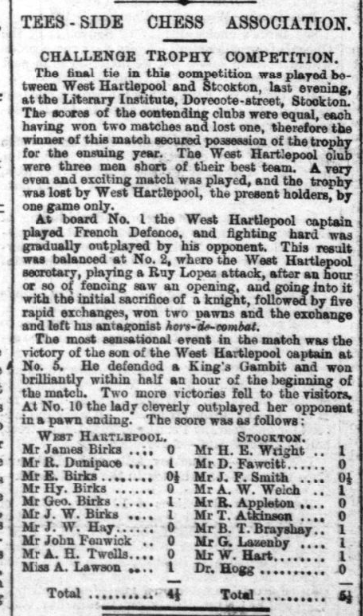
You’ll note that the lady cleverly outplayed her opponent in a pawn ending.
By the time of the 1901 census all six surviving Lawson children were working. Four were in education: Edith and Agnes assistant schoolmistresses, Ada a pupil teacher, and Arthur a clerk for the school board. William and Fred were both in shipping: a draughtsman and a pattern maker respectively.
Agnes was still playing chess, with increasing success, with Ada also making the occasional appearance from 1904 onwards.
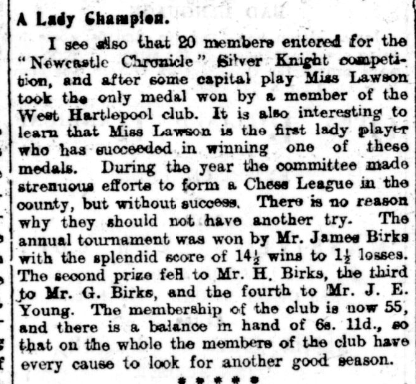
At the West Hartlepool Chess Club’s 1902 AGM Agnes Lawson proposed that ladies should pay the full club membership instead of receiving free honorary membership, but her proposal was vetoed by the chairman. She would continue to play regularly for them in inter-club competitions for the next decade, as well as running fund-raising whist drives.
Regular readers will be aware that the first British Championships, incorporating the British Ladies’ Championship, took place in 1904. Miss Lawson wasn’t there, but by the following year her reputation was such that her entry was accepted. She did pretty well, too, as you’ll see from the cross-table reprinted from BritBase.
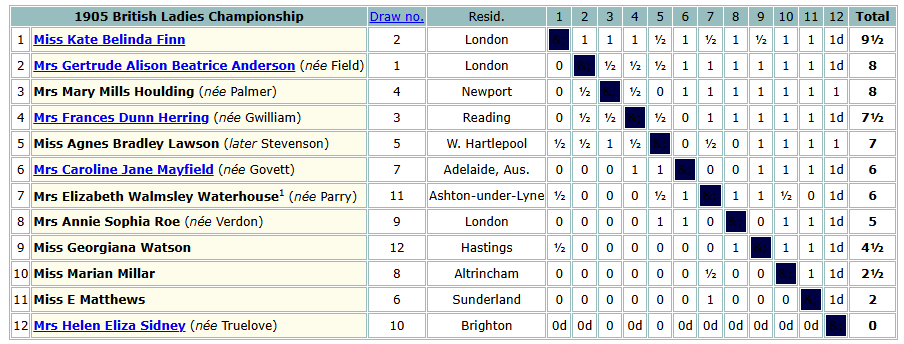
She would take part in this event every year for the rest of her life, usually finishing in the top half: a remarkable achievement. I’ll only post a few of the cross-tables here, but you’ll find them all, of course, on Britbase.
Her results in 1906 and 1907 were not so good: in this 1906 game, facing a dangerous gambit, she lost a piece to a knight fork on her 12th move. I really ought to write about Mary Houlding at some point.
(The games in this article were mostly found on MegaBase 2026. The remaining games, which have credited sources, come from BritBase.)
[Event “British Ladies Championship: Shrewsbury R4”]
[Date “1906.08.09”]
[White “Houlding, Mary Mills”]
[Black “Lawson, Agnes Bradley”]
[Result “1-0”]
[ECO “C50”]
1. e4 e5 2. d4 exd4 3. Nf3 Nc6 4. c3 dxc3 5. Bc4 Be7 6. Qd5 Nh6 7. Bxh6 O-O 8. Bxg7 Kxg7 9. Nxc3 d6 10. Qd1 Be6 11. Nd5 Bg4 12. Qb3 Na5 13. Qc3+ Bf6 14. Qxa5 b6 15. Qd2 Be6 16. O-O h6 17. Rac1 Bg4 18. Nd4 c5 19. Nc6 Qd7 20. Nxf6 Kxf6 1-0
The 1908 congress, held at Tunbridge Wells, saw a very different player. The British Chess Magazine reported that she had greatly improved in both strength and style of play, and, with two rounds to go, she appeared a certain winner. But, alas, she lost her final two games against her two main rivals, and had to be content with a three-way tie for first place.
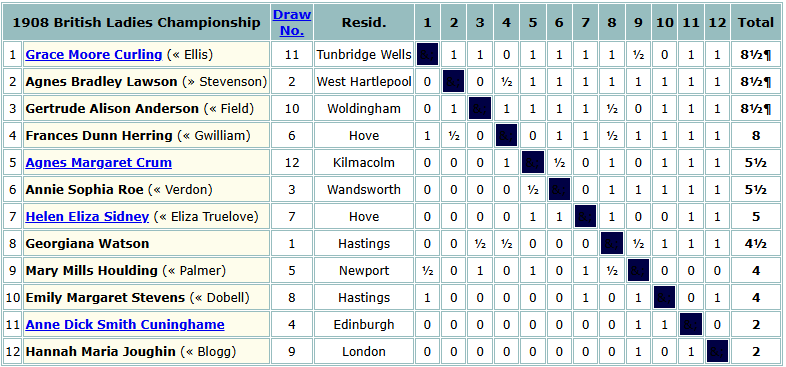
The play-off took place in London the following February, with Grace Curling narrowly taking the title on 2½/4, followed by Agnes Lawson on 2 and Gertrude Anderson on 1½.
It may have been here, that Agnes first met the local organiser, Rufus Henry Streatfeild Stevenson. They would eventually become more than just good friends.
1909 was another good result for Miss Lawson, finishing second just half a point behind Mrs Anderson, whom she defeated in their individual game, but spoiling her chances with a loss to one of the tail-enders.
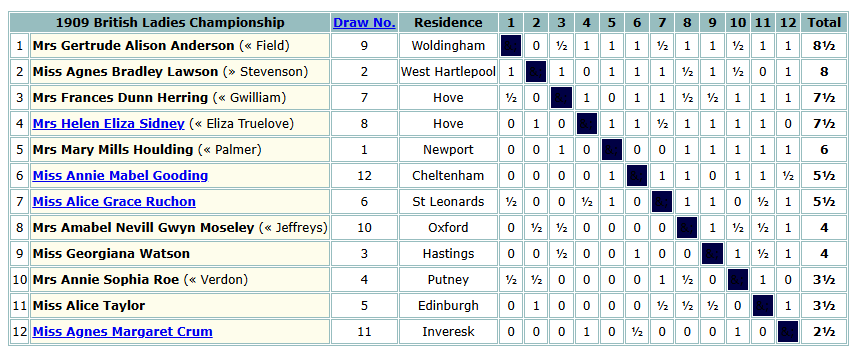
We have two of her games from this event: the win against Mrs Herring, and the defeat by Mrs Sidney.
The former is a nice attacking game which has a modern feel about it.
[Event “British Ladies Championship: Scarborough R7”]
[Date “1909.08.16”]
[White “Lawson, Agnes Bradley”]
[Black “Herring, Frances Dunn”]
[Result “1-0”]
[ECO “B30”]
1. e4 c5 2. Nf3 Nc6 3. Nc3 Nf6 4. Bb5 Qb6 5. d3 Nd4 6. a4 a6 7. Bc4 d6 8. Nxd4 cxd4 9. Nd5 Nxd5 10. Bxd5 e6 11. Bb3 Bd7 12. O-O Rc8 13. f4 g6 14. Bd2 Bg7 15. a5 Qc7 16. Qe1 O-O 17. Bb4 f6 18. f5 Rfe8 19. fxg6 hxg6 20. Qg3 Kf7 21. Bxd6 Qd8 22. Be5 Bb5 23. Qf2 f5 24. Bxg7 Kxg7 25. Qf4 Qc7 26. e5 Rcd8 27. Rf3 Re7 28. Rh3 Rh8 29. Rxh8 Kxh8 30. Qh6+ Kg8 31. Qxg6+ Rg7 32. Bxe6+ Kh8 33. Qh6+ 1-0
This was a game won, as so often, by an unsound sacrifice: simply 16… Nd7 would have led to an advantage, and, with care, the championship title.
[Event “British Ladies Championship: Scarborough R8”]
[Date “1909.08.17”]
[White “Sidney, Helen Eliza”]
[Black “Lawson, Agnes Bradley”]
[Result “1-0”]
1. d4 d5 2. Nf3 Bf5 3. c4 e6 4. Nc3 Nf6 5. Nh4 Be4 6. f3 Nh5 7. g3 Bg6 8. Nxg6 hxg6 9. g4 Qh4+ 10. Kd2 Ng3 11. Rg1 Nxf1+ 12. Rxf1 Qxh2 13. Qa4+ c6 14. cxd5 b5 15. Nxb5 cxb5 16. Qxb5+ Kd8 17. Qb7 Qc7 18. Qxa8 Bb4+ 19. Kd1 Ke7 20. dxe6 Rc8 21. Qe4 f6 22. Bf4 Qb6 23. a3 Qa6 24. Bd2 Qa4+ 25. Ke1 Bxd2+ 26. Kxd2 Qb3 27. Rab1 Rd8 28. Rfc1 {‘and W. won.’ Taken from the Cheltenham Examiner 9.9. 1909. Also published in the Birmingham Daily Post 7.9.1909.} 1-0
Perhaps it was a growing friendship with Rufus Stevenson that encouraged Agnes to make the long journey down to Kent for their 1910 Easter Congress held in Bromley Town Hall, where she took second place in the Second Class Open section.
In that year’s British Ladies’ Championship she again finished just a half point behind the winner.
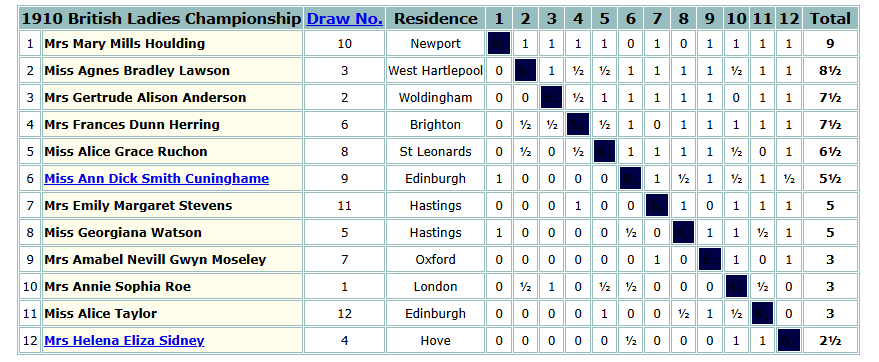
Mary Houlding crushed her with the black pieces in the decisive final round game. Miss Lawson seemed confused by her opponent’s unusual opening choice.
[Event “British Ladies Championship: Oxford R11”]
[Date “1910.08.26”]
[White “Lawson, Agnes Bradley”]
[Black “Houlding, Mary Mills”]
[Result “0-1”]
[ECO “C01”]
1. e4 b6 2. d4 e6 3. Nc3 Bb4 4. Bd2 Bb7 5. Qg4 Nf6 6. Qxg7 Rg8 7. Qh6 Bxc3 8. Bxc3 Bxe4 9. Nf3 Bxc2 10. Qd2 Be4 11. Qe3 Nc6 12. h3 Qe7 13. g4 Nb4 14. Kd2 Nc2 15. Qf4 Nxa1 and wins 0-1
The 1911 census found Mary, Agnes and Ada still in West Hartlepool, living in Mitchell Street, in a modest two up two down terraced house, with what must have been a tiny third bedroom on the second floor, suggesting that the family, in spite of Agnes and Ada’s schoolteaching jobs, were not at all well off. I’m not sure what had happened to Edith, who by now had disappeared from the records. The census also tells us that Mary had had nine children, six of whom were still alive. This implies that there were two who died before their births could be recorded.
Later in the year, perhaps having heard the news of Septimus’s death in Australia, Mary married a man named William Ilderton.
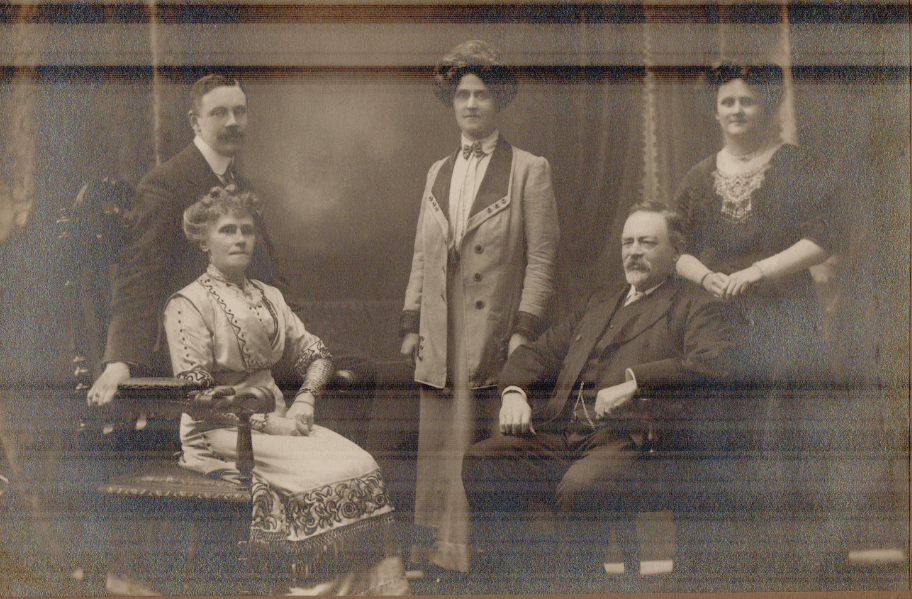
Here they are now, with Agnes standing in the centre, Ada on the right and one of their brothers on the left. This wonderful photograph was posted on ancestry.com by Ada’s granddaughter Jan Tyson. Mary would live on until the age of 90, her death being recorded in North Yorkshire in 1938.
Just a few days after the 1911 census, Agnes travelled down to Kent again for their annual Easter Congress, this time winning first prize in the Ladies’ Tournament ahead of Mrs Sidney.
Her performance in 1911 British Ladies’ Championship was disappointing: perhaps she had other things on her mind. Easter 1912 saw what had become an annual visit to Kent, where a score of 6/10 was enough for her to win the Ladies’ Tournament again. It must have been a close-run thing.
The 1912 British Championships, which took place just down the road from me in Richmond, saw a return to form and a fourth place finish. Three games are available: one win and two defeats.
In a long game against Edith Price she was outmanoeuvred in the ending.
[Event “British Ladies’ Championship: Richmond R3”]
[Date “1912.08.14”]
[White “Lawson, Agnes Bradley”]
[Black “Price, Edith Charlotte”]
[Result “0-1”]
[ECO “C02”]
1. e4 e6 2. d4 d5 3. e5 c5 4. f4 Nc6 5. Nf3 Qb6 6. c3 Nge7 7. Na3 Bd7 8. Nb5 Ng6 9. a4 a6 10. dxc5 Bxc5 11. Nbd4 Nge7 12. b4 Bxd4 13. Nxd4 Nxd4 14. a5 Qa7 15. Qxd4 Qxd4 16. cxd4 Nf5 17. Bb2 Ne3 18. Rc1 Nxf1 19. Rxf1 Bb5 20. Rf2 O-O 21. Rfc2 Bc4 22. Kd2 f6 23. Ke3 Kf7 24. g4 Kg6 25. h4 f5 26. Rg1 Kh6 27. Rh2 g6 28. Rhg2 Rf7 29. Rh2 fxg4 30. Rxg4 Rf5 31. Bc3 Rc8 32. Be1 Bb5 33. Rg5 Rc1 34. Bd2 Rb1 35. Bc3 Rb3 36. Rc2 Rf8 37. Rc1 Rc8 38. Kd2 Rc4 39. Rg3 Kh5 40. Rg5+ Kh6 41. Rg3 Rxd4+ 42. Bxd4 Rxg3 43. Be3 Bc4 44. f5+ Kg7 45. f6+ Kf7 46. Re1 Rh3 47. Bg5 Rb3 48. Rh1 h5 49. Ra1 Rxb4 50. Kc3 Rb3+ 51. Kd4 Bb5 52. Rc1 Bc6 53. Ra1 Rb4+ 54. Kc5 Rc4+ 55. Kd6 d4 56. Rc1 Ra4 57. Bd2 d3 58. Rc3 Rd4+ 59. Kc7 Rd5 60. Ra3 Rxe5 61. Bg5 Rd5 62. Ra2 e5 63. Kb6 e4 64. Rf2 Rxg5 65. hxg5 e3 0-1
In the fifth round she reached a knight ending she really should have won against Daisy Campbell, her opponent having two sets of doubled pawns, but played too passively on move 37 (Ng3 was correct) before imploding on move 39.
[Event “British Ladies’ Championship: Richmond R5”]
[Date “1912.08.16”]
[White “Lawson, Agnes Bradley”]
[Black “Campbell, Daisy”]
[Result “0-1”]
[ECO “C50”]
1. e4 e5 2. Nf3 Nc6 3. Bc4 Bc5 4. d3 d6 5. Be3 Bb6 6. Nc3 Nf6 7. h3 Be6 8. Bxe6 fxe6 9. Bxb6 axb6 10. a3 O-O 11. Ng5 Nd4 12. Ne2 Qe7 13. Nxd4 exd4 14. O-O h6 15. Nf3 c5 16. Nh4 Kh7 17. g3 Nd7 18. f4 Rae8 19. Qh5 Qf7 20. Qxf7 Rxf7 21. Rae1 Ref8 22. b3 b5 23. f5 exf5 24. Nxf5 Rf6 25. g4 Ne5 26. Kg2 Rg6 27. Ne7 Rgf6 28. Nd5 Rxf1 29. Rxf1 Rxf1 30. Kxf1 c4 31. Ke2 Ng6 32. b4 c3 33. Kd1 b6 34. Kc1 Ne5 35. Nf4 g5 36. Ne2 Nf3 37. Kb1 Kg6 38. Ka2 Kf6 39. a4 bxa4 40. Ka3 b5 41. Ka2 Ke5 42. Ka3 Ne1 Source: Oxford Times, 31 August 1912. Contributed by Gerard Killoran, 4 May 2026. Daisy Campbell’s formal name was Mary Alice Campbell Campbell (1878-1933). 0-1
She defended well against her old rival Mary Houlding in Round 6, this time demonstrating much better endgame skill.
[Event “British Ladies’ Championship: Richmond R6”]
[Date “1912.08.17”]
[White “Houlding, Mary Mills”]
[Black “Stevenson, Agnes Bradley”]
[Result “0-1”]
[ECO “C44”]
1. e4 e5 2. d4 exd4 3. Nf3 Nc6 4. c3 dxc3 5. Bc4 Nf6 6. e5 d5 7. Bb3 c2 8. Bxc2 Ng4 9. O-O Be7 10. Ba4 O-O 11. Bxc6 bxc6 12. h3 Nh6 13. Nd4 Bb7 14. Bxh6 gxh6 15. Qg4+ Kh8 16. Nf5 Rg8 17. Nxh6 Rg7 18. Qh5 Qf8 19. Nf5 Rg6 20. Qf3 Bc8 21. Nd4 Bc5 22. Ne2 Ba6 23. Nf4 Bxf1 24. Nxg6+ fxg6 25. Kxf1 Qxf3 26. gxf3 Bd4 27. Nc3 Bxe5 28. Rc1 Rf8 29. Kg2 Kg7 30. b3 Rf6 31. Na4 Kf7 32. Nc5 Ke7 33. Re1 Kd6 34. Nb7+ Ke6 35. Nd8+ Kd7 36. Nxc6 Kxc6 37. Rxe5 d4 38. Re2 Rd6 39. Rc2+ Kb6 40. Kf1 c5 41. Rc4 a5 42. a4 Re6 43. Rc2 Kc6 44. Rc1 Kd5 45. Rc4 Rb6 0-1
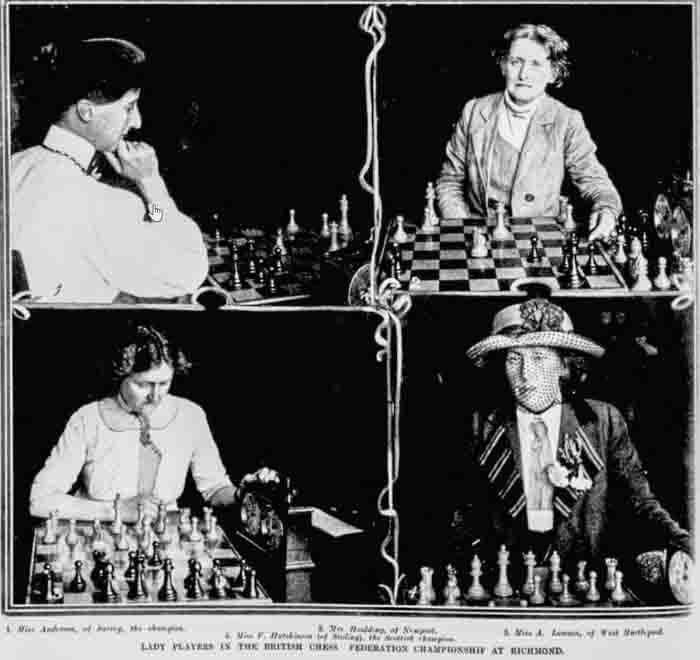
You can see her lower left in this photograph contributed to BritBase by Gerard Killoran. Top left is Gertrude Anderson, top right, Mary Houlding and lower right, Florence Hutchison-Stirling.
With her father having died and her mother having remarried, the family’s financial situation must have improved, and Agnes was now able to marry the love of her life. And so Rufus Henry Streatfeild Stevenson travelled up from Kent to Hartlepool, and, having spent Christmas with his new family, escorted Agnes up the aisle on Boxing Day.
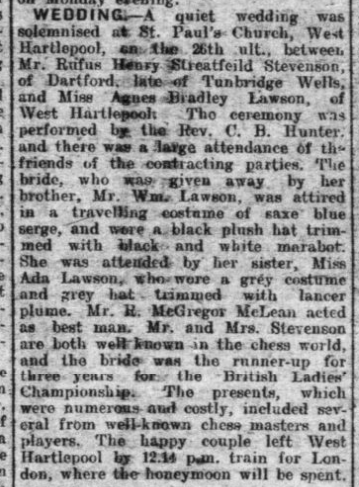
They didn’t have far to go: St Paul’s Church was just round the corner from the Lawson house, next to St Joseph’s Catholic Church. The two splendid late Victorian redbrick buildings standing side by side still make a striking impression today. Mr Robert McGregor McLean, a saw mill foreman born in Darlington, would marry Agnes’s sister Ada in 1915.
We’ll leave Mr and Mrs Stevenson there for now, on the steps of the altar of St Paul’s Church, West Hartlepool on 26 December 1912. Next time you’ll find out the story of the rest of Agnes’s life, following which there will be a lot more to say about Rufus Henry Streatfeild Stevenson.
Sources and Acknowledgents
ancestry.co.uk
findmypast.co.uk/British Newspaper Library
Britbase (John Saunders)
EdoChess (Rod Edwards: Agnes Lawson here)
chessgames.com (Agnes Lawson here)
Wikipedia


Leave a comment