I posted last year about a 1930 chess match on a liner, featuring a team from the Imperial Chess Club, promising to return at some point in the future.
It’s about time I wrote more about the club and its indomitable founder Mrs Arthur Rawson.
She was born Ellen Frances Bremner in Govan, now part of Glasgow, on 31 October 1856, the daughter of a banker, but always known as Ella, perhaps to distinguish her from her mother, also Ellen.
In the mid 1860s the family emigrated to New Zealand, with her father perhaps dying on the voyage (his death recorded in 1866 in ‘Red Sea Sudan’) and her mother remarrying and ending up, for some reason, in Mexico.
It seems, then, we had a group of siblings on their own on the other side of the world: perhaps they had relatives there.
We next pick Ella up in 1881, when she married Arthur John Rawson, the son of an English doctor, who had been born in 1850.
Here’s his father’s obituary (Taranaki Herald 16 December 1869):
On Sunday at about three o’clock in the afternoon, Dr. T. E. Rawson, who has for some time been an invalid, breathed his last. Dr. Rawson had nearly reached the age which is said to be the allotted span of human existence, being in his seventieth year. He was born at Windsolt, in Leicestershire, and, after studying for the medical profession, started in practice in London. He afterwards removed to Kegworth, in Leicestershire, where he had a very large practice. In 1858 he emigrated with his family to Taranaki, and the war breaking out shortly after his arrival, he was appointed Surgeon-Major to the Militia and Volunteers of the District. In 1861, he resigned that position, and went to Auckland, where he commenced to practice his profession. He, however, returned again to Taranaki in 1863, when he was appointed Hospital Surgeon, which, with other offices, he held until a short time ago, when failing health compelled him to resign them. Dr. Rawson was highly respected, and enjoyed a large share of the confidence of his medical brethren.
Dr Rawson’s sons all held prominent positions in New Zealand, several following their father into the medical profession. Arthur, though, became a surveyor.
Arthur and Ella had no children, and on his relatively premature death, Ella was left a widow, in the convention of the day styling herself Mrs Arthur Rawson.
The Wairarapa Times published an obituary on 15 October 1894.
We regret to have to record the death of Mr Arthur J Rawson, which occurred this morning at Wellington after a somewhat prolonged illness. Mr Rawson was originally on the Government Survey staff, retiring in 1879 to take up a private
practice on the West Coast. About nine years ago he came to Masterton and resided here until within a few weeks of his death. The deceased was a brother-in-law to Mr C E Bremner, engineer to the Wairarapa North County Council, and has several brothers holding prominent positions in various professions, amongst them being Dr Rawson and Mr Herbert Rawson of Wellington, and Mr T Rawson, Engineer to the Westport Harbour Board. The deceased, who was the fourth son of Dr Rawson of New Plymouth, leaves a widow but no family.
These obituaries and other information about the Rawson family were taken from a paper written by Mary Skipworth, who, since you asked, is indeed related to the Reverend Arthur Bolland Skipworth.
On September 19 1893 New Zealand became the first country in the world to grant all women the right to vote, Ella Rawson having signed a petition in its support, and we can pick her up in Wellington on the electoral rolls up to 1908, when she decided to return to Britain, settling in London.
She had been keeping in touch with life on the other side of the world, in 1899 donating two guineas to a fund for the Gordon Memorial College in Khartoum.
I’m not sure how she learnt chess: perhaps her husband taught her. Given his family background you’d assume he at least knew the moves. It wasn’t long after her arrival in London that she joined the Ladies’ Club.
Here she is, in January 1910, playing in a London League match against Battersea.
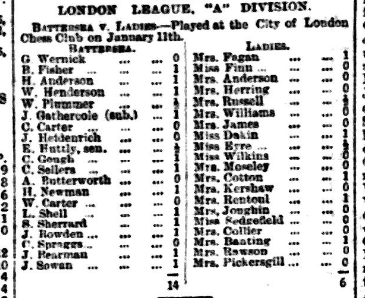
I presume Mr C Carter won his Board 7 game against Mrs James (no relation) in order to make the scores tally. The Battersea top board, George Wernick, is remembered today through the Wernick Cup, the fourth division of the Surrey Individual Championships.
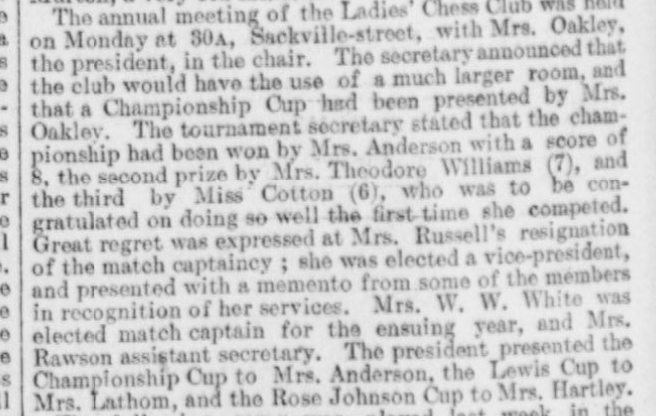
At that year’s AGM Ella Rawson was appointed assistant secretary of the Ladies Club. You’ll also spot that Mrs Russell resigned as match captain.
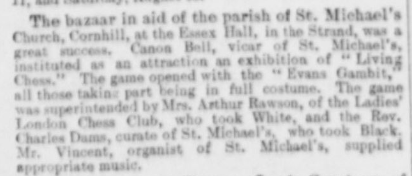
She also staged a game of Living Chess to raise money for the City of London parish of St Michael’s Cornhill.
The 1911 census, taken on 2 April, recorded Ella Frances Rawson as a 53-year-old widow of private means, living on her own as a boarder at 10 Scarsdale Terrace, Kensington.
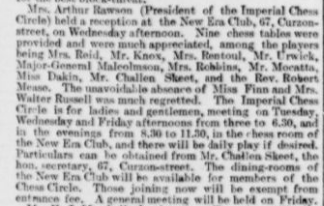
The following month, she was billed as the President of the Imperial Chess Circle, whose secretary, Challen Skeet, had also moved from New Zealand to London. Robert Challen Skeet (1858-1926) had been born in Rugby: his family emigrated when he was very young, living in Otago, but had, like Mrs Rawson, recently moved back to London. I have no idea whether they knew each other before the Imperial Chess Circle. His son, the extraordinarily named Challen Hasler Lufkin Skeet, played first class cricket for Oxford University and Middlesex before becoming a colonial administrator in Sudan.
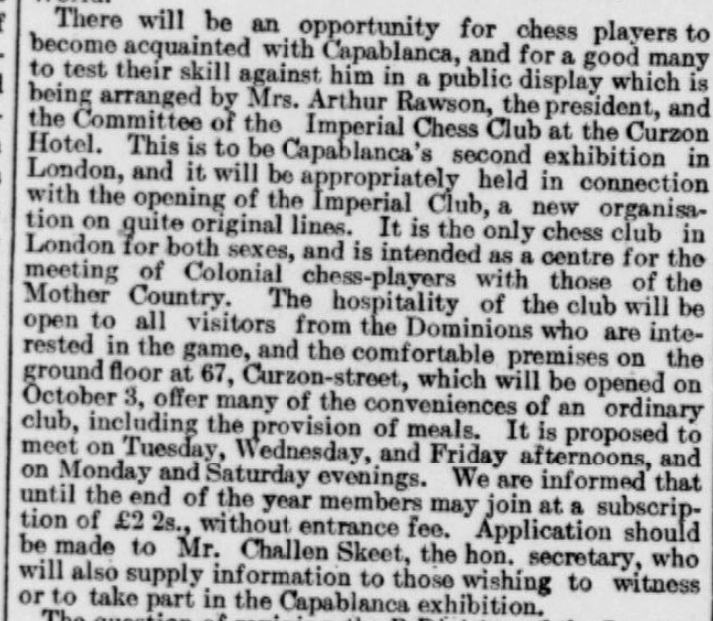
In September the Imperial Chess Circle morphed into the Imperial Chess Club, the only chess club in London for both sexes. It opened with a bang: an announcement of a simultaneous display by Capablanca.
The following month there was more news.
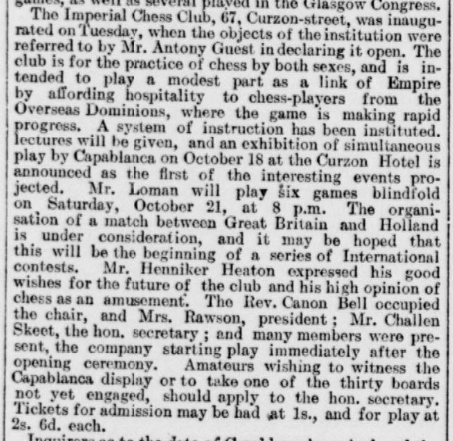
John Henniker Heaton‘s granddaughter Mary later became a strong player.
Capa’s visit to Europe was postponed, so the display didn’t take place until November. Sources differ as to whether there were 25 games and one draw or, as here, 26 games and two draws.
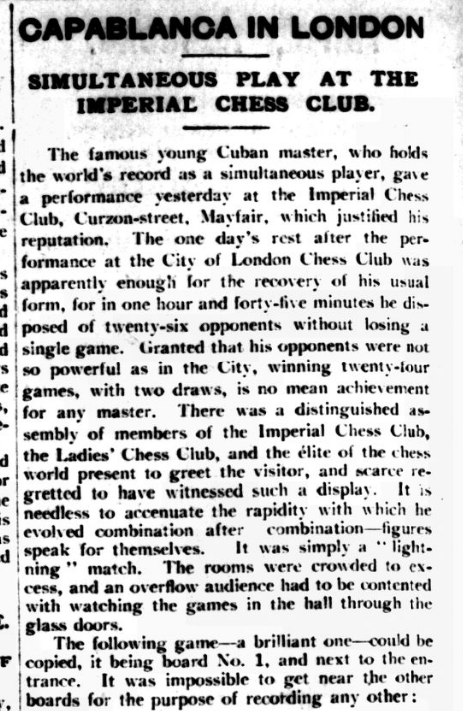
Here’s the game, in which White opened, appropriately enough, with what is now, but wasn’t then, called the London System.
[Event “Simultaneous Display: Imperial Chess Club”]
[Date “1911.11.17”]
[White “Capablanca, Jose Raul”]
[Black “Loman, Rudolf Johannes”]
[Result “1-0”]
[ECO “D02”]
1. d4 d5 2. Nf3 c5 3. c3 e6 4. Bf4 Qb6 5. Qc2 Nc6 6. e3 Nf6 7. Nbd2 Be7 8. Bd3 Bd7 9. O-O Nh5 10. Bg3 Nxg3 11. hxg3 Rc8 12. dxc5 Qxc5 13. Rac1 e5 14. e4 Qd6 15. exd5 Nb4 16. Qb1 Nxd3 17. Qxd3 Qc7 18. Rfe1 Bd6 19. Nxe5 Bxe5 20. d6 Qc5 21. b4 Qc6 22. Rxe5+ Kd8 23. c4 Re8 24. Rxe8+ Kxe8 25. Re1+ Be6 26. c5 a5 27. b5 Qd7 28. Qxh7 f6 29. Qg8#
MegaBase 2026 provides this game, against another Dutch opponent.
[Event “Simultaneous Display: Imperial Chess Club”]
[Date “1911.11.17”]
[White “Capablanca, Jose Raul”]
[Black “Davidson, Jacques”]
[Result “1/2-1/2”]
[ECO “D26”]
1. e4 c6 2. c4 d5 3. exd5 cxd5 4. cxd5 Qxd5 5. Nc3 Qd8 6. Bc4 Nf6 7. Nf3 e6 8. O-O Be7 9. d4 O-O 10. Ne5 Bd7 11. d5 exd5 12. Nxd5 Be6 13. Nxe7+ Qxe7 14. Bg5 Bxc4 15. Nxc4 Nbd7 16. Nd6 Qe5 17. Bxf6 Nxf6 18. Nxb7 Qxb2 19. Qb3 Qxb3 20. axb3 Rfb8 21. Nc5 Rb5 22. Rfc1 g6 23. Rc4 a5 24. h4 h5 25. b4 Rc8 26. Rxa5 Rxa5 27. bxa5 Nd7 28. a6 Nxc5 29. a7 1/2-1/2
This game, against a visitor from Newcastle, was published in the Hereford Times (18-05-1912).
[Event “Simultaneous Display: Imperial Chess Club”]
[Date “1911.11.17”]
[White “Capablanca, Jose Raul”]
[Black “Downey, Frederick Thomas”]
[Result “1-0”]
[ECO “C21”]
1. e4 e5 2. d4 exd4 3. c3 dxc3 4. Bc4 cxb2 5. Bxb2 d6 6. Qb3 Nh6 7. Nf3 Nc6 8. O-O Bd7 9. Qc2 Qe7 10. Nc3 O-O-O 11. Nd5 Qe8 12. Rfc1 f6 13. Nd4 Ng4 14. Nb5 Qh5 15. h3 Nge5 16. Bxe5 dxe5 17. Nxa7+ Kb8 18. Nxc6+ Bxc6 19. Rab1 Qe8 20. Bb5 Bd6 21. Bxc6 1-0
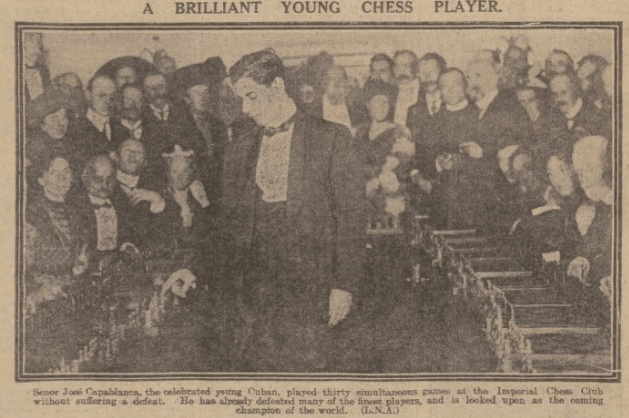
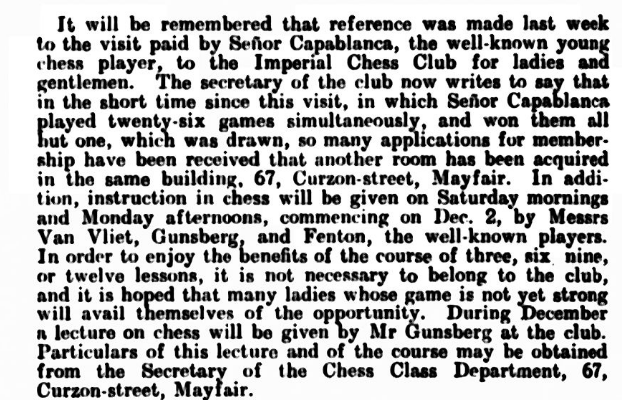
The publicity surrounding this event led to a surge in interest in joining the club, which decided to provide lessons for ‘ladies whose game is not yet strong’.
Mrs Rawson was still involved with the Ladies’ Chess Club, winning the second division of their winter tournament.
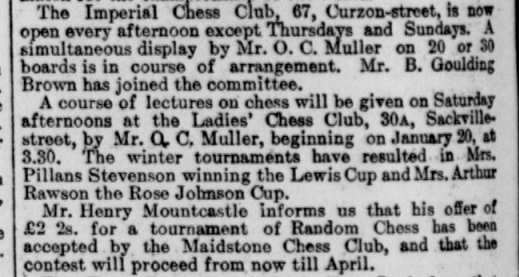
Mrs Pillans Stevenson was a Canadian, and no relation to RHS Stevenson, about whom much more later.
Bertram Goulding Brown (1881-1985), later better known as a chess historian, provided some young blood on the Imperial Chess Club committee.
I’d like to find out more about Henry Mountcastle (Knight-Rook?) and his Random Chess. Was this something like FischerRandom, Chess960, Freestyle or whatever you prefer to call it? Perhaps something for another time.
In April 1912 the Imperial Chess Club organised and hosted a match between teams representing Great Britain and Holland.
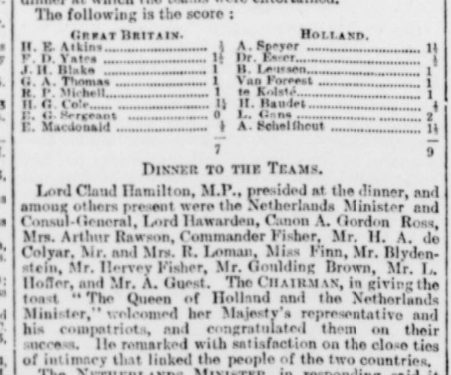
John Saunders has provided an excellent report on this match on BritBase here, where you can also play through all the games.
I’ll offer you two English victories.
[Event “Match/Nation ENG-NED 7,0-9,0”]
[Date “1912.04.12”]
[White “Yates, Fred Dewhirst”]
[Black “Esser, Johannes”]
[Result “1-0”]
[ECO “C14”]
1. e4 e6 2. d4 d5 3. Nc3 Nf6 4. Bg5 Be7 5. e5 Nfd7 6. Bxe7 Qxe7 7. Nb5 Nb6 8. c3 O-O 9. f4 Bd7 10. Nf3 a6 11. Na3 Na4 12. Qd2 b5 13. Bd3 c5 14. O-O b4 15. cxb4 cxb4 16. Nc2 Nc6 17. Ne3 f5 18. exf6 Qxf6 19. Ne5 Nxe5 20. fxe5 Qh6 21. Rxf8+ Rxf8 22. Bxa6 Ra8 23. Rf1 Rxa6 24. Qf2 g5 25. Qf7+ Kh8 26. Qxd7 Ra8 27. Qc6 Rg8 28. Qxa4 g4 29. Qb3 g3 30. hxg3 Rxg3 31. Nf5 Rxb3 32. Nxh6 Rxb2 33. Rf2 Rb1+ 34. Kh2 Rd1 35. Nf7+ 1-0
[Event “Match/Nation ENG-NED 7,0-9,0”]
[Date “1912.04.12”]
[Round “1.5”]
[White “Michell, Reginald Pryce”]
[Black “Te Kolste, Jan Willem”]
[Result “1-0”]
[ECO “E91”]
1. d4 Nf6 2. c4 g6 3. Nc3 Bg7 4. e4 d6 5. Nf3 O-O 6. Be2 Nbd7 7. h3 e5 8. Be3 exd4 9. Nxd4 Re8 10. f3 Nh5 11. O-O f5 12. Qd2 f4 13. Bf2 Ne5 14. Nd5 Rf8 15. Rfd1 a6 16. Rac1 g5 17. c5 dxc5 18. Rxc5 c6 19. Nb4 Qe7 20. Rcc1 Rd8 21. Ndxc6 Rxd2 22. Nxe7+ Kf7 23. Rxd2 Kxe7 24. Rc7+ Ke6 25. Rd8 1-0
It’s worth a look at some of those present at the dinner.
Lord Claud Hamilton was an aristocrat, politician and railway director, who is buried in Richmond Cemetery.
Lord Hawarden seems to have been Robert Cornwallis Maude, 6th Viscount Hawarden (6 September 1890 – 26 August 1914), a British Army officer and peer who was killed in action during the early days of the First World War.
Canon Alexander George Gordon Ross would later become President of the British Chess Federation.
Commander William Wordsworth Fisher was a naval officer from a distinguished family, a first cousin of Virginia Woolf. His brother Hervey is mentioned below, and his sister Adeline was married to the composer (and one of my heroes) Ralph Vaughan Williams.
Henry Anselm de Colyar (1826-1945) was a barrister and legal author.
Rudolf Loman and Kate Belinda Finn were very well known in the chess world, and will need no introduction to regular readers.
Mr Blydenstein was presumably the same gentleman who played our last Minor Piece subject, George Lumley, more than half a century earlier. and Henry Gifford back in the 1870s. Born back in 1839, he died in 1914.
Hervey George Stanhope Fisher (1875-1921) would, for a short time, play an important administrative role in the Imperial Chess Club. Unlike his illustrious siblings he never seemed to have a job, probably for health reasons. He wrote a few short stories which failed to find favour with the critics.
Bertram Goulding Brown was mentioned earlier, while Hoffer and Guest will also be familiar names.
Here, thanks again to John Saunders and Britbase, are the players and organisers.
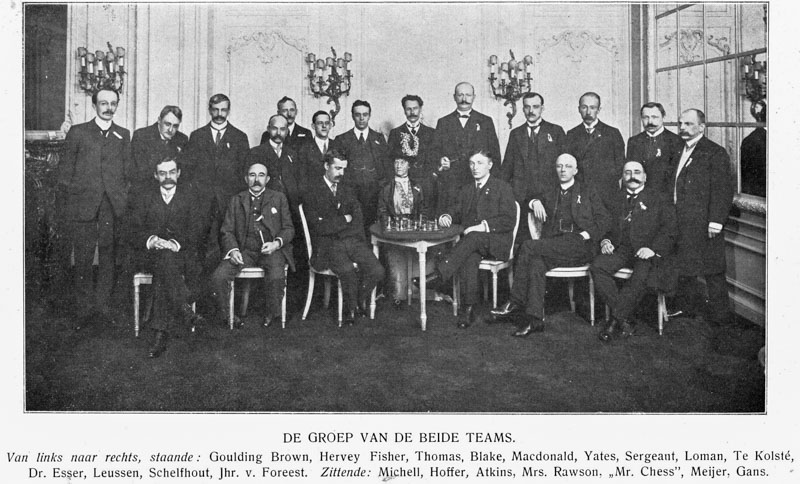
“Mr Chess” is presumed to be Abraham Speijer. Mrs Rawson is easy to recognise, but it’s interesting to see Bertram Goulding Brown and Hervey Fisher, neither very often photographed, standing on the left.
The AGM in June reported on an eventful first season.
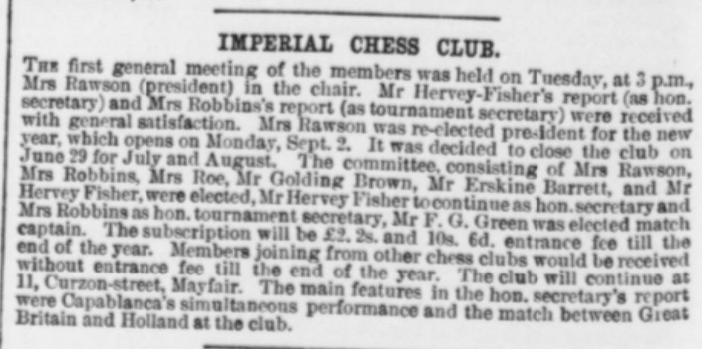
Mr Erskine Barrett appears to have been Albert Erskine Barrett (1861-1933), a bachelor (until 1919) of private means, the son of a wealthy property developer.
The first major event of the second season of the Imperial Chess Club was a simultaneous display by American star Frank Marshall, who won 15 games out of 17, drawing with Mrs Banting and Mr Goulding Brown.
This game was published in OC Müller’s column on page 8 of The Globe, 12 October 1912 (submitted to Edward Winter’s Chess Notes by Gerard Killoran). The winner, since you asked, was a great niece of James Innes Minchin, one of the promoters of the London 1883 tournament.
[Event “Imperial Chess Club”]
[Date “1912.10.12”]
[White “Goulding Brown, Bertram”]
[Black “Cotton, Charlotte Helena Minchin”]
[Result “0-1”]
[ECO “C30”]
1. e4 e5 2. f4 d6 3. Nf3 Nc6 4. Bc4 Be7 5. O-O Bg4 6. c3 Bxf3 7. Rxf3 exf4 8. d4 Nf6 9. Rxf4 d5 10. Bd3 dxe4 11. Bxe4 Nxe4 12. Rxe4 Qd7 13. Bf4 O-O-O 14. a4 g5 15. Bg3 f5 16. Re1 f4 17. Bf2 g4 18. Nd2 h5 19. Ne4 h4 20. g3 hxg3 21. hxg3 Qf5 22. Kf1 f3 23. Qc2 Rh1+ 24. Bg1 Qh5 25. Nf2 Qh2 0-1
In February 1913 there was what appeared to be an important announcement, advertising what might well have been the first junior chess club in the UK outside schools. In the fashion of the time (and of our time) they were promoting the game as a ‘valuable educational instrument’.
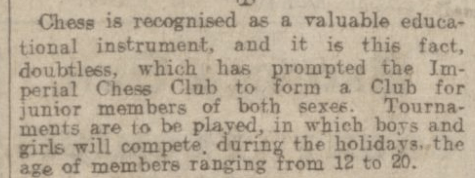
As far as I can tell, this didn’t actually get very far (there was one brief mention a short time later), and it would be many years before they returned to promoting chess for young people.
That March they moved into splendid new premises.
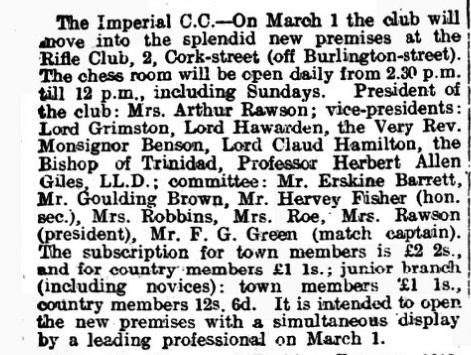
The Vice Presidents included Lord Grimston, who, as well as being the Earl of Verulam, was an electrical engineer; Monsignor (Robert Hugh) Benson, a Roman Catholic convert from a famous ecclesiastical family, a friend of Frederick Rolfe (featured here) and Lord Alfred Douglas; John Francis Welsh, the Bishop of Trinidad, was well known in English chess circles; Herbert Allen Giles was a diplomat and sinologist.
The ‘leading professional’ turned out to be Edward Lasker, who took on 20 opponents, winning 16, drawing 2 and losing 2.
They were only there a few weeks before the Rifle Club unexpectedly closed down, forcing them to move to new premises in Albemarle Street, where Loman gave a blindfold simul.
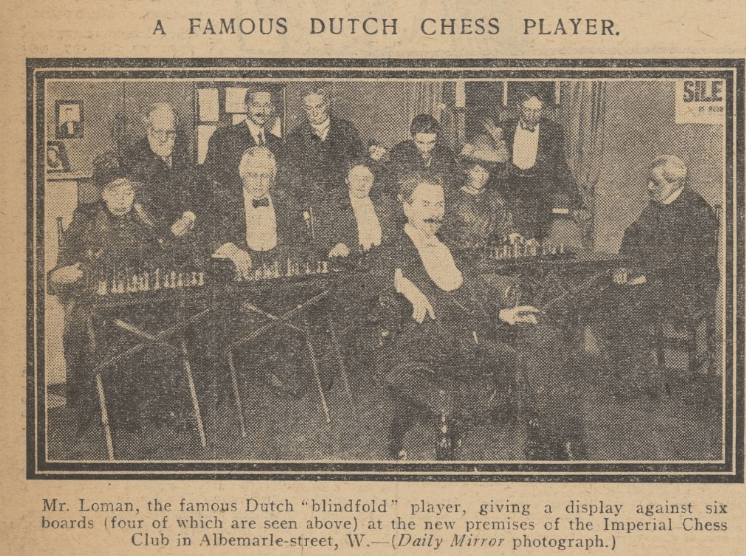
Antony Guest published a report on the 1913 AGM.
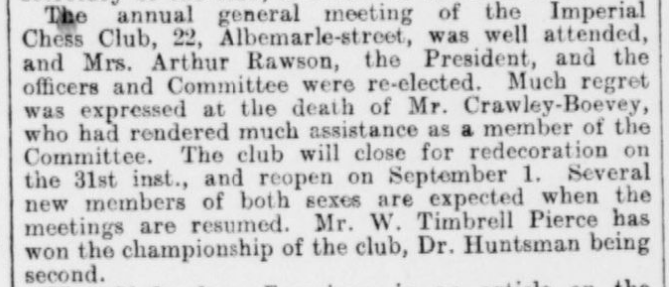
The death of their committee member Mr Crawley-Boevey was regretted, but there had been no previous mention of him. William Timbrell Pierce was better known as a problemist but had been a strong player back in the 1880s, giving his name to a line of the King’s Gambit: do follow the link to an excellent Tim Harding article. Dr Alfred Huntsman was the President of Islington Chess Club – his father (here) had been a well known player.
The 1914 AGM reported that Hervey Fisher was, through ill health, unable to continue with his secretarial duties.
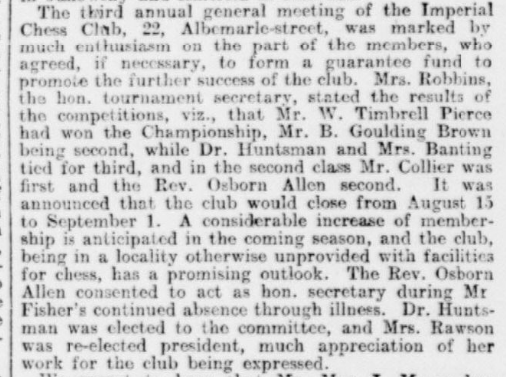
The acting Hon Sec was Rev William Osborn Bird Allen (1849-1930).
By now war had broken out, and many chess clubs paused their activity. Not so the Imperial Chess Club. Mrs Rawson wrote to the Morning Post (26 October 1914) informing their readership that the club was appreciated as an oasis of peace, with no German or Austrian members. J Walter Russell no doubt approved.
They were still attracting new members, though.
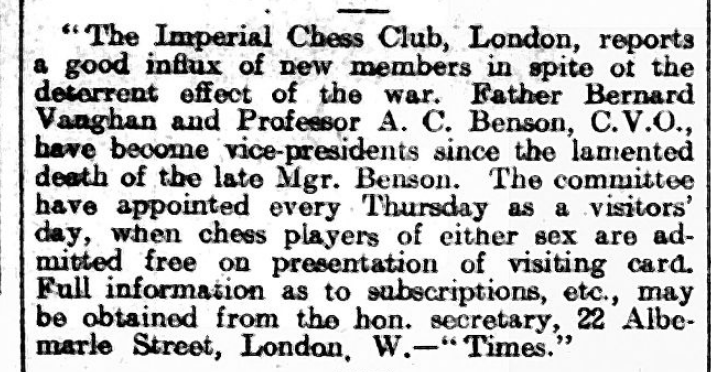
Father Vaughan is here, and Professor Benson, the man who wrote the words to Land of Hope and Glory, here.
That year’s AGM, with Hervey Fisher still out of action, witnessed the appointment of a new match captain and tournament secretary.
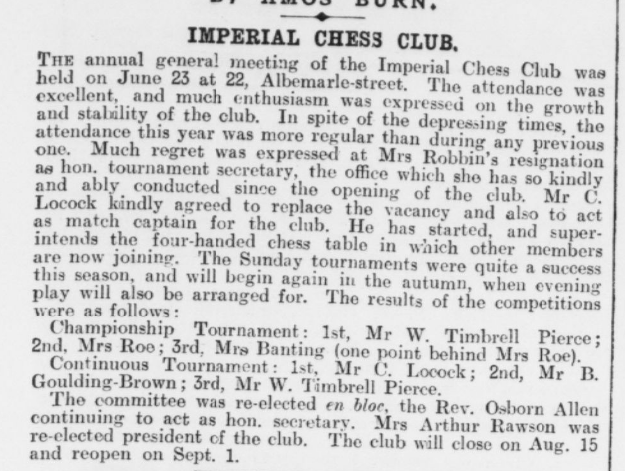
Yes, it was our old friend Charles Dealtry Locock, the subject of three previous Minor Pieces, the most relevant for this article is here.
It was very much business as usual in 1916, but health problems meant that Mrs Rawson had to cut down on her activity.
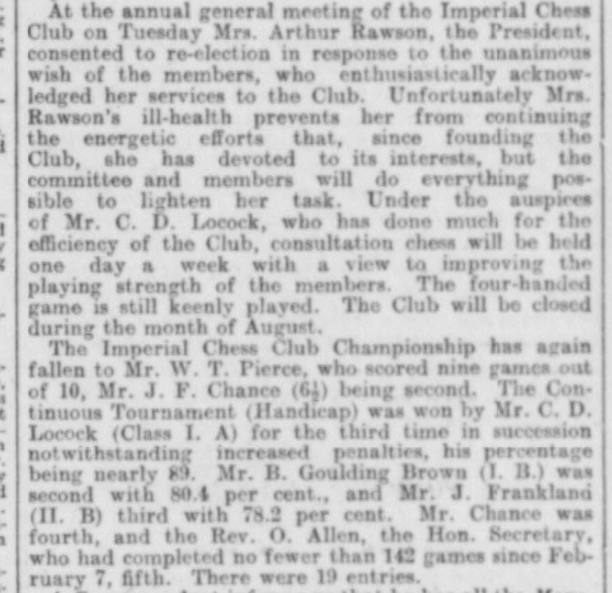
1917 saw the appearance of Major Sir Richard Whieldon Barnett (1863-1930), who took second board in the 1930 match on a liner, and would remain one of the Imperial’s leading players for the rest of his life.
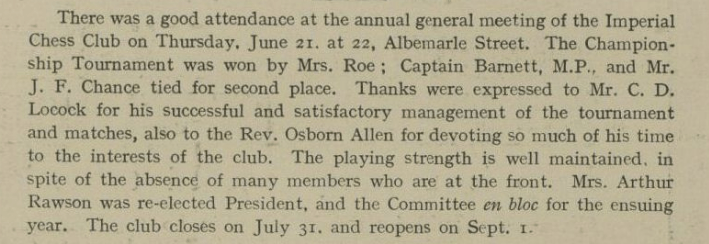
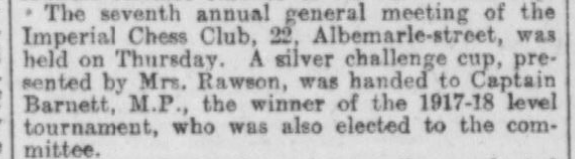
The following year, with the war drawing to an end, he was elected to the committee.
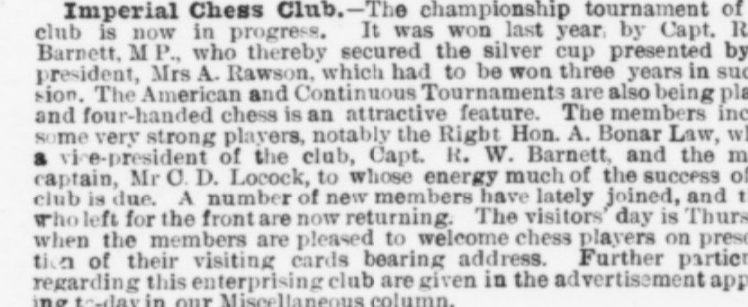
By 1919 there was an illustrious new member: future Prime Minister Andrew Bonar Law.
Later in the year, a visit from Capablanca fell through due to Mrs Rawson again being ill, but there was a successful match to report.
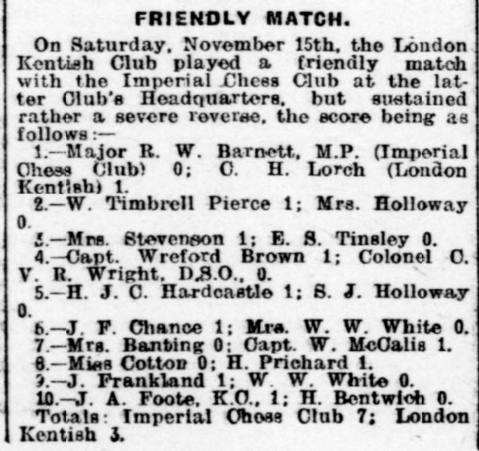
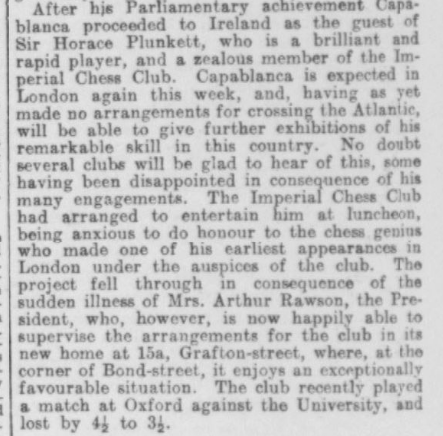
Next month there was news of a new venue and another chess-playing politician: Horace Plunkett.
The Imperial fielded a weaker team for the return match against London Kentish, who managed to reverse their previous defeat.
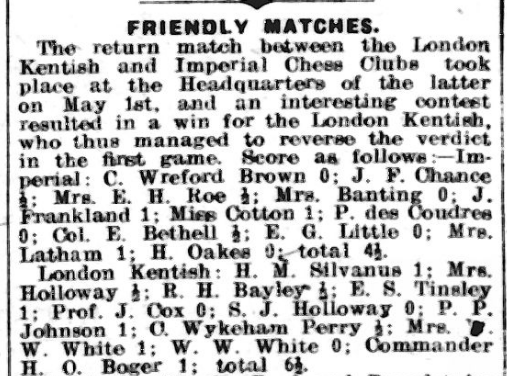
I shall reveal my personal connection with the Kentish top board, Harold Miles Silvanus, another time.
The 1920 AGM uncovered a minor scandal.
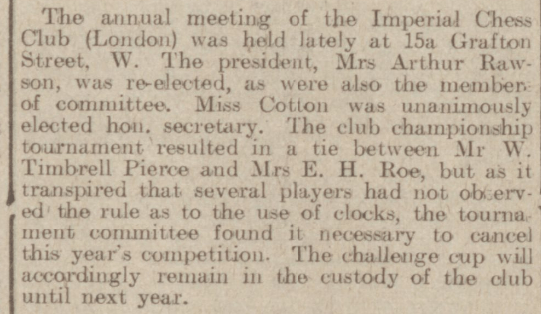
The club championship was annulled because some games had been played without clocks. One would imagine this was, in two ways, highly controversial, with strong feelings on both sides. Had clocks always been used in previous years?
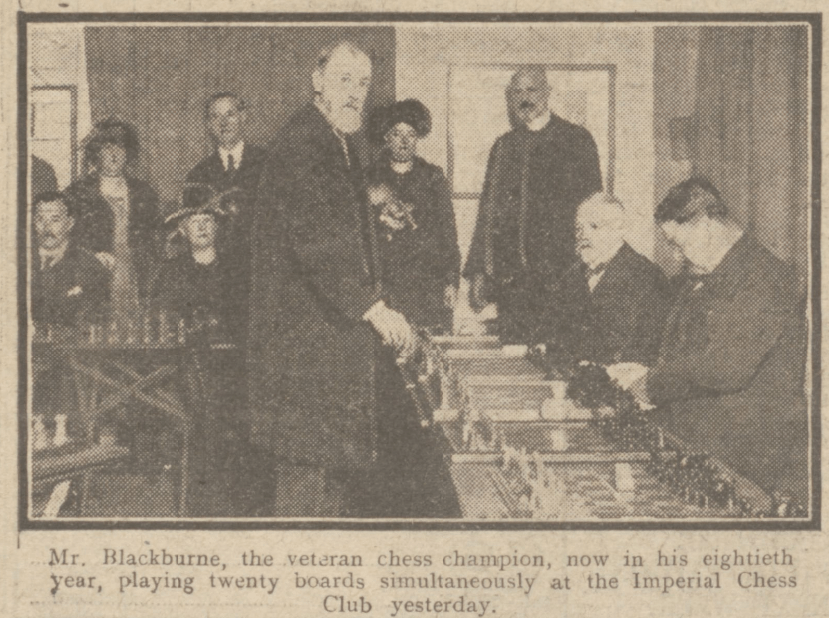
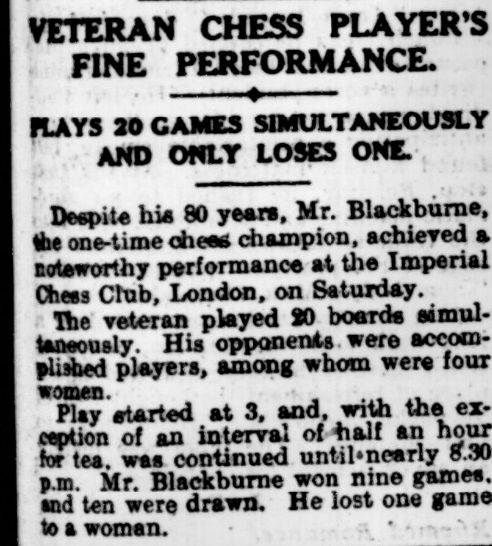
Skipping forward to 1921, Blackburne celebrated his 80th birthday a few days earlier by giving a 20-board simul at the Imperial.
We now move on to 1922, when the BCF decided to hold its annual congress in London, replacing the championship itself with a major international tournament.
This featured a star-studded line-up. Using Rod Edwards’ retrospective ratings on EdoChess, five of the top six in the world were there: Capablanca, Alekhine, Vidmar, Rubinstein and Bogoljobov, with Lasker notable by his absence. Tartakower, Reti and Maroczy, all in the top 15, made up a formidable top half. Representatives of the Netherlands and Italy were also invited, the up-and-coming Euwe and Marotti, who, like his compatriot Vergani at Hastings 27 years earlier, was sadly out of his depth. There were three British participants, all from the north of England: Yates and Atkins (via Leicestershire) from Yorkshire, and the now almost forgotten Wahltuch from Lancashire. Three representatives of the British Empire were also invited: Morrison from Canada, Watson from Australia and Khadilkar from India, who was unable to make the journey and replaced by Znosko-Borowsky.
Mrs Rawson and the Imperial Chess Club were very much involved.
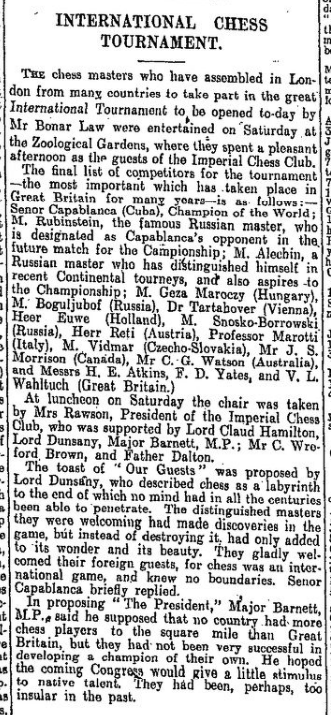
You’ll notice that two further chess-playing celebrities were now involved with the club, writer Lord Dunsany and footballer Charles Wreford Brown.
Here, taken from BritBase, is the final cross-table.
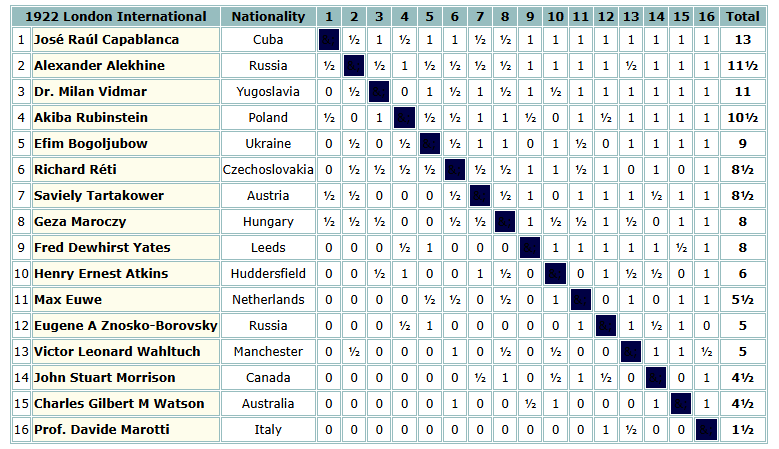
An outstanding result from Yates, who was much more consistent than usual against the players in the lower half of the tournament.
You’ll find much more, including results of the many other sections, on BritBase here.
Edward Winter has also written an outstanding feature on this event, including a lot of wonderful cartoons, which I’d urge to you read here.
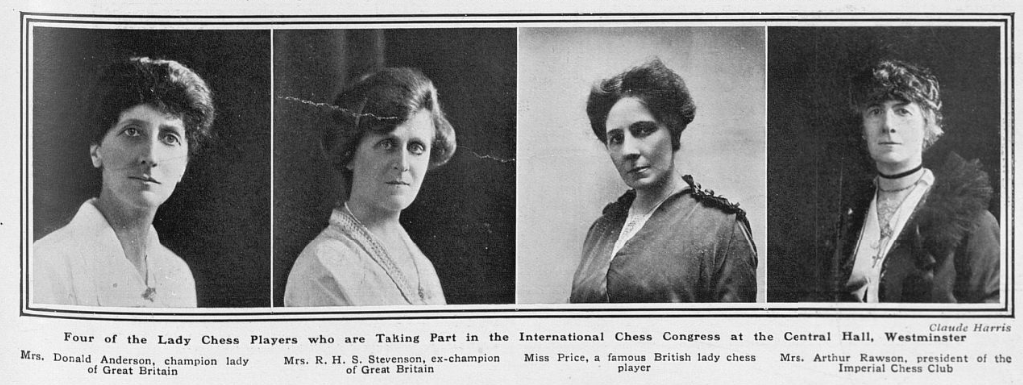
Here we see Mrs Arthur Rawson herself: unlike the other three ladies pictured she wasn’t playing herself, but would have been very much involved with the social and administrative side of the event.
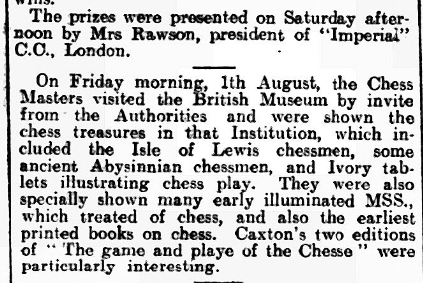
Although there must have been many celebrities on hand, it was Mrs Arthur Rawson herself who presented the prizes.
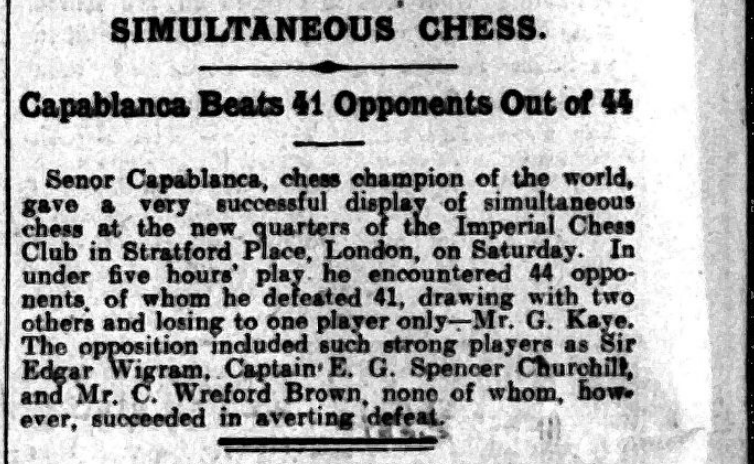
Capablanca returned to the Imperial Chess Club in October, taking on no less than 44 opponents.
By 1924 it was clear that Mrs Agnes Stevenson was playing a major part in the club.
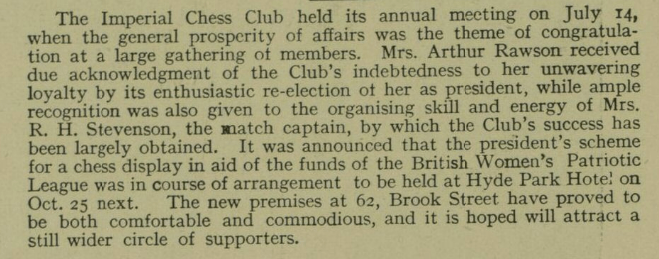
The British Women’s Patriotic League was a politically conservative women’s organization founded in 1908 with the motto “Our Country First”. However, the chess display wasn’t given by a British master.
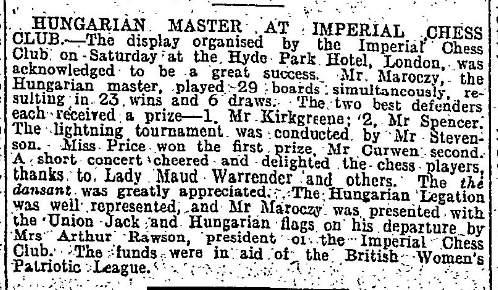
Lady Maud Warrender was a poet, singer and friend of Elgar.
The 1925 AGM saw some new names on the Vice-Presidents list.
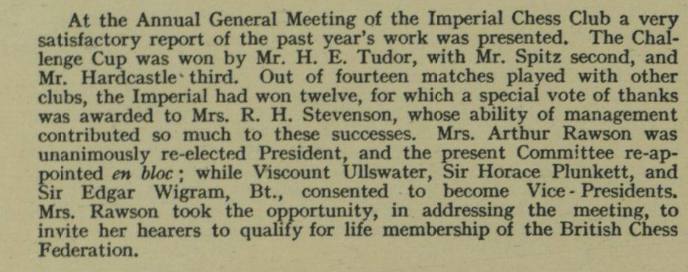
Viscount Ullswater was a Conservative politician and former Speaker of the House of Commons. Sir Edgar Wigram was an architect and painter, Mayor of St Albans 1926-27. He was also a pretty strong player, sometimes taking top board for Hertfordshire.
In September, Mrs Arthur Rawson, now in her late 60s, wrote to the Daily Mirror.
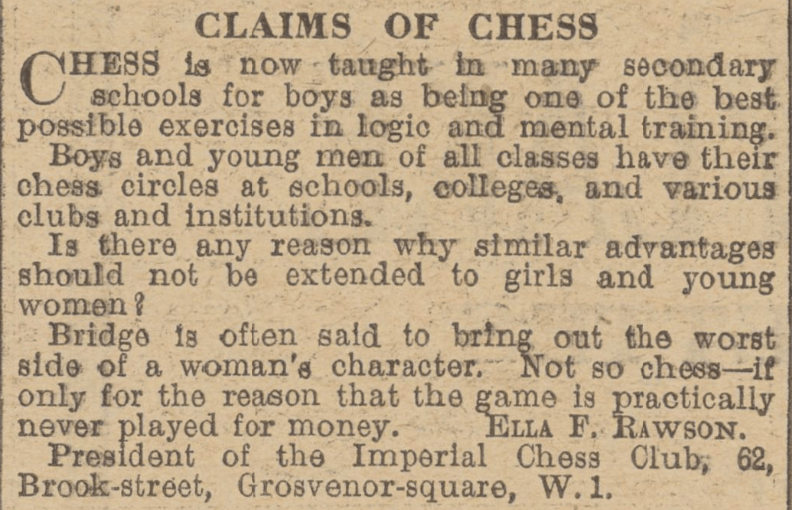
It may or may not be significant that she signed herself Ella F rather than Mrs Arthur. She soon obtained sponsorship from Lady Hamilton Russell, who generously presented a challenge cup. Presenting cups ran in the family: her husband, Frederick Gustavus Hamilton-Russell gives his name to two trophies, one awarded every year to the winner of a competition for social, political, military and sports clubs in Great Britain. and the other every two years to the winning team in the Chess Olympiad.
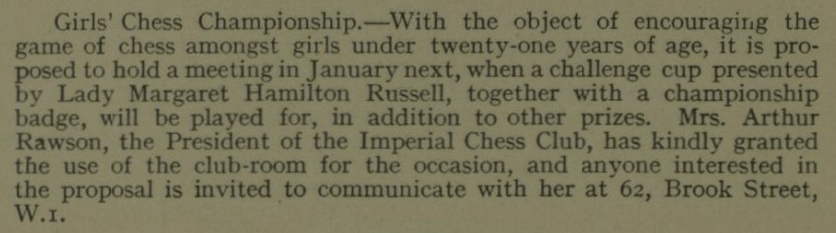
Boys now had their own championships, so why shouldn’t girls have championships as well? A very reasonable question.
Clubs catering for a specific membership tend to be very much of their time, lasting perhaps a generation or two. This was very much the case with the London Ladies’ Club, which had, by the early 1910s, served its purpose. It was now established that there was no reason why women couldn’t play chess. The Imperial Chess Club, under the presidency of Ella Rawson, took over its role as somewhere ladies could play chess, but extending it to include gentlemen from the higher echelons of society. They would have grown up, for the most part, in the 1860s and 1870s, when learning chess was part of every young gentleman’s education. A club where ladies and gentlemen could play social chess together would have been a welcome and popular addition to the London scene.
In the mid 1920s, Mrs Rawson took the club, now with an ageing membership, in a very different direction. A supporter of votes for women back in New Zealand, she turned her still considerable energies to chess for girls.
You’ll find out next time how successful she was.
Acknowledgements and Sources
ancestry.co.uk
findmypast.co.uk/British Newspaper Library
Wikipedia
BritBase (John Saunders)
chessgames.com
ChessBase/Mega Database 2025
EdoChess (Rod Edwards)
Chess Notes (Edward Winter)
Yorkshire Chess History (Sreve Mann)
Mary Skipworth Genealogy Site
Other sources linked to above.


Leave a Reply