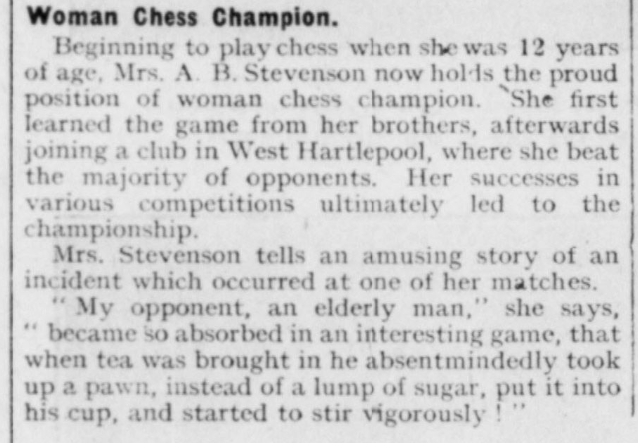
I left you last time on Boxing Day 1912 in Hartlepool, at the wedding of Agnes Bradley Lawson and Rufus Henry Streatfeild Stevenson, being informed that they were spending their honeymoon in London.
It was more than a honeymoon: they spent the rest of their lives there.
Now free from family responsibilities and financial concerns in Hartlepool, she was able to retire from teaching and devote the rest of her life to her real passion: the game of chess.
As well as playing regularly she was also very much involved with helping her new husband with his chess administration.
Here they are, both playing for Dartford in an inter-club match.
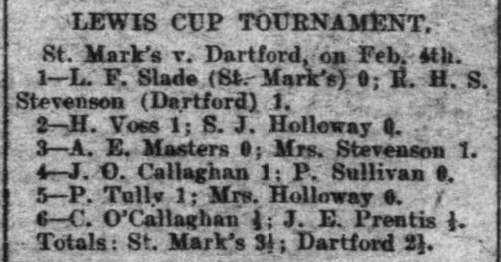
Although they both won their games, their team lost. You’ll notice they weren’t the only married couple in the Dartford side, although Samuel and Edith Holloway were unsuccessful on this occasion.
Chess was exceptionally popular among the ladies of Kent and Sussex at the time, partly because of the fashion for ladies learning chess in the late 19th century, and partly because of the organisational work carried out by Rufus Stevenson and his colleagues.
Just look at the list of entrants for the Whitsun Congress in Hastings.
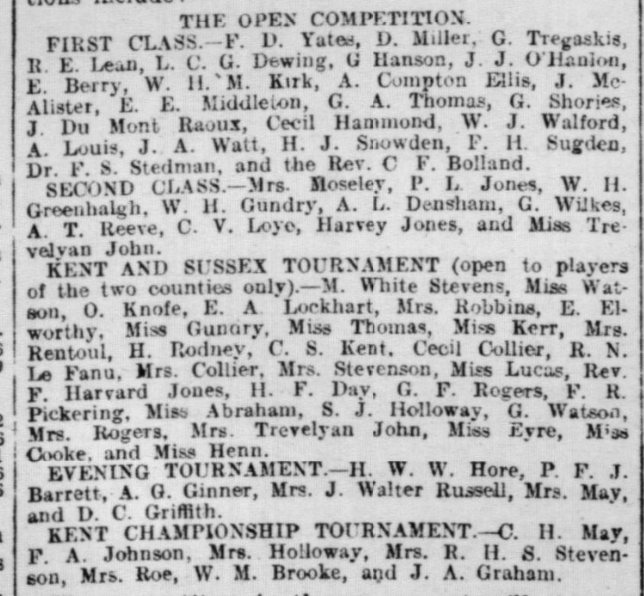
There were even three women amongst the seven Kent County Championship contestants. Agnes finished on 2½ points, one behind Mrs Roe, but one ahead of Mrs Holloway.
As she was playing so often, I’ll abandon my usual narrative style at this point and just provide a list of her tournament performances.
- August 1913: British Ladies’ Championship Cheltenham. Agnes finished in a tie for 1st place.
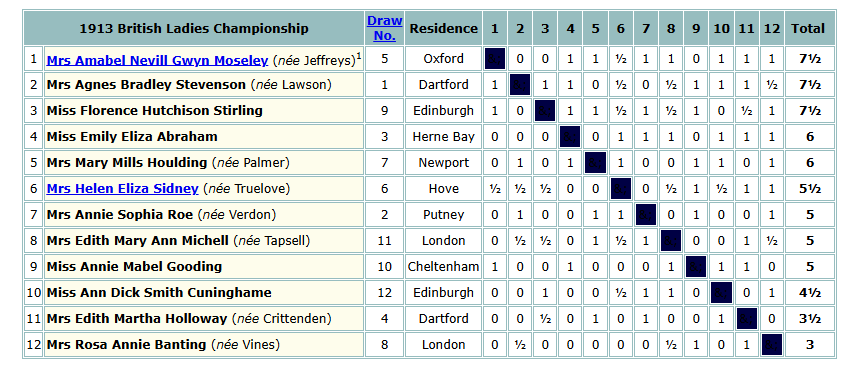
The play-off for the title took place at the Gambit Café. the HQ of the Lud-Eagle Chess Club, in October, Miss Hutchison Stirling withdrawing due to ill-health after one game.

Here are the play-off games.
Against her Scottish opponent Mrs Stevenson won a vital centre pawn in the opening (novices should be aware of this sequence) and never looked back.
[Event “BCF-chW 10th play-off”]
[Date “1913.10.27”]
[White “Stevenson, Agnes Bradley”]
[Black “Hutchison Stirling, Florence”]
[Result “1-0”]
[ECO “C77”]
1. e4 e5 2. Nf3 Nc6 3. Bb5 a6 4. Ba4 Nf6 5. d3 Be7 6. Bxc6 dxc6 7. Nxe5 O-O 8. Be3 Nd7 9. Nxd7 Bxd7 10. f4 c5 11. Nd2 Qc8 12. O-O b6 13. Nf3 Bf6 14. Rb1 Bc6 15. Qe1 Re8 16. b3 Qd7 17. Qg3 Bd4 18. Bxd4 cxd4 19. h4 f6 20. Nh2 Kh8 21. f5 Qf7 22. Nf3 Rad8 23. Qf2 Qd7 24. h5 Bb7 25. Nh4 c5 26. Qd2 Qc7 27. Rf3 Qf7 28. Rh3 h6 29. Ng6+ Kh7 30. Rf1 Bc6 31. Rf4 b5 32. Rg4 c4 33. Rhg3 Ba8 34. Nf4 Rg8 35. Ne6 Rd7 36. Rg6 Re7 37. Nxd4 Bxe4 38. dxe4 Rxe4 39. Ne6 Qa7+ 40. Kf1 Rxe6 41. fxe6 Qe7 42. Qd7 Qxd7 43. exd7 cxb3 44. cxb3 Kh8 45. Rxg7 1-0
She could easily have done better in her two games against Mrs Moseley, a lady with family or marital connections with a whole host of distinguished scientists.
In their first game she carelessly hung a piece on move 23, having missed a pin.
[Event “BCF-chW 10th play-off”]
[Date “1913.10.30”]
[White “Stevenson, Agnes Bradley”]
[Black “Moseley, Amabel Nevill Gwyn”]
[Result “0-1”]
[ECO “C01”]
1. e4 e6 2. d4 d5 3. exd5 exd5 4. Nf3 Nf6 5. Be2 Be7 6. O-O O-O 7. Re1 c5 8. c3 Nc6 9. dxc5 Bxc5 10. b4 Bb6 11. Bg5 Qd6 12. Bh4 Rd8 13. a3 Bf5 14. Bg3 Qf8 15. Nh4 Bxb1 16. Rxb1 Ne4 17. Qc2 g6 18. Rf1 Nxg3 19. hxg3 Qd6 20. Kh2 Ne7 21. Rbd1 Bc7 22. Qb3 Qf6 23. Rd3 Qxh4+ 24. Kg1 Qf6 25. Rfd1 Bb6 26. Bf3 Rab8 27. a4 a6 28. R1d2 h5 29. a5 Bc7 30. Bxd5 Rxd5 31. Rxd5 Nxd5 32. Rxd5 Rd8 33. Rc5 Qd6 34. Qc4 Rd7 35. Qe4 Qe7 36. Qf3 Qe1+ 37. Kh2 Rd1 38. Qxd1 Qxd1 0-1
Needing a win to share first place, she was too eager to agree a draw in an ending with two bishops against two knights. Capturing en passant instead of playing a check and offering to share the points would have given her a winning advantage.
[Event “BCF-chW 10th play-off”]
[Date “1913.10.31”]
[White “Moseley, Amabel Nevill Gwyn”]
[Black “Stevenson, Agnes Bradley”]
[Result “1/2-1/2”]
[ECO “A00”]
1. Nc3 e5 2. d4 exd4 3. Qxd4 Nc6 4. Qa4 Nf6 5. e4 d6 6. Be3 Bd7 7. Bb5 a6 8. Bxc6 Bxc6 9. Qd4 Qe7 10. f3 Qe5 11. Nge2 Be7 12. Qxe5 dxe5 13. O-O O-O 14. Rad1 Rfd8 15. a3 b6 16. Rd3 Rd6 17. Rfd1 Rad8 18. Bg5 Rxd3 19. Rxd3 Rxd3 20. cxd3 h6 21. Bh4 g5 22. Bf2 Nd7 23. d4 exd4 24. Nxd4 Bb7 25. Nf5 Bf8 26. Bg3 c5 27. Ne3 Bg7 28. Nf5 Bf8 29. Kf2 f6 30. Ke2 Ne5 31. Ne3 Kf7 32. Ncd5 b5 33. Bxe5 fxe5 34. Kd3 Ke6 35. Nc3 c4+ 36. Kc2 Bc5 37. Nf5 Bf8 38. Nd1 h5 39. h3 h4 40. Nfe3 Bc5 41. Kc3 a5 42. b4 Bd4+ 1/2-1/2
- April 1914 Kent County Championship Congress in Dartford. Mrs Stevenson played in the 1st class section, finishing 3rd with 4/7. Four of the players were female, with Mrs Moseley taking the second prize.
- August 1914 British Ladies’ Championship in Chester. Mrs Stevenson finished in second place.
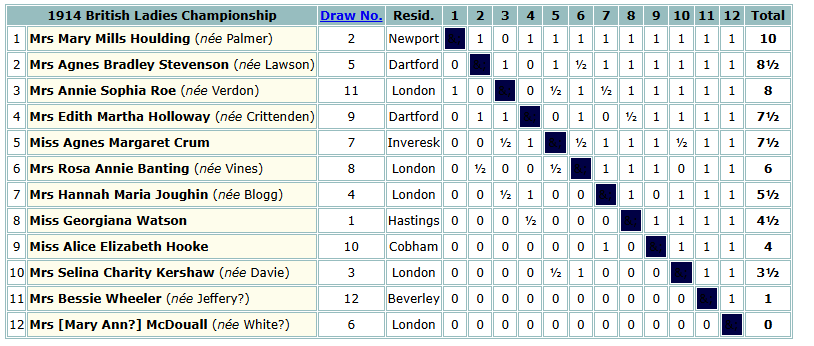
The only one of her games from this event which has been uncovered is, unfortunately, one of her defeats, against a regular rival. Agnes’s rather indifferent opening play left Edith with two strong centre pawns, and she was able to control the attack well and bring home the full point.
[Event “British CF-11 Women: Chester R1”]
[Date “1914.08.10”]
[Round “1”]
[White “Holloway, Edith Martha”]
[Black “Stevenson, Agnes Bradley”]
[Result “1-0”]
[ECO “C70”]
1. e4 e5 2. Nf3 Nc6 3. Bb5 a6 4. Ba4 Bc5 5. c3 b5 6. Bb3 d6 7. d4 exd4 8. cxd4 Bb4+ 9. Nc3 Bb7 10. O-O Nce7 11. Ng5 Nh6 12. Qf3 O-O 13. Qg3 Ng6 14. f4 Bxc3 15. bxc3 c5 16. f5 c4 17. fxg6 cxb3 18. gxh7+ Kh8 19. axb3 Qe7 20. d5 Rad8 21. Bb2 Bc8 22. Rf4 Rde8 23. c4 f6 24. Qh4 fxg5 25. Rxf8+ Rxf8 26. Qxh6 Rf4 27. Re1 Rh4 28. Qg6 Bd7 29. Rf1 Rxh7 30. Rf7 1-0
At this point formal chess competitions stopped for the duration, but the Stevensons were still able to take part in occasional friendly matches and competitions. In February 1918 it was reported that Agnes, and perhaps also Rufus, had joined the Imperial Chess Club.
In this game from the Imperial Club Championship, her MP opponent, a former Irish champion, gave up a pawn for no very obvious reason and was duly ground down in the ending. (Source: Hull Times 28 June 1919)
[Event “Imperial CC Championship”]
[Date “1919.06.??”]
[White “Barnett, Richard Whieldon”]
[Black “Stevenson, Agnes Bradley”]
[Result “0-1”]
[ECO “C25”]
1. e4 e5 2. Nc3 Nc6 3. Bc4 Bc5 4. Qg4 g6 5. Qg3 d6 6. Nge2 Nf6 7. d3 Be6 8. Bxe6 fxe6 9. Bg5 h6 10. Qh4 Kf7 11. Bxf6 Qxf6 12. Qxf6+ Kxf6 13. Rf1 g5 14. g3 Kg6 15. Na4 Bb6 16. Nxb6 axb6 17. c3 Rhf8 18. f4 Rf7 19. f5+ exf5 20. exf5+ Rxf5 21. Rxf5 Kxf5 22. Kd2 Kg6 23. a3 Rf8 24. Ke1 Ne7 25. Ng1 Nd5 26. Ke2 g4 27. c4 Ne7 28. Rf1 Rxf1 29. Kxf1 Kg5 30. Ne2 h5 31. Nc3 Nc8 32. b4 c6 33. Ke2 Kf5 34. Ke3 Ne7 35. Ne4 d5 36. Nf2 Kg5 37. Nd1 Nf5+ 38. Kf2 d4 39. Nb2 Ne3 40. Na4 Nc2 41. Nxb6 Nxa3 42. Nd7 Kf5 43. Ke2 Nc2 44. b5 cxb5 45. cxb5 Nb4 46. Nb6 e4 47. dxe4+ Kxe4 48. Nc4 Kd5 49. Nd2 Kc5 50. Ne4+ Kxb5 51. Nf6 Kc4 52. Kd2 Nd5 53. Nxh5 b5 0-1
- August 1919 British Ladies’ Championship Hastings: 6th, scoring 6/11.
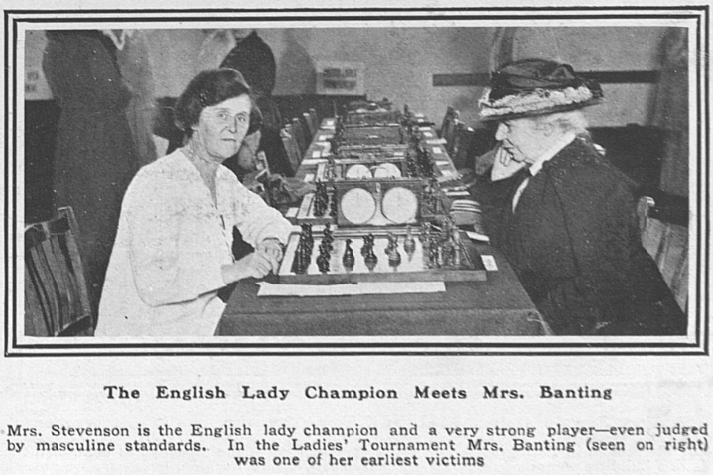
Here she is, on the right, in action against that year’s champion, Edith Holloway.
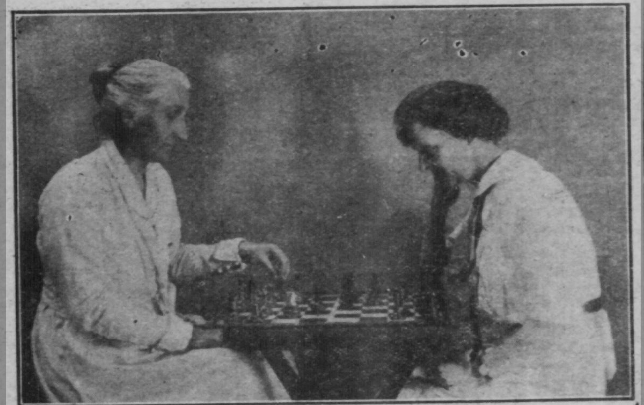
- April 1920 Bromley Easter Congress. It was announced that Mrs Stevenson had entered, but she was not among the prizewinners and the full results weren’t published.
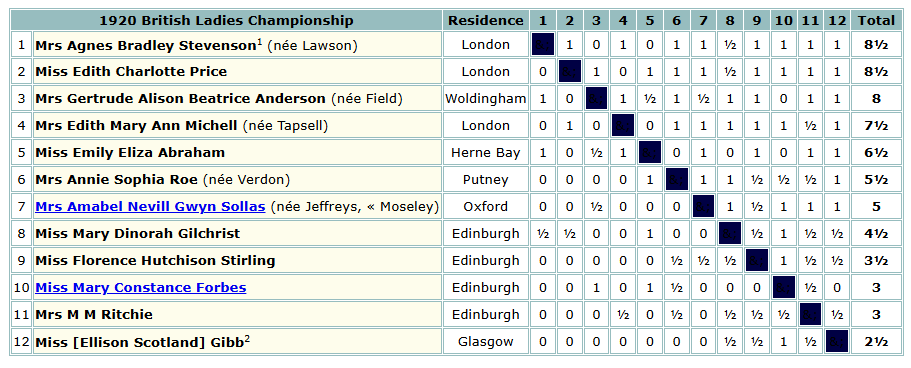
- August 1920 British Ladies’ Championship Edinburgh. Mrs Stevenson shared first place with Miss Edith Price. Mrs Holloway didn’t defend her title, preferring to take on the gentlemen in the First Class section.
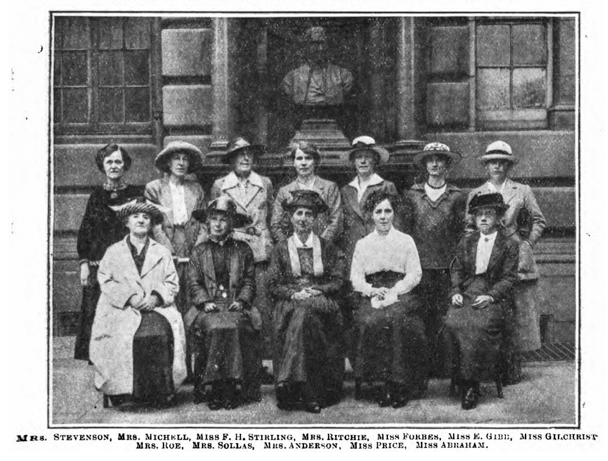
There she is, standing on the far left in this group photograph.
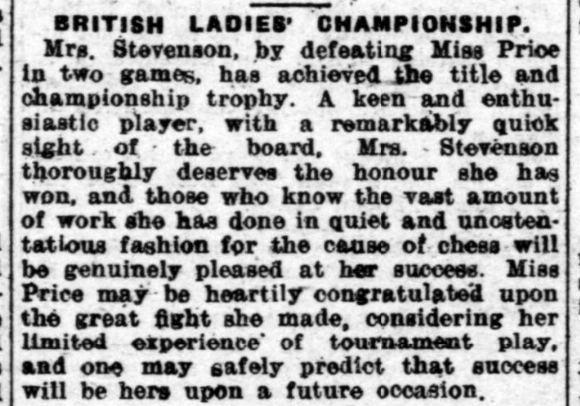
The play-off took place in London shortly afterwards. Agnes Stevenson won both games, but was lucky here, when Edith Price, instead of playing the obvious 21. Nd5+ with a winning position, simply gave away a piece.
[Event “British CF-13 Women play-off R2”]
[Date “1920.09.01”]
[White “Price, Edith Charlotte”]
[Black “Stevenson, Agnes Bradley”]
[Result “0-1”]
[ECO “C70”]
1. e4 e5 2. Nf3 Nc6 3. Bb5 a6 4. Ba4 Bc5 5. c3 b5 6. Bc2 d6 7. d4 exd4 8. cxd4 Ba7 9. h3 Nb4 10. Bb3 c5 11. a3 Nc6 12. Bd5 Nge7 13. dxc5 Bxc5 14. Ng5 Qb6 15. Bxf7+ Kd8 16. O-O h6 17. Ne6+ Bxe6 18. Bxe6 Kc7 19. Nc3 Raf8 20. Qe1 Nd4 21. Be3 Nxe6 22. Nd5+ Nxd5 23. exd5 Bxe3 24. dxe6 Bd4 25. Rc1+ Kb8 26. e7 Re8 27. Qe4 Be5 28. Rc6 Qb7 29. Rfc1 Rxe7 30. Qc2 Bf4 31. Rd1 Rhe8 32. Kf1 Be5 33. Qe4 g5 34. Qd5 Rc8 35. Rxd6 Qxd5 36. R6xd5 Bxb2 37. a4 bxa4 38. Rd6 a3 39. Rxa6 Rc1 40. Rxc1 Bxc1 41. Rxh6 a2 42. Ra6 Ra7 0-1
The 1921 census found Rufus and Agnes at their new address, 45 Clapham Road, Lambeth, just a short walk from the Oval cricket ground. Rufus was a pharmacist working for Boots, while Agnes had no occupation recorded. They would stay there until about 1928, when they moved a mile and a half down the road, to 47 Gauden Road, Clapham, where they’d remain for the rest of their lives.
- April 1921 Kent Easter Congress Broadstairs. She entered the Ladies’ tournament but the results aren’t available. She also finished 2nd in a lightning tournament, behind Euwe, but ahead of Znosko-Borowsky.
- August 1921 British Ladies’ Championship Malvern. Mrs Stevenson finished 4th, with a score of 7½/11, just a half point behind Mrs Anderson, Miss Price and Mrs Michell.
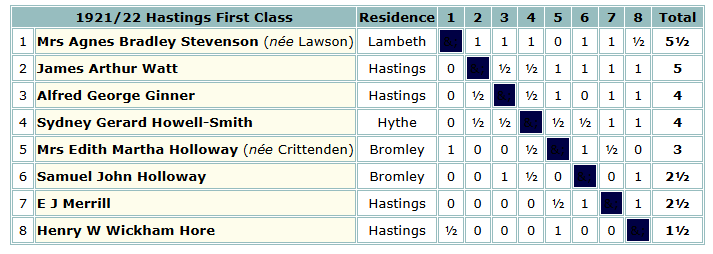
- December 1921-January 1922 First Class section at Hastings. Here, Agnes Stevenson took first place, well ahead of both Mr and Mrs Holloway.
- April 1922 Weston-super-Mare Mrs Stevenson played in the First Class A section, scoring 2/9.
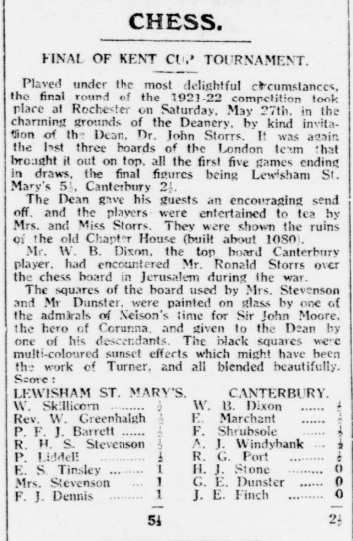
Rufus and Agnes were now living in Surrey rather than Kent, but, in order to maintain their Kent connection they joined Lewisham St Mary’s Chess Club. In this match Mrs Stevenson played her game on an unusual board.
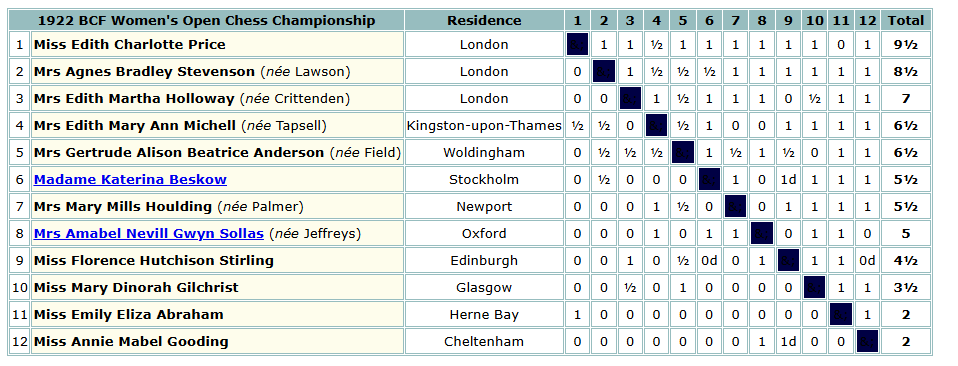
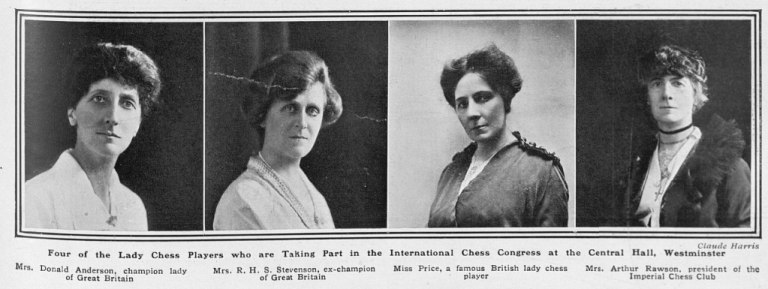
- The 1922 BCF Congress was held in August in conjunction with the London 1922 International Tournament. While the Ladies’ event wasn’t billed as the British Championship as there was a non-British participant, the winner, Edith Price, was still recognised as the British Ladies’ Champion. Agnes Stevenson finished in second place.
- December 1922-January 1923 Hastings. Agnes Stevenson played in the First Class A section, scoring 4/9 and finishing in 6th place.
- April 1923 Margate. Mrs Stevenson finished third in the First Class Section A tournament, but lost this nicely played game to the teenage Ronald Melville Norman (source: Weston-super-Mare Gazette 14 April 1923)
[Event “Margate First Class”]
[Date “1923.04.??”]
[White “Norman, Ronald Melville”]
[Black “Stevenson, Agnes Bradley”]
[Result “1-0”]
[ECO “D53”]
1. Nf3 Nf6 2. d4 d5 3. c4 c6 4. Nc3 e6 5. Bg5 Be7 6. e3 h6 7. Bh4 Nbd7 8. Qc2 dxc4 9. Bxc4 Nd5 10. Bxe7 Qxe7 11. Rc1 N7b6 12. Bb3 Nb4 13. Qe2 N6d5 14. Ne4 Na6 15. O-O O-O 16. Ne5 Nf6 17. Nxf6+ Qxf6 18. f4 Nb4 19. Rf3 Rd8 20. f5 Qe7 21. Nxf7 Rf8 22. Ne5 Rf6 23. e4 Kh7 24. g4 exf5 25. gxf5 Bd7 26. Qe1 a5 27. a3 Na6 28. Qxa5 Be8 29. Qe1 Rd8 30. Rd3 Rfd6 31. Qc3 Bh5 32. Re1 Qg5+ 33. Rg3 Qe7 34. Rd3 Qg5+ 35. Rg3 Qe7 36. d5 c5 37. Nc4 Rf6 38. Qe5 Qxe5 39. Nxe5 Re8 40. Nd3 b5 41. Kf2 c4 42. Nf4 Bf7 43. Bc2 Re5 44. Reg1 Nc5 45. Rxg7+ Kh8 46. Kf3 Nd3 47. Bxd3 cxd3 48. Rxf7 Rxf7 49. Ng6+ 1-0
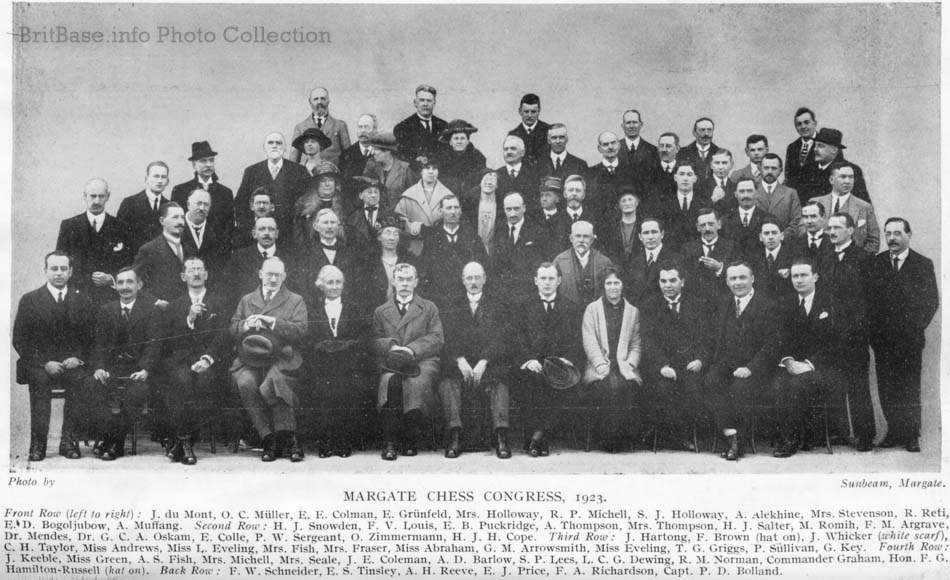
You can see her here, sitting between Alekhine and Réti in the front row.
- August 1923 British Ladies’ Championship Southsea. Mrs Stevenson finished in a 4-way tie for second place on 7/9, two points behind Edith Price.
In this game her Scottish opponent played an unusual second move also favoured by Harry Jackson. Agnes made a fatal error on move 34, when Rh8 would have held. The bishop had to remain on e7 to capture on c5 in some lines.
[Event “British CF-16 Women: Southsea R7”]
[Date “1923.08.20”]
[White “Hutchison Stirling, Florence”]
[Black “Stevenson, Agnes Bradley”]
[Result “1-0”]
[ECO “D00”]
1. d4 d5 2. Qd3 c6 3. Bf4 Nf6 4. Nd2 Bg4 5. f3 Bh5 6. e4 Bg6 7. Qb3 Qb6 8. Bd3 e6 9. e5 Nfd7 10. Ne2 Be7 11. Be3 Na6 12. O-O Nb4 13. Bxg6 hxg6 14. a3 Na6 15. Qc3 c5 16. Bf2 Qc7 17. f4 c4 18. b3 cxb3 19. cxb3 Qxc3 20. Nxc3 f5 21. Nb5 Nb6 22. Rac1 Kd7 23. b4 g5 24. g3 gxf4 25. gxf4 g5 26. Bg3 gxf4 27. Bxf4 Rh3 28. Rf3 Rxf3 29. Nxf3 Nc4 30. Kf2 Nc7 31. Nxc7 Kxc7 32. Nd2 b5 33. Nb3 Kd7 34. Rg1 Bh4+ 35. Ke2 Nxa3 36. Rg7+ Kc8 37. Nc5 a5 38. Rg8+ Bd8 39. Bg5 Kc7 40. Bxd8+ 1-0
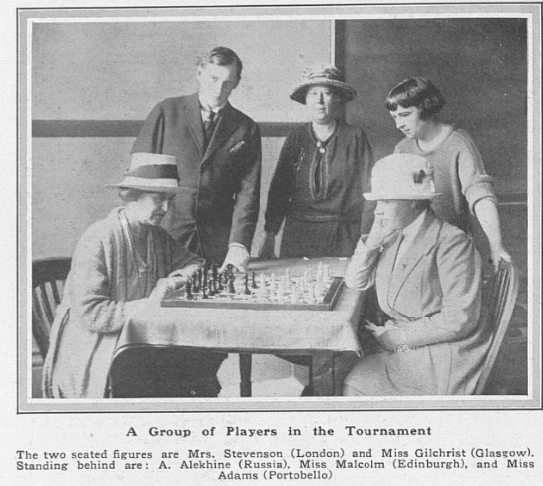
Note that MegaBase includes a game Mrs Stevenson – RE Lean from this congress where the white pieces were actually played by Alfred Dudley Barlow.
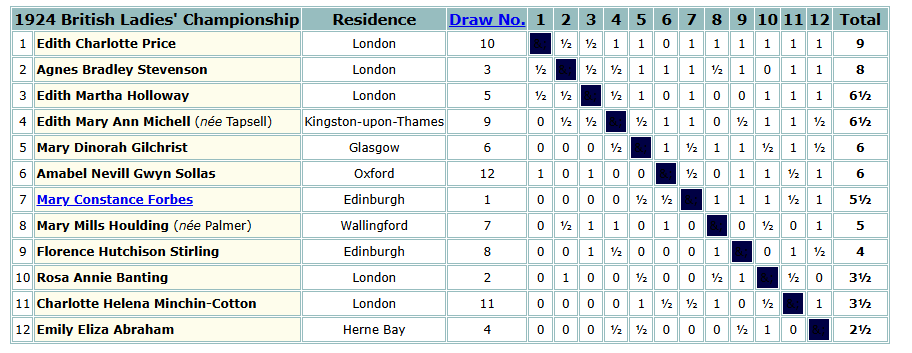
In this last round game, Edith Price offered a draw in a positi0n in which she held a large advantage.
January 1924: London League Congress. Agnes Stevenson played in Section A, won by L Savage and WH Watts, where she finished outside the prize list.
The Daily Herald sent an unsympathetic reporter along to visit a room which all London chess players of a certain age will remember well, but perhaps not fondly. The inaugural London Boys’ Championship was taking place there at the same time.
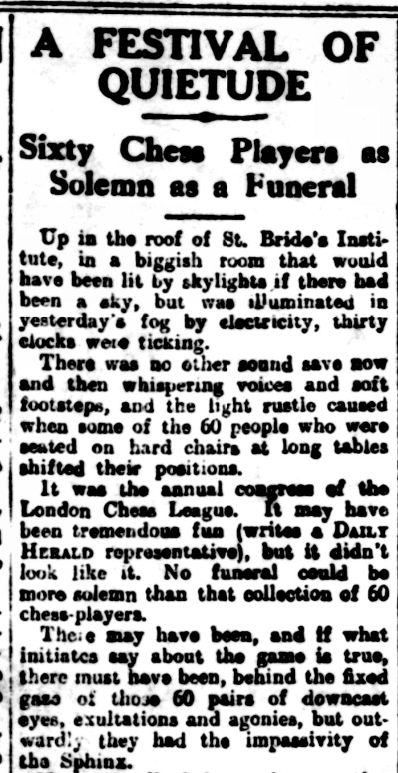
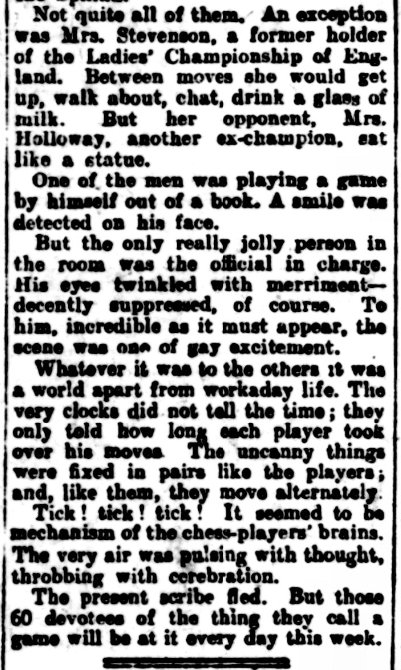
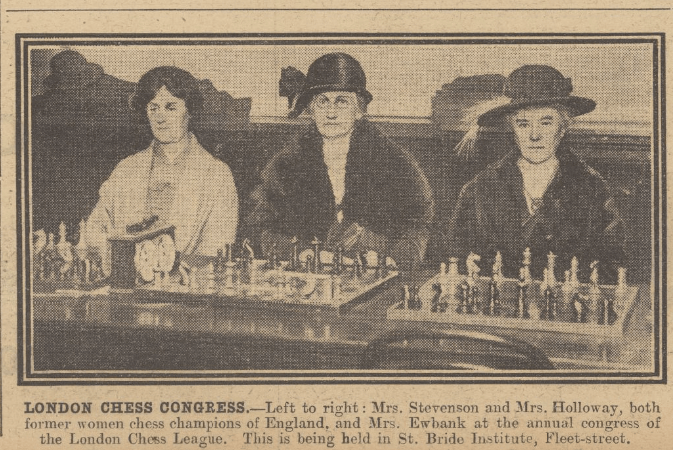
- February 1924: Agnes Stevenson was one of the competitors in an international ladies’ tournament in Merano, Italy. The English players dominated, with Helena Minchin Cotton unexpectedly sharing first place with Edith Holloway.
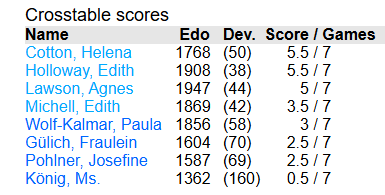
After the tournament a match took place between the ladies of London and Vienna, Agnes winning both her games against Josefine Pohlner.
- April 1924 Weston-Super-Mare. Mrs Stevenson played in the First Class B section, where her score of 5½/9 was enough for a share of third prize.
This game (source: Western Daily Press 21 April 1924) demonstrates her skill at manoeuvring in closed positions.
[Event “Weston-super-Mare First Class B”]
[Date “1924.04.??”]
[White “Stevenson, Agnes Bradley”]
[Black “Finch, Francis Frederick”]
[Result “1-0”]
[ECO “C65”]
1. e4 e5 2. Nf3 Nc6 3. Bb5 Nf6 4. d3 d6 5. Be3 Be7 6. Nc3 O-O 7. h3 Ne8 8. Nd5 a6 9. Nxe7+ Qxe7 10. Bc4 Na5 11. Bb3 Nxb3 12. axb3 h6 13. g4 Be6 14. c4 f6 15. Nh4 Qf7 16. Qf3 g5 17. Nf5 Bxf5 18. gxf5 Qg7 19. Kd2 Kf7 20. Rag1 Rh8 21. h4 c6 22. hxg5 fxg5 23. Qh5+ Kg8 24. f3 Nf6 25. Qh3 Kf7 26. d4 Rad8 27. Kc2 Rdg8 28. dxe5 dxe5 29. Qh2 Nd7 30. Bd2 Qf6 31. Bc3 Re8 32. Qh5+ Kf8 33. Rd1 Re7 34. Rh2 Qf7 35. Qh3 Rh7 36. Rd6 Nf6 37. Qg3 Nh5 38. Qf2 Nf6 39. Rh1 Qg7 40. Qg3 Ng8 41. Rg6 Qh8 42. Bb4 Ke8 43. Bxe7 Rxe7 44. Rxg5 Nf6 45. Rg6 b5 46. Rhxh6 Qf8 47. Rxf6 1-0
We also have an ending (source: Western Daily Press 23 April 1924)
[Event “Weston-super-Mare First Class B”]
[Date “1924.04.??”]
[White “Stevenson, Agnes Bradley”]
[Black “Viveash, Samuel Waterman”]
[Result “1-0”]
[SetUp “1”]
[FEN “2Rr4/1pRrkb2/p4ppp/K2P4/1P2P1P1/6NP/1P6/8 w – – 0 1”]
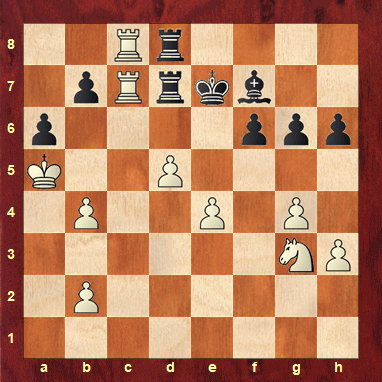
1. Kb6 Rxc8 2. Rxc8 Be8 3. Rc7 Kd6 4. Rxd7+ Bxd7 5. Kxb7 Bb5 6. h4 Bd3 7. Kc8 Bc4 8. Kd8 Bb5 9. h5 Ke5 10. Ke7 Kf4 11. Kxf6 1-0
- August 1924 British Ladies’ Championship Southport. Edith Price finished first on 9/11, ahead of Agnes Stevenson, who scored 8/11.
[Event “British CF-17 Women: Southport R11”]
[Date “1924.08.22”]
[White “Stevenson, Agnes Bradley”]
[Black “Price, Edith Charlotte”]
[Result “1/2-1/2”]
[ECO “C05”]
1. e4 e6 2. d4 d5 3. exd5 exd5 4. Nf3 Nf6 5. Nbd2 Bd6 6. Be2 O-O 7. O-O c6 8. Nb3 Qc7 9. c3 Ne4 10. Bd3 f5 11. c4 b6 12. cxd5 cxd5 13. Bd2 Qf7 14. Rc1 Bb7 15. Ne5 Qe7 16. f4 Nd7 17. Rf3 Ndf6 18. Rh3 Nxd2 19. Nxd2 Bxe5 20. fxe5 Ne4 21. Rf3 Rac8 22. Nb3 g6 23. Bxe4 fxe4 24. Rfc3 Rxc3 25. bxc3 Ba6 26. Nd2 Bd3 1/2-1/2
- 1924-25 Hastings. Agnes Stevenson played in the First Class Section 2, scoring 2/7: Vera Menchik scored 5/7 for second place, and the same score was recorded by Edith Price in the First Class Section 1.
- April 1925 A match against Minnie Musgrave resulted in a 3½-1½ win for Mrs Stevenson.
- June 1925 Scarborough Major. Mrs Stevenson failed to reach the final stages.
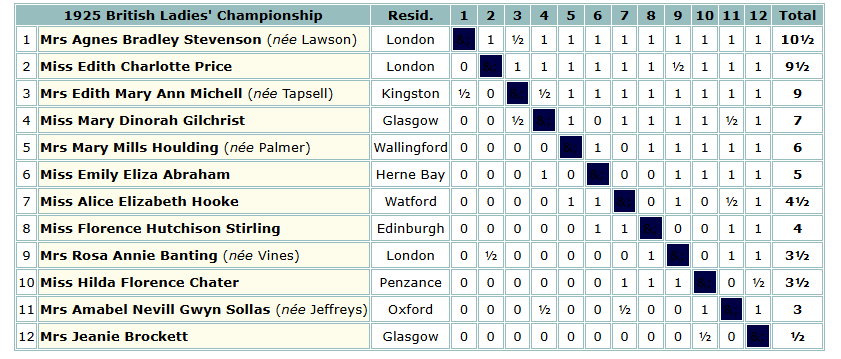
- August 1925 British Ladies’ Championship Stratford. Agnes Stevenson won her second title, scoring 10½/11, winning an exciting and protracted game against the defending champion Edith Price in round 9.
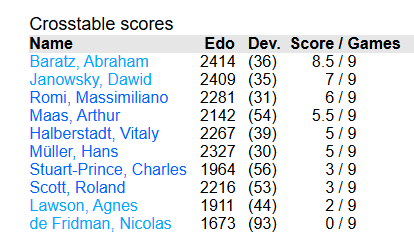
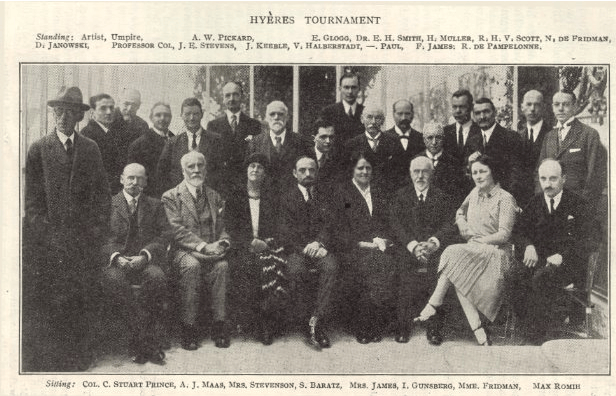
- January 1926: Agnes travelled abroad again, to play in a tournament in Hyères, on the French Riviera. This was a very mixed event, with master players, including a veteran World Championship candidate, down to enthusiastic amateurs. Here are the final scores.
She is seated third from the left in this group photograph.
- May 1926 Scarborough. Mrs Stevenson scored 2/7 in the Major B section.
- August 1926 British Ladies’ Championship Edinburgh. Agnes retained her British Championship title, again ahead of Edith Price, this time with a score of 8½/11.
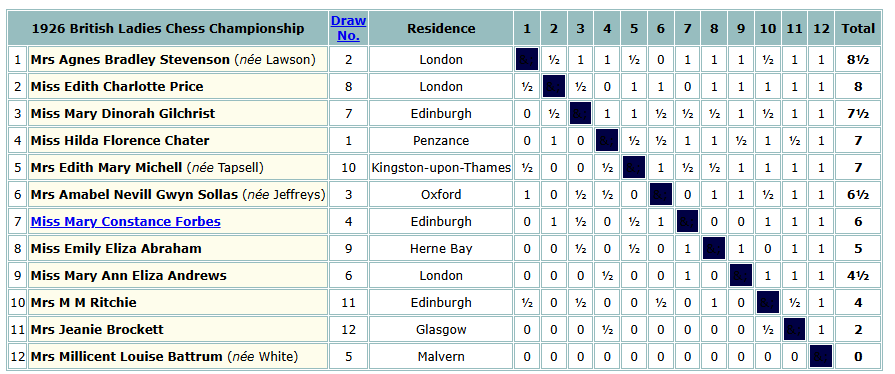
We have three of Agnes Stevenson’s games from this event.
This was her only loss. The former Mrs Moseley (she had by now remarried) used a temporary queen sacrifice to reach a winning ending, after Agnes’s erroneous 32nd move left her queen unprotected.
[Event “British CF-19 Women: Edinburgh R3”]
[Date “1926.08.04”]
[White “Stevenson, Agnes Bradley”]
[Black “Sollas, Amabel Nevill Gwyn”]
[Result “0-1”]
[ECO “B40”]
1. e4 c5 2. Nf3 e6 3. d4 cxd4 4. Nxd4 Nf6 5. Bd3 Be7 6. Nc3 O-O 7. f4 d5 8. e5 Ne8 9. Qh5 f5 10. Rf1 Nc6 11. Nxc6 bxc6 12. Rf3 g6 13. Qh3 Bb4 14. Bd2 Qe7 15. g4 d4 16. Nb1 Bxd2+ 17. Nxd2 c5 18. gxf5 exf5 19. O-O-O Be6 20. b3 Nc7 21. Rg1 Rf7 22. Nc4 Nd5 23. Qg3 Nb4 24. Kb2 Nxd3+ 25. cxd3 Bxc4 26. dxc4 Rb8 27. a4 Rg7 28. Kc2 a5 29. h4 Qb7 30. Qf2 Qe4+ 31. Kd2 Qc6 32. Rfg3 Rgb7 33. Kc2 Qxa4 34. Qg2 Qa2+ 35. Kc1 Qxg2 36. R1xg2 Rxb3 37. Rxb3 Rxb3 38. Ra2 Rf3 39. Rxa5 Rxf4 40. Rxc5 Rxh4 41. Rd5 Kf7 42. Kd2 Ke6 43. Kd3 Re4 0-1
The moves of this game conclude by stating that Black went on to win, but in fact White is winning, for fairly obscure reasons (controlling the e-file) in the final position of the game as published. 32… Ree7 or 32… Rd7, for example, would have been equal. It’s possible, I suppose that the final move is incorrect.
[Event “British CF-19 Women: Edinburgh R4”]
[Date “1926.08.05”]
[White “Forbes, Mary Constance”]
[Black “Stevenson, Agnes Bradley”]
[Result “0-1”]
[ECO “C64”]
1. e4 e5 2. Nf3 Nc6 3. Bb5 Bc5 4. O-O d6 5. Bxc6+ bxc6 6. d4 exd4 7. Nxd4 Bb7 8. Nc3 Qf6 9. Nf3 h6 10. e5 Qf5 11. Nh4 Qh7 12. e6 g5 13. exf7+ Qxf7 14. Qe1+ Ne7 15. Nf3 Ba6 16. Ne2 O-O-O 17. b3 Nd5 18. c4 Nb4 19. Qd2 Bb7 20. a3 Na6 21. Bb2 Rhf8 22. Bd4 Bxd4 23. Nfxd4 Nc5 24. f3 Rde8 25. Ng3 Qf4 26. Qxf4 Rxf4 27. Nde2 Rf7 28. Nd4 Nd3 29. Rad1 Nf4 30. Ne4 c5 31. Nxd6+ cxd6 32. Nb5 Rfe7 0-1
In this game Mrs Stevenson showed off her attacking skills. There’s a problem with the published notation, which appears to have an extra pair of moves which may belong somewhere else. BritBase considers, and I concur, that this is the most likely course of the game.
[Event “British CF-19 Women: Edinburgh R7”]
[Date “1926.08.09”]
[White “Stevenson, Agnes Bradley”]
[Black “Gilchrist, Mary Dinorah”]
[Result “1-0”]
[ECO “B30”]
1. e4 c5 2. Nf3 Nc6 3. Bb5 a6 4. Bxc6 bxc6 5. d3 d6 6. Nc3 e6 7. Bg5 Be7 8. Bxe7 Qxe7 9. O-O Bb7 10. Nd2 Nf6 11. f4 Qc7 12. b3 Rd8 13. Na4 Bc8 14. Qe2 Nd7 15. Qg4 O-O 16. Qh4 f5 17. Rf3 Rf6 18. Rh3 Nf8 19. Nf3 Rh6 20. Qg3 Rxh3 21. Qxh3 Qf7 22. e5 dxe5 23. Nxe5 Qf6 24. Re1 Rd4 25. Qe3 Qh4 26. g3 Qh3 27. Nxc6 Bd7 28. Nxd4 1-0
- April 1927 Kent Congress Tunbridge Wells. Agnes Stevenson played in the Major Reserves section, scoring 3½/7 and sharing 3rd place.
One of Mrs Stevenson’s weaknesses was defending against gambits. In this game against her friend and rival Edith Holloway, she was totally lost after only four moves.
[Event “Tunbridge Wells Major Reserves”]
[Date “1927.04.??”]
[White “Holloway, Edith Martha”]
[Black “Stevenson, Agnes Bradley”]
[Result “1-0”]
[ECO “C21”]
1. e4 e5 2. d4 exd4 3. Nf3 c5 4. Bc4 f6 5. c3 dxc3 6. Nxc3 Ne7 7. Qb3 d6 8. Be3 Qb6 9. Bf7+ Kd8 10. Qc2 Nbc6 11. O-O Bd7 12. Rad1 Nc8 13. a3 a5 14. Rd2 Ne5 15. Nxe5 fxe5 16. Rfd1 Qc7 17. Bg5+ Be7 18. Bxe7+ Nxe7 19. Rxd6 Kc8 20. Rxd7 Qxd7 21. Rxd7 1-0
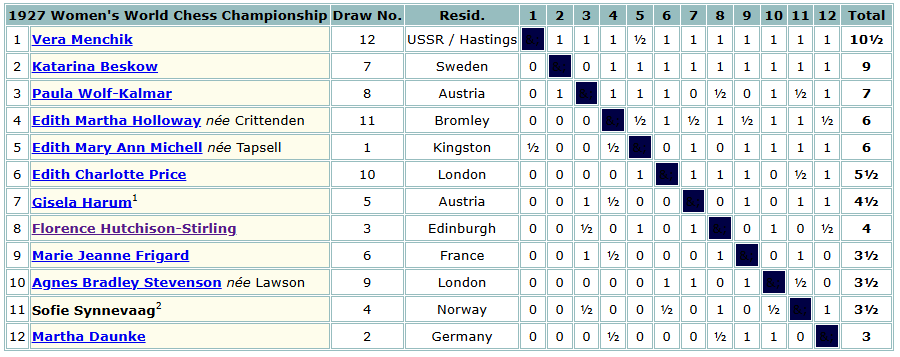
- July 1927: the British Championships didn’t take place, because the first Chess Olympiad was taking place in London, with the first Women’s World Championship taking place alongside. Mrs Stevenson was selected to take part, but was sadly out of form. Vera Menchik won easily, and it was also clear that the continental ladies had improved since Merano, taking second and third place.
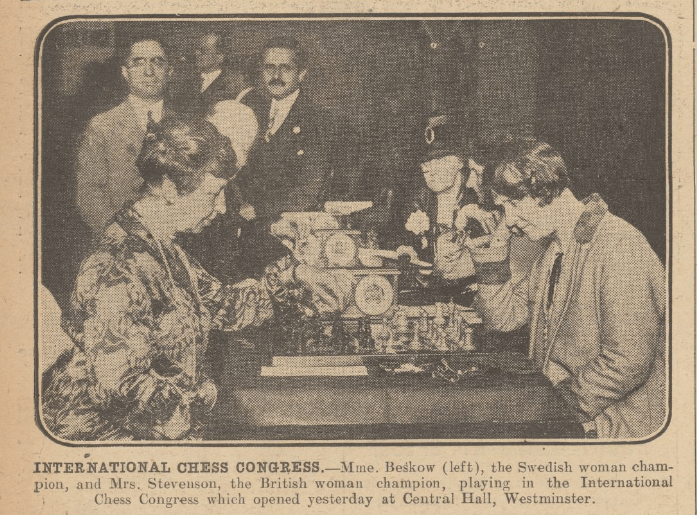
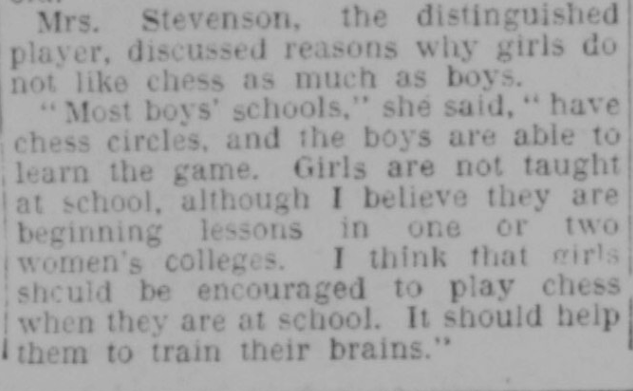
In January 1928, when the girls’ championship only attracted three players, Agnes was asked to comment.
July 1928: British Ladies’ Championship, Tenby, South Wales. Edith Price regained her title, with Agnes Stevenson taking sec0nd place.
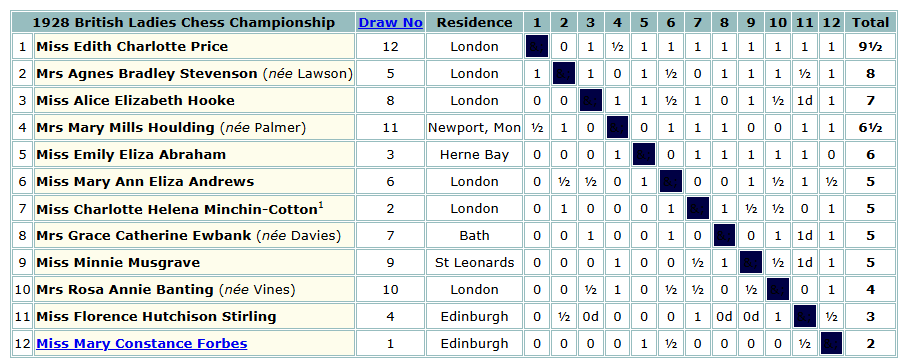
The runner-up defeated the winner in this game, thanks to an oversight costing the exchange (25… Qc3 should have been preferred)
[Event “British Ladies’ Championship Tenby R8”]
[Date “1928.07.10”]
[White “Stevenson, Agnes Bradley”]
[Black “Price, Edith Charlotte”]
[Result “1-0”]
[ECO “C02”]
1. e4 c5 2. c3 Nc6 3. d4 cxd4 4. cxd4 d5 5. e5 e6 6. f4 Nge7 7. Nf3 Qb6 8. g4 Bd7 9. Nc3 Ng6 10. a3 Rc8 11. Na4 Qc7 12. b4 Be7 13. Nc5 Bxc5 14. bxc5 b6 15. cxb6 Qxb6 16. Be3 O-O 17. g5 Nce7 18. Bd3 Rc3 19. O-O Nf5 20. Bxf5 Rxe3 21. Bd3 Nxf4 22. Qd2 Rxd3 23. Qxf4 Qb2 24. a4 Rc8 25. Rab1 Qa3 26. Ne1 Be8 27. Nxd3 and wins 1-0
- Kent Congress Ramsgate April 1929. Mrs Srevenson played in the First Class Section C, scoring 2½/7: George Clifford Brown finished last in this section.
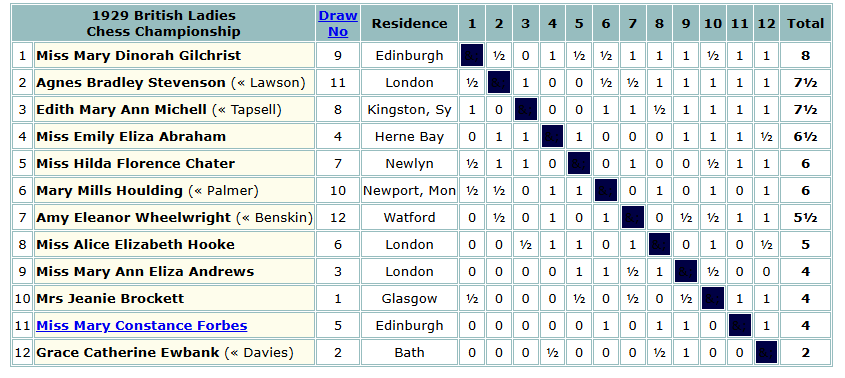
- July-August 1929 British Ladies’ Championship Ramsgate. Mrs Stevenson shared second place behind Mary Gilchrist, spoiling her chances by blundering her queen against Miss Abraham.
- April-May 1930 Kent Congress Canterbury. Mrs Stevenson played in the Major B section, finishing in last place on 2/7.
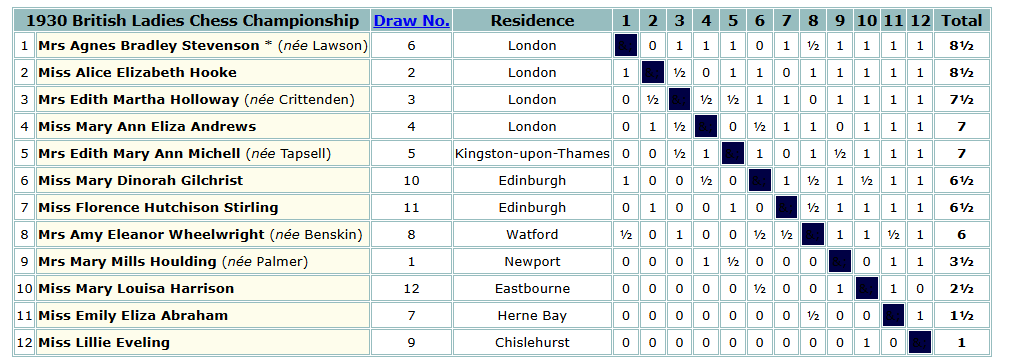
- June-July 1930 British Ladies’ Championship Scarborough. Agnes Stevenson won her fourth title, beating Alice Hooke after a play-off.
- July 1930 2nd World Women’s Championship Hamburg. Mrs Stevenson, representing England, finished last of the five competitors.
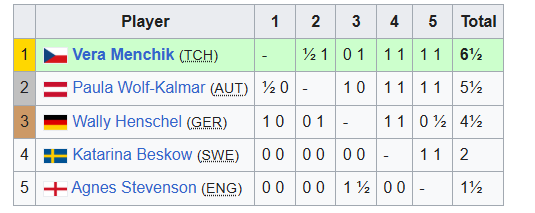
Vera Menchik was in a different class altogether. Here, Mrs Stevenson played far too passively and was duly squashed.
[Event “2nd World-ch (Women): Hamburg”]
[Date “1930.07.??”]
[White “Stevenson, Agnes Bradley”]
[Black “Menchik, Vera”]
[Result “0-1”]
[ECO “C77”]
1. e4 e5 2. Nf3 Nc6 3. Bb5 a6 4. Ba4 Nf6 5. d3 d6 6. Bg5 Be7 7. Nbd2 O-O 8. h3 b5 9. Bb3 Na5 10. Qe2 c5 11. c3 Qc7 12. Bc2 Nc6 13. a4 Be6 14. O-O b4 15. c4 Ne8 16. Bxe7 Qxe7 17. b3 f5 18. Kh2 f4 19. Rh1 Nf6 20. Kg1 h6 21. Rh2 Nh5 22. Kh1 Ng3+ 23. fxg3 fxg3 24. Qe1 gxh2 25. Kxh2 Qf6 26. Qg3 Qf4 27. Qxf4 Rxf4 28. Rf1 Raf8 29. Bd1 Bd7 30. Kg3 Nd8 31. Kh2 g6 32. Kg3 Kg7 33. Rf2 g5 34. Rf1 h5 35. Re1 Ne6 36. Kh2 R4f6 37. Kg3 a5 38. Kh2 g4 39. hxg4 hxg4 40. Nh4 Nf4 0-1
- July 1931 3rd World Women’s Championship Prague. The five players were the same as in 1930, but this time Agnes did better, taking third place.
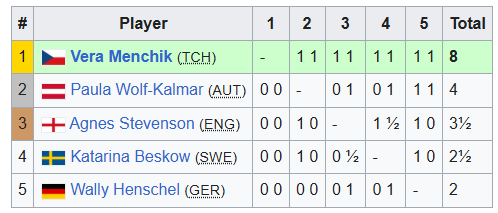
Again, Agnes Stevenson played too passively against Vera Menchik’s Queen’s Gambit, failing to attempt the c5 pawn break at any point. You’ll spot that Vera missed an obvious mate in 2 on move 27, but it was never going to affect the result.
[Event “3rd World-ch (Women): Prague R4”]
[Date “1931.07.??”]
[White “Menchik, Vera”]
[Black “Stevenson, Agnes Bradley”]
[Result “1-0”]
[ECO “D15”]
1. d4 d5 2. c4 c6 3. Nf3 Nf6 4. Nc3 Bf5 5. cxd5 Nxd5 6. e3 Nxc3 7. bxc3 e6 8. Bc4 h6 9. Qe2 Be4 10. O-O Nd7 11. Nd2 Bg6 12. e4 Nb6 13. Bb3 Be7 14. f4 O-O 15. Nf3 Bh5 16. Be3 Bf6 17. Bc2 Bg6 18. g4 Bh7 19. Kh1 Be7 20. f5 exf5 21. gxf5 f6 22. Rg1 Kh8 23. Qg2 Rg8 24. Bb3 Qd6 25. Nh4 g5 26. fxg6 f5 27. Nxf5 Rxg6 28. Nxd6 Rxg2 29. Nf7+ Kg7 30. Rxg2+ 1-0
In the return game Menchik outplayed her opponent in a positional Caro-Kann.
[Event “3rd World-ch (Women): Prague R8”]
[Date “1931.07.??”]
[White “Stevenson, Agnes Bradley”]
[Black “Menchik, Vera”]
[Result “0-1”]
[ECO “B12”]
1. e4 c6 2. d4 d5 3. e5 Bf5 4. Bd3 Bxd3 5. Qxd3 e6 6. f4 Nh6 7. Nf3 Qb6 8. c3 c5 9. O-O Nc6 10. b3 Rc8 11. Be3 cxd4 12. Bxd4 Nxd4 13. cxd4 Nf5 14. Kh1 h5 15. a3 Be7 16. Nbd2 O-O 17. b4 a5 18. b5 Rc7 19. Nb3 a4 20. Nc1 Rc4 21. Ne2 Qxb5 22. Rab1 Qd7 23. Nd2 Rc7 24. h3 h4 25. g4 hxg3 26. Nxg3 Rfc8 27. Ne2 Rc2 28. Rbc1 Qc7 29. Kh2 Bh4 30. Rcd1 Qa5 31. Kg2 Ng3 32. Rf3 Nxe2 33. Qxe2 R8c3 34. Rd3 Rxd3 35. Qxd3 Rc3 36. Qb1 Qa6 37. Nf1 Qe2+ 0-1
- August 1931 British Ladies’ Championship Worcester. Mrs Stevenson scored 7/11 for a share of third place.
- February 1932 Sunday Referee Tournament Ladies’ section. London. Agnes Stevenson took first place in this event. This was an international tournament connected with the new Empire Chess Club. There was a strong Masters tournament, won by Alekhiine ahead of Flohr, with Kashdan and Sultan Khan sharing third place, a Major Reserves and a ladies’ section.
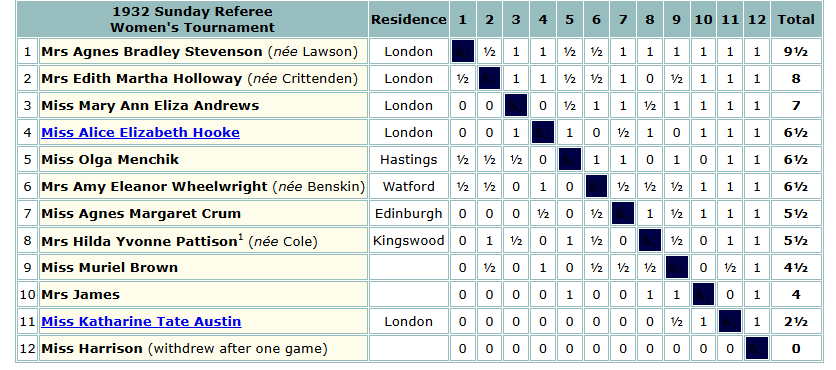
Against lesser opposition, Agnes was more than capable of playing a strong attacking game, as here, when her opponent, who features here, weakened her king’s defences on move 10. Source: Staffordshire Advertiser 20 February 1932.
[Event “London Int (Women)”]
[Date “1932.02.??”]
[White “Pattison, Hilda Yvonne”]
[Black “Stevenson, Agnes Bradley”]
[Result “0-1”]
[ECO “D35”]
1. d4 d5 2. c4 c6 3. e3 Nf6 4. Nc3 e6 5. Nf3 Bd6 6. cxd5 exd5 7. Bd3 Bg4 8. Be2 Nbd7 9. O-O Qc7 10. g3 h5 11. h4 Bh3 12. Re1 Bxg3 13. Ng5 Bxf2+ 14. Kxf2 Qh2+ 15. Kf3 Bg4# 0-1
- March 1932 Cambridge Congress: Agnes Stevenson played in the Open Section B, sharing second place on 5/7.
- August 1932 British Ladies’ Championship London. Mrs Stevenson scored 8/11, finishing in a three-way tie for first place with Edith Michell and Alice Hooke. The tournament was enlivened by the presence of Miss Fatima, like Sultan Khan a member of Sir Umar Hayat Khan’s entourage. Only about 20 years old, and only having learnt chess after arriving in England, she offered a contrast to the middle-aged, middle class ladies called Mary, Edith and Agnes.
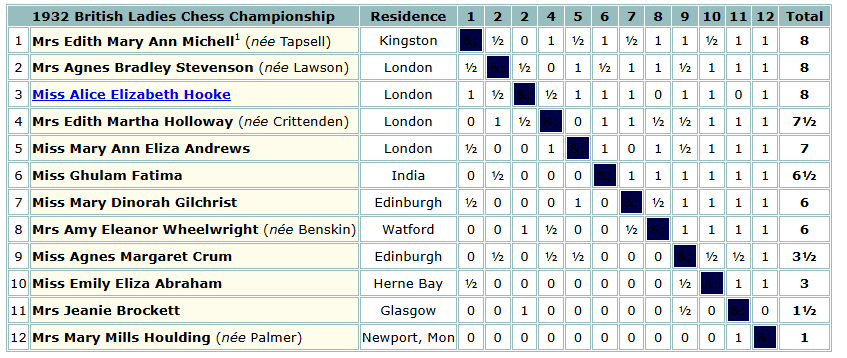
The play-off took place in London in September, finishing like this.
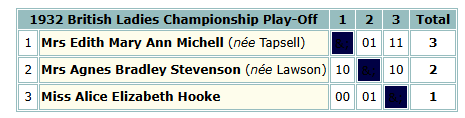
Four of the play-off games are available, including three involving Mrs Stevenson. In her first game she outplayed Edith Michell on the black side of a Stonewall Dutch her bad bishop managed to escape, eventually winning her the game.
[Event “GBR-chW 25th play-off London R1”]
[Date “1932.09.08”]
[White “Michell, Edith Mary Ann”]
[Black “Stevenson, Agnes Bradley”]
[Result “0-1”]
[ECO “A84”]
1. d4 d5 2. Nf3 c6 3. e3 f5 4. c4 e6 5. Nc3 a6 6. cxd5 cxd5 7. Bd3 Nc6 8. a3 Nf6 9. O-O Bd6 10. Bd2 Bd7 11. Ne1 g5 12. g3 h5 13. Nf3 Ne4 14. Bxe4 dxe4 15. Ne1 h4 16. Qe2 g4 17. Ng2 hxg3 18. fxg3 Ne7 19. Nf4 Bxf4 20. Rxf4 Bc6 21. Rf2 Rc8 22. Qd1 Qb6 23. Rb1 Nd5 24. Ne2 Rh7 25. Nf4 Kd7 26. Nxd5 Bxd5 27. Bb4 Qc6 28. Bd2 Qb5 29. Bc3 Bb3 30. Qd2 b6 31. Qe2 Bc4 32. Qd1 Bd3 33. Rc1 a5 34. b4 a4 35. Bb2 Rc4 36. Rxc4 Qxc4 37. Kg2 Kd6 38. Qh1 Kd5 39. Qc1 b5 40. Rd2 Rc7 41. Qe1 Qc6 42. Qf2 Qd6 43. Qe1 Rc4 44. Qf2 Qc7 45. h4 gxh3+ 46. Kxh3 Qh7+ 47. Kg2 Qh6 48. Kg1 Rc8 49. Qe1 Rh8 50. Rg2 Qh1+ 51. Kf2 Qxe1+ 52. Kxe1 Rh1+ 53. Kd2 Bf1 54. Rf2 Rg1 55. Rh2 Rxg3 56. Rh8 Rg2+ 57. Kc3 Bd3 58. Rd8+ Kc6 59. Rc8+ Kd7 60. Rc5 Rc2# 0-1
She also won her first game against Miss Hooke, where her central control allowed her king to march up the board, concluding with an unusual fork.
[Event “GBR-chW 25th play-off London R3”]
[Date “1932.09.??”]
[White “Stevenson, Agnes Bradley”]
[Black “Hooke, Alice Elizabeth”]
[Result “1-0”]
[ECO “C70”]
1. e4 e5 2. Nf3 Nc6 3. Bb5 Bc5 4. c3 a6 5. Ba4 b5 6. Bc2 Nf6 7. b4 Ba7 8. h3 Bb7 9. d3 O-O 10. Bg5 d6 11. g4 h6 12. Bh4 d5 13. Nbd2 d4 14. cxd4 Bxd4 15. Nxd4 Nxd4 16. Nb3 Qd6 17. a3 Nxc2+ 18. Qxc2 Rac8 19. Bxf6 Qxf6 20. Ke2 Rfd8 21. Nc5 Ba8 22. h4 Rd6 23. Rag1 Qd8 24. g5 Qe7 25. Qc1 h5 26. Rg3 Rcd8 27. f4 exf4 28. Qxf4 Rc6 29. Rf1 a5 30. Rgf3 Rf8 31. Re3 axb4 32. axb4 Qd6 33. Ref3 Qxf4 34. Rxf4 Rd6 35. Ke3 Bc6 36. d4 Rdd8 37. d5 Bd7 38. Ra1 Be8 39. Ra7 c6 40. Kd4 g6 41. Ke5 cxd5 42. exd5 Rb8 43. Rf6 Kg7 44. Rfa6 Kg8 45. Kf6 Rc8 46. Rb6 Kh8 47. Raa6 Rd8 48. Ke7 Rxd5 49. Kxf8 Re5 50. Rb8 Re2 51. Rxe8 Rxe8+ 52. Kxe8 1-0
Two nicely played games there, but the return encounters didn’t go so well. She needed to win her final game against Alice Hooke to catch up with Edith Michell, but this time her bad light-squared bishop never got out of the box.
[Event “GBR-chW 25th play-off London R6”]
[Date “1932.09.29”]
[White “Hooke, Alice Elizabeth”]
[Black “Stevenson, Agnes Bradley”]
[Result “1-0”]
[ECO “D43”]
1. d4 d5 2. c4 c6 3. Nc3 Nf6 4. Qc2 e6 5. Nf3 Bd6 6. Bg5 h6 7. Bh4 g5 8. Bg3 a6 9. Ne5 Nh5 10. c5 Nxg3 11. hxg3 Bxe5 12. dxe5 Nd7 13. f4 Qe7 14. Na4 g4 15. e3 f5 16. Rd1 Kf7 17. Be2 h5 18. Rh4 Nf8 19. Kf2 Ng6 20. Rh2 h4 21. Rdh1 hxg3+ 22. Kxg3 Bd7 23. Rh7+ Rxh7 24. Rxh7+ Ke8 25. Rxe7+ 1-0
- June 1933 Folkestone. Folkestone hosted the Olympiad and the World Women’s Championship, with a general congress alongside. Agnes Stevenson wasn’t selected for the championship this time, but played in the First Class A section, scoring 3½/9.
- July-August 1933 British Ladies’ Championship Hastings. Mrs Stevenson scored 7/11, sharing third place behind Miss Fatima, who, having made considerable progress in the past year, only dropped half a point.
The conclusion of this game demonstrates Miss Fatima’s understanding of good and bad bishops, but 32… Qg1+ or Bd7 would have given Mrs Stevenson every chance of a perpetual check.
[Event “British CF-26 Women: Hastings R9”]
[Date “1933.08.09”]
[White “Fatima, Ghulam”]
[Black “Stevenson, Agnes Bradley”]
[Result “1-0”]
[SetUp “1”]
[FEN “2br4/1pk4q/p1p1p2p/2P1Pp2/1P2pP2/P1Q1P1RP/4B3/2K5 b – – 0 30”]
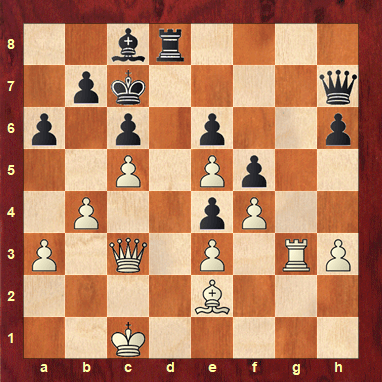
30… Rg8 31. Rxg8 Qxg8 32. Qd4 Qd8 33. Qd6+ Qxd6 34. exd6+ Kd7 35. Bc4 b5 36. Bb3 Ke8 37. Kd2 Kf7 38. Kc3 Kf6 39. Kd4 Bd7 40. Bd1 Be8 41. h4 Bf7 42. d7 Ke7 43. Ke5 Kxd7 44. Kf6 Be8 45. Bb3 Kc7 46. Bxe6 {and wins. Source: BCM, Sept 1933, p376} 1-0
- February 1924 Empire Social Club Women’s Tournament. Agnes scored 5½ (out of 6 or 7) in her qualifying section, and 1/3 in the final pool, won by Alice Hooke on 3/3.
- July-August 1924 British Ladies’ Championship, Chester. Mrs Stevenson scored 6½/11, leaving her in 4th place. This tournament saw the first appearance of Elsie Reid of Leicester.
Agnes really should have won this game against the eventual winner (3… Nxg8), but instead allowed Mary Gilchrist the opportunity to sacrifice her rook and queen for a neat stalemate.
[Event “British CF-27 Women: Chester R2”]
[Date “1934.07.31”]
[White “Stevenson, Agnes Bradley”]
[Black “Gilchrist, Mary Dinorah”]
[Result “1/2-1/2”]
[SetUp “1”]
[FEN “3r3k/2Q5/4pN1p/3pPp1P/1q1P1P2/5B2/5K2/8 b – – 0 1”]
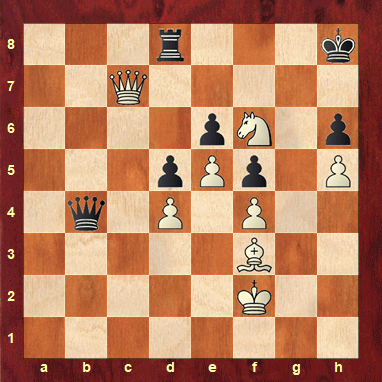
1… Qb2+ 2. Kg3 Rg8+ 3. Kh3 Rg3+ 4. Kxg3 Qg2+ 5. Kxg2 1/2-1/2
- February-March 1935 Empire Social Club Women’s Championship. Agnes Stevenson took first place with 10/12 ahead of Edith Holloway and Sonja Graf.
In April 1935 John Bull published an article about Chess Fever, quoting Mrs Stevenson.
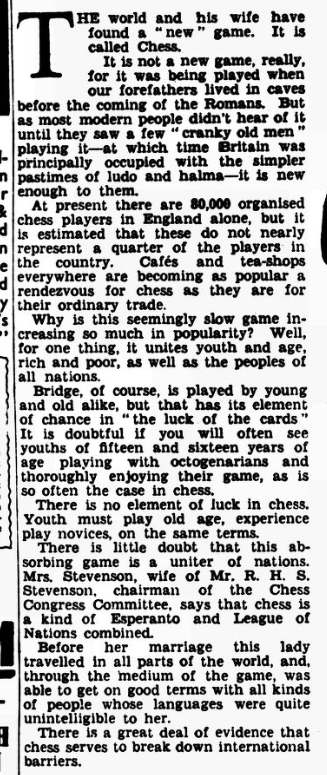
I wonder if this was a misunderstanding: she certainly travelled round Europe playing chess after her marriage.
- April-May 1935 Margate Congress: Major Section. Mrs Stevenson scored 2½/10. Chess wasn’t her only game there: the BCM reported that ‘Mrs. Stevenson and Miss Menchik arranged a bridge match between the residents of the Grand and Carlton Hotels, which were principally used by congressists. In the former team Capablanca and Reshevsky formed a redoubtable partnership. M. Ellinger, a bridge international, preferred billiards on this occasion.’
- July 1935 British Ladies’ Championship Great Yarmouth. Agnes Stevenson scored 7½/11, sharing third place with Mrs Florence Thomson, the mother of future Scottish champion and Richmond & Twickenham Chess Club stalwart Aird Thomson. But for hanging a rook against Elsie Read, Mrs Stevenson would have shared second place instead.
That summer, Agnes Stevenson, now aged 61, was again selected to represent her country in the World Ladies’ Championship, held that year in Warsaw.
The rest of the BCF delegation travelled by train, but Agnes, who had never flown before, decided to take to the skies instead. This, tragically, proved to be a fatal mistake.
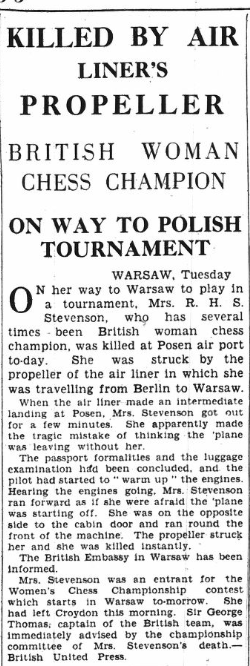
What a tragic end to an inspiring life. The papers over the next few days were full of tributes.
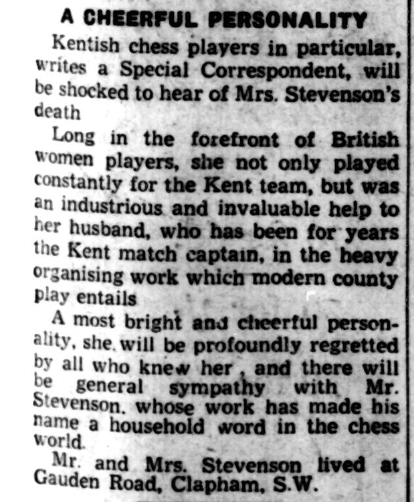
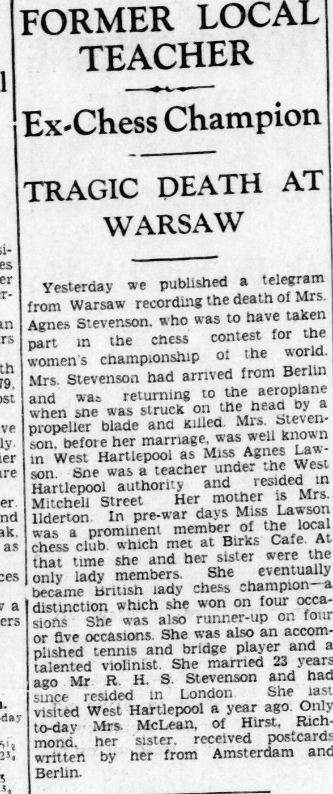
‘A most bright and cheerful personality’, according to her chess friends. But her neighbours had a slightly different impression.
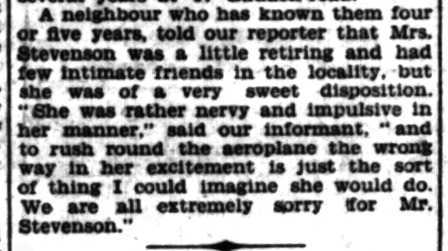
‘Retiring’, ‘few intimate friends’, ‘rather nervy’. It sounds as if this neighbour was talking about a very different person.
Come to think of it, I suspect she’s not the only chess player who might be seen as friendly and outgoing within the chess community, but shy and retiring to the outside world.
Agnes Bradley Stevenson was one of that generation of women who learnt chess in the mid 1890s, at the time it was, briefly, a fashionable pastime for ladies. While others dropped out, she, like Alice Hooke, continued playing enthusiastically for the rest of her life. Not just in the tournaments featured here, but in club matches for Lewisham in the London and Kent Leagues, friendly matches, often for the Imperial Club, internal competitions and much else. (I haven’t yet found any shared opponents with me, but she missed TI Caswell by one board in a London League match and played an a parallel congress section to RN Coles.)
Her surviving games give us some idea of her strength. EdoChess gives her a highest retrospective rating of 1958 in 1922: a strong club and lower board county player. She was described as moving quickly (which ties in with her neighbour’s description of her as ‘impulsive’) and playing aggressively, but her particular skill seemed to be building up attacks in closed positions. She was, perhaps unsurprisingly, prone to the occasional blunder, and seemed ill at ease in more open position. Of course a 1950 strength player today is very much stronger than one from a century ago (or even 20 years ago).
Chess clearly meant a lot to Agnes: not just the games themselves, but the worldwide friendships and community it brought her. The lively lady with many chess playing friends across Europe contrasts sharply with the Clapham housewife perceived by her neighbours as having few friends.
I’m increasingly drawn to the conclusion that, at one level, the purpose of chess, and indeed of any hobby of this nature, is one of bringing people from different backgrounds together through a shared interest. This only happens if there are devoted administrators such as Rufus Stevenson there to make everything happen. It’s good to record that Agnes played a vital part in helping her husband with this work.
The administrators also had stories which demand to be told, and I’ll tell you much more about her husband next time.
Sources and Acknowledgents
ancestry.co.uk
findmypast.co.uk/British Newspaper Library
Britbase (John Saunders)
EdoChess (Rod Edwards: Agnes Stevenson here)
chessgames.com (Agnes Stevenson here)
Wikipedia


Leave a Reply