During the 1970s and 1980s Richmond & Twickenham Chess Club counted two artists amongst its most distinguished members.
One of them was Jack Redon, whom you met here. Jack was a wealthy man, living in a large house in perhaps Twickenham’s most desirable road, for whom painting was an enjoyable hobby. Phil Poyser was very different, a professional artist living a rather bohemian life in a Victorian terraced cottage at the other end of town.
Philip Leighton Poyser was born on 11 May 1912, his birth being registered in Reigate, Surrey. His middle name suggests that his family might have had some artistic interests.
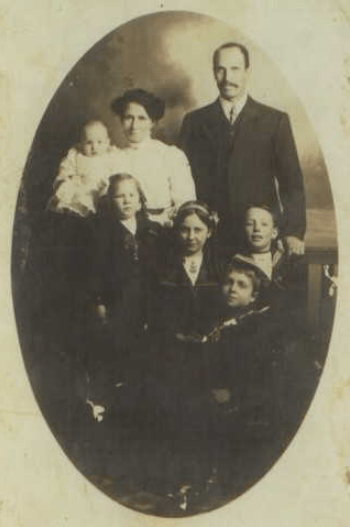
Here, from an online family tree, is baby Philip in his mother Neena’s arms, along with his father, James, and older siblings Evelyn, Raymond, Mervyn and Olive. Another boy, Edward, had sadly died when only a few months old.
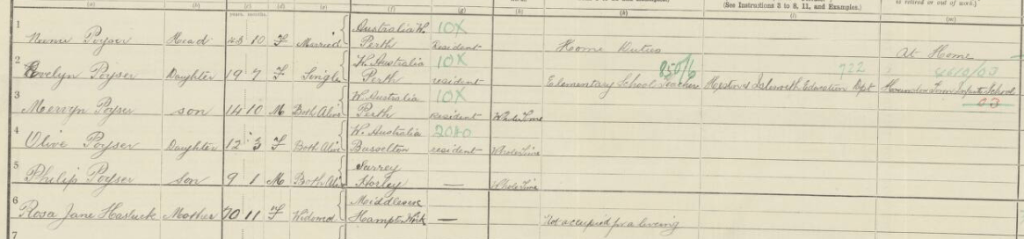
By 1921 the family were living at 53 Ailsa Avenue, St Margarets. James wasn’t at home, but his wife, mother-in-law, Evelyn (working as an elementary school teacher), Mervyn, Olive and Philip were all there. I suspect the marriage might have broken up, and there is evidence that James might have been living in North America.
Philip made an early appearance at the chessboard at the age of 15, here playing alongside Mervyn for Old Isleworthians against Old Richmondonians.
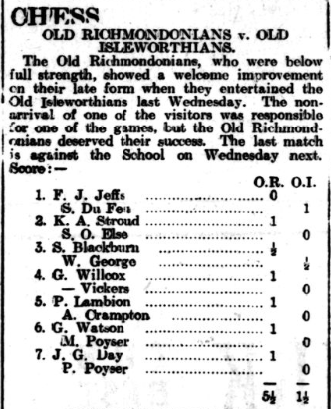
It must have been the Isleworth board 2 who failed to arrive, with S O Else, being ‘someone else’: later D E Fault would sometimes (fail to) make an appearance.
This suggests that Mervyn had previously been a pupil at what was then Isleworth Grammar School, and perhaps Philip was also a pupil there.
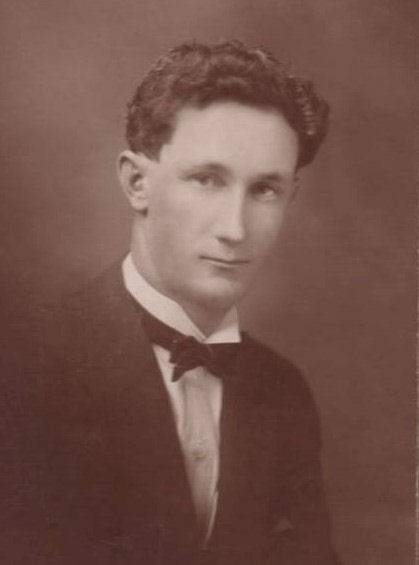
Here’s a photo of Philip Poyser as a young man.
By 1931 the family, with James (known in the family as Jim) having returned, had moved to what must have been a newly built house, 57 Kneller Gardens, Isleworth, very close to what is now the Allianz Stadium, the home of Rugby Union, as well as to the eponymous Kneller Hall, for many years the home of the Royal Military School of Music, but now being developed as an independent school scheduled to open in September 2027.
The 1939 Register records Philip as living in an apartment at 2 Mount Ararat Road Richmond, working as an artist and art teacher. This is just a short walk from the Red Cow, where I would first meet him getting on for 30 years later.
Up to this point I can find no further reference of him as a chess player, but I’d imagine he was probably involved in the London chess café life, something which would have suited his temperament.
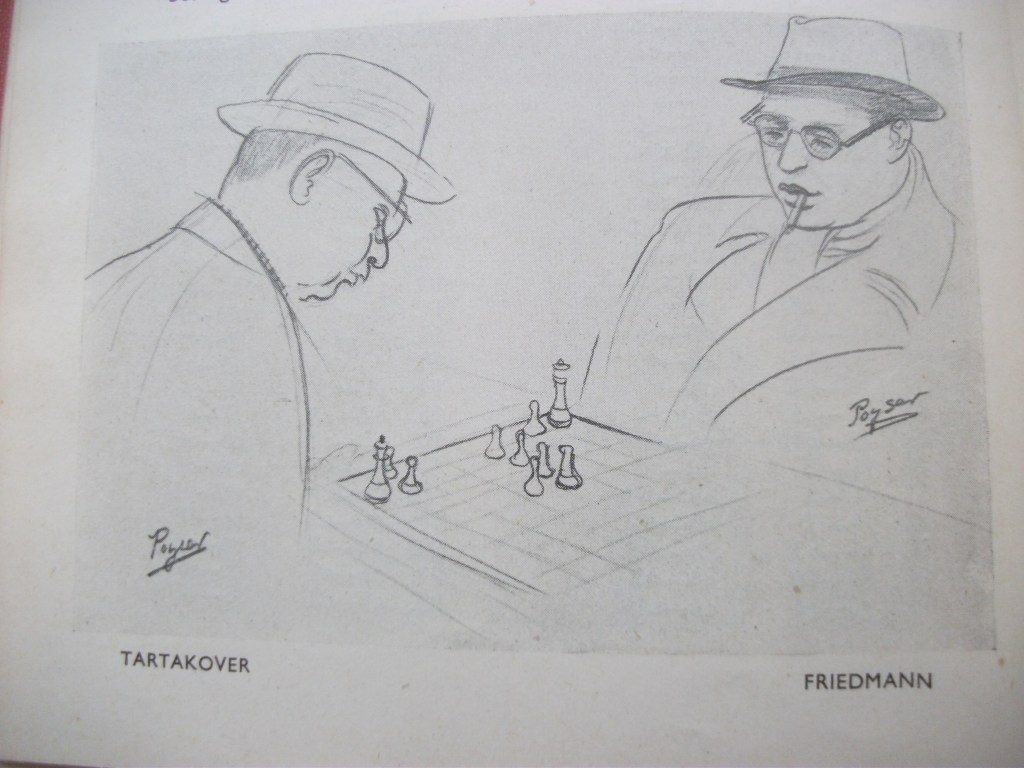
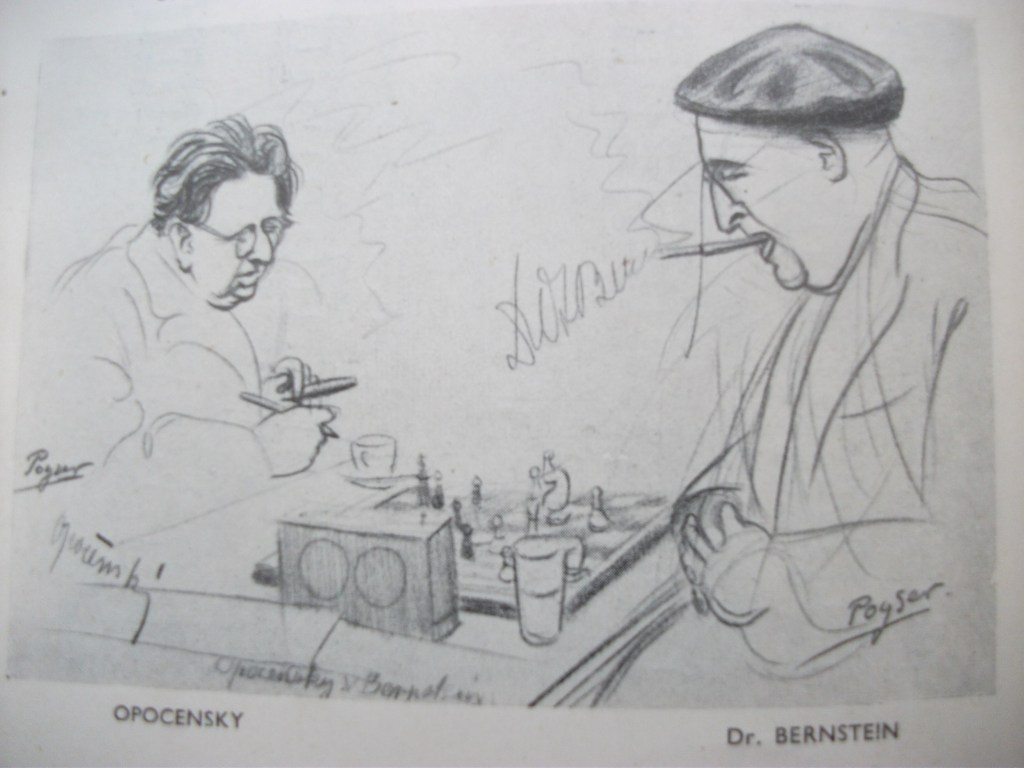
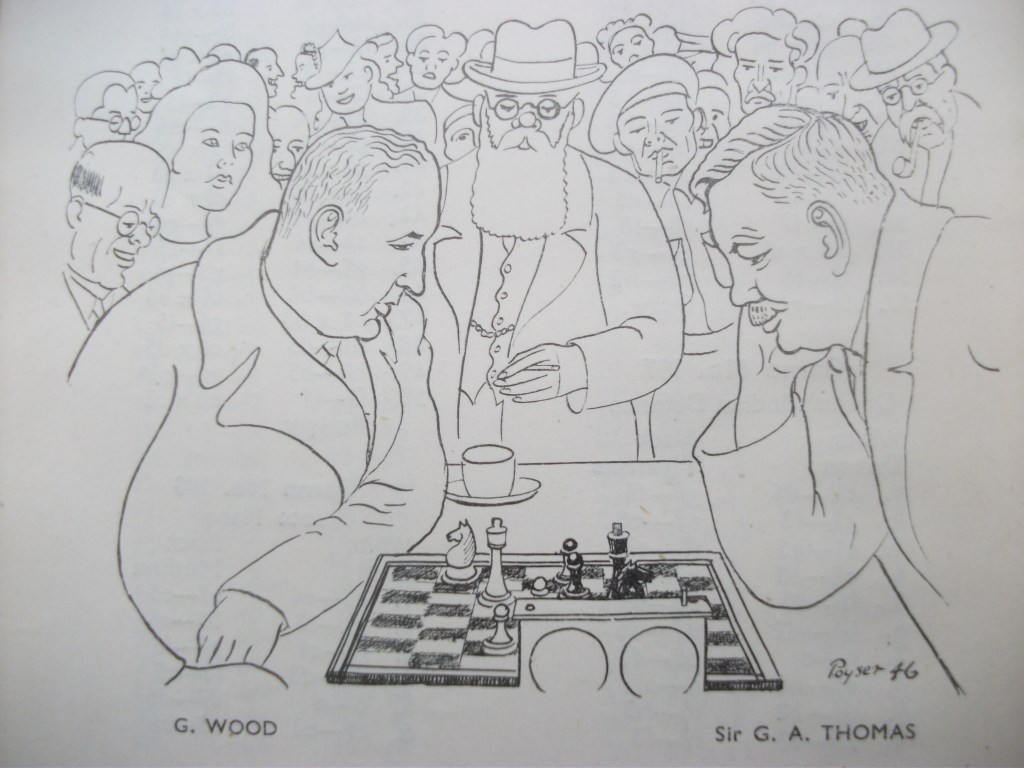
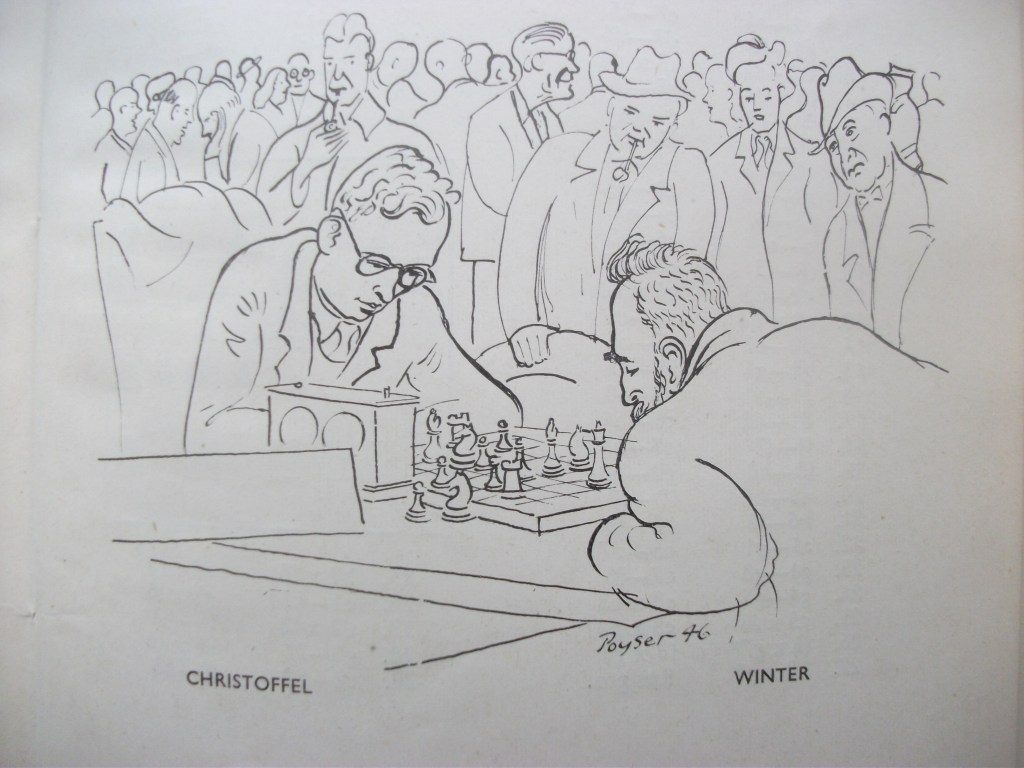
In January 1946 an international tournament took place in London, celebrating the return of competitive chess after the war.
A tournament book was published including sketches of some of the participants. One of the artists involved was Philip Poyser.
Atmospheric drawings redolent of a bygone age by an artist of considerable talent, I think you’ll agree.
Around that time Poyser joined the venerable Lud-Eagle Club, as he related almost 30 years later.
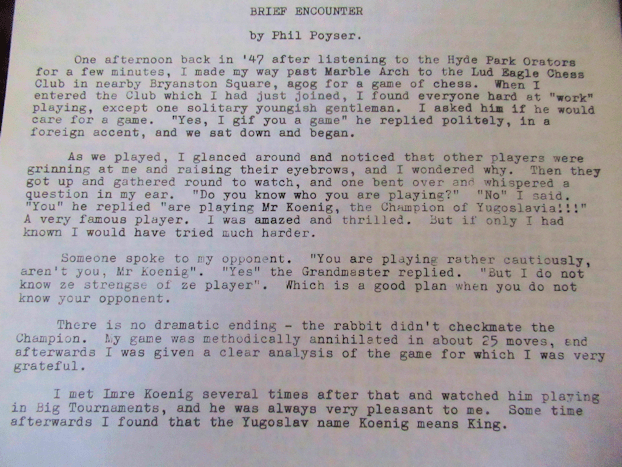
(This and the three following articles were first published in RaT, the club magazine which ran for a few years under my editorship in the mid 1970s.)
As Koenig had taken part in the London 1946 tournament it might be surprising that Philip hadn’t recognised him. Perhaps, then, this incident might have taken place earlier, perhaps late 1945.
In 1948 Philip married Peggy Baron Hill, also of an artistic bent, but her major interest was music: she was a pianist and singer as well as doing clerical work for her father’s cutlery and fancy goods business.
Here she was, for example, entertaining the disabled ex-servicemen at the Royal Star and Garter Home with Chopin’s Minute Waltz.
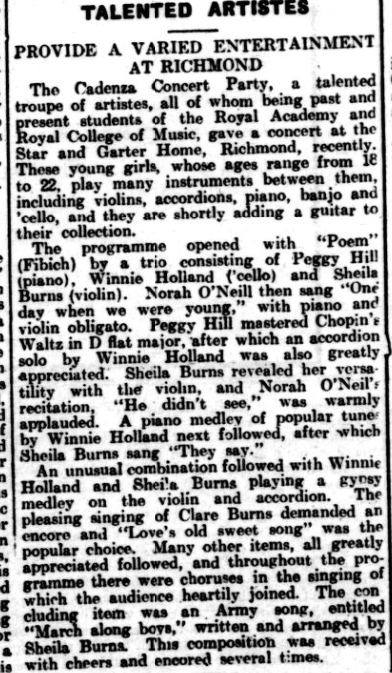
There were no children from the marriage, but they lived together happily for forty years, at first with Philip’s parents, where Jim died in 1950 followed by Neena in 1952. By 1955 they’d moved a mile or so south (via Redway Drive) from a road called Kneller Gardens in Isleworth to 68 Mereway Road, Twickenham, just a few yards from a park called Kneller Gardens, where they would remain for the rest of their lives. My recollection is that I only visited once, and the interior was as chaotic as you would imagine.
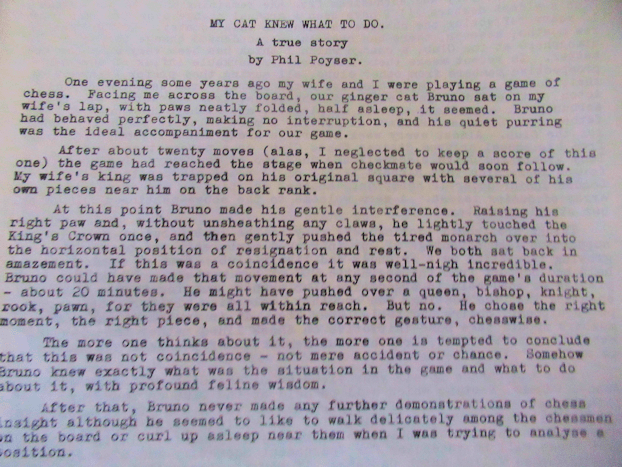
As well as their art and music, Peggy also enjoyed playing chess against Philip, with some assistance from Bruno the cat, as Phil later recalled.
In 1956 Poyser had two more sketches of chess players published, capturing Darga and Korchnoi in action at Hastings.
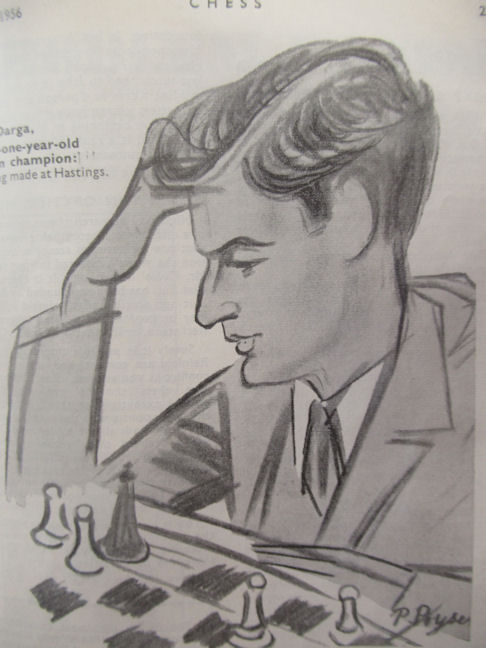
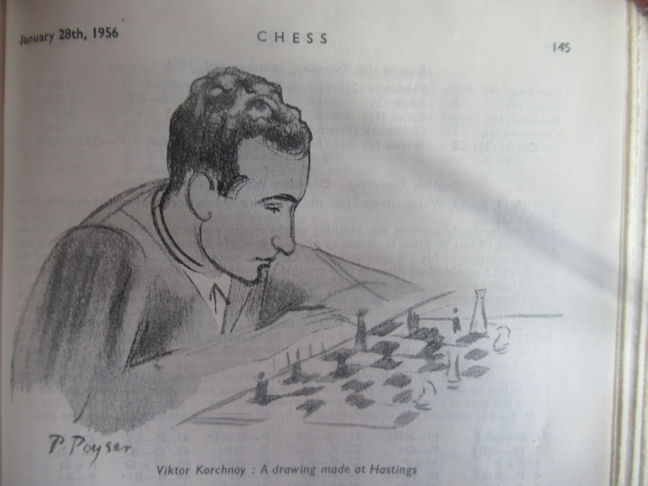
I’m not sure when Philip Poyser joined Richmond & Twickenham Chess Club, or whether he was a member of Twickenham before their amalgamation in the 1950s. I have a vague recollection that he might have joined just after me, in the mid 1960s, but it could have been earlier. I haven’t found any records of him playing for the club before then.
At this time he took an interest in chess problems, combining with chess playing bus driver Ralph Gunning to produce a composition you can find in this article.
By the late 1960s he was throwing himself into chess with a passion, taking part in the burgeoning London congress scene as well as playing regularly for Richmond & Twickenham.
In one of these congresses he was surprised by a sudden explosion coming from his table.
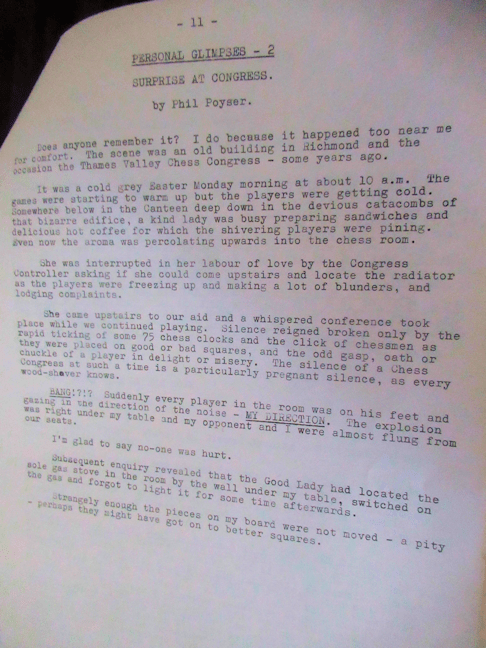
We met over the board in three competitive games during that period, two in congresses and one in a club competition.
Our first game was played in the First Class C section of the Thames Valley Congress, held, perhaps in the old Richmond Community Centre (there’s a Waitrose there now) at the end of August 1968. This might have been the congress referred to above, but I don’t remember an explosion.
[Event “Thames Valley Congress First Class C: Round 1”].
[Date “1968.08.29”]
[White “James, Richard”]
[Black “Poyser, Philip Leighton”]
[Result “1/2-1/2”]
1. e4 e5 2. Nf3 Nc6 3. Bb5 a6 4. Ba4 b5 5. Bb3 Nf6 6. O-O d6 7. Re1 Bg4 8. d3 Nd4 9. Nbd2 Be7 10. c3 Ne6 11. Nf1 O-O 12. Ne3 Bh5 13. Nf5 Re8 14. Nxe7+ Rxe7 15. h3 Nf4 16. Bxf4 exf4 17. Qd2 Bxf3 18. gxf3 Nh5 19. Kh2 c6 20. Rg1 g6 21. Rg5 Re5 22. Rxe5 dxe5 23. d4 Qc7 24. dxe5 Rd8 25. Qe2 Qxe5 26. Rd1 Rxd1 27. Qxd1 Qe7 28. Qd2 g5 29. a4 Nf6 30. Qd4 c5 31. Qd1 h5 32. Qg1 Qe5 33. Qd1 c4 34. Bc2 g4 35. Qg1 bxa4 36. Bxa4 Kf8 37. hxg4 hxg4 38. fxg4 f3+ 39. Qg3 Nxg4+ 40. Kg1 Qxe4 41. Qd6+ Kg7 42. Qd4+ Qxd4 43. cxd4 Kf6 44. Bd1 Ke6 45. Bxf3 Nf6 46. Kg2 Nd5 47. Bg4+ f5 48. Bd1 Nf4+ 49. Kf3 Nd3 1/2-1/2
Phil completely outplayed me here, but generously agreed a draw in a totally won position.
Today, if you’re not a grandmaster by 18 you’re nothing, but back then I was still a pretty inexperienced player.
We met again in the Hammersmith Congress the following Easter, when I was home from college. This took place at the old Town Hall, very close to my old school in King Street. Again, we were assigned to the same all-play-all section, this time the Main K. Again I had White, opening 1. e4, but this time he chose a different defence, with less success.
[Event “Hammersmith Congress Main K: Round 3”]
[Date “1969.04.05”]
[Round “3”]
[White “James, Richard”]
[Black “Poyser, Philip Leighton”]
[Result “1/2-1/2”]
1. e4 d6 2. d4 Nf6 3. Nc3 g6 4. f4 Bg7 5. Nf3 e6 6. e5 dxe5 7. fxe5 Nd5 8. Bc4 c6 9. Nxd5 cxd5 10. Bd3 Nc6 11. c3 O-O 12. Qc2 Ne7 13. g4 f5 14. g5 b6 15. h4 a5 16. Qh2 Rf7 17. h5 Bh8 18. hxg6 Nxg6 19. Nh4 Nxh4 20. Qxh4 Raa7 21. Qh5 Rg7 22. Bf4 Bd7 23. O-O-O Be8 24. Qh2 b5 25. Kb1 b4 26. c4 a4 27. c5 b3 28. a3 Bg6 1/2-1/2
This time I generously (or more likely foolishly) agreed a draw in a winning material. I must have thought the position was too blocked for me to make progress, but my computer tells me White has a winning attack after Be2 followed by Rd3 and Rh3.
We met for the third time that summer in the club handicap tournament: this would still have been at the Red Cow. I don’t recall what the handicap was, but it wouldn’t have been a 19th century handicap tournament or a time handicap tournament. For the third time I had the white pieces, and again he chose a different defence to my 1. e4.
[Event “Richmond Handicap Tournament: Round 3”]
[Date “1969.07.17”]
[White “James, Richard”]
[Black “Poyser, Philip Leighton”]
[Result “1-0”]
1. e4 c5 2. Nf3 Nc6 3. d4 cxd4 4. Nxd4 e5 5. Nb5 d6 6. c4 a6 7. N5c3 Nf6 8. h3 Be7 9. Na3 O-O 10. Nc2 Ne8 11. Ne3 Nd4 12. Ned5 f5 13. Be3 fxe4 14. Bxd4 exd4 15. Qxd4 Bf6 16. Nxf6+ Nxf6 17. O-O-O d5 18. Nxd5 Nxd5 19. Qxd5+ Qxd5 20. Rxd5 Rxf2 21. Rd8+ Rf8 22. Rxf8+ Kxf8 23. g4 Bd7 24. Bg2 Rc8 25. b3 b5 26. Bxe4 bxc4 27. Rf1+ Kg8 28. Bd5+ Kh8 29. Bxc4 Bb5 30. Kb2 Bxc4 31. bxc4 g6 32. Kc3 Kg7 33. Kd4 Rd8+ 34. Ke3 Re8+ 35. Kf3 Kf6 36. Kg3+ Kg7 37. Rc1 Re3+ 38. Kh4 Kf6 39. g5+ Ke5 40. c5 Re4+ 41. Kg3 Kd5 42. c6 Re3+ 43. Kf4 Re4+ 44. Kf3 Re8 45. c7 Rc8 46. h4 Kd6 47. Ke4 a5 48. Rc4 Ke6 49. Rc6+ Kd7 50. Kd5 a4 51. Rd6+ Kxc7 52. Rc6+ Kd7 53. Rxc8 Kxc8 54. Kc4 Kd7 55. Kb4 a3 56. Kxa3 Ke6 57. Kb4 Kf5 58. a4 Kg4 59. a5 Kxh4 60. a6 Kxg5 61. a7 h5 62. a8=Q Kg4 63. Qe4+ Kh3 64. Qxg6 Kh4 65. Kc4 1-0
On move 28 he went the wrong way with his king: Ke8 would have been level. I made a similar error on move 38: Kf4 heading to the centre was winning, but he made the final error on move 40: Kf4 would have boxed in my king, forcing me to give up the c-pawn to prevent mate. A quick sample variation: 40… Kf4 41. c6 Kf3 42. Rc4 Re5 43. c7 h6 44. Rg4 Rc5 with equality.

Here he is, again from an online family tree, snapped at the Dungeon Club in Nottingham in the late 1960s.
About this time Alan May ran a club newsletter, which published this game. There’s no indication of exactly when or where it was played but I’d imagine in a local weekend congress. His opponent didn’t put up much resistance.
[Event “Thames Valley Congress?”]
[Date “1970.??.??”]
[White “Elgy, Leslie Valentine Robert”]
[Black “Poyser, Philip Leighton”]
[Result “0-1”]
1. d4 e6 2. e3 d5 3. Nd2 c5 4. c3 c4 5. Ngf3 Nc6 6. Be2 Bd6 7. O-O Qc7 8. g3 h5 9. b4 Nf6 10. Nh4 g5 11. Ng2 h4 12. Ne1 hxg3 13. fxg3 Bxg3 14. Rf3 Bxh2+ 15. Kf2 Ng4+ 16. Kg2 f5 17. Nf1 Bd7 18. Ng3 Bxg3 19. Rxg3 Rh2+ 20. Kf3 Rf2#
After a gap of a few years, I revived the club magazine, and Phil submitted this game he’d played a couple of years earlier, culminating in a brilliant queen sacrifice.
[Event “RTCC Summer Tournament”]
[Date “1972.??.??”]
[White “Poyser, Philip Leighton”]
[Black “Goldschmidt, Martin”]
[Result “1-0”]
1. e4 Nf6 2. e5 Nd5 3. Nc3 e6 4. Nf3 d6 5. d4 Nc6 6. Bc4 Nb6 7. Bb5 Be7 8. Bf4 a6 9. Bd3 Nd5 10. Nxd5 exd5 11. Qd2 dxe5 12. dxe5 O-O 13. h4 f6 14. exf6 Bxf6 15. O-O-O Bg4 16. Bg5 g6 17. Rhe1 Bxf3 18. gxf3 Bxg5 19. hxg5 Rxf3 20. Re2 Qd7 21. Rde1 Raf8 22. Be4 R3f4 23. Bxd5+ Kh8 24. Qxf4 Rxf4 25. Re8+ Kg7 26. Rg8#
His opponent in this game, Martin Goldschmidt, was a talented junior who dropped out of chess on leaving school, later finding fame in the music industry, co-founding the Cooking Vinyl record label where he worked with artists such as Billy Bragg. He seems to have resumed his chess career recently, playing in Devon and sporting a highly respectable rating round about 2000.
These games suggest that, given the opportunity, Phil was a formidable attacking player, but perhaps endings were not his strongest suit.
We never met again in serious competitions, but played many friendly games over the years. I can recall one in which I equalled a world record by forming a pawn chain right across the board from the 2nd to the 7th ranks.
His rating for many years was in the 130s: about 1700 today, a decent average club player who remained active almost to the end of his life. Unfortunately, I have no further game scores for him from this period.
He was an organiser as well, captaining our C team in the Thames Valley League for several years. But his most important contribution to chess, in my opinion, was his organisation of our annual match against Broadmoor, then described as a hospital for the criminally insane.
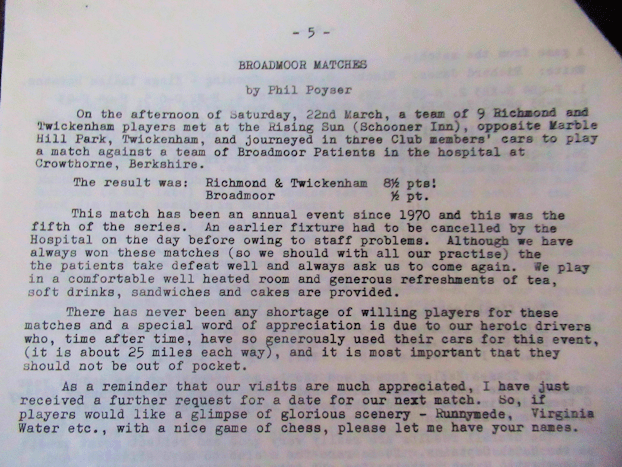
I hope to write much more about chess in Broadmoor in a future Minor Piece, but if you’re interested I’d strongly recommend this series of articles, with a further episode here, written by my friend Martin Smith.
Martin, who is, unlike me, an art connoisseur, has also written, back in 2013, about Philip Poyser’s art here.
Next time I’ll write more about this side of his life, as well as about the fascinating story of the wider Poyser family.
But for now I’ll leave you with some of the comments on Martin’s post.
Peter Sowray, who knew Phil at Richmond & Twickenham Chess Club back in the 1970s wrote “Nice man, Phil Poyser“, to which I added “Yes, Phil was a very nice man: always friendly and with never an unkind word for anyone. Fondly remembered by everyone at R&TCC in the 60s and 70s.”
It wasn’t only the chess community who noted Martin’s article.
“I was Phil’s next door neighbour in Mereway Road through the 70s, a child then but he was as everyone says a true gentleman, softly spoken and a bohemian.”
I was also Phil Poyser’s neighbour in Mereway Road from approx 1952 – 1967. A wonderful man, dedicated to his art. He rode a motorbike, as did my father, and they both broke down frequently. I remember the smell of oil paint always with him, and I & my family have 2 of his paintings, the London Apprentice at Isleworth and the Thames, I believe between Twickenham & Richmond.
It says much for Philip Poyser that, many years after his death in the summer of 1988, his former neighbours were still searching out his name and remembering him so fondly.
Here was a man who, after a brief childhood dalliance, took up competitive chess in middle age, gaining a lot of satisfaction from the game, but also giving a lot back.
Phil made the world, and the chess world, a better place and, almost 40 years since he made his final move, is still remembered by many today.
For several decades now we’ve been focusing on grandmasters, champions and prodigies at the expense of average club players like Philip Poyser. Stepping back, taking a different perspective will perhaps do much to strengthen the wider chess community.
Sources and Acknowledgements
ancestry.co.uk/Poyser family trees
findmypast.co.uk/British Newspaper Library
Wikipedia
Google Maps
Streatham & Brixton Chess and Lost on Time Blogs
Richmond & Twickenham Chess Club archives


 Minor Pieces
Leave a comment