In the heady early years of the Ladies’ Chess Club in London, back in the mid 1890s, their teams were often headed by the F Squad: four players whose names all began with that letter.
They usually played Mrs (Louisa Matilda) Fagan on top board, followed by Miss (Gertrude Alison) Field, later Mrs Donald Anderson, on board 2, Miss (Kate Belinda) Finn on board 3 and Miss (Rita) Fox on board 4.
Rita Fox is something of an enigma. We don’t know for certain when she was born, what her birth name was or who her parents were.
Names are important and often provide family historians with useful information. What, I wonder, comes to mind when you hear the name Rita?
If you’re from my generation you might think of a Lovely Meter Maid, or a hairdresser educated by Michael Caine. Today, you might think of Rita Ora, but she was born in Kosovo to Albanian parents. My parents’ generation would have thought of Rita Hayworth, who was actually Margarita.
That’s how the name came about, as a pet form of Margarita, or of other versions of Margaret. It started becoming popular as a distinct name in the USA in the 1890s, spreading to England in the early 20th century where it enjoyed several decades of popularity before fading again.
The first Rita Fox in England was born in 1906, and the first Rita James in 1902. The chess playing Rita, though, was born in the mid 1860s, with no obvious birth record.
We can pick her up in the 1891 census, a few years before the start of her chess career, living in a large house near Ilford in East London.

Here we have Margaret C Fox, aged 25 and her sister Rita, aged 24, living with an adopted 7 year old boy, two servants and a visitor, Herbert Barrow, who would later marry their sister Mary.
We also know from Rita’s newspaper marriage announcement (we’ll come to that much later) that she was the youngest daughter of Charles James Fox, who was a dental surgeon.
We can spin back 20 years, to the 1871 census.

Here’s they are, living not very far from me in Barnes. The head of the household, born in Falmouth, is EA (Elizabeth Anna) Fox, the wife of a dental surgeon, along with a son, William H, aged 7, a daughter, Margaret C and an adopted child Anne M, both aged 6. Anna Carkeet, also living there, is Elizabeth’s sister.
It seems possible that Anne M Fox later changed her name to Rita, perhaps also taking a year or two off her age.
The Foxes were a prominent Quaker family from Cornwall who are well worth investigating. Note that they are unrelated to George Fox, the founder of Quakerism. Let’s travel back a few hundred years and relate something of their story.
This family can be traced back to another George Fox (1693-1756) and his wife Anna Debell, who had a very large family. One of his sons was Joseph (1729-1785), who married Elizabeth Hingston: they also had a very large family.
Their oldest son, also Joseph (1758-1832), was an apothecary and physician who also had business interests in London along with a friend named Richard James. No, not me, nor any relation to me. He married a second cousin, Elizabeth Peters, and had four children, but she wasn’t their mother. These children were named Emily, Mary James, Sophia James and Charles James. The use of James for a middle name indicates that the three youngest children were almost certainly the children of a sister, daughter or other relation of Richard James. You can find out more about Joseph here. The Quakers didn’t approve of family arrangements of this nature, so Joseph left the Society of Friends and joined the Roman Catholic church instead.
His son, Charles James Fox (1799-1874), also became a doctor. His wife was Anne Mary Guion, and they had five sons and a daughter. It’s his oldest son, another Charles James Fox (1829-1895) who interests us. He continued the family medical tradition, becoming not just a dentist but a pioneer of modern dental surgery (AI will tell you more).
His wife was Elizabeth Anna Carkeet (1828-1890): her unusual surname originates in Cornwall where, also coming from a privileged Quaker background, she would have moved in the same circles as the extended Fox family.
We can pick them up in the 1861 census, in Mortimer Street in the heart of London, just north of Oxford Street. Along with Charles and Anna were their three children, a third Charles James, aged 5, a second Elizabeth Anna, aged 3, and 1-year-old Francis John. Another daughter, Mary Theodora, would be born seven weeks later. Anna’s brother William is there along with a dental assistant, two visitors, one a medical student, and four servants. Here was a young ,prosperous and ambitious family.
But by 1871, as you’ve already seen, something had gone wrong. The family had moved out of London to suburban Barnes, and could only afford the one servant. Elizabeth is now the head of the family, with additional children William Henry, aged 7, Margaret Carkeet, aged 6, and an adopted daughter, Ann M, also aged 6. Their oldest daughter had sadly died in 1863, but there’s no obvious sign of the three older surviving children anywhere. I’d guess they were away at school.
Another mystery is that the births of only three of their children, Charles, Elizabeth and Mary, seem to have been registered. I wonder why. Negligence or some other reason?
A plausible guess as to what had happened is that Charles senior had a mistress who gave birth to a daughter at roughly the same time that Elizabeth gave birth to Margaret, that this was Ann M Fox, who later changed her name to Rita.
Meanwhile, he later turned up in 1891 in Gravenhurst, Ontario, with a much younger English wife, Agatha, who seems to have been born in Reading.
The 1881 census found Elizabeth in Fulham: Charles junior, working as a dental editor, Mary and Margaret were all at home, along with three young men boarding there, one of whom would later marry Mary, and a servant. Mary had no occupation listed, while Margaret was studying. There’s no sign of anyone named Ann or Rita.
You’ve seen the 1891 census above: Margaret has deducted a year from her age, and Rita, her sister, perhaps two years. If they were half-sisters of the same age it’s understandable that they might have wanted to falsify their ages. You’ll also see that they were born in the same place: Cavendish Square.
I have no idea when, how and why Rita Fox learnt chess, but she was one of the first members of the Ladies’ Club in 1895, rapidly becoming established as one of their strongest players.
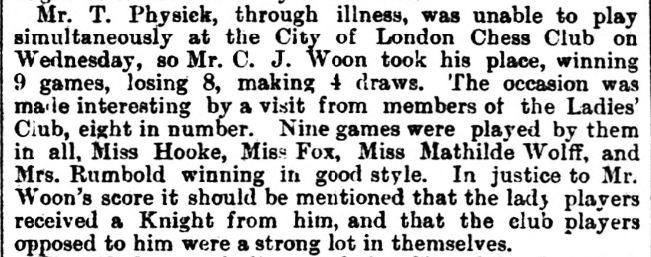
Here she is, winning a game in a simul, admittedly starting with an extra knight.
It wasn’t long before she had her first game published.
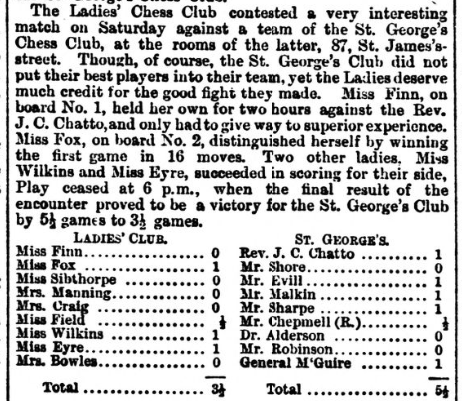
The report was incorrect: Miss Fox won her game in only 13 moves: Mrs Gunsberg’s new column in the Lady’s Pictorial, which featured many games played by female players along with problems by female composers, provided the game score.
[Event “Ladies’ Club v St George’s”]
[Date “1895.07.13”]
[White “Fox, Rita”]
[Black “Shore, Mr”]
[Result “1-0”]
{Source: Lady’s Pictorial 20 July 1895} 1. e4 e5 2. d4 exd4 3. Nf3 Nc6 4. Bc4 d6 5. Nxd4 Nxd4 6. Qxd4 Qf6 7. Be3 Ne7 8. Nc3 c6 9. O-O-O Ng6 10. g3 Bg4 11. e5 dxe5 12. Qxg4 h6 13. Qd7#
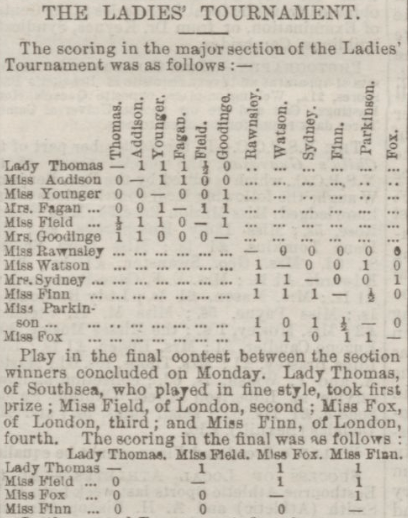
That summer, as you might have seen in previous articles, a ladies’ tournament was held in conjunction with the great Hastings Congress.
Finishing second behind Kate Finn in her section qualified her for the final: you can see the results here.
07 September 1895
Here’s her win against Miss Finn in the final pool. A nice finish, to be sure, but I’m not impressed with White’s 4th move, nor do I understand why neither player noticed the possibility of 29. Bxd5.
[Event “Ladies’ Tournament: Hastings”]
[Date “1895.08.??”]
[White “Finn, Kate Belinda”]
[Black “Fox, Rita”]
[Result “0-1”]
{Source: Lady’s Pictorial 28 September 1895} 1. e4 e5 2. Nf3 Nc6 3. Nc3 Nf6 4. Ng5 d5 5. Bb5 Be7 6. Bxc6+ bxc6 7. exd5 Nxd5 8. Nf3 Bg4 9. d3 Bb4 10. Bd2 O-O 11. h3 Bh5 12. O-O f6 13. a3 Bxc3 14. bxc3 Qd6 15. c4 Ne7 16. Re1 c5 17. Rb1 Nc6 18. g4 Bg6 19. Qe2 Rae8 20. Be3 h5 21. Nh4 f5 22. Nxg6 Qxg6 23. Bxc5 Rf7 24. f3 hxg4 25. fxg4 Qg5 26. Be3 f4 27. Bf2 f3 28. Qe4 Nd4 29. Re3 Kf8 30. Rf1 Rf4 31. Qh7 Rxg4+ 32. Kh2 Rg2+ 0-1
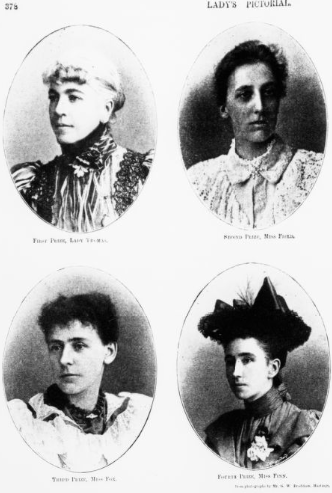
The Lady’s Pictorial provided photographs of the finalists: Rita Fox is in the South West corner.
On 17 April 1896 World Champion Lasker visited London for a simul. Four members of the Ladies’ Chess Club took part, with Rita managing to draw her game.
Let’s have a look.
[Event “Simul: Criterion, London”]
[Date “1896.04.17”]
[White “Lasker, Emanuel”]
[Black “Fox, Rita”]
[Result “1/2-1/2”]
{Source: Lady’s Pictorial 16 May 1896} 1. e4 e5 2. f4 d5 3. Nf3 Nc6 4. exd5 Qxd5 5. Nc3 Qd8 6. fxe5 Bc5 7. Bb5 Bd7 8. d4 Bb6 9. Be3 Nge7 10. Qd2 Nf5 11. Bf2 O-O 12. O-O-O a6 13. Bxc6 bxc6 14. Ne4 Be6 15. g4 Ne7 16. Bh4 Kh8 17. Neg5 Qd5 18. Qd3 Ng6 19. b3 a5 20. a4 h6 21. Nxe6 Qxe6 22. Bf2 {Adjudicated a draw} 1/2-1/2
In those days simul givers were often generous towards their lady opponents and that seems to have been the case here. Miss Fox was clearly losing from the opening, and, when time was called, was a pawn down in a bad position. I suspect Lasker’s adjudication might have been different had he been playing a gentleman.
That summer there was a major international tournament in Nuremberg, and a number of ladies, including Miss Field and Miss Fox, went along to watch. While they were there they played an informal match. Miss Field was successful, but Rita Fox won this game.
[Event “Informal match: Nuremberg”]
[Date “1896.08.??”]
[White “Field, Gertrude Alison”]
[Black “Fox, Rita”]
[Result “0-1”]
{Source: Lady’s Pictorial 19 September 1896} 1. e4 e5 2. Bc4 Nf6 3. d3 d5 4. exd5 Nxd5 5. Qf3 Be6 6. Nc3 c6 7. Nge2 Bd6 8. Nxd5 Bxd5 9. Qg4 O-O 10. Bh6 Qf6 11. Bg5 Qg6 12. Bxd5 cxd5 13. Qg3 f5 14. f4 Nc6 15. fxe5 Bxe5 16. Bf4 Qxg3+ 17. hxg3 Bxb2 18. Rb1 Bd4 19. Rxb7 Bb6 20. Kd2 Rae8 21. Rd7 d4 22. Bd6 Rf6 23. Ba3 Rfe6 24. Nf4 Re3 25. Nh5 Ba5+ 26. c3 dxc3+ 27. Kc2 Rb8 28. Nxg7 Re2+ 29. Kc1 c2 30. Bb2 Bc3 0-1
The visiting ladies also had the opportunity to take on some of the masters in casual encounters. In this game Miss Fox beat none other than Carl Schlechter after her opponent sacrificed unsoundly on move 23.
[Event “Casual game: Nuremberg”]
[Date “1896.08.??”]
[White “Fox, Rita”]
[Black “Schlechter, Carl”]
[Result “1-0”]
{Source: Lady’s Pictorial 18 December 1896} 1. e4 d5 2. Nc3 d4 3. Nce2 e5 4. d3 f5 5. Ng3 f4 6. N3e2 Nf6 7. Nf3 Bd6 8. c3 c5 9. cxd4 cxd4 10. Qb3 Nc6 11. Ng5 Qe7 12. g3 h6 13. Nf3 g5 14. gxf4 gxf4 15. Nh4 Be6 16. Qa4 O-O 17. Ng6 Bb4+ 18. Kd1 Qd6 19. Rg1 Kh7 20. Nxf8+ Rxf8 21. a3 b5 22. Qc2 Ba5 23. b4 Bxb4 24. axb4 Nxb4 25. Rxa7+ Kh8 26. Qc7 Bb3+ 27. Kd2 Qxc7 28. Rxc7 Nxd3 29. Kxd3 Bc4+ 30. Rxc4 bxc4+ 31. Kxc4 Nxe4 32. Kd5 Nxf2 33. Kxe5 f3 34. Nxd4 Nd1 35. Bxh6 Re8+ 36. Ne6 f2 37. Bg7+ Kg8 38. Rg3 Nb2 {and White wins in four} 1-0
This inter-club game gave her the chance to demonstrate her endgame skills after both players missed 23. e6, taking advantage of Black’s king in the centre.
[Event “Ladies’ Club v Hampstead III B2”]
[Date “1896.10.12”]
[White “Allen, H W”]
[Black “Fox, Rita”]
[Result “0-1”]
{Source: Lady’s Pictorial 31 October 1896} 1. e4 e5 2. Nc3 Nf6 3. f4 d5 4. fxe5 Nxe4 5. Qf3 Nxc3 6. bxc3 Qh4+ 7. g3 Qe4+ 8. Qxe4 dxe4 9. Bg2 Bf5 10. Ne2 Nc6 11. Nd4 Nxd4 12. cxd4 Rd8 13. c3 c5 14. Bb2 g6 15. O-O Bh6 16. Rad1 b6 17. h3 e3 18. dxe3 Bxe3+ 19. Kh1 Bc2 20. Rde1 cxd4 21. Ba3 Ba4 22. cxd4 Bxd4 23. Rf4 Bb5 24. Rd1 Bc5 25. Rxd8+ Kxd8 26. Bxc5 bxc5 27. Rxf7 a6 28. Bd5 h5 29. Kg2 c4 30. Rf3 Ke7 31. Rf6 c3 32. Rf2 Bd3 33. Bb3 Rc8 34. Bc2 Bxc2 35. Rxc2 Ke6 36. Kf3 Kxe5 37. Ke3 g5 38. Kd3 Rf8 {Adjudicated a win for Black} 0-1
The London Ladies were clearly making rapid progress, but they weren’t the only chess playing women around. A few days after the Hampstead match they visited Brighton where they lost, not for the first time, to an all-female team featuring Mrs Sidney.
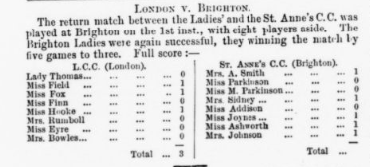
[Event “Ladies’ Club v St Anne’s Brighton B2”]
[Date “1896.10.15”]
[White “Parkinson, Marion”]
[Black “Fox, Rita”]
[Result “0-1”]
{Source: Lady’s Pictorial 17 October 1896} 1. e4 e5 2. Nf3 Nc6 3. Bc4 Nf6 4. Nc3 Bc5 5. d3 d6 6. h3 a6 7. Qe2 b5 8. Bd5 Nxd5 9. Nxd5 Be6 10. c3 Bxd5 11. exd5 Ne7 12. c4 O-O 13. O-O Nf5 14. Be3 Bxe3 15. fxe3 Ng3 16. Qf2 Nxf1 {and Black won} 0-1
Under the inspirational leadership of Rhoda Bowles the ladies were competitive and ambitious, even entering the London League, where they won most of their matches.
Their usual top four players were a class above the opposition.
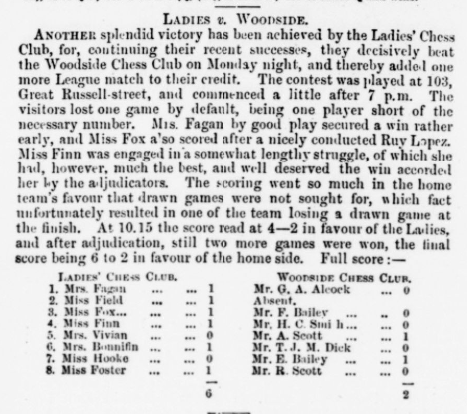
Here’s how Rita Fox won her game.
[Event “Ladies’ Club v Woodside”]
[Date “1896.12.??”]
[White “Fox, Rita”]
[Black “Bailey, F”]
[Result “1-0”]
{Source: Lady’s Pictorial 2 January 1897} 1. e4 e5 2. Nf3 Nc6 3. Bb5 Nf6 4. O-O a6 5. Ba4 Nxe4 6. Re1 Ng5 7. Bxc6 dxc6 8. Nxe5 Be6 9. d4 Bd6 10. Qh5 h6 11. Nf3 g6 12. Bxg5 gxh5 13. Bxd8 Rxd8 14. c4 Kf8 15. Nbd2 b5 16. b3 Be7 17. Re4 Bf6 18. Rae1 Rg8 19. Rf4 Rg6 20. Nh4 Bxh4 21. Rxh4 bxc4 22. Nxc4 Bd5 23. Ne3 Rg5 24. Rc1 Rd7 25. f4 Rg6 26. Rxh5 Be4 27. f5 Rg8 28. Rxh6 Rxd4 29. f6 Rd3 30. Re1 Rd2 31. g3 Rd6 32. Nc4 Rd4 33. Rh4 c5 34. Rhxe4 Rxe4 35. Rxe4 Rg5 36. Re5 Rxe5 37. Nxe5 1-0
The excitement continued unabated in 1897, with Miss Fox winning a game in which she took advantage of a tactical oversight.
The Lady’s Pictorial wasn’t the only publication reporting on their successes.
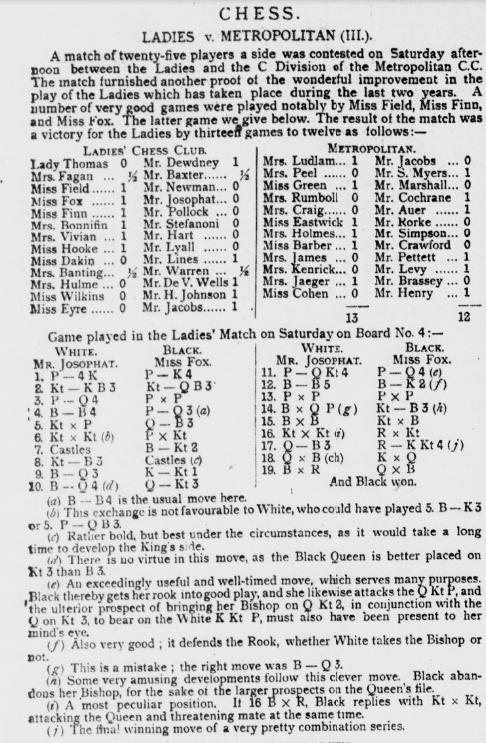
Here’s the game again.
[Event “Ladies’ Club v Metropolitan C Division”]
[Date “1897.02.27”]
[White “Josophat, Armin”]
[Black “Fox, Rita”]
[Result “0-1”]
{Source: Pall Mall Gazette 01 March 1897} 1. e4 e5 2. Nf3 Nc6 3. d4 exd4 4. Bc4 d6 5. Nxd4 Qf6 6. Nxc6 bxc6 7. O-O Bb7 8. Nc3 O-O-O 9. Be3 Kb8 10. Bd4 Qg6 11. b4 d5 12. Bc5 Be7 13. exd5 cxd5 14. Bxd5 Nf6 15. Bxe7 Nxd5 16. Nxd5 Rxd5 17. Qf3 Rg5 18. Qxb7+ Kxb7 19. Bxg5 Qxg5 {and Black won} 0-1
On 5 April the Ladies’ Club hosted two simultaneous displays on the same day, which the Lady’s Pictorial reported with its customary enthusiasm. In the afternoon the ‘young and talented’ Mr G A Thomas took on 14 opponents, winning 11 and losing three, to Mrs Fagan, Mrs Bowles – and his mother! Then, in the evening, veteran master Mr H E Bird faced 15 ladies, a contest ‘the single player treated with that chivalrous consideration to the fair sex for which he is famed, his chief object being not so much to make sure of winning every game, as to afford enjoyment to his opponents, by treating them to all sorts of fanciful attacks in which pieces flew about in all directions’. He lost three games to the F Squad, Mrs Fagan, Miss Field and Miss Fox, and drew two.
Against Miss Fox he lost a piece on move 9, whether deliberately or accidentally, rather than choosing the winning Bxb7.
[Event “Simultaneous Display”]
[Date “1897.04.05”]
[White “Bird, Henry Edward”]
[Black “Fox, Rita”]
[Result “0-1”]
{Source: Lady’s Pictorial 10 April 1897} 1. e4 e5 2. f4 exf4 3. Bc4 d5 4. Bxd5 Nf6 5. Nc3 Bb4 6. Qf3 Bd6 7. d4 Bg4 8. Qf2 Qe7 9. Bd2 Nxd5 10. Kf1 Nxc3 11. Bxc3 O-O 12. e5 Bb4 13. Qxf4 Bh5 14. Nf3 f6 15. Re1 fxe5 16. Qe4 Nd7 17. Qxb7 Bxc3 18. bxc3 Rab8 19. Qxc7 Bxf3 20. gxf3 Rxf3+ 21. Ke2 Rbf8 22. Kd1 e4 23. Qxa7 e3 24. Qa5 Qe4 25. Re2 Rf1+ 26. Rxf1 Rxf1+ 27. Re1 Qf3+ 0-1
Meanwhile, preparations were going ahead for the ambitious International Ladies’ Tournament which took place in London in early summer.
Here, again, are the players, with Rita Fox seated on the floor on the left, wearing her trademark hat.
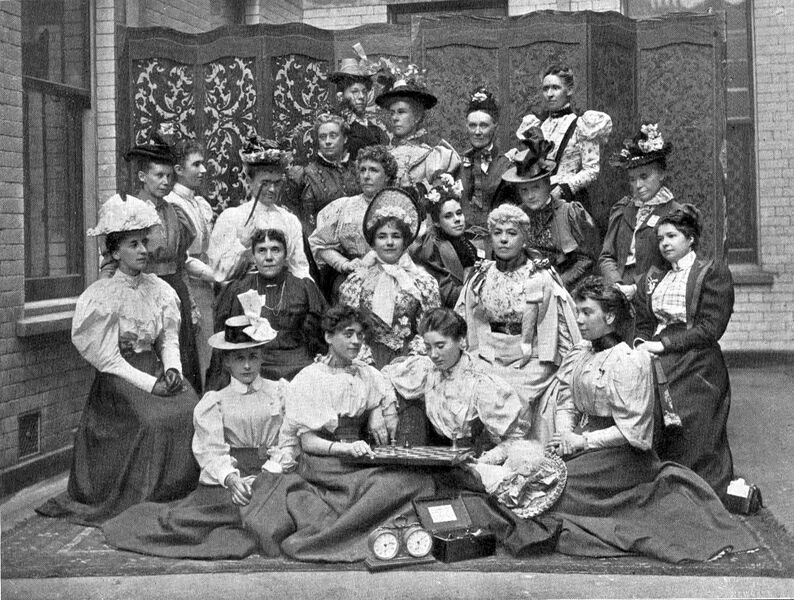
Upper row (from left to right): Madame Marie Bonnefin, Miss Alice E. Hooke, Miss G. Watson, Miss Eliza M. Thorold, Miss Forbes-Sharp; second row: Miss Mary Rudge, Miss Kate B. Finn, Mrs. Anna S. Stevenson, Madame de la Vingne, Miss A.M. Gooding, Miss Müller-Hartung, Mrs. F. Sterling Berry; third row: Miss Gertrude Field, Mrs. Harriet J. Worrall, Mrs. Rhoda A. Bowles, Lady Edith M. Thomas, Mrs. Louisa M. Fagan; fourth row: Miss Rita Fox, Miss Anna Hertzsch, Miss Eschwege, Mrs. E.H. Sidney.
The crosstable again (note that Miss Field later became Mrs Anderson and appears here under her married name):
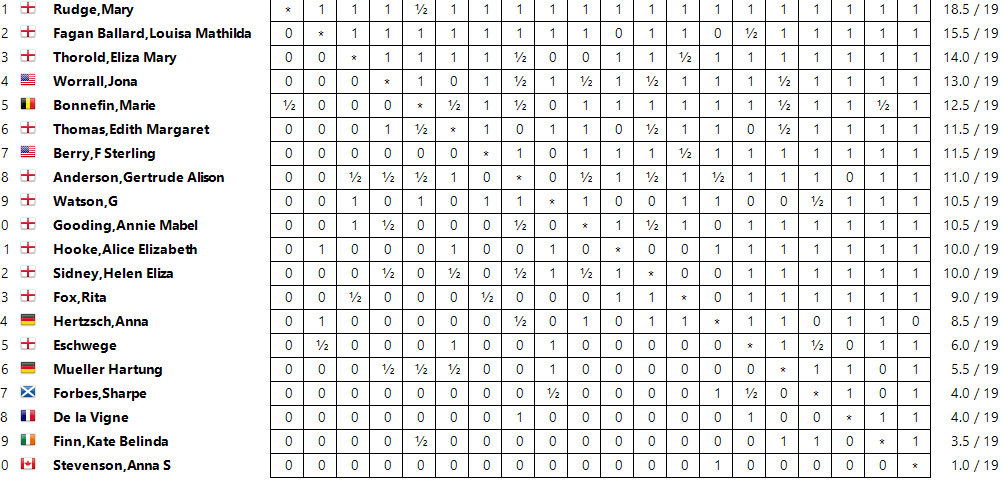
She would probably have been slightly disappointed with her performance, finishing below several ladies who played on lower boards in club matches.
Only one of her games has survived in full: her first round defeat at the hands of Marie Bonnefin, where she blundered a rook in a level position.
By now she had taken on the demanding role of Match Captain at the Ladies’ Club. The Lady’s Pictorial (27 November 1897) reported that ‘this lady fulfils her new duties of match captain of this club with an amount of zeal and discretion which has given general satisfaction. Captain Fox’s generalship has been fairly successful up to the present as far as the match results are concerned.’ General satisfaction? Fairly successful?
They were certainly successful in a December match against a team from the City of London Chess Club, where their captain won this fine attacking game, concluding with a pin mate.
[Event “Ladies Club v City of London”]
[Date “1897.12.??”]
[White “Leary, E G”]
[Black “Fox, Rita”]
[Result “0-1”]
{Source: Lady’s Pictorial 18 December 1897} 1. e4 e5 2. Bc4 Nf6 3. d3 Nc6 4. c3 Bc5 5. Bg5 h6 6. Bh4 g5 7. Bg3 d6 8. Nf3 Qe7 9. O-O Bg4 10. Nbd2 Nh5 11. Kh1 Nf4 12. Bxf4 gxf4 13. b4 Bb6 14. a4 a5 15. b5 Nd8 16. Qe1 Ne6 17. Bd5 O-O-O 18. Bxe6+ Qxe6 19. Nh4 Rdg8 20. Rg1 Qf6 21. Ndf3 Rg5 22. Nxg5 hxg5 23. Nf3 Qh6 24. g3 Bxf3+ 25. Rg2 Qxh2# 0-1
By now, Rita was developing a fondness for gambits. In these club games she essayed the dangerous but unsound Allgaier Gambit with success.
[Event “Ladies’ Club match”]
[Date “1898.02.??”]
[White “Fox, Rita”]
[Black “Lawson, Mr”]
[Result “1-0”]
{Source: Lady’s Pictorial 26 February 1898} 1. e4 e5 2. f4 exf4 3. Nf3 g5 4. h4 g4 5. Ng5 h6 6. Nxf7 Kxf7 7. Bc4+ d5 8. Bxd5+ Kg7 9. d4 Qf6 10. e5 Qf5 11. O-O Be6 12. Bxf4 Qg6 13. Bxb7 c6 14. Bxa8 Ne7 15. Nc3 Nf5 16. g3 Be7 17. Qd3 Rd8 18. d5 Bc5+ 19. Kh1 h5 20. Qc4 Rxd5 21. Bxc6 Nxc6 22. Nxd5 Ncd4 23. Qxc5 Nxg3+ 24. Bxg3 Qe4+ 25. Kh2 Qe2+ 26. Rf2 Nf3+ 27. Kh1 Qe4 28. Qe7+ Bf7 29. Qf6+ Kf8 30. Qh8+ Bg8 31. Qxg8+ Kxg8 32. Nf6+ 1-0
Declining the gambit was even less successful here.
[Event “Ladies’ Club v Poplar B3”]
[Date “1898.03.??”]
[White “Fox, Rita”]
[Black “Avery, W”]
[Result “1-0”]
{Source: Lady’s Pictorial 2 April 1898} 1. e4 e5 2. f4 exf4 3. Nf3 g5 4. h4 g4 5. Ng5 h5 6. Bc4 Nh6 7. d4 f6 8. Bxf4 fxg5 9. hxg5 Nf7 10. g6 Ng5 11. Rf1 Nxe4 12. Bf7+ Ke7 13. Qe2 Bg7 14. Qxe4+ Kf8 15. Bxc7 1-0
In 1899 Pillsbury visited the Ladies’ Club to give a blindfold simultaneous display of chess and draughts, while at the same time playing whist.
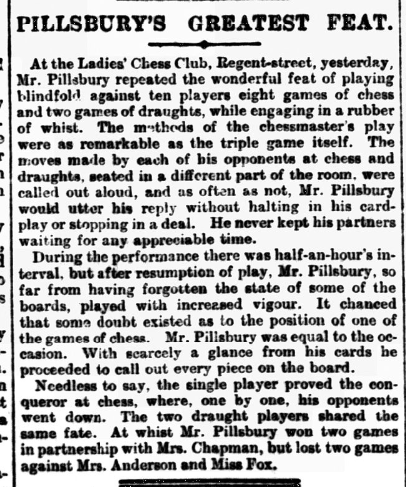
Rita Fox was one of the card players, an interest she would continue until her dying day.
Although the ladies were making rapid progress, they suffered a severe defeat when the City of London Club’s first team, boasting genuine master standard players on their top four boards, offered them knight odds.

28 October 1899
In the first few months of 1900 Rita was involved in a very different project: knitting socks for soldiers serving in the 2nd Boer War.
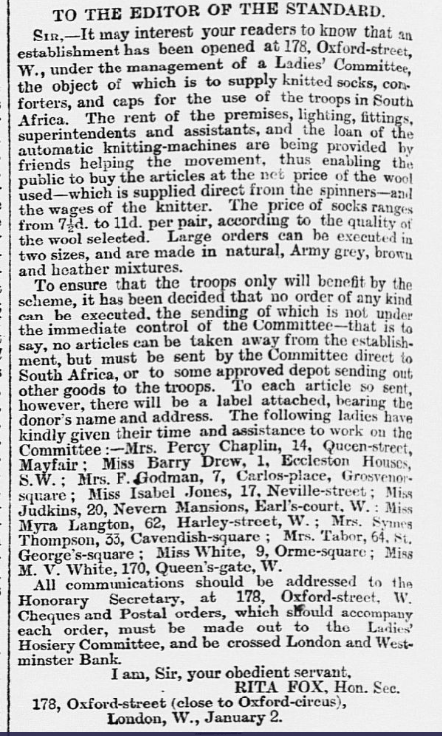
During the Kent Congress that June, Miss Fox was on the right side of a brief and brilliant consultation game.
[Event “Consultation: Kent CCA”]
[Date “1900.06.??”]
[White “Blackburne, Joseph Henry”]
[Black “Teichmann, Richard”]
[Result “1-0”]
{Source: Hampstead & Highgate Express 16 June 1900 Blackburne, Lines & Miss Fox v Teichmann, Coleman and Rev Dr Lewis} 1. e4 e5 2. Nf3 Nc6 3. Bc4 Nf6 4. d4 exd4 5. Ng5 d5 6. exd5 Nxd5 7. O-O Be6 8. Re1 Qd7 9. Nxf7 Kxf7 10. Qf3+ Kg8 11. Rxe6 Rd8 12. Re4 Na5 13. Re8 1-0
She was one of several members of the Ladies’ Chess Club taking part (along with Charles Chapman and his friend Charles Corke).
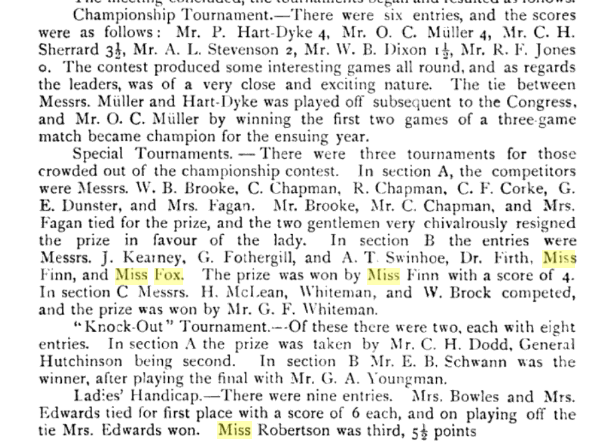
She was back in action in September, in the Class III section of the SCCU congress at Bath, where a score of 6/10 gave her a share of fourth place.

In March 1901 Richmond Chess Club paid a visit to the Ladies’ Club.
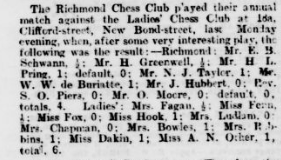
16 March 1901
Defaulting two games, as Richmond often did at the time, led to a defeat by 6 points to 4. Were the matches between these two clubs the origin or the result of a growing friendship between Rita and the Richmond top board?
In May, Mrs Fagan, Miss Finn and Miss Fox played in the Kent Congress in Folkestone.
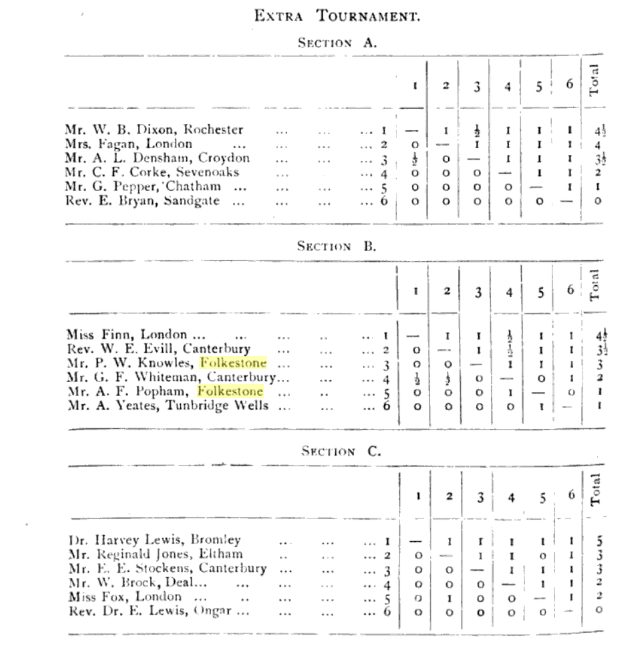
Mrs Fagan and Miss Finn (who outpointed our favourite chess playing clergyman) both did well. Rita Fox was less successful, but did have the consolation of winning this game.
[Event “Folkestone Congress Extra Section C”]
[Date “1901.05.??”]
[White “Fox, Rita”]
[Black “Jones, Reginald”]
[Result “1-0”]
{Source: Westminster Gazette 08 June 1901} 1. e4 e5 2. Nf3 Nc6 3. c3 d5 4. Bb5 Qd6 5. d4 Bg4 6. Qa4 Bxf3 7. gxf3 exd4 8. Qxd4 Nge7 9. e5 Qg6 10. Bf4 a6 11. Qa4 Qg2 12. Rf1 Qxf3 13. Nd2 Qg4 14. Be2 Qe6 15. O-O-O b5 16. Bxb5 Kd8 17. Ne4 Nxe5 18. Bxe5 Qxe5 19. Rfe1 Qe6 20. Nc5 Qg6 21. Rxd5+ Kc8 22. Bxa6+ Rxa6 23. Qe8#
Rhoda Bowles had some news to report in Womanhood in Spring 1902.
Under the headline “An Interesting Chess Match” was the news that “It is my pleasing duty to announce what may in every sense of the word be termed a ‘chess engagement’, which will happily terminate in a ‘match’ early in the autumn, when the wedding of Miss Rita Fox and Mr. Edward B. Schwann will take place.”
Tragically, as you’ll see from Schwann’s story, the match never happened, as her fiancé lost his life falling from a window. At least he ensured Rita was remembered.
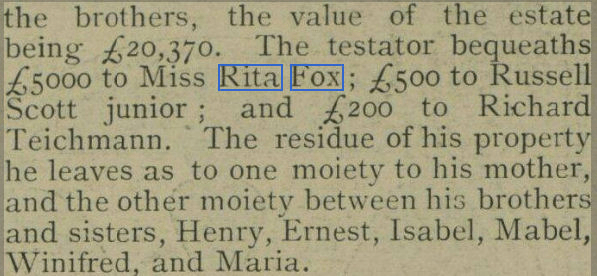
It didn’t take long, though, for Rita to find another partner. The following August she married J Walter Russell (1849-1931), the formidable and controversial secretary of the City of London Chess Club, whom I really ought to write more about at some point. For the moment I’ll just direct you to William Winter’s memoirs.
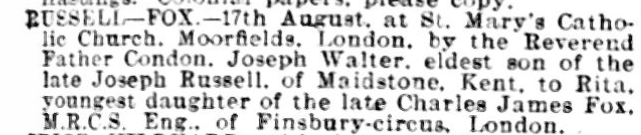
The City of London club members were very generous, although it’s notable that press reports failed to mention his new wife’s name.
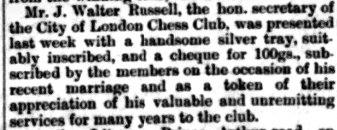
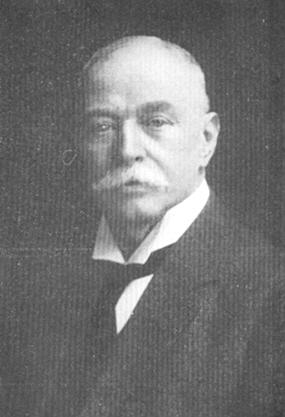
After her marriage she wound down her participation in tournaments, never taking part in the British Ladies’ Championship, but continued playing for the Ladies’ Club on a high board as well as in internal competitions. She made a brief return in the evening section of the 1913 Folkestone Congress, scoring 2/5 (Mrs Fagan made 100%), but that seems to have been the end of her chess career.
The Ladies’ Chess Club closed for the duration in 1915, and doesn’t seem to have been revived after the war, its function having been, in part, taken over by the new Imperial Chess Club.
I have been unable to locate them in the 1911 census (perhaps they were abroad on holiday) but here are Walter and Rita in 1921, living at 21 Portland Road, Kensington, close to Holland Park. It’s the house in the centre behind a tree, with a dark blue car parked outside here. It appears there were two other families at the same address, so they would only have had an apartment there.

You’ll notice a few other points. There were no live-in domestic staff, and poor Rita had had to find herself a job, as a bank clerk in the city. She gave her age as 54 years 3 months, which, if correct, pinpoints her date of birth as February or March 1867.
Rita Russell, as she now was, reverted to her love of card games. Trick taking games such as whist had been popular for centuries, and, by the 1890s the new game of bridge became fashionable. In 1904 auction bridge introduced the idea of the partnerships bidding to determine the trump suit (if any), and, in 1925, Harold Vanderbilt published a new set of rules with changes to scoring, which, more than a century on, is (with only minor scoring changes) still played today by, for instance, our friends at Richmond Bridge Club.
These developments made the game even more popular: it was increasingly a fashionable pastime appealing, unlike chess, equally to women and men. While also intellectually demanding, it was also seen by some as a much more sociable game, played in partnerships rather than by individuals.
Rita had already demonstrated her interest in whist, and, no doubt, she was have been drawn into the new world of contract bridge. She was a member of the Lyceum Club, which had been founded in 1904 as, according to Wikipedia, ‘a place for women involved with literature, journalism, art, science and medicine to meet in an atmosphere that was similar to the men’s professional clubs of that era’, and it was there that she enjoyed playing bridge.
It was while playing bridge (some reports claim her cards were in her hand at the time) that she made her final move.
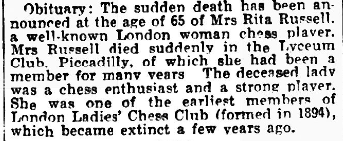
Her death record states that she was 65 years old, so she would have been born in 1864 or very early 1865, which would imply that the 1871 census record (as Ann Fox) was correct, and that she’d subtracted a couple of years from her age in both 1891 and 1921.
Her presumed half-sister Margaret Carkeet Fox, according to online family trees, had been born on 13 January 1865. She was apparently her father’s youngest daughter, which suggests that Margaret and Ann/Rita might have been born at very much the same time. Rita’s childhood can’t have been that easy: the cuckoo in the nest, being brought up by her adoptive mother after her father had fled the country. Then she lost her fiancé in tragic circumstances before rushing into marriage with a much older man. Perhaps her later years weren’t so easy either. If you believe William Winter (and others had seen a very different side of J Walter Russell), her husband became increasingly cantankerous and irascible in old age.
But in between, she must have gained a lot of satisfaction, friendship and intellectual stimulation from playing chess, as well as card games. She was a pretty good chess player as well – EdoChess rates her about 1800 – with a penchant for dashing gambits and mating attacks. She, along with the other pioneers from the Ladies’ Chess Club, deserves to be remembered.
Before I leave you, it’s worth taking a quick look at Margaret. In 1891 she married an Indian doctor, David Chowry Muthu, who specialised in the treatment of tuberculosis and was also a friend of Gandhi (see here).
There are some ironies here. Rita was engaged to a man of part German descent, but after his death married a man who, later in life, was noted for his xenophobic and specifically anti-German views, while her sister’s husband was Indian. I wonder if J Walter knew his wife’s brother-in-law. Sensitivities and paradoxes which echo down the years, for more than a century.
Join me again soon, for some more sensitivities and paradoxes, and some more vulpine chess players.


 Minor Pieces
Leave a reply to gentlesoldier Cancel reply