Let’s return to the 1913 British Championships in Cheltenham.
A couple of months after the event, the prizes for Brilliant Games were announced.
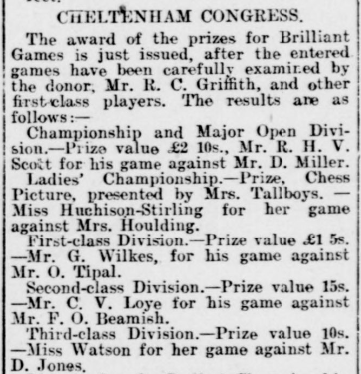
Here’s the prize winning game from the Ladies’ Championship, won by Miss Hutchison Stirling. (Sources vary on whether Hutchison was part of her surname or her middle name.)
[Event “British Ladies Championship Cheltenham R3”]
[Date “1913.08.13”]
[White “Stirling, Florence Hutchison”]
[Black “Houlding, Mary Mills”]
[Result “1-0”]
1. Nf3 e6 2. d4 d5 3. c4 b6 4. cxd5 Qxd5 5. Nc3 Qd8 6. e4 Bb7 7. Bf4 Bb4 8. Qa4+ Nc6 9. Bb5 Bxc3+ 10. bxc3 Nge7 11. O-O O-O 12. Rad1 a6 13. Bd3 b5 14. Qc2 Ng6 15. Bg3 Rc8 16. h4 b4 17. h5 Nge7 18. d5 exd5 19. exd5 Nb8 20. Bxh7+ Kh8 21. Ng5 Nxd5 22. Bg8 f5 23. Nf7+ Rxf7 24. Bxf7 bxc3 25. h6 Qd7 26. Bg6 Qc6 27. Qxf5 Nf6 28. hxg7+ Kxg7 29. f3 Nbd7 30. Rfe1 Qc5+ 31. Bf2 Qxf5 32. Bxf5 Rd8 33. Re7+ Kf8 34. Re2 Nd5 35. Bh4 Re8 36. Rxe8+ Kxe8 37. Re1+ Kf8 38. Bxd7 Nb4 39. Be7+ {Source: The Times, 15 Aug 1913} 1-0
A nice win, to be sure, but Black’s opening knowledge was sadly deficient.
But I’m sure you’d like to know more about Mrs Tallboys (certainly not to be confused with Annie Gooding or Mary Houlding, who were both short girls) and her chess painting.
Let’s start by correcting the spelling, she was Agnes Augusta Talboys (only one ‘l’), usually signing her paintings A Augusta Talboys.
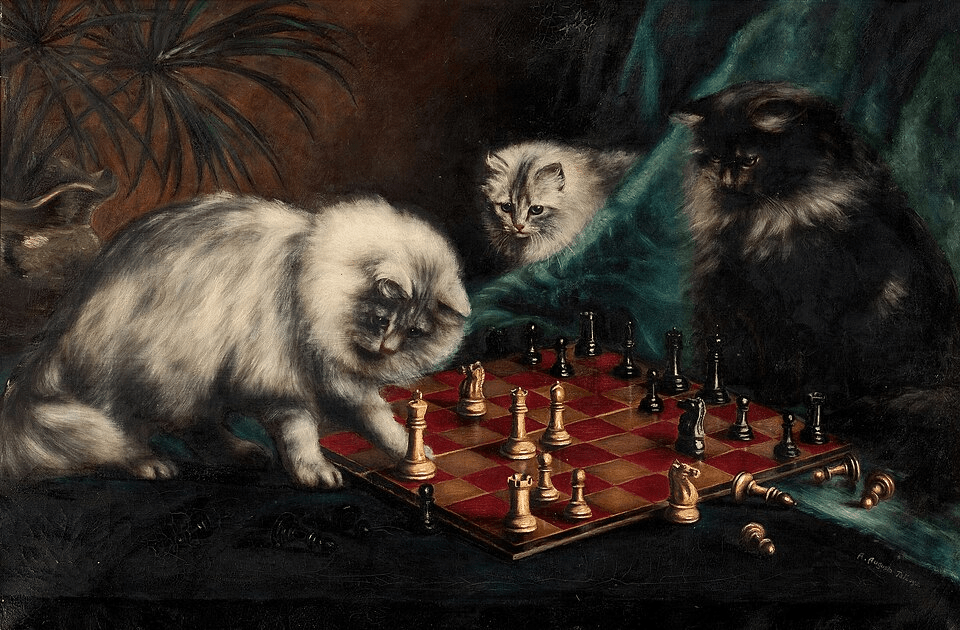
She specialised in sentimental pictures of cats and dogs, in particular Persian kittens. Sometimes the cute kitties were portrayed playing chess, as in Cats and Chess Board, which you’ll find in the Bristol Museum and Art Gallery.
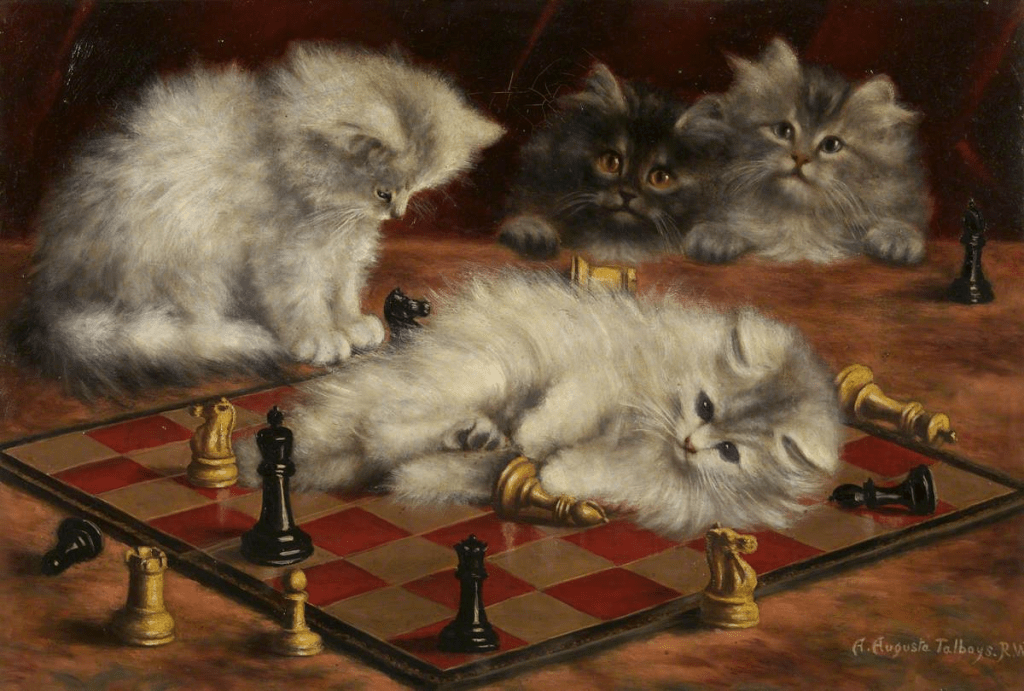
Mrs Talboys herself was, as well as being an artist, a county and club chess player. I’d assume Miss (Hutchison-)Stirling’s prize would have been something similar.
But of course you want to find out more about our chess playing, animal loving artist.
She was born Agnes Augusta Snell in Bristol on 5 April 1866, the daughter of Russell Abraham Snell and Agnes Bullock. Her father died just before her 5th birthday, after which she and her brother Edward were brought up by her mother and aunts.
In 1889 she married George Harmer Talboys, a commercial traveller. A son, Reginald George, was born on 12 January 1895 and baptised in the Wesleyan Methodist Chapel in Kingsdown, Bristol on 24 March, but sadly died on 11 April. There were no other children. In 1901 the couple were living by the sea in Weston-super-Mare.
It was there in 1904 that Mrs Talboys first made her appearance in competitive chess, having joined what might have been a recently formed chess club, and taking part successfully in a match between the combined players of Bridgwater, Weston-super-Mare and Backwell against the combined players of Bath and Taunton. Her first paintings were displayed at about the same time.
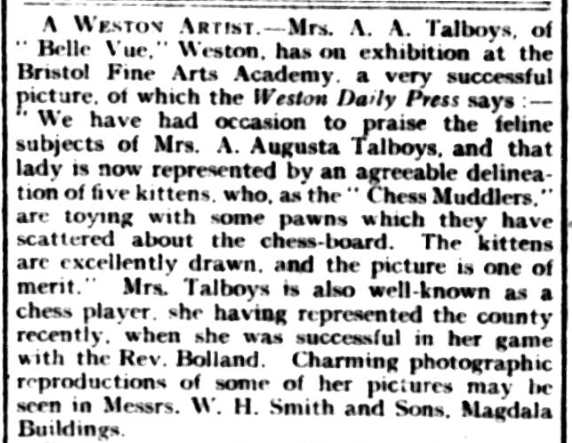
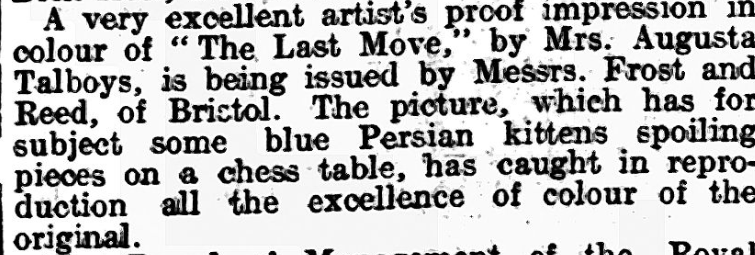
In 1909 she exhibited a painting of chess playing kittens.
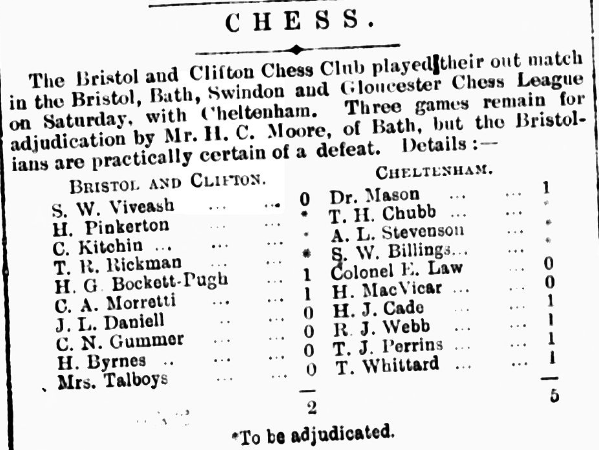
Later that year she left Weston, returning to Bristol where she joined the local club, in this match encountering Thomas Whittard.
There was also news of another chess painting.
The 1911 census reveals that Mr and Mrs Talboys had split up. George was in a boarding house in Bristol, while Augusta was back with her mother and aunt, by now giving her occupation as ‘artist’.
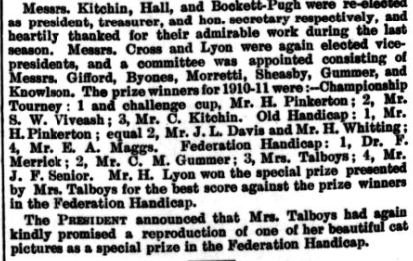
Her chess club AGM reports her generosity in donating reproductions of her paintings as prizes in the handicap tournament.
In 1913, the year the British Championships came to Cheltenham, George Talboys died, leaving Augusta a widow.
Here’s another chess painting for you to enjoy, this one entitled Checkmate.
There was, of course, not so much competitive chess played during the First World War, but she did represent Weston-super-Mare YMCA in a match against Bristol YMCA in 1916, even though she was neither young nor a man. This didn’t seem to be an obstacle: in later years she’d also play for Bristol YMCA.
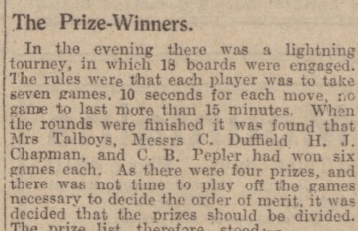
Mrs Talboys played regular competitive club and county chess throughout the 1920s. The 1925 Bristol Easter Week Chess Festival gave her the opportunity to display her skill at lightning chess.
This game from 1927 gives some idea of her style of play. She chose the fashionable Winawer Variation of the French Defence, but her 6th and 7th moves soon left her in a difficult position. Source: Western Daily Press 19 December 1927
[Event “Bristol & Clifton v Bath B13”]
[Date “1927.12.17”]
[White “Baskett, Bertram George Mortimer”]
[Black “Talboys, Agnes Augusta”]
[Result “0-1”]
1. e4 e6 2. d4 d5 3. Nc3 Bb4 4. e5 c5 5. a3 Bxc3+ 6. bxc3 c4 7. Nf3 h6 8. Be2 Ne7 9. a4 O-O 10. Ba3 f5 11. exf6 Rxf6 12. Ne5 Nbc6 13. Ng4 Rg6 14. O-O Nf5 15. Bc1 Qe7 16. Bf4 Qf8 17. Ne5 Nxe5 18. Bxe5 Nh4 19. Bg3 Nf5 20. Bh5 Nxg3 21. fxg3 Rf6 22. Qe2 Bd7 23. Rxf6 Qxf6 24. Rf1 Qg5 25. Bf7+ Kh8 26. Bxe6 Re8 27. Rf8+ Rxf8 0-1
Her opponent let her back into the game, and then gifted her the full point with an egregious blunder on move 26.
Other reports suggest that she favoured closed positions, playing the Bird’s Opening with white, and tenacious defence.
Here’s the report of a 1928 county match: defaulting 8 boards in a home match suggests an administrative problem in Gloucestershire chess.
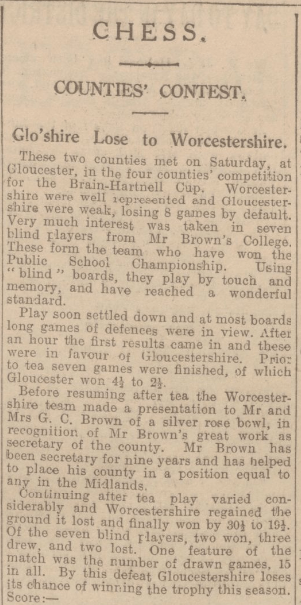
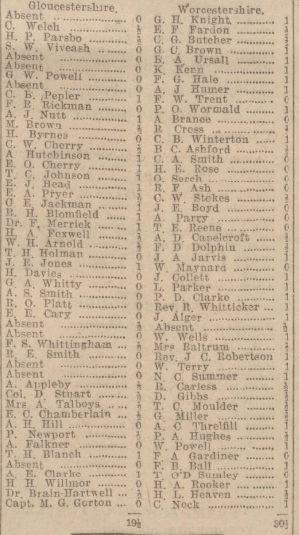
If you want to know more about the blind players from Mr Brown’s College you’ll need to read this Minor Piece.
The local press were generous in their coverage of her art work, as seen here in 1930, when we learn that her paintings were popular with feminine visitors.
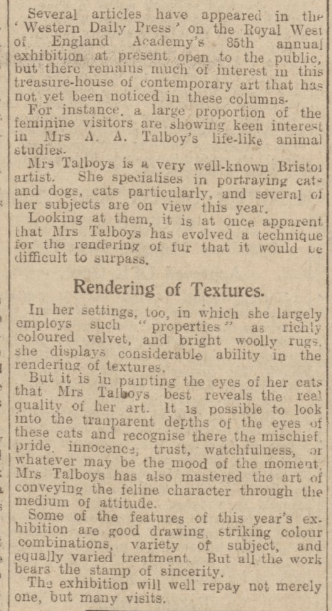
Throughout the 1930s Augusta Talboys continued playing chess and painting kittens, as in this notice from the annual exhibition of the Royal West of England Academy in 1937.
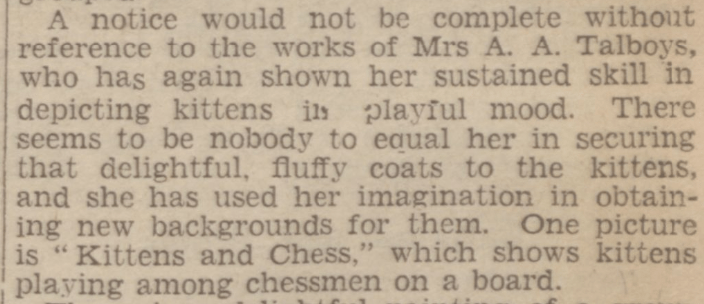
The 1939 Register found her still employed as an artist, living at 20 Southfield Road, Bristol. The last chess I can find for her was a match between Bristol YMCA and Bath in April 1940.
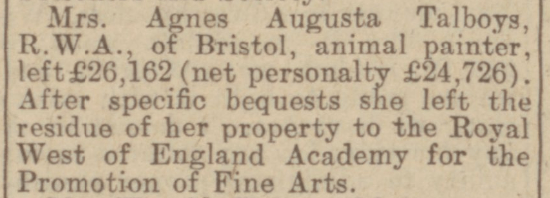
Her death was recorded in the 3rd quarter of 1941, back in Weston-super-Mare: it appears she had houses both there and in Bristol most of her life.
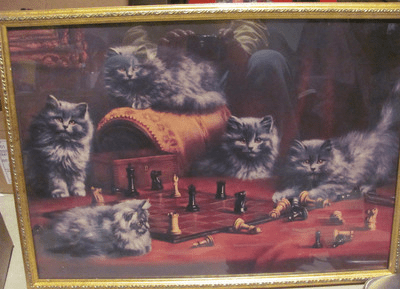
One final picture: this is Five Grey Cats Playing Chess.
Agnes Augusta Talboys was a talented painter whose works are still very collectible today. She was also a competent, club standard chess player, who enjoyed her favourite game throughout her life. She deserves to be remembered, not just for her art, but also as a pioneer of women’s chess in Gloucestershire and Somerset.
I have some more animal loving chess playing ladies, as well as some more chess playing artists, queueing up for your attention, so be sure to join me again soon.


 Minor Pieces
Leave a reply to Minor Pieces 96: Helen Eliza Sidney – Minor Pieces Cancel reply