Come with me, if you will, to the beautiful island of Barbados, noted particularly, to many of us, for its record in producing world class cricketers.
Having previously been captured and then abandoned by the Spanish, the first English ship arrived in 1625, taking possession of the island in the name of King James I. Two years later, the first permanent English settlers landed, and, in 1641 or thereabouts, a young man from Oxfordshire named John Goodin arrived. His family name sometimes appeared as Goodwin, but they eventually settled on Gooding. This family, like many others, would have owned sugar plantations, using slave labour imported from West Africa.
We can follow the Gooding family down the generations. John, John, Robert and Robert, who married Mary Greenidge. You might recognise the name from the great opening batsman Gordon Greenidge. Gordon is Black, but his contemporary Geoff is White, as, I’d imagine Mary was. Slaves in the West Indies often took on their owners’ surnames, so it seems quite likely that, a couple of centuries earlier, Geoff’s ancestors may have owned Gordon’s ancestors. It seems shocking, as indeed it was, looking back on it now.
Robert junior and Mary had a son named Matthew, who married Rebecca Hunte, who had another name cricket fans of a certain age will recognise from another opening batsman, Conrad Hunte. One of Matthew’s sons, also Matthew, married another Greenidge, Elizabeth. They had a son, John Robert Gooding, who became a doctor, spending the last part of his life in England. He in turn married Mary Elizabeth Anne Callender, and their first child, John Callender Gooding, born in 1838, also became a doctor.
John Callender Gooding studied in Edinburgh, qualifying in 1861. He then moved to Huntingdonshire, where he married doctor’s daughter Anne Sweetland Newton in 1865, and, later that year, moved to Cheltenham, where he set up a medical practice.
John and Anne had three children, Annie Mabel (1867), Lancelot Newton (1868) and, a decade later, George Callender (1878).
When she was three years old, Annie suffered an accident which life-changing consequences. It was thought at first that she wouldn’t survive, or would only have a short life, and it left her with a lifelong physical handicap. The family suffered another tragedy in 1884, when Anne, suffering from depression (it happened every spring: we’d now call it Seasonal Affective Disorder (SAD)), stabbed herself fatally in the chest with a surgical implement.
Dr Gooding was a chess enthusiast, and, perhaps thinking it would be good for young Annie due to her physical disability, taught her the game as well. When the second Cheltenham Chess Club opened its doors in 1889, John was present at its inaugural meeting, as you might remember from last time, being elected a Vice-President due to his standing within the community.
He soon brought Annie along with him: here they are playing in a match a few month later.
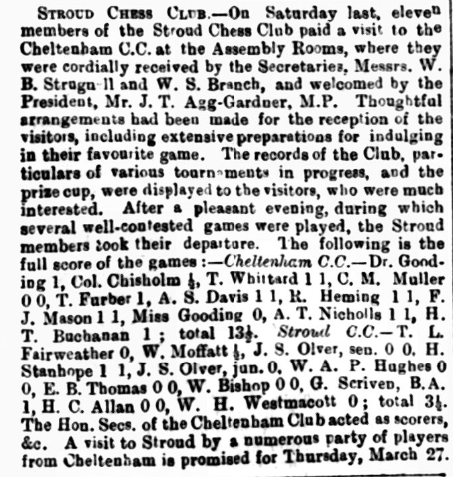
You’ll see that Dr Gooding won his game on top board, with Thomas Whittard winning two games on Board 3, while Annie lost her game on Board 9.
Annie made rapid progress over the next few years, soon outstripping her father, and, in both 1891 and 1894, making the news by drawing against Blackburne in simuls. Here’s the earlier game (Source: Cheltenham Examiner 02 December 1891).
[Event “Simultaneous Display: Cheltenham”]
[Date “1891.11.11”]
[White “Blackburne, Joseph Henry”]
[Black “Gooding, Annie Mabel”]
[Result “1/2-1/2”]
1. e4 e5 2. Nf3 Nc6 3. d4 exd4 4. Nxd4 Qe7 5. Nc3 Nxd4 6. Qxd4 d6 7. Be2 c5 8. Qd3 Bd7 9. Bf4 Nf6 10. O-O-O O-O-O 11. Bxd6 Qe6 12. e5 Bc6 13. Qc4 Qxc4 14. Bxc4 Ng4 15. Bxf8 Rxd1+ 16. Rxd1 Rxf8 17. e6 Ne5 18. Bd5 fxe6 19. Bxe6+ Kc7 20. f3 Ng6 21. Bd5 Rd8 22. Bxc6 Rxd1+ 23. Kxd1 Kxc6 24. g3 Ne5 25. Ke2 a6 26. b3 b5 27. Ne4 Kd5 28. Nd2 Kd4 29. Ne4 c4 30. c3+ Kd5 31. Nf2 g5 32. b4 h5 33. Ke3 1/2-1/2
Blackburne’s draw offer seems rather chivalrous, having won a pawn in the opening and traded off into a winning ending. I’m sure he’d have won had the game been played out.
In 1895 a Ladies’ Tournament in two sections was run in conjunction with the famous Hastings International Tournament. Although the top section was pretty strong the event received very little publicity outside the local press.
Annie Gooding took part, performing respectably in her preliminary section.
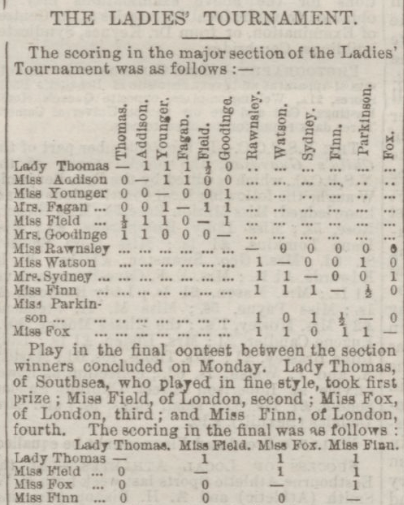

You’ll see she, playing in what seems to have been the stronger of the two qualifying tournaments, was the only player to defeat the eventual winner, but lost to the tail-ender. Lady Thomas, the mother of the future Sir George Thomas, was a more than useful player, although she rarely played in public.
Very few of the games from this event were published, but we do have Miss Gooding’s win against Lady Thomas, from the Nottinghamshire Guardian of 16 November 1895.
[Event “Hastings Major Ladies’ Tournament Section 1”]
[Date “1895.08.??”]
[White “Thomas, Edith Margaret”]
[Black “Gooding, Annie Mabel”]
[Result “0-1”]
1. e4 e6 2. a3 d5 3. Nc3 d4 4. Nce2 c5 5. d3 Nc6 6. Nf3 e5 7. h3 Be7 8. Ng3 g6 9. Be2 Be6 10. Bd2 Qd7 11. c4 a5 12. Qa4 Bd6 13. O-O f6 14. Rfb1 Ra6 15. Qd1 Nge7 16. Nh2 Rf8 17. Qf1 f5 18. f4 exf4 19. Bxf4 fxe4 20. Nxe4 Bxf4 21. Bf3 Bxh2+ 22. Kxh2 Ne5 23. Nxc5 Nxf3+ 24. gxf3 Qd6+ 25. Kh1 Qxc5 26. Qg2 Qh5 27. Rf1 Bxh3 28. Qh2 Raf6 29. f4 Qg4 30. Rf2 Rxf4 31. Rxf4 Rxf4 32. Rg1 Qf3+ 0-1
Although this event received little publicity, the same was not true of the London International Ladies’ Tournament of 1897, which received worldwide attention.
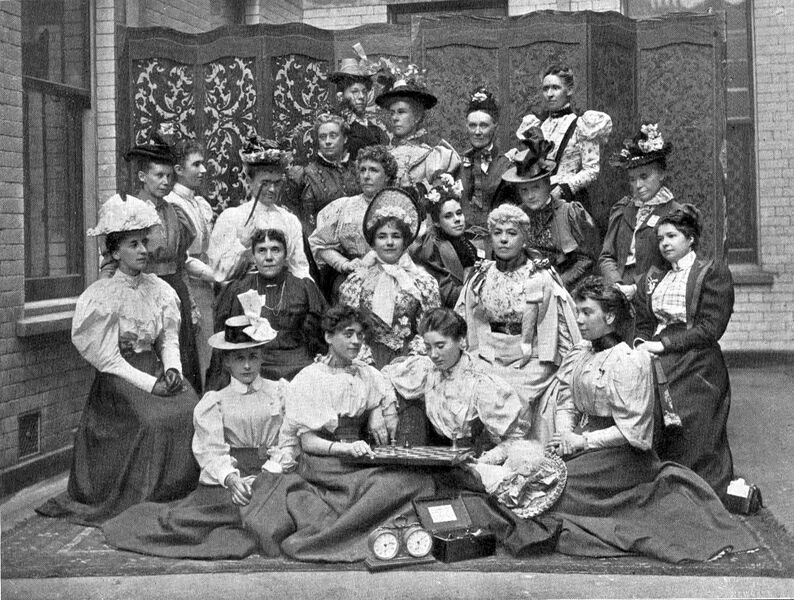
Here are the competitors: Annie Mabel Gooding is the small lady just right of centre.
Upper row (from left to right): Madame Marie Bonnefin, Miss Alice E. Hooke, Miss G. Watson, Miss Eliza M. Thorold, Miss Forbes-Sharp; second row: Miss Mary Rudge, Miss Kate B. Finn, Mrs. Anna S. Stevenson, Madame de la Vingne, Miss A.M. Gooding, Miss Müller-Hartung, Mrs. F. Sterling Berry; third row: Miss Gertrude Field, Mrs. Harriet J. Worrall, Mrs. Rhoda A. Bowles, Lady Edith M. Thomas, Mrs. Louisa M. Fagan; fourth row: Miss Rita Fox, Miss Anna Hertzsch, Miss Eschwege, Mrs. E.H. Sidney.
The crosstable:
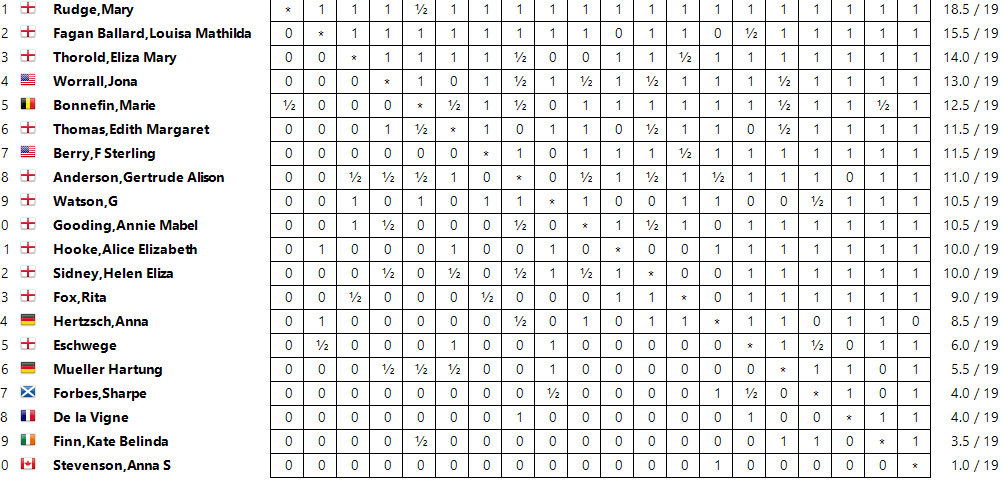
Making a plus score was quite an achievement: she started very strongly, but, probably due to her physical frailty, faded towards the end.
A few of her games were published: two of them from the later rounds when she was fatigued.
This was a well played draw against one of the stronger competitors.
[Event “London International Ladies Tournament R3”]
[Date “1897.06.24”]
[White “Worrall, Harriet Jona”]
[Black “Gooding, Annie Mabel”]
[Result “1/2-1/2”]
1. f4 d5 2. e3 Nf6 3. Nf3 Bf5 4. b3 e6 5. Bb2 Be7 6. Be2 h6 7. O-O Nbd7 8. c4 c6 9. Nc3 O-O 10. Rc1 Nb6 11. cxd5 exd5 12. Qe1 Re8 13. Nd1 Ne4 14. Nf2 Bf6 15. Bd4 Nd7 16. Nd3 Bxd4 17. Nxd4 Bh7 18. Nf3 f6 19. Kh1 Nf8 20. Nc5 Qe7 21. Nxe4 Qxe4 22. Qf2 Rac8 23. Ne1 d4 24. Bd3 dxe3 25. Bxe4 exf2 26. Bxh7+ Kxh7 27. Rxf2 Rcd8 28. Nf3 Rd5 29. g3 Nd7 30. d4 g5 31. fxg5 fxg5 32. Rd2 Re3 33. Rf1 b6 34. g4 Re4 35. h3 Nf8 36. Kg2 Ne6 37. Rfd1 Nf4+ 38. Kh2 Re3 39. Rf1 Re2+ 40. Rf2 Rxf2+ 41. Rxf2 Kg7 42. h4 Ne6 43. hxg5 hxg5 44. Rd2 Kf6 45. Kg3 Nc7 46. Kf2 Rd8 1/2-1/2
In this game her piece sacrifice in the opening may not have been sound, but it presented her opponent with too many problems.
[Event “London International Ladies Tournament R11”]
[Site “London (Hotel Cecil)”]
[Date “1897.06.29”]
[Round “11”]
[White “Gooding, Annie Mabel”]
[Black “De la Vigne, Constance Eveline Wood”]
[Result “1-0”]
1. e4 b6 2. Bc4 e6 3. Nc3 Bb7 4. Qe2 Bb4 5. d3 Ne7 6. Bd2 d5 7. Bb5+ c6 8. exd5 cxb5 9. dxe6 O-O 10. exf7+ Rxf7 11. f3 Nd7 12. Nxb5 Bxd2+ 13. Qxd2 Nf6 14. Nc3 Ned5 15. Ne4 Nc7 16. Ne2 Nxe4 17. fxe4 Qd7 18. O-O-O h6 19. h3 Qd8 20. h4 Qd6 21. g4 Ne6 22. Rdg1 Nf4 23. Ng3 Rd8 24. Rd1 Rc7 25. Kb1 Bc8 26. Nf5 Qe5 27. Rhf1 Ne6 28. g5 Nf8 29. gxh6 g6 30. Qg5 Rdd7 31. h7+ Rxh7 32. Nh6+ Kh8 33. Qxe5+ Rcg7 34. Rxf8#
Here, she played much too passively in the early middlegame and was duly crushed by her Irish opponent (known as Freda).
[Event “London International Ladies Tournament R18”]
[Date “1897.07.03”]
[White “Gooding, Annie Mabel”]
[Black “Sterling Berry, Sarah Fridzweeda”]
[Result “0-1”]
1. e4 e5 2. Nf3 Nc6 3. Bb5 a6 4. Ba4 Nf6 5. d3 b5 6. Bb3 d6 7. Be3 Na5 8. Nbd2 Nxb3 9. Nxb3 Be7 10. h3 Be6 11. Nbd2 O-O 12. Nh2 d5 13. f3 d4 14. Bf2 Nh5 15. g3 g6 16. Ng4 Bd6 17. Ke2 f5 18. exf5 gxf5 19. Nh2 Rf7 20. Qg1 Rg7 21. Re1 c5 22. b3 Rc8 23. Kd1 Qa5 24. Ke2 Nf4+ 25. Kd1 Qxa2 26. Qf1 Qa1+ 27. Nb1 Qxb1+ 28. Kd2 Qb2 29. gxf4 c4 30. bxc4 Bb4+ 31. Kd1 Qb1+ 32. Ke2 Qxc2#
She went wrong when facing her very strong opponent’s Evans Gambit here, losing a piece before going down to a smart attack. (You may well notice, though, that White missed the triple fork 11. Qa4+.)
[Event “London International Ladies Tournament R19”]
[Date “1897.07.03”]
[White “Fagan, Louisa Mathilda”]
[Black “Gooding, Annie Mabel”]
[Result “1-0”]
1. e4 e5 2. Nf3 Nc6 3. Bc4 Bc5 4. b4 Bxb4 5. c3 Bc5 6. d4 exd4 7. O-O Na5 8. Bd3 dxc3 9. Nxc3 d6 10. e5 Bg4 11. exd6 Qxd6 12. Ne4 Qf8 13. Qa4+ Nc6 14. Nxc5 Bxf3 15. Re1+ Nge7 16. gxf3 O-O-O 17. Qb5 Rd6 18. Qxb7+ Kd8 19. Bf4 Nc8 20. Bxd6 Qxd6 21. Bf5 N8e7 22. Qa8+ Nb8 23. Qxb8+ Nc8 24. Qxc8#
Chess in Cheltenham was thriving, and the following year the club welcomed World Champion Emanuel Lasker, who took on 30 players, of whom four, including Miss Gooding, drew their game, while two were victorious.
Annie Gooding continued her involvement with Cheltenham Chess Club over the next decade, and, in 1907, was invited to play in the fourth British Ladies Championship, held in Crystal Palace.
She performed very respectably, finishing just outside the prize list.
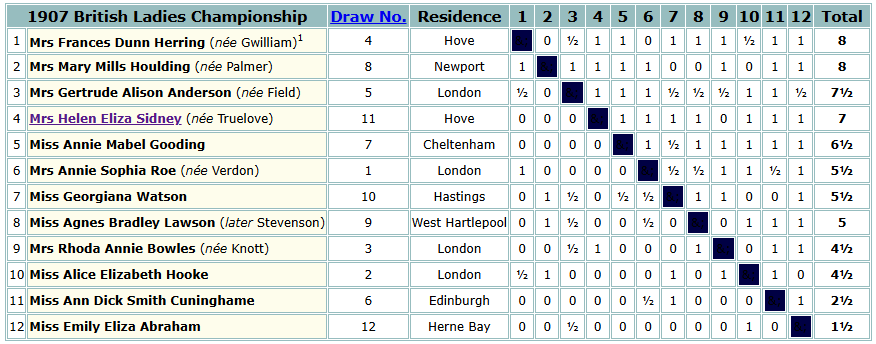
Here’s her loss against the eventual champion (who won the play-off a few months later).
[Event “British Ladies Championship: London R9”]
[Date “1907.08.21”]
[White “Gooding, Annie Mabel”]
[Black “Herring, Frances Dunn”]
[Result “0-1”]
1. e4 c5 2. Bc4 Nc6 3. Nc3 Nf6 4. d3 d6 5. Be3 a6 6. a4 g6 7. Nd5 Bg7 8. c3 O-O 9. Ne2 Ng4 10. Ng3 Nxe3 11. fxe3 e6 12. Nf4 Bd7 13. h4 Na5 14. Ba2 e5 15. Nd5 Bh6 16. h5 Kg7 17. hxg6 fxg6 18. Rc1 Qg5 19. Ne2 Qxg2 20. Rg1 Qh3 21. Kd2 Rf2 22. b4 Nc6 23. Rh1 Qf3 24. Re1 Bg4 25. bxc5 dxc5 26. Rb1 Rb8 27. Bc4 Bg5 28. Rb3 Na5 29. Rb6 Nxc4+ 30. dxc4 Qxe4 31. Qb3 Bxe3+ 32. Nxe3 Rd8+ 33. Nd5 Bxe2 34. Rxb7+ Kh6 35. Kc1 Rf1 36. Rxf1 Bxf1 37. Rxh7+ Kg5 38. Rh5+ gxh5 0-1
She didn’t seem to have anything in particular in mind against her opponent’s Sicilian Defence, and soon ran into trouble by leaving her king in the centre.
In 1908 Lasker returned to Cheltenham to give another simul (+23 =5 -2). This time he beat Miss Gooding, but only after getting his queen trapped in the opening. He found the game so interesting that he used it as a subject of lectures.
[Event “Simultaneous Display: Cheltenham”]
[Date “1908.02.19”]
[White “Lasker, Emanuel”]
[Black “Gooding, Annie Mabel”]
[Result “1-0”]
1. e4 e6 2. d4 d5 3. Nc3 Bb4 4. e5 Ne7 5. Qg4 Nf5 6. Nf3 Nc6 7. Bd3 h5 8. Qf4 Nce7 9. Bd2 Ng6 10. Qg5 Be7 11. Bxf5 Bxg5 12. Bxg5 Qd7 13. Bxg6 fxg6 14. Nh4 Qf7 15. f4 O-O 16. O-O-O b6 17. g4 c5 18. Nb5 Kh7 19. Nd6 Qc7 20. Rhg1 hxg4 21. Rxg4 Ba6 22. Nxg6 Be2 23. Rh4+ Kxg6 24. Rg1 Qxd6 25. Bf6+ Kf5 26. Rg5+ Ke4 27. f5+ Kf3 28. Rg3+ Kf2 29. Rf4+ Ke1 30. Bh4 Bf1 31. Re3# 1-0
Although she had a queen against two knights, she was under a lot of pressure and it wasn’t surprising that she cracked under the strain.
By the way, in some sources (including MegaBase) this game is mistakenly attributed to her unrelated contemporary and acquaintance William Gooding.
In 1909 she returned to the British Ladies Championship, this time in Scarborough, where she recorded a 50% score.
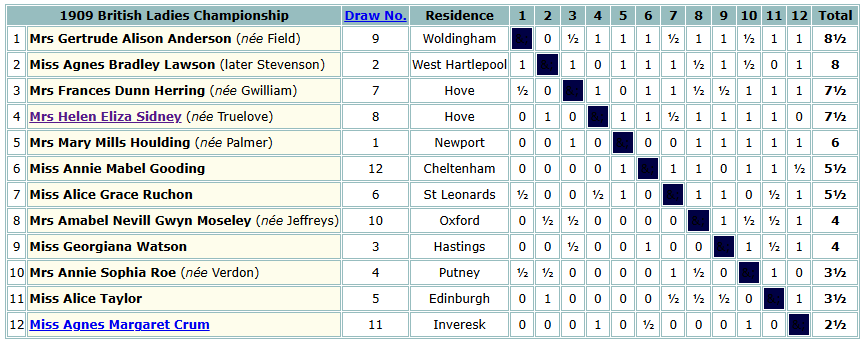
Sadly, very few games from this event have survived: BritBase only lists four.
Dr John Callender Gooding died in July 1913, leaving a significant amount of money, and bequeathing a piano to his daughter.
The 1913 British Championships took place, as you may remember from the previous Minor Piece, in Miss Gooding’s home town of Cheltenham. Although she would have been mourning the recent loss of her father, she still took part in the Ladies Championship, scoring 5/11.
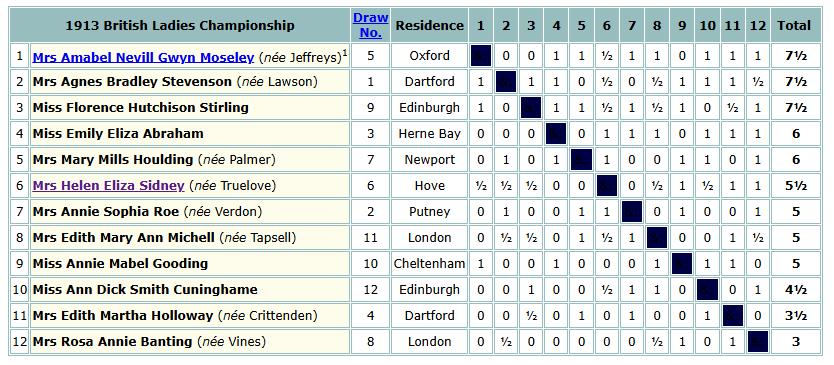
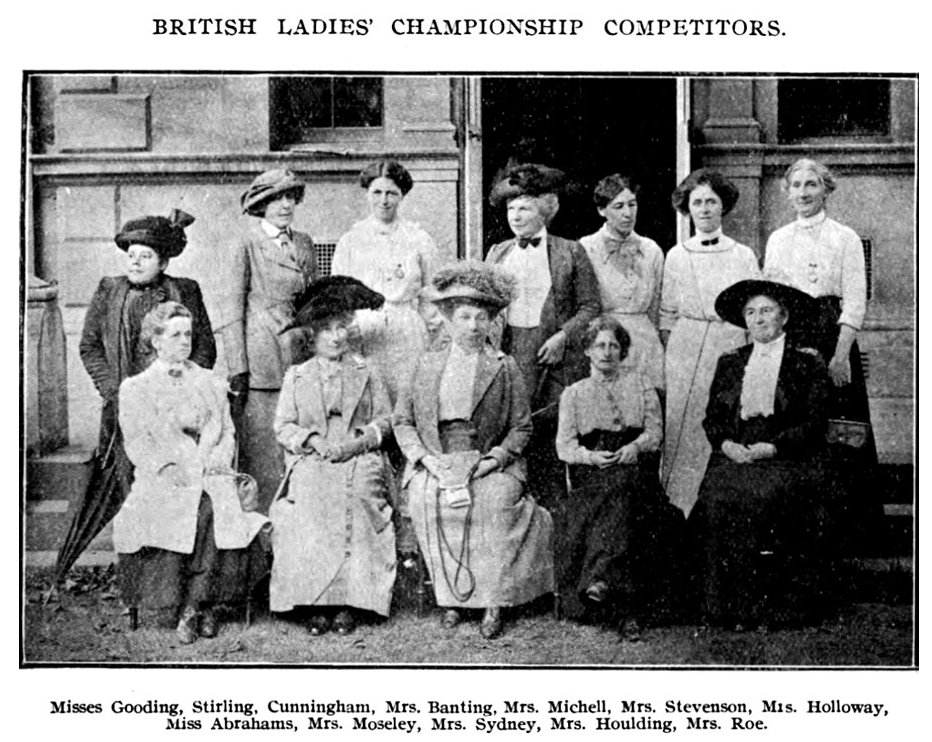
Here, from BritBase, are the competitors, with Miss Gooding standing on the left.
Here’s her game against the tiny, and remarkable, Mary Mills Houlding.
[Event “British Ladies’ Championship Cheltenham R4”]
[Date “1913.08.14”]
[White “Houlding, Mary Mills”]
[Black “Gooding, Annie Mabel”]
[Result “1-0”]
1. e4 e5 2. Nf3 Nc6 3. Bc4 Bc5 4. O-O d6 5. c3 a6 6. b3 Nf6 7. d4 exd4 8. cxd4 Bb6 9. d5 Ne7 10. Nbd2 Bg4 11. Bb2 Qc8 12. Qc2 Bxf3 13. Nxf3 Qg4 14. Rfe1 Nh5 15. h3 Qg6 16. Nh4 Qg5 17. Nf5 f6 18. Bc1 Nf4 19. Bxf4 Qxf4 20. Nxg7+ Kd7 21. Nh5 Qg5 22. Be2 Ng6 23. Bg4+ Ke7 24. Kf1 Nf4 25. Ng3 Raf8 26. Nf5+ Kd8 27. Nxd6 h5 28. Nxb7+ Ke7 29. Bf3 Rhg8 30. e5 fxe5 31. Rxe5+ Qxe5 32. Re1 Qxe1+ 33. Kxe1 Nxg2+ 34. Bxg2 Rxg2 35. Qe4+ Kd7 36. Qe6# 1-0
A neat finish, but Annie Gooding was handicapped, as so often, by a combination of indifferent opening play and a failure to castle.
She was now able, perhaps as a result of the family inheritance, to buy a large house on the Promenade in the town centre (probably somewhere around here), making a spacious room available for the use of Cheltenham Chess Club on every day except Sunday.
After a break due to the First World War, the British Ladies Championship returned in 1919, held in conjunction with the Hastings Victory Congress. By now, she was finding the competition tougher, only managing 4/11.
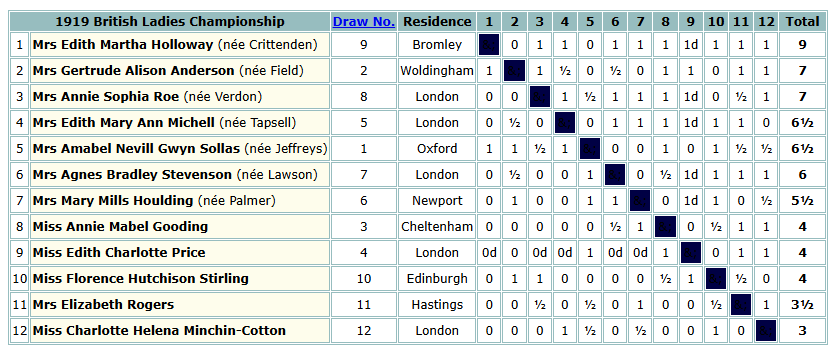
Two of her losses have survived, against two of the leading players in the tournament.
In this game she did manage to castle, but on the wrong side.
[Event “British Ladies Championship: Hastings R3”]
[Date “1919.08.13”]
[White “Anderson, Gertrude Alison”]
[Black “Gooding, Annie Mabel”]
[Result “1-0”]
1. e4 e5 2. Nf3 Nc6 3. d4 exd4 4. Nxd4 Qf6 5. Be3 Bc5 6. c3 Nge7 7. Be2 a6 8. O-O Ba7 9. Kh1 b5 10. f4 Bb7 11. Bf3 O-O-O 12. Qd3 Nxd4 13. cxd4 Bb8 14. Nc3 c6 15. e5 Qg6 16. Be4 f5 17. Bf3 h5 18. Rac1 Bc7 19. d5 cxd5 20. Nxd5 Bxd5 21. Bxd5 Nc6 22. Qc3 Rh6 23. e6 Qe8 24. exd7+ Qxd7 25. Bxc6 Qe7 26. Bf3 Rdd6 27. Bd4 g6 28. Be5 Rd7 29. Bc6 Bxe5 30. Bxd7+ Kxd7 31. Qc8+ Kd6 32. Rfd1+ Bd4 33. Rxd4#
Against the tournament winner, she went wrong on move 6 (6… d5 is the dangerous – for both sides – Max Lange Attack) and gave up a piece on move 7.
[Event “British Ladies Championship: Hastings R10”]
[Date “1919.08.21”]
[White “Holloway, Edith Martha”]
[Black “Gooding, Annie Mabel”]
[Result “1-0”]
1. e4 e5 2. Nf3 Nc6 3. Bc4 Nf6 4. d4 exd4 5. O-O Bc5 6. e5 Ne4 7. Bd5 h6 8. Bxe4 d5 9. exd6 Qxd6 10. Bxc6+ bxc6 11. Nbd2 Be6 12. Ne4 Qd5 13. Nxc5 Qxc5 14. Nxd4 Rd8 15. c3 Qd6 16. Be3 Bc8 17. Qa4 Bb7 18. Qxa7 Ba8 19. Qa4 O-O 20. Rad1 Qg6 21. Qc2 Qg4 22. f3 Qc8 23. Nf5 Rde8 24. Bc5 Re5 25. Ne7+ Rxe7 26. Bxe7 Re8 27. Rfe1 Qb8 28. Rd2 c5 29. Qd1 Qb6 30. Rd8 Bc6 31. Rxe8+ Bxe8 32. Qd2 Bb5 33. Re5 c4+ 34. Bc5 Qg6 35. Qe1 f6 36. Re3 Bd7 37. Re2 Bf5 38. Re8+ Kh7 39. Re2 h5 40. Qg3 Qxg3 41. hxg3 Bb1 42. a3 Bd3 43. Rd2 Bf5 44. Kf2 g5 45. Rd4 Be6 46. Ke3 f5 47. Be7 Kg6 48. Bd8 g4 49. Bxc7 Kg5 50. Bd8+ Kg6 51. Rd6 Kf7 52. fxg4 hxg4 53. Rxe6 Kxe6 54. Kd4 Kd6 55. Kxc4 Kc6 56. b4 Kd7 57. Bg5 Kc6 58. b5+ Kb6 59. Bd8+ Kb7 60. Kc5 Kc8 61. Bb6 1-0
After the congress Capablanca stayed on to tour British chess clubs giving simultaneous displays, including a visit to Cheltenham in October where he played 39 games, winning 36 and drawing 3. One of those draws was against Annie Mabel Gooding: the game was published in the Cheltenham Chronicle of 18 October 1919.
[Event “Simultaneous Display: Cheltenham”]
[Date “1919.10.10”]
[White “Capablanca, Jose Raul”]
[Black “Gooding, Alice Mabel”]
[Result “1/2-1/2”]
1. d4 e6 2. e4 d5 3. Nc3 Nc6 4. Nf3 Bb4 5. Bd3 h6 6. O-O Bxc3 7. bxc3 f5 8. exf5 exf5 9. Re1+ Nce7 10. Ne5 Qd6 11. Rb1 Nf6 12. Bf4 g5 13. Bd2 g4 14. Bf4 Nh5 15. Qd2 Nxf4 16. Qxf4 h5 17. c4 b6 18. c5 bxc5 19. dxc5 Qxc5 20. Ng6 Rh7 21. Nxe7 Rxe7 22. Rxe7+ Qxe7 23. Bxf5 Bxf5 24. Qxf5 Qf7 25. Qxf7+ Kxf7 26. Rb7 Rc8 27. Rxa7 Kf6 28. f3 c5 29. fxg4 hxg4 30. Kf2 c4 31. Ke3 Re8+ 32. Kd2 Rh8 33. Rd7 Rxh2 34. Rxd5 Rxg2+ 35. Kc3 Rg3+ 36. Kb4 Rg2 37. Kc3 Rg3+ 38. Kxc4 Ra3 1/2-1/2
It looks again like Capa might have been chivalrous, trading queens into a drawn ending when he could have won by playing 25. Re1+ Kf8 26. Qe5, taking advantage of his opponent’s all too typically exposed king.
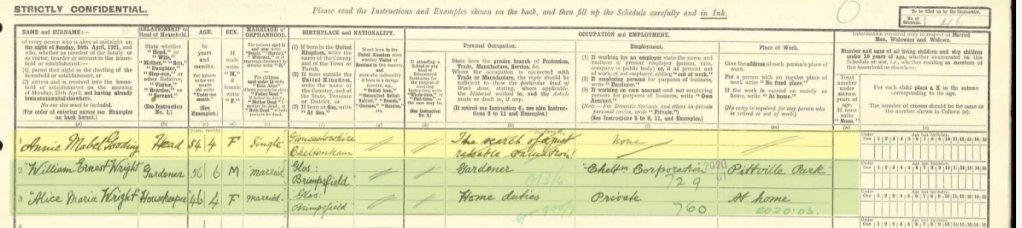
In 1920 Annie Mabel Gooding made the national papers due to a legal case in which she claimed that the rateable value of her property was too high. She conducted her own case, but her plea was unsuccessful.
The 1921 census gave her the opportunity to protest. She gave her occupation as ‘the search of a just rateable valuation’ for her 13 roomed house.
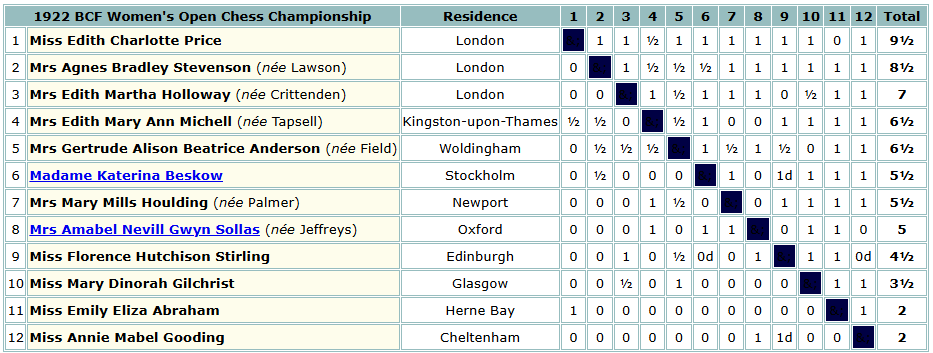
In 1922 Miss Gooding made her final tournament appearance. By now her play was clearly in decline
Annie Mabel Gooding died on 3 June 1925, at the age of 58. Here’s her obituary.
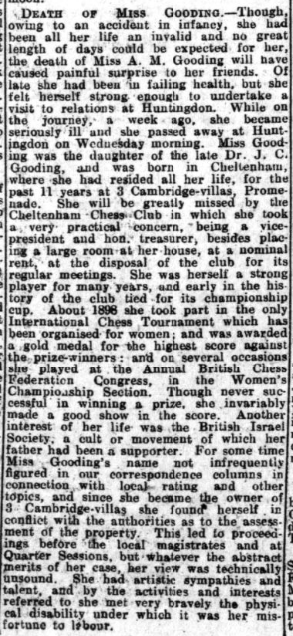
The British Israel Society was an organisation devoted to the belief that the British were the direct descendants of the ten lost Tribes of Israel. Similar views were later expressed by Herbert W Armstrong of the Worldwide Church of God, whose devotees included, relatively briefly, Bobby Fischer.
Her death didn’t put an end to her eccentricity, as there was an unseemly dispute concerning the existence of two wills.
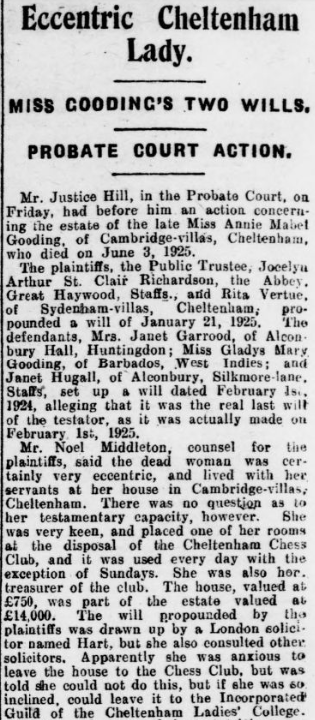
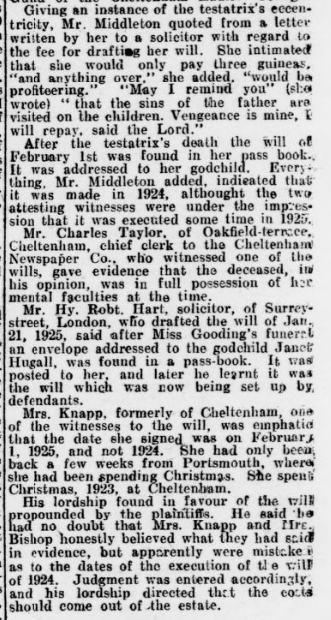
Annie Mabel Gooding’s life triggers a few thoughts.
Here was a lady who devoted much of her life to chess, and to her beloved Cheltenham Chess Club. She was, I suppose, an average club standard player: EdoChess has her in the 1700s until her later years. She clearly had ability as well as passion, as witnessed by her results against Blackburne, Lasker and Capablanca, but was held back, as far as we can tell from her relatively few surviving games, by a lack of opening knowledge and a tendency to neglect the safety of her king. In most of her surviving games she either castled late or not at all. She was clearly eccentric, like many passionate hobbyists, and perhaps not the easiest person to get on with, but the chess players of Cheltenham must have benefitted enormously from her presence in their club. Her story also might make you think that we should do more to promote chess as a suitable pastime for those with physical disabilities. In the centenary year of her death, her life should be remembered and celebrated.
One final thought. There are both Black and White families named Gooding connected with Barbados. One of the most famous bearers of the Gooding name is the actor Cuba Gooding Jr, whose grandfather was born there. It seems very probable, therefore, that Annie Mabel Gooding’s slave-owning ancestors owned Cuba Gooding Jr’s slave ancestors.
We’ll return to the Cheltenham area soon to meet some more eccentric lady chess players.
Sources and Acknowledgements:
First of all, my thanks to John Saunders and other contributors to the English Chess Forum, whose posts first attracted my interest in Miss Gooding. For more information see here.
ancestry.co.uk
findmypast.co.uk/British Newspaper Library
BritBase (John Saunders)
chessgames.com (Miss Gooding here)
EdoChess (Rod Edwards (Miss Gooding here)
MegaBase 2025/Stockfish 17
Wikipedia
Google Maps


 Minor Pieces
Leave a reply to Minor Pieces 95: Agnes Augusta Talboys – Minor Pieces Cancel reply