Here’s the Surrey Comet from 13 August 2004.
A 99-year-old father and his son were rescued by neighbours during a fire which destroyed most of the home they have shared for more than 70 years.
Neighbours of Harry Gunning, and Harry junior, 72, rushed to help them out of their house at around 10.30am on Saturday, when a bedroom fire spread across the top floor of their semi-detached home in Tolworth.
They were then moved to a care home by Kingston Social Services, where Harry senior died that December, just missing out on the opportunity to celebrate his centenary. Harry junior died in 2020 at the age of 89.
What the Surrey Comet failed to mention was that Harry senior was also a prize-winning chess problemist and occasional player. His older brother Ralph had also been a problemist and player. Unexpectedly, perhaps, they were both also bus drivers.
I’ve mentioned before about the popularity of chess amongst London Transport bus employees in the years following World War Two, and the Gunning brothers were part of that community.
Here’s their story.
Let’s start with the 1901 census, knocking on the door of 35 Lion Road Twickenham, a terraced house alongside the railway line, where we find William Broadbent Gunning, a bricklayer’s labourer, his wife Mary, and their children Herbert, Eleanor, Florence, Archibald and baby Ralph.
By 1911 they’d moved round the corner to 26 Albert Road, where Herbert had left home, but the family had welcomed three more sons, Charles, Harry and John. Unless the road has been renumbered the house isn’t there any more: there’s a block of flats where it would have stood. (I’ve always wondered about the proximity of the Lion and Albert, but it’s clearly unconnected with Stanley Holloway.)
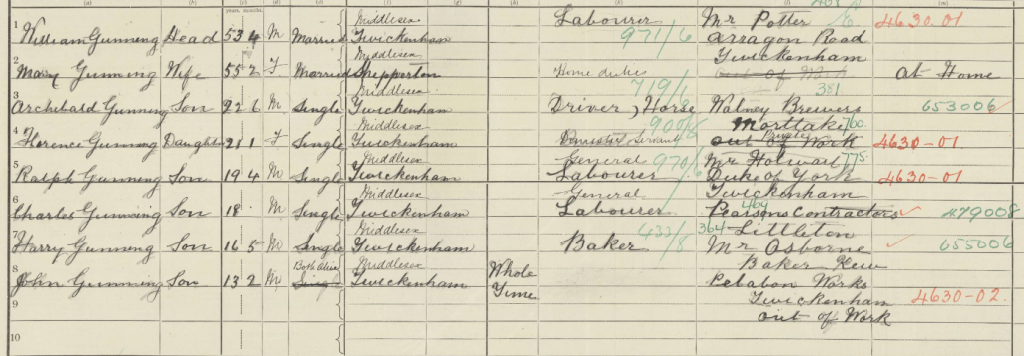
By 1921 the family were living near the river rather than the railway, at 1 Ferry Road. Herbert had lost his life in 1916, a prisoner of war in Turkey. William was still working as a labourer, for Mr Potter in Arragon Road, Eleanor had moved out, but the other six children were still at home. Their occupations give us an insight into working class life in Twickenham at the time. Archibald was a horse driver for Watneys Brewery, Florence was in domestic service in Mortlake, Ralph a labourer in a pub, Charles a labourer for a building contractor and Harry a baker.
A quick note about Herbert: he had joined the Royal Field Artillery in 1909 under the name John Smith (I wonder why, and how many others used that name).
Here’s the information about him being wounded and imprisoned, followed by his death.

Here’s his Effects Form from 1918.

This was very much a working class family, but they must also have been a chess playing family who would have read newspaper chess columns.
Ralph and Harry, though, were the two who demonstrated their love of chess in public.
By 1922 the teenage Harry was already submitting problems to AG Conde’s column in The People, where Ralph was also listed as successfully solving problems.
Over the next few years he would have several problems published.
This is the earliest I’ve been able to find. You’ll find the solution at the end of this article.

Illustrated London News 18-08-1923
By 1926, though, he’d switched from composition to playing, joining his older brother at Twickenham Chess Club.
Here they both are, playing in a closely fought match against Richmond.
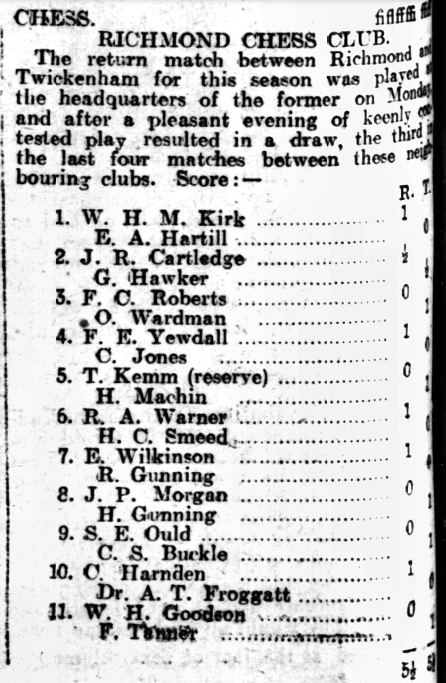
Their membership only seems to have lasted a year or two. They would have had other things on their minds.
Ralph married in 1927, when his wife was already expecting their first child, who, sadly, did not survive. They would go on to have another five children. Harry married in 1930: Harry junior, whom you met at the start of this article, was their only child.
At some point they both changed their occupation.
In 1931 the first London Trolleybuses were introduced, a fleet of 60 operating from Fulwell Bus Depot, very close to Twickenham. They would have needed some new drivers, and perhaps it was then that Ralph and Harry decided this would be just the ticket. Perhaps one of them was driving the trolleybus in this video.
In 1936 we pick the brothers up representing their place of work in the Sandover Shield, a multi-sports competition between social clubs, the like of which had been taking place since the 1870s. The Richmond Herald of 24 October 1936 reported that Fulwell Bus Depot had a chess club with about 30 keen and enthusiastic members.
In 1937 the name Gunning started appearing above problems again, but now it was Ralph, composing two, three and four-movers, for the Sunday Referee. This is the earliest I’ve come across.

Sunday Referee 24-10-1937
The 1939 census found Ralph, along with his wife and children, at 49 Prospect Crescent, Whitton, still working as a trolley bus driver. Harry, also still in the same occupation, was at 87 Red Lion Road, Tolworth.
In 1945 Harry resumed his composing career, his problems appearing in the Sunday Chronicle and The Problemist, and, from 1954, in the Busmen’s Chess Review.
Here are two examples from this period. This two-mover offers a generous key leading to three quarters of a popular theme.
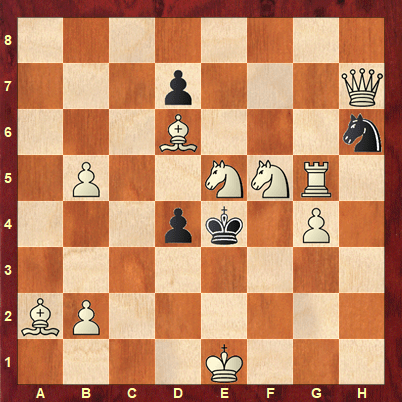
Sunday Chronicle 08-06-1947
Harry exploits another popular theme in this four-mover.

The Problemist 09-1949
In 1951 Ralph started composing regularly for the London Evening News, striking up a friendship with CHO’D Alexander, who conducted its chess column. His first (that I can find) offering made the sign of the cross.

London Evening News 03-01-1951
The Thames Valley Chess League started up after the war, and Fulwell Bus Depot soon entered a team.

Here’s Harry, beating Richmond’s Ted Fairbrother in a league match. One wonders what Bruce Hayden’s (not Haydn: he composed symphonies rather than chess problems) connection was: perhaps he came in to give the bus drivers some instruction. You’ll also see our old friend Mr Bodycoat mentioned.
The two brothers both also joined Twickenham Chess Club, the third of that name, which had started up a few years previously.
In 1950 Ralph was on Board 4 when a combined team from, Twickenham, Richmond and Ealing visited Hastings, losing this game against Frank Rhoden, who combined the Evans and King’s Gambits to great effect, soon bringing his game to a smart sacrificial conclusion.
[Event “Hastings v Twickenham/Richmond/Ealing”]
[Date “1950.09.??”]
[White “Rhoden, Frank Arthur”]
[Black “Gunning, Ralph”]
[Result “1-0”]
1. e4 e5 2. Bc4 Bc5 3. b4 Bxb4 4. f4 Nf6 5. fxe5 Nxe4 6. Nf3 O-O 7. O-O d5 8. exd6 Qxd6 9. d4 Bg4 10. Qd3 Nf6 11. c3 Ba5 12. Ba3 Qd8 13. Bxf8 Qxf8 14. Ng5 Bh5 15. Rxf6 Bg6 16. Rxg6 {Source: Hastings and St Leonards Observer 16.9. 1950.} 1-0

Here we see Twickenham going down to Uxbridge in a Middlesex League match, even though the Gunnings managed a point and a half between them.
The following season Uxbridge again beat Twickenham.

This time Ralph lost his game, but Harry drew against Barry Sandercock.
At this time, London Transport visited Hastings Chess Club for summer friendly matches. Harry, as their strongest player, encountered the formidable Arthur Winser on several occasions. Here’s what happened in 1952.
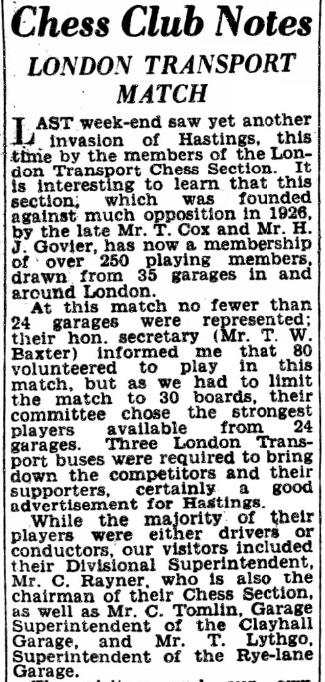
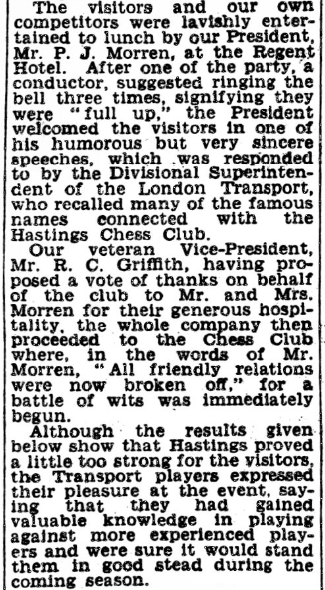
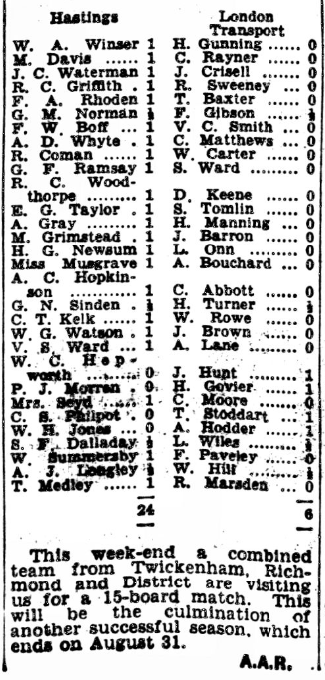
30 August 1952
In 1953, Ralph took part in a televised celebrity simul given by Alexander at the National Chess Centre, billed as the London Transport champion (did he beat his brother that year?). You’ll find the Vicky Wiki here.
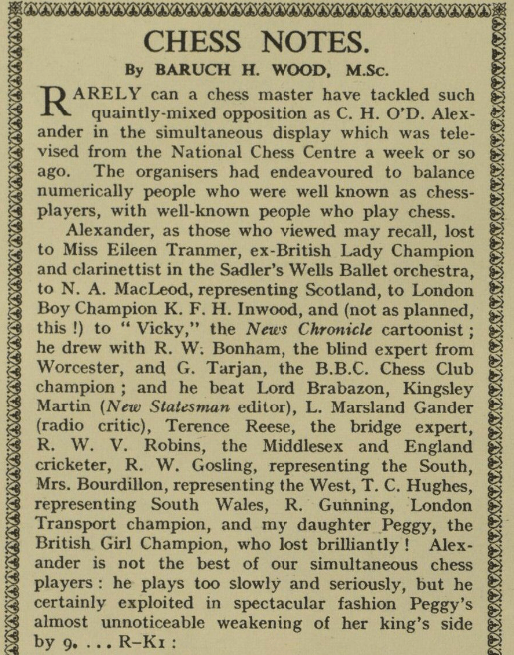
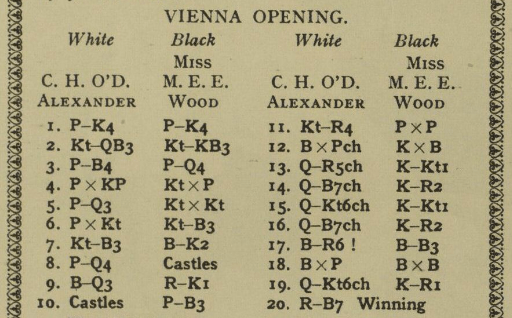

The report on the 1953 Hastings visit was much more succinct than that of the previous year. There was good news for Harry.
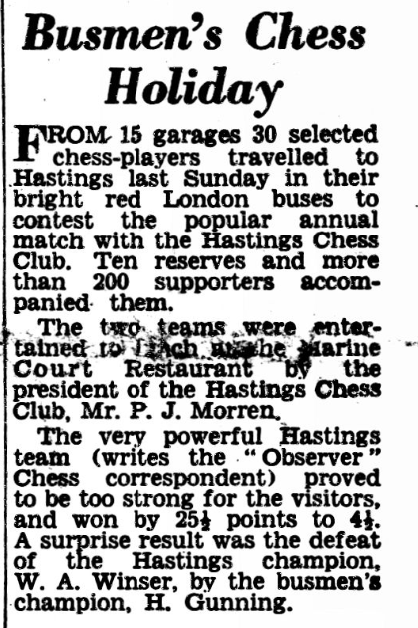
05 September 1953
Harry was not only the busmen’s champion player: he was also their champion problem composer as well.

1st Prize: Busmen’s Chess Review 1953
Ralph didn’t play in, at least, the 1952 Hastings match, but he was still playing for Twickenham in 1954, as witnessed by this game.
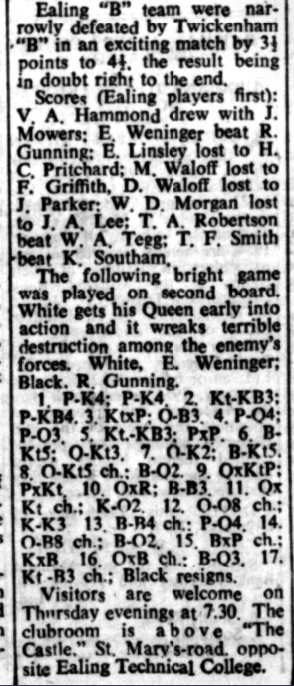
18 December 1954
[Event “Twickenham B v Ealing B”]
[Date “1954.12.16”]
[White “Weninger, Edwin”]
[Black “Gunning, Ralph”]
[Result “1-0”]
1. e4 e5 2. Nf3 f5 3. Nxe5 Qf6 4. d4 d6 5. Nf3 fxe4 6. Bg5 Qg6 7. Qe2 Bg4 8. Qb5+ Bd7 9. Qxb7 exf3 10. Qxa8 Bc6 11. Qxb8+ Kd7 12. Qd8+ Ke6 13. Bc4+ d5 14. Qc8+ Bd7 15. Bxd5+ Kxd5 16. Qxd7+ Bd6 17. Nc3+ 1-0
Ralph’s Latvian Gambit confused his opponent, and he could have won a piece with 7… Be7 or Ne7, but instead committed a fatal blunder, overlooking 8. Qb5+.
Here’s one of his Evening News problems from this time, published on my brother’s first birthday.

London Evening News 19-02-1955
Harry won another 1st prize this year.

1st Prize: Busmen’s Chess Review 1955
Here’s the 1957 Hastings match report, along with a couple of games, one of which is very brief. By this time, Harry was working at Norbiton Bus Depot, where, rather than trolleybuses, he’d be driving one of these.


28 September 1957
Ralph again didn’t play in this match, but he was still composing. One of his sons, Jack, was also interested in chess problems, and, on this occasion, helped his father with a joint composition.

London Evening News 26-05-1958
In the early 1960s, Harry took the first prize in the Busmen’s Chess Review competition in three consecutive years.

1st Prize: London Transport Tourney
(Busmen’s Chess Review) 1961
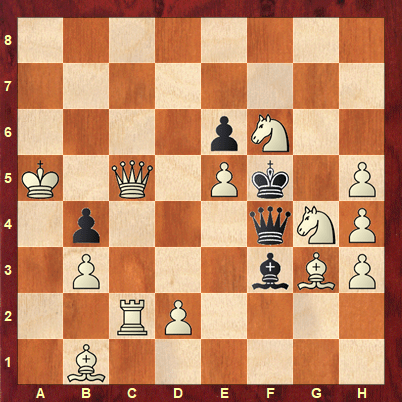
1st Prize: London Transport Tourney
(Busmen’s Chess Review) 1962

1st Prize: London Transport Tourney
(Busmen’s Chess Review) 1963
London Transport only required a single-decker for this 1963 visit to Brighton.

Geoffrey James, victorious over Harry on top board, is still an active player today. Here’s the game.
[Event “Regency v London Transport Board 1”]
[Date “1963.06.23”]
[White “James, Geoffrey Herbert”]
[Black “Gunning, Harry”]
[Result “1-0”]
1. e4 e6 2. d4 d5 3. Nc3 Nf6 4. Bg5 Be7 5. e5 Nfd7 6. Bxe7 Qxe7 7. Qd2 a6 8. f4 c5 9. Nf3 cxd4 10. Nxd4 Nc6 11. Be2 Nxd4 12. Qxd4 Qc5 13. O-O-O Qxd4 14. Rxd4 b6 15. Rhd1 Bb7 16. Ne4 Bc6 17. Nd6+ Ke7 18. c4 f6 19. cxd5 Bxd5 20. Nf5+ exf5 21. Rxd5 Rhd8 22. exf6+ Nxf6 23. Rxd8 Rxd8 24. Rxd8 Kxd8 25. Bxa6 Kc7 26. Kd2 Ne4+ 27. Ke3 Kd6 28. Bd3 Kd5 29. Bxe4+ fxe4 30. g4 h5 31. gxh5 b5 32. h3 {Source: G H James.} 1-0
I’ve no idea who G Gunning was, or if he was related to Harry.
Later that year, Harry lost quickly against Arthur Winser when London Transport visited Hastings.
[Event “Hastings v London Transport Board 1”]
[Date “1963.09.15”]
[White “Winser, William Arthur”]
[Black “Gunning, Harry”]
[Result “1-0”]
1. d4 Nf6 2. c4 g6 3. Nc3 Bg7 4. e4 d6 5. Be2 O-O 6. f4 e6 7. Nf3 Nc6 8. O-O Kh8 9. b3 Ne7 10. Ba3 b6 11. Qd2 Bb7 12. d5 e5 13. fxe5 dxe5 14. Nxe5 Nxe4 15. Nxf7+ Rxf7 16. Nxe4 Nf5 17. Ng5 Bd4+ 18. Qxd4+ {Source: Hastings and St Leonards Observer 21.9.1963.} 1-0
Ralph continued composing for the Evening News up to March 1968.
In this example his co-composer was his friend, who, a few years later, would become my friend as well, Phil Poyser.

#3 Ralph Gunning & Philip Leighton Poyser
London Evening News 08-02-1965
Ralph’s problems were designed to be popular with casual solvers rather than to win prizes, but this late composition received a mention in a competition. Unfortunately, it was anticipated, but by a first prizewinner from one of England’s finest ever composers, which, I guess, puts him in excellent company.

London Evening News/3rd Mention BCPS Ring Tourney
Anticipated by Percy Francis Blake
1st Prize The Cricket and Football Field 1902
Oh for the days when there were cricket and football magazines which also published chess problems!
Ralph’s death was recorded in the first quarter of 1969.
Harry was still submitting compositions to the Busmen’s Chess Review up to 1972, which was perhaps when publication ceased. After that he lived quietly in Tolworth with his wife, who died in 1994, and his son, until, at the great age of 99, his house caught fire. I wonder if his friends and neighbours were aware of his career as a chess problemist.
Here we have two chess addict brothers from a working class family, learning the game at a time of great social mobility when almost everyone would see problems and games in their daily newspapers. They, like many of their contemporaries, developed a passion for chess composition as well as playing the game. Good for them, I say. My family background was in one way similar: their father was a bricklayer, while my father taught bricklaying, amongst other things. One of the attractions for me, back in the 1960s, was that chess was, at the time anyway, totally classless.
The trolleybuses were retired in 1962, the 601 route being replaced by the 281, which still follows almost the same route today. Whenever I take the 281 bus home on a Tuesday evening, I like to imagine it’s really a 601 trolleybus being driven by Ralph or Harry, working the late evening shift so unable to attend (Richmond &) Twickenham Chess Club that week.
If you have any further information on the Gunning family, or would like to see my file of their problems, you can contact me here.
Acknowledgements and Sources
ancestry.co.uk
findmypast.co.uk/British Newspaper Library
Wikipedia
YouTube
MESON chess problem database
Yet Another Chess Problem DataBase (YACPDB)
British Chess Problem Society website/The Problemist
Hastings Chess Club website
Brian Denman, for sending me three Gunning games.
Problem Solutions
Problem 1:
1. Qg4 Rxg4 (1… Rxc3+ 2. Nxc3#) (1… d4 2. Bc6#) (1… e5 2. Nd6#) (1… exf5 2. Qe2#) (1… Rxh1 2. Re3#) (1… Ba2 2. Bd3#) (1… Bc2 2. Re3#) (1… Bd3 2. Bxd3#) (1… Ng6 2. f3#) (1… Nxf2 2. Qxf4#) 2. Nd6#
Problem 2:
1. Bc8 {Threat: Bxe6#} Qxc8 (1… Re4 2. Bxe6+ Rxe6 3. Nh4#) (1… Bd6 2. Ne7+ Bxe7 3. Bxe6#) 2. Nb4 {Novotny interference, threatening Ne7# and Nh4#} Rxb4 (2… Bxb4 3. Nh4#) 3. Ne7#
Problem 3:
1. Nc4 Kd5 (1… d3 2. Nd2#) (1… Kd3 2. Nxh6#) (1… Kf3 2. Nh4#) (1… Nxg4 2. Nh4#) (1… Nxf5 2. Qxf5#) 2. Nd2#
Problem 4:
1. Qh8 axb6 (1… a5 2. Kc7 a4 3. Qxb8#) (1… Na6 2. Qh1 axb6 3. Qxb7#) (1… Nc6 2. Kc7+ Nb8 3. Qxb8#) 2. Qa1+ Na6 3. Qh1 c4 4. Qxb7#
Problem 5:
1. Kd5 Ka4 2. Ra5+ Kb4 3. Kc6 Kxc4 4. Ra4#
Problem 6:
1. f4 {Threat: Qc4#} Kxf4 (1… Rxf4 2. Re3#) (1… Bxf4 2. Bg2#) (1… Bd6 2. Qc4#) (1… Be5 2. Qxe5#) (1… d6 2. Qc4#) (1… d5 2. Qe3#) (1… Rg6 2. Qc4#) (1… Rd6 2. Qe5#) (1… Rf8 2. Qc4#) (1… Ba7 2. Qe5#) 2. Qe3#
Problem 7:
1. Re2 Qxc7 (1… Qd3 2. Ra2+ bxa2 3. Bxd3#) (1… Qb5 2. Ra2+ bxa2 3. Bxb5#) (1… b2 2. Rxb2 Qxf1 3. Ra2#) 2. Ra2+ Kb6 3. Ra6#
Problem 8:
1. Nc3 Kxe5 (1… Rxe5+ 2. Bd5#) (1… cxb5 2. Nd5#) (1… Rxe2 2. Nxe2#) (1… Rd3 2. Re4#) (1… Rxf3 2. Qxf3#) (1… Rxc3 2. Re4#) (1… Bg8 2. Ng6#) (1… Bg6 2. Nxg6#) (1… Nd4 2. Qxh4#) (1… Ng3 2. Qxe3#) 2. Nd5#
Problem 9:
1. Bg1 {Threat: f3#} Kxd4 (1… Nxd4 2. Bd3#) (1… exd4 2. Re1#) 2. Rxb4#
Problem 10:
1. Qh8 Bxh8 2. Rd2 {Threat: Bd5#} Nf6 (2… Ne3 3. Nd6#) 3. Rd4#
Problem 11:
1. Qf2 Qxe5+ (1… Qxg4 2. hxg4#) (1… Bxg4 2. Rc5# (2. Qxf4#)) (1… Qxg3 2. Rc4#) (1… Qxd2 2. Rxd2#) (1… Qc4 2. Rxc4# (2. Nh6#) (2. Ne3#)) 2. Rc5#
Problem 12:
1. Ne4 {Threat: Bg1/f2/e2/d4#} Nd3+ (1… b3 2. Ba3#) (1… Nd5+ 2. Be3#) (1… Ng6+ 2. Be3#) (1… Nh3+ 2. Be3#) (1… Ne2+ 2. Be3#) (1… Bd2 2. Nxb2#) (1… Bxe4 2. Qxe4#) 2. Nd2#
Problem 13:
1. Ba5 Ke4 (1… e5 2. Ng5+ Kc6 3. Qa8#) (1… Kc6 2. Qa8#) 2. g5 Kd5 (2… Kf5 3. Qxh7#) (2… d5 3. Qxh7#) (2… e5 3. Nxd6#) 3. Qa8#
Problem 14:
1. Qa5 Kxg5 (1… Bxg5 2. Qc7#) (1… Ng3 2. Qd2#) (1… Bg3 2. Rf5#) (1… Ne3 2. Bd6#) (1… Nd2 2. Qxd2#) (1… Nh2 2. Qd2#) (1… Ne4 2. Rg4#) (1… Ng4 2. Rxg4#) (1… Nxh3 2. Nxh3#) 2. Be3#


 Minor Pieces
Leave a comment