Sir Charles Locock (1799-1875) was an interesting chap. Queen Victoria’s obstretician, he also pioneered potassium bromide as a treatment for epilepsy and conducted the autopsy in the notorious Eastbourne Manslaughter Case, establishing that an unfortunate 15-year-old boy had died as a result of corporal punishment.
Locock had five sons, four of whom had distinguished careers. Charles junior became a barrister, Alfred a clergyman, Sidney a diplomat and Herbert an army officer. The middle son, Frederick, though, was the black sheep of the family. He married the illegitimate daughter of a labourer and brought up a son who claimed he was the illegitimate child of Princess Louise. There’s little evidence that this might have been true, so we’ll move swiftly on to the Reverend Alfred Henry Locock.
Alfred married Anna Maria Dealtry: their four children were Ella, Charles Dealtry, Henry and Mabel.
Charles Dealtry Locock, born in Brighton on 27 September 1862, was a lifelong chess addict. He started playing chess at his prep school, Cheam, which is now in Hampshire, but really was in Cheam in those days, delivering a back rank mate at the age of 6 or 7, and later winning a tournament there. I would have thought chess tournaments at prep schools were quite unusual in those days. Moving to Winchester at the age of 13, and playing chess on his first evening there, he could find no one to beat him, instead immersing himself in the world of chess problems.
In Autumn 1881 Locock went up to University College Oxford, where he takes up the story.

Wainwright (whom you might have met in previous Minor Pieces) was sufficiently impressed to select his adversary for matches against the Oxford city club, Birmingham and the City of London club. At first he was placed on bottom board, but rapidly worked his way up the board order.
In those days the standard of play in the universities wasn’t strong, and their teams would take on the Knight’s Class players of the City of London Club (who would receive knight odds from the top players). Here, he describes a game was one of those matches.

I’m not sure how reliable Locock’s memoir is. We do have a game against Staniforth with a bishop on b2, but otherwise it doesn’t match this description. As with all the games in this article, you can copy and paste the pgn here to play through the game online.
[Event “Oxford U v City of London Knight Class”]
[Date “1882.03.28”]
[White “Locock, Charles Dealtry”]
[Black “Staniforth, Henry Smallpage”]
[Result “1-0”]
1. e4 e5 2. Nf3 Nc6 3. Bc4 Bc5 4. b4 Bxb4 5. c3 Ba5 6. d4 exd4 7. O-O dxc3 8. Qb3 Qf6 9. e5 Qg6 10. Nxc3 Nge7 11. Ba3 d6 12. Rfe1 O-O 13. Rad1 Bg4 14. Bd3 Qh5 15. exd6 Bxf3 16. dxe7 Rfe8 17. gxf3 Nd4 18. Bxh7+ Kxh7 19. Rxd4 Qxf3 20. Qc2+ g6 21. Re3 Qf6 22. Rh3+ Kg7 23. Ne4 Qf5 24. Bb2 f6 25. Rdd3 1-0
By the 1882 Varsity Match Locock had reached Board 3, where he scored a draw and a win against Edward Lancelot Raymond. He already had quite a reputation as a tactician, the BCM describing him as ‘perhaps the most brilliant and attacking player now at either University’. Unfortunately, the score of his second game, decided ‘by an uncommonly happy series of finishing strokes’, does not appear to have survived.
The 1883 Varsity Match found Locock on top board against Frank Morley. The first game was a solid draw, but the second was more exciting. Zukertort adjudicated the game a draw, but today’s engines give Morley (Black, to play) a winning advantage after h5 (or h6) followed by Ng4.
That summer he played his first tournament, the Second Class section of the Counties Chess Association meeting in Birmingham, scoring 10/14 for second place, a point behind Pollock.
In October that year he took part in a Living Chess exhibition in his home town of Brighton. It all sounded rather splendid.


Playing against auctioneer and estate agent Walter Mead, early exchanges led to Locock being a pawn down. Exchanges in living chess games are always fun, but didn’t really play to his strengths. (The game had actually been played the previous day: they re-created the moves for the exhibition.)
[Event “Living Chess Exhibition: Brighton”]
[Date “1883.09.26”]
[White “Locock, Charles Dealtry”]
[Black “Mead, Walter”]
[Result “0-1”]
1. e4 e5 2. Nf3 Nc6 3. d4 exd4 4. Nxd4 Bc5 5. Be3 Qf6 6. c3 Nge7 7. Bb5 Qe5 8. Qd3 d5 9. Nf3 Qxe4 10. Qxe4 dxe4 11. Bxc5 exf3 12. Bxe7 fxg2 13. Rg1 Kxe7 14. Bxc6 bxc6 15. Rxg2 Re8 16. Nd2 Kf8+ 17. Kd1 Rb8 18. b3 Rb5 19. f4 Rd5 20. c4 Rd4 21. Rf2 Ree4 22. Kc2 Rxf4 23. Raf1 Rxf2 24. Rxf2 g6 25. c5 a5 26. Nc4 Bf5+ 27. Kb2 a4 28. Kc3 Rd3+ 29. Kb4 axb3 30. a4 Be6 31. Ne5 Rd4+ 32. Ka3 Rd5 33. Nxc6 Bd7 34. Nb4 Rxc5 35. Kxb3 Ra5 36. Nd3 Bxa4+ 37. Kb4 Ra8 38. Ne5 Be8 0-1
Round about this point we have a mystery. Several correspondence games between Locock and FA Vincent were published, dated 1884. Locock’s memoirs suggest they were actually played much earlier, when he was still at school. They also state that his opponent was Mrs Vincent, while newspaper columns of the time refer to this player as Mr Vincent. We can identify Francis Arthur Frederick Vincent, a retired Indian Civil Servant who had been born in Singapore, living in Cam, Gloucestershire (not far from Slimbridge Wetland Centre) with his wife, born, rather strangely, Sutherland Rebecca Sutherland. It’s not clear which of them was the chess player, or whether they might have collaborated on their games. If you know more than I do, don’t hesitate to get in touch.
In the 1884 Varsity Match Locock again faced Frank Morley on top board. This time they only had time for one game, and, more than compensating for the previous year’s incorrect adjudication, he was awarded a win in a lost position, even though Bird, the adjudicator, spent 15 minutes determining what the result should be.
[Event “12th Oxford – Cambridge Varsity Match B1”]
[Date “1884.04.03”]
[White “Locock, Charles Dealtry”]
[Black “Morley, Frank”]
[Result “1-0”]
1. e4 e6 2. d4 d5 3. Nc3 Nc6 4. e5 Bb4 5. Qg4 g6 6. Nf3 b6 7. Bd3 Bb7 8. O-O Qd7 9. a4 O-O-O 10. Nb5 h5 11. Qh4 Be7 12. Bg5 Bxg5 13. Qxg5 a6 14. Na3 Nce7 15. b4 Nf5 16. a5 b5 17. c3 Nge7 18. Nd2 h4 19. Nb3 Rh5 20. Qd2 Rg8 21. Qe2 c6 22. Rfc1 Rh6 23. Nc5 Qd8 24. Bxb5 cxb5 25. Nxb5 axb5 26. Qxb5 Qc7 27. a6 Bc6 28. Qe2 Qb6 29. a7 Kc7 30. c4 Ra8 31. Ra6 Qxb4 32. Rxc6+ Kd8 33. Na6 1-0
In the final position, 33… Qa3 is winning for Black, but 33. Rc7, perhaps not so easy to find, would have been winning for White.
In summer 1884 Locock was promoted to Division 2 of the First Class tournament in the Counties Chess Association gathering, held that year in Bath, finishing on 4½/10. First place was divided between Fedden, Loman and Pollock.
However, his game against Blake, where, after getting the worst of the opening, he successfully ventured a positional queen sacrifice for two minor pieces, demonstrated exactly why his creativity, imagination and tactical ability were so highly regarded. He must have seen at move 18 that his queen was being trapped.
[Event “Counties’ Chess Association 1st Class 2: Bath”]
[Date “1884.07.31”]
[White “Blake, Joseph Henry”]
[Black “Locock, Charles Dealtry”]
[Result “0-1”]
1. e4 e5 2. Nf3 Nc6 3. d4 exd4 4. Nxd4 Bc5 5. Be3 Qf6 6. c3 Nge7 7. Qd2 Bxd4 8. cxd4 d5 9. Nc3 Qg6 10. Bb5 Qxg2 11. O-O-O Be6 12. Rdg1 Qf3 13. Be2 Qf6 14. e5 Qh4 15. Nb5 Kd7 16. Bg5 Qe4 17. f3 Qf5 18. Rg3 a6 19. Bd3 axb5 20. Bxf5 Nxf5 21. Rg4 Rxa2 22. Kc2 h6 23. Bh4 Na5 24. Qb4 Ne3+ 25. Kb1 Ra1+ 26. Kxa1 Nc2+ 27. Kb1 Nxb4 28. Rxg7 Ra8 29. b3 Nxb3 30. Kb2 Nxd4 31. Kc3 c5 0-1
Here’s a position from a game against Colonel Duncan of the St George’s Club (whom I suspect was this rather interesting fellow) he sacrificed four pawns for nebulous attacking chances against his opponent’s Benoni formation.

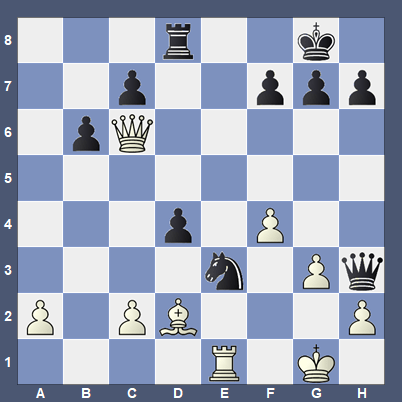
He was rewarded when the Colonel overlooked his threat, playing 31… b3?? (there were plenty of good defences available), allowing 32. Qxh6!! Kg8 33. Rxg6 with a winning attack.
In the 1885 Varsity Match Locock was again on top board, this time facing a former prodigy, John Drew Roberts. This game suggested that, although he excelled at attacking play, he was less comfortable in endings.
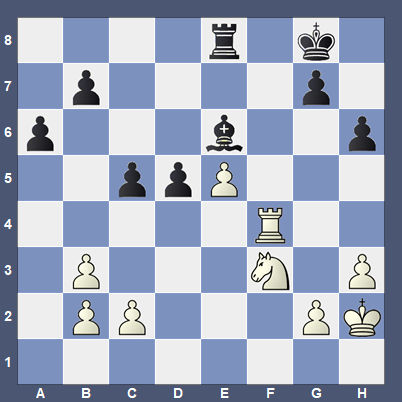
Here, Locock (Black, to move), would have been slightly better after a move like d4 or a5, but misguidedly played 32… b5?, allowing 33. b4!, fixing some pawns on the same colour square as his bishop.
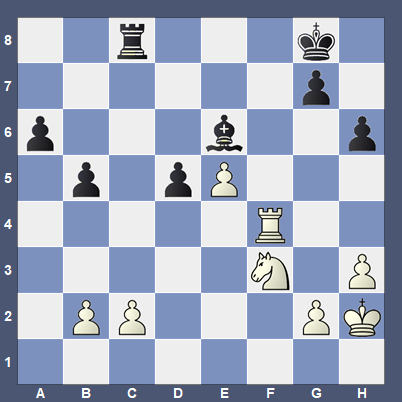
A few moves later he erred again: Bd7, for example, should hold, but after 35… Rf8? 36. Rxf8+ Kxf8 37. b4! he was saddled with a bad bishop against a good knight. Roberts converted his advantage efficiently.
From these examples, we can see that Locock was a player with very specific strengths and weaknesses.
The 1885 Counties Chess Association meeting was held in Hereford, and, in the Class 1A tournament he shared first place with another old friend of ours, George Archer Hooke.
The game between the two winners was a very exciting affair which Locock really should have won, but positions with queens flying round an open board are never easy to calculate.
[Event “Counties’ Chess Association 1st Class A: Hereford”]
[Date “1885.08.??”]
[White “Locock, Charles Dealtry”]
[Black “Hooke, George Archer”]
[Result “1/2-1/2”]
1. d4 f5 2. c4 e6 3. Nf3 b6 4. e3 Bb7 5. Be2 Nf6 6. O-O c5 7. Nc3 Be7 8. d5 exd5 9. cxd5 Ne4 10. Bd3 Nxc3 11. bxc3 O-O 12. Qc2 Bxd5 13. Bxf5 Nc6 14. Rd1 Bxf3 15. Rxd7 Qe8 16. gxf3 Ne5 17. Rd5 Nxf3+ 18. Kh1 h6 19. e4 Rd8 20. Bf4 Rxd5 21. exd5 Qh5 22. Be6+ Kh8 23. Bg3 Bh4 24. Qe2 Bf6 25. Rc1 Qg5 26. Rc2 Be5 27. Qe4 Rf4 28. Qe3 h5 29. Qc1 Qg6 30. Bxf4 Bxf4 31. Qd1 Bxh2 32. Rc1 Nh4 33. Qf1 Qe4+ 34. Kxh2 Qf4+ 35. Kh3 Nf3 36. Qh1 g5 37. Kg2 Nh4+ 38. Kh3 Nf3 39. Kg2 Nh4+ 40. Kh3 Nf3 41. Rd1 g4+ 42. Kg2 h4 43. d6 h3+ 44. Kf1 Nh2+ 45. Qxh2 Qxh2 46. d7 Qh1+ 47. Ke2 Qe4+ 48. Kd2 Qa8 49. Bxg4 h2 50. Rh1 Qd5+ 51. Kc2 Qe4+ 52. Kb2 Qxh1 53. d8=Q+ Kg7 54. Qg5+ Kf7 55. Bh5+ Ke6 56. Qg6+ Ke5 57. Bg4 Qe4 58. Qg5+ Kd6 59. Qd8+ Ke5 60. Qc7+ Kf6 1/2-1/2
Locock’s fifth and last Varsity Match appearance in 1886 was another defeat, when he misdefended against Herman George Gwinner’s kingside attack. That year he finally graduated with honours in Classics.
In the Counties Chess Association meeting in Nottingham he encountered two members of the Marriott family in the Minor Tournament Division 1. John Owen took first place, ahead of Edwin Marriott, with Locock, Thomas Marriott and George MacDonnell sharing third place. Although he lost to both Marriotts he managed to beat Owen, who blundered in what should have been a drawn ending.
Locock then took a job as an assistant master at Worcester Cathedral School, whose headmaster, William Ernest Bolland, was a chess acquaintance of his.
In August 1887, placed in a stronger section, he disappointed in the Counties Chess Association meeting in Stamford. Blake won with 5/6, and Locock’s solitary point left him in last place.
Later in the year (I’m not sure how he managed to get the time off his teaching job) he took part in the Amateur Championship in the 3rd British Chess Association Congress. He won his qualifying group, shared 1st place in the final group, where he encountered his old University friend Wainwright, and won the play-off against Frederick Anger, making him the British Amateur Chess Champion.
August 1888 gave Locock his first taste of international chess. The British Chess Association held a tournament in Bradford, and Locock was invited to take part. His score was respectable given the strength of the opposition.

It could have been so much better, though. He certainly should have beaten Mackenzie in the first round.
[Event “British CA Congress-04 Masters: Bradford R1”]
[Date “1888.08.06”]
[White “Locock, Charles Dealtry”]
[Black “Mackenzie, George Henry”]
[Result “0-1”]
1. e4 e5 2. Nf3 Nc6 3. Bb5 a6 4. Ba4 Nf6 5. d4 exd4 6. O-O Be7 7. e5 Ne4 8. Nxd4 Nc5 9. Nf5 O-O 10. Qg4 Ne6 11. Re1 Kh8 12. Bb3 g6 13. Nxe7 Nxe7 14. Bxe6 fxe6 15. Bg5 Qe8 16. Bf6+ Kg8 17. Nc3 d5 18. Rad1 Nf5 19. Rd3 Bd7 20. Rh3 Qf7 21. Qg5 c5 22. g4 Nd4 23. Ree3 Bc6 24. Rh6 Rad8 25. Reh3 Rd7 26. Kf1 b5 27. Rxh7 Qxh7 28. Rxh7 Kxh7 29. Qh4+ Kg8 30. Qh8+ Kf7 31. Qg7+ Ke8 32. Qxg6+ Rdf7 33. h4 b4 34. Nd1 Bb5+ 35. Kg2 Be2 36. Ne3 Bf3+ 37. Kf1 Be4 38. Qh5 Kd7 39. g5 Rh7 40. Qg4 Bf3 41. Qg3 Be2+ 42. Kg2 Bf3+ 43. Kh2 Be4 44. g6 Rh6 45. Qg4 Rxg6 46. Qd1 Nf3+ 47. Kh3 Rg1 48. Qe2 Rfg8 49. Ng4 Rh1+ 50. Kg3 Rg1+ 51. Kh3 R1xg4 52. Qxa6 Rxh4+ 53. Bxh4 Bf5# 0-1
He lost in ridiculous fashion against the tournament winner in a game which he might later have confused with the Staniforth game.
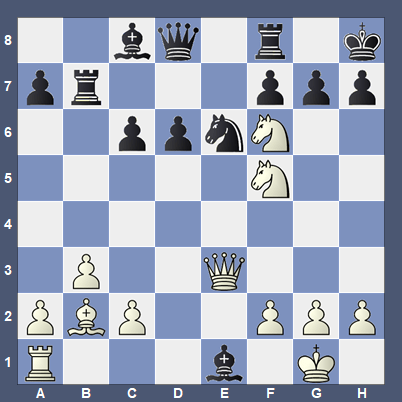
Either Nxg7 or the simple Rxe1 would have given him a very large advantage, but instead he played the absurd 19. Qh6??, simply overlooking that Gunsberg could block the discovered check with f6.
His game against Mortimer again demonstrated his prowess in the Ruy Lopez.
[Event “British CA Congress-04 Masters: Bradford R3”]
[Date “1888.08.07”]
[White “Locock, Charles Dealtry”]
[Black “Mortimer, James”]
[Result “1-0”]
1. e4 e5 2. Nf3 Nc6 3. Bb5 Nf6 4. O-O Nxe4 5. d4 Be7 6. Qe2 Nd6 7. Bxc6 bxc6 8. dxe5 Nb7 9. Nd4 Nc5 10. Rd1 Bb7 11. Qg4 g6 12. Nc3 h5 13. Qf3 a5 14. b3 Rb8 15. Bb2 h4 16. Qg4 Qc8 17. Re1 Rh5 18. Bc1 d5 19. e6 Rh7 20. exf7+ Kxf7 21. Rxe7+ Kxe7 22. Qxg6 Qh8 23. Ba3 Rg8 24. Bxc5+ Kd8 25. Qf5 Rd7 26. Re1 Qh7 27. Qxh7 Rxh7 28. Ne6+ Kd7 29. Nf8+ Rxf8 30. Bxf8 h3 31. Na4 c5 32. Nxc5+ Kc6 33. Re6+ 1-0
On 12 February 1889, at St George’s Hanover Square, Charles Dealtry Locock married his first cousin, Ida Gertrude Locock, a daughter of Charles’s army officer Uncle Herbert. They can’t have had much time for a honeymoon as he was soon in action again over the board.
In a March 1889 match between Oxford Past and Cambridge Past (the first of what would become an annual event) he faced an interesting opponent in economist John Neville Keynes, the father of John Maynard Keynes.
Again he attacked strongly in the opening, but missed the best continuation, allowing his opponent to equalise, and then blundered in what should have been a drawn ending.
[Event “Oxford Past v Cambridge Past B2 “]
[Date “1889.03.27”]
[White “Locock, Charles Dealtry”]
[Black “Keynes, John Neville”]
[Result “0-1”]
1. e4 c5 2. Nf3 Nc6 3. Nc3 Nf6 4. d4 cxd4 5. Nxd4 d6 6. Be2 e6 7. O-O Be7 8. Kh1 a6 9. f4 Bd7 10. Bf3 O-O 11. Be3 Rc8 12. Qe1 e5 13. Nxc6 Bxc6 14. Rd1 Qc7 15. Qg3 exf4 16. Bxf4 Ne8 17. Rf2 Rd8 18. Rfd2 b5 19. e5 Bxf3 20. exd6 Bxd6 21. Bxd6 Rxd6 22. gxf3 Rxd2 23. Rxd2 Qc4 24. Qf2 Nf6 25. Kg2 b4 26. Rd4 Qc5 27. Ne4 Nxe4 28. Rxe4 Qd6 29. Qd4 Qxd4 30. Rxd4 a5 31. Rc4 h6 32. c3 Rb8 33. cxb4 axb4 34. Kf2 Kf8 35. Ke3 Ra8 36. Rxb4 Rxa2 37. Rb7 g5 38. h3 Kg7 39. Kf2 Kg6 40. Kg3 Ra4 41. b4 f5 42. h4 f4+ 43. Kg4 h5+ 44. Kh3 g4+ 45. fxg4 Ra3+ 46. Kg2 hxg4 47. Rb5 Ra2+ 48. Kg1 g3 49. Rg5+ Kf6 50. b5 Rb2 51. Kf1 Rh2 0-1
They met again in the same fixture two years later, the game resulting in a draw.
At the end of 1889 Locock resigned his position at Worcester Cathedral School, briefly taking a post at Hereford Grammar School before moving to London.
The BCA ran another strong international tournament in 1890, this time in Manchester. This time Locock was less successful, not helped by leaving a piece en prise on move 7 against Alapin, although he did score 50% against the top four.

Unlike two years before, he made no mistake against Mackenzie.
[Event “British CA Congress-06 Masters: Manchester R18”]
[Date “1890.09.06”]
[White “Locock, Charles Dealtry”]
[Black “Mackenzie, George Henry”]
[Result “1-0”]
1. e4 c5 2. Nc3 Nc6 3. Nf3 e6 4. d4 cxd4 5. Nxd4 Bb4 6. Be2 Nf6 7. Nxc6 bxc6 8. O-O O-O 9. e5 Nd5 10. Ne4 f5 11. Nd6 Bxd6 12. exd6 Rb8 13. c4 Nf6 14. b3 c5 15. Bb2 Bb7 16. f3 Qe8 17. Qd2 Qc8 18. Rad1 h6 19. Bd3 Qc6 20. Bb1 Rbe8 21. Rfe1 Rf7 22. Re5 Kh7 23. Qf2 Rc8 24. Ba3 Qb6 25. Bxc5 Qd8 26. Bxa7 Nh5 27. Qb6 Qxb6+ 28. Bxb6 g5 29. Rxe6 dxe6 30. d7 Rd8 31. Bxd8 Bc6 32. Be7 1-0
In 1891 Locock’s first daughter was born in Hawkhurst, Kent, although his location was still being given as London at the time. He was also still playing at the British Chess Club, winning this brilliant miniature against a strong opponent in their handicap tournament.
[Event “British Chess Club Handicap”]
[Date “1891.??.??”]
[White “Trenchard, Herbert William”]
[Black “Locock, Charles Dealtry”]
[Result “0-1”]
1. e4 e5 2. f4 d5 3. exd5 exf4 4. Nf3 Qxd5 5. Nc3 Qh5 6. d4 g5 7. Bc4 Bg4 8. O-O Bxf3 9. Qe1+ Ne7 10. Rxf3 Nbc6 11. d5 Nd4 12. Rh3 Qxh3 13. Qe5 Nf3+ 14. gxf3 O-O-O 15. Nb5 Nxd5 16. b4 Bxb4 17. Bb2 Bc5+ 18. Bd4 Bxd4+ 19. Qxd4 Nb6 20. Qe5 Qd7 21. Bd3 Rhe8 22. Nxa7+ Kb8 23. Qa5 Qd4+ 24. Kg2 Qxa1 25. Nb5 Rxd3 0-1
In 1892 the BCA ran another international tournament, this time in London, with the participation of the young Emanuel Lasker. Locock did well to score 6½/11.

Unfortunately, his draw against Lasker doesn’t appear to have been published, but we do have this game.
[Event “BCA Congress: London R6”]
[Date “1892.03.12”]
[White “Fenton, Richard Henry Falkland”]
[Black “Locock, Charles Dealtry”]
[Result “0-1”]
1. e4 e5 2. Nf3 Nc6 3. Bb5 g6 4. d4 exd4 5. Nxd4 Bg7 6. Be3 Nf6 7. Nc3 O-O 8. Qd2 Ng4 9. O-O-O Nxe3 10. fxe3 Ne5 11. Be2 d6 12. h3 a6 13. g4 b5 14. Rdg1 b4 15. Nd1 Bb7 16. Nf2 c5 17. Nb3 Qf6 18. Rh2 a5 19. g5 Qe7 20. h4 a4 21. Na1 a3 22. Kb1 c4 23. b3 Nf3 24. Bxf3 Qe5 25. c3 Qxh2 26. Rh1 Qe5 27. bxc4 bxc3 28. Qc2 Bc6 29. Nb3 Rab8 30. Kc1 Ba4 31. Bd1 Bxb3 32. axb3 a2 33. Qxa2 Ra8 34. Qb1 c2 35. Qxc2 Qa1+ 36. Qb1 Qc3+ 0-1
This would be his last tournament, although he continued playing in matches for several more years.
Soon afterwards Charles Dealtry Locock and his family moved out of London and back to his county of birth, settling in the village of Burwash, not all that far from Hawkhurst. Although it was 15 miles away, he wasn’t deterred from joining the Hastings and St Leonards Chess Club.

17 December 1892
It was in Burwash that his second daughter was born in 1894. Meanwhile, he was taking part in county and other matches, and playing consultation games with other leading players, a popular feature of Hastings chess at the time.
Here’s an exciting example in which he had a very strong partner.
[Event “Consultation game: Hastings “]
[Date “1895.01.18”]
[White “Gunsberg, Isidor Arthur/Locock, Charles Dealtry”]
[Black “Bird, Henry Edward/Womersley, Frederick William”]
[Result “1-0”]
[ECO “C46”]
1. e4 e5 2. Nf3 Nc6 3. Nc3 g6 4. d4 exd4 5. Nxd4 Bg7 6. Be3 Nge7 7. Bc4 d6 8. f4 Bd7 9. O-O O-O 10. Nce2 Na5 11. Qd3 Nxc4 12. Qxc4 c5 13. Nb5 Qb6 14. Nbc3 Rfe8 15. Rab1 Qc6 16. Qd3 Rad8 17. Bf2 b5 18. Bh4 c4 19. Qd2 b4 20. Nd5 Nxd5 21. Bxd8 Rxe4 22. Bh4 Ne3 23. Rf3 Nf5 24. Bf2 Bxb2 25. Rxb2 c3 26. Nxc3 bxc3 27. Rxc3 Qa4 28. Rc7 Nd4 29. h3 Bxh3 30. Rb8+ Kg7 31. Qc3 Be6 32. Bxd4+ Rxd4 33. Re8 Kf6 34. Rc6 Kf5 35. Rxd6 Rxf4 36. Rd5+ Bxd5 37. Re5+ 1-0
One of the opposing team would late meet a tragic end, as described in Edward Winter’s excellent and thorough article here.
The same year a cable match took place between the British and Manhattan Chess Clubs, which was the predecessor of the official Anglo-American Cable Matches starting the following year. Locock was matched against Albert Beauregard Hodges: their game was drawn in 28 moves.
As a gentleman amateur he was just the sort of chap the selectors were looking for, and, although he was no longer an active tournament player he was selected for the Great Britain team for the first four matches. In 1896 he drew a fairly long ending against Edward Hynes, but in 1897 he was well beaten by Jackson Whipps Showalter.
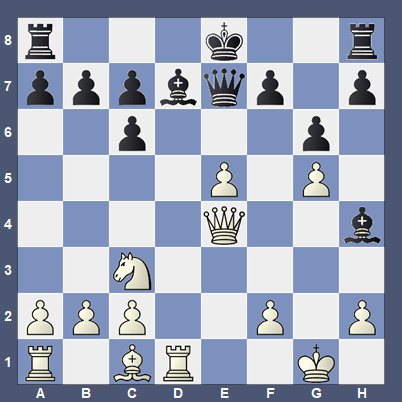
Locock, playing Black, had misplayed the opening, and now Showalter replied to 14… Bxg5 with 15. Rxd7! Kxd7 16. Qg4+ Qe6 17. Qd4+ Kc8 18. Bxg5, having no problem converting his advantage.
This very short consultation game is (or at least was) perhaps his best known game, although it’s not clear whether the game lasted 9 or 18 moves: some sources claim that White resigned after Black’s 9th move, while other sources take the game up to move 18. Unsurprisingly, it involves a queen sacrifice.
[Event “Consultation game: Hastings”]
[Date “1897.02.15”]
[White “Bird Henry Edward/Dobell Herbert Edward”]
[Black “Gunsberg Isidor Arthur/Locock Charles Dealtry”]
[Result “0-1”]
1. f4 e5 2. fxe5 d6 3. exd6 Bxd6 4. Nf3 g5 5. c3 g4 6. Qa4+ Nc6 7. Nd4 Qh4+ 8. Kd1 g3 9. b3 Qxh2 10. Nxc6 Qxh1 11. Ke1 Qg1 12. Ne5+ c6 13. Nd3 Bf5 14. e4 O-O-O 15. exf5 Nf6 16. Kd1 Qxf1+ 17. Kc2 Qxf5 18. Qxa7 Qxd3+ 0-1
This position, from an 1897 match between North London and Hastings & St Leonards, is another demonstration of how Locock’s predilection for sacrifices could end up looking foolish.
He was Black here against Joseph William Hunt.
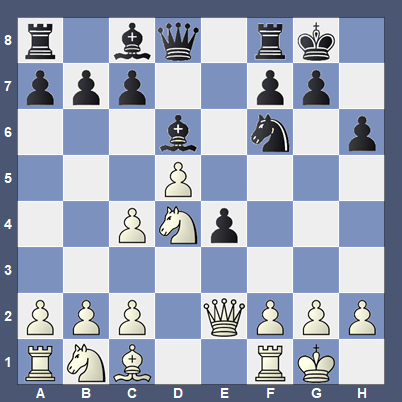
Locock being Locock, he couldn’t resist the Greek Gift sacrifice here. 11… Bxh2? 12. Kxh2 Ng4+. Hunt played 13. Kg3?, which was unclear, the game eventually resulting in a draw, but 13. Kg1! Qh4 14. Bf4! would have left Black with very little for the piece. These sacrifices usually don’t work if your opponent has a diagonal defence of this nature: there are one or two examples of this in Chess Heroes: Puzzles Book 1. Curiously, the notes in the Pall Mall Gazette (Gunsberg?) claim that 13. Kg1 ‘was obviously impossible owing to Qh4 by Black’. Obviously not, but newspaper annotations, without Stockfish to assist and probably written overnight, were very poor in those days.
In the 1898 Cable Match Locock drew with David Graham Baird, this time missing an early tactical opportunity.
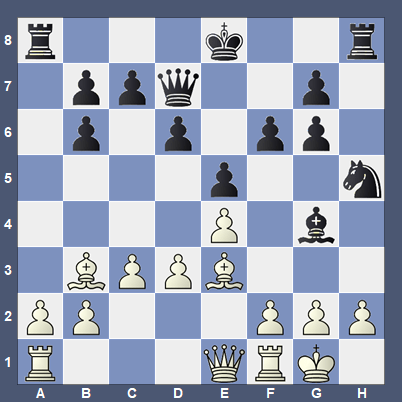
15… Bf3! 16. gxf3 Qh3 was winning, but instead he played 15… g5 and after 16. f3 White was safe, the game eventually resulted in a draw after a long double rook ending.
Locock’s opponent in the 1899 Cable Match was Sidney Paine Johnston.
Here’s the game.
[Event “Cable Match USA-England B7.1”]
[Date “1899.03.10”]
[White “Locock, Charles Dealtry”]
[Black “Johnston, Sidney Paine”]
[Result “1/2-1/2”]
1. e4 e5 2. Nf3 Nc6 3. Bb5 Nf6 4. O-O Nxe4 5. d4 Nd6 6. Bxc6 bxc6 7. dxe5 Nb7 8. Nd4 Nc5 9. Nd2 Be7 10. b4 Ne6 11. Nxe6 dxe6 12. Qg4 O-O 13. Ne4 Kh8 14. Rd1 Qe8 15. Rd3 f5 16. exf6 gxf6 17. Ng3 f5 18. Bb2+ Bf6 19. Bxf6+ Rxf6 20. Qh4 Rf8 21. Rad1 Qg6 22. Rd8 Bb7 23. Rxf8+ Rxf8 24. Qd4+ Kg8 25. Qxa7 f4 26. Qxb7 fxg3 27. Qxc6 Qh5 28. Rd2 Qxh2+ 29. Kf1 Qh1+ 30. Ke2 gxf2 31. Qxe6+ 1/2-1/2
Locock missed a win: 28. Qxe6+ Kh8 29. Rd8!, while Johnston in turn missed 29… Qh6!
There was quite a lot of comment in the press about Locock’s miss. Here’s the Morning Post (Antony Guest):

Stung by this criticism, he decided it was time to give up competitive over-the-board chess. He kept his word, too. In 1901 it was announced that he’d compete in the Kent Congress, but he changed his mind. This was indeed the end of that part of his chess career.
Many years later he recalled:


What, then, should we make of Charles Dealtry Locock (pictured above) as a chess player? He was clearly a very creative and imaginative tactician, who, at his best, was of master standard for his day (EdoChess rates him as 2346 in 1892), but his constant quest for brilliancy led him to play the occasional silly move, and he sometimes missed tactical opportunities, particularly if they involved more unusual ideas. He also seemed to find endings rather boring. But perhaps, judging from the quote above, he wasn’t temperamentally suited to competitive chess, finding the pressure of the ticking clock too stressful. I can empathise. Fortunately for him, there were other ways to fuel his chess addiction.
You’ll find out more in my next two Minor Pieces.
Sources and Acknowledgements
Many thanks, first of all, to Brian Denman for kindly sending me his extensive file of Locock games.
Locock’s memoirs, quoted in several places above, and written with a combination of arrogance, false modesty and facetiousness, were published in the January 1933 issue of the British Chess Magazine.
Other sources:
ancestry.co.uk
findmypast.co.uk/British Newspaper Library
Wikipedia
BritBase (John Saunders)
Chess Notes (Edward Winter)
ChessBase 17/MegaBase 2023/Stockfish 16.1
chessgames.com (Locock here)
EdoChess (Rod Edwards: Locock here)
Correspondence Chess in Britain and Ireland 1824-1987 and British Chess Literature to 1914, both written by Tim Harding and published by McFarland & Company Inc.


 Minor Pieces
Leave a reply to Minor Pieces 75: Charles Dealtry Locock (2) – Minor Pieces Cancel reply