Last time we left London chess professional Francis Joseph Lee as the calendar turned from 1899 into 1900.
He was finally selected for the Anglo-American Cable Match that year, being assigned to Board 2 where he took the white pieces against one of his London 1899 opponents, Jackson Whipps Showalter. Standing worse much of the way he managed to escape into a somewhat fortunate draw.
This was the critical position, with Black to play his 45th move.
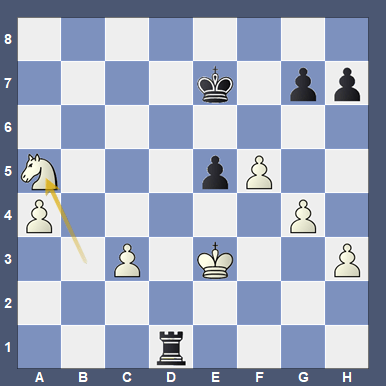
Stockfish tells me Black is winning easily if he goes after the h-pawn, but, in the heat of battle, it’s very tempting to target the dangerous looking a-pawn instead. The game concluded 45… Ra1? 46. Nc4 Rxa4? (Kf6 still offered some winning chances) 47. Nxe5 Kd6 48. Nf3, and the combatants agreed to share the point.
In April Lee took part in an invitation tournament run by the City of London club, where his result was about what he would have expected, although he only managed to beat the three tail-enders.

In this game his knights on the rim were far from dim. As usual, you can copy and paste the pgn here to play through the games in this article online.
[Event “London City Club Invitation R7”]
[Date “1900.04.23”]
[White “Passmore, Samuel”]
[Black “Lee, Francis Joseph”]
[Result “0-1”]
1. e4 c6 2. d4 d5 3. exd5 cxd5 4. Bd3 Nf6 5. Nc3 Nc6 6. Nf3 Bg4 7. Be3 e6 8. O-O Rc8 9. Re1 Bd6 10. Ne2 Qc7 11. Ng3 O-O 12. c3 Ne7 13. Bg5 Ng6 14. Rc1 Bf4 15. Bxf4 Qxf4 16. Re3 Nh4 17. Be2 Bxf3 18. Bxf3 Rfe8 19. Qe2 Rc6 20. Re1 Rec8 21. Nh5 Nxh5 22. Bxd5 Qh6 23. Bxc6 bxc6 24. Re5 Nf4 25. Qe4 Nhxg2 26. Rf1 f5 27. Qf3 Nh4 28. Qg3 Rf8 29. Kh1 Rf6 30. Qe3 Rg6 31. Rg1 Nhg2 0-1
A match against Passmore that summer was won by 5 points to 3. In December he finished second to Teichmann in a 5-player tournament at Simpson’s Divan.
In this game he was successful with the London System.
[Event “Simpson’s tournament: London”]
[Date “1900.12.??”]
[White “Lee, Francis Joseph”]
[Black “Mueller, Oscar Conrad”]
[Result “1-0”]
1. d4 d5 2. Nf3 Nf6 3. Bf4 e6 4. Nbd2 c5 5. e3 a6 6. c3 Be7 7. Bd3 c4 8. Bc2 b5 9. e4 dxe4 10. Nxe4 Bb7 11. Qe2 Nbd7 12. O-O Qb6 13. Ne5 O-O 14. Rfe1 Rad8 15. Ng5 h6 16. Nxd7 Rxd7 17. Nf3 Nd5 18. Bd2 Bd6 19. Ne5 Rc7 20. Qg4 Nf6 21. Qh4 Be7 22. Bxh6 Ne8 23. Bg5 1-0
In 1901 Francis Joseph Lee was on tour again, returning to Ireland where he spent a weekend with Irish Nationalist MP and chess addict John Howard Parnell, whose love of chess is mentioned on several occasions in James Joyce’s Ulysses.
Here’s a game from a Dublin simultaneous display.
[Event “Simultaneous Display: Dublin”]
[Date “1901.03.??”]
[White “Lee, Francis Joseph”]
[Black “Mr M”]
[Result “1-0”]
1. e4 e5 2. Nf3 Nc6 3. d4 exd4 4. Bc4 Bc5 5. c3 dxc3 6. Nxc3 Qe7 7. O-O Ne5 8. Bb3 Nxf3+ 9. Qxf3 d6 10. e5 dxe5 11. Nd5 Qd6 12. Rd1 Bd4 13. Rxd4 exd4 14. Bf4 Qc5 15. Re1+ Be6 16. Nxc7+ Kd7 17. Bxe6+ fxe6 18. Nxe6 Qc6 19. Qg4 1-0
Lee was also interviewed by the Dublin Evening Herald (16 March 1901).


In April he returned to London where he was placed on Board 3 in the Anglo-American cable match, drawing his game with John Finan Barry. That summer there was another match against Richard Teichmann, which he lost by 5½ to 2½.
Lee continued touring in England into 1902, when he played on Board 4 in the Anglo-American Cable Match. Playing white against Albert Beauregard Hodges, he seemed ill at ease in an IQP position, losing the exchange and, eventually, the game.
Then, in April, there was an announcement.

But he had time for an Easter party before he left, having fun with some distinguished friends.

Except that he never reached Australia, instead stopping off in South Africa, where his brother George was living. By June it was reported that he was giving simultaneous displays and playing exhibition games in Cape Town.
This game was played against two of South Africa’s strongest players, Abraham Michael and Max Blieden, playing in consultation.
[Event “Consultation Game: Johannesberg”]
[Date “1902.09.??”]
[White “Lee, Francis Joseph”]
[Black “Michael, Abraham & Blieden, Max”]
[Result “1-0”]
1. d4 d5 2. e3 Nf6 3. Bd3 Nc6 4. f4 Nb4 5. Nf3 Nxd3+ 6. cxd3 e6 7. O-O Be7 8. Bd2 Bd7 9. b4 O-O 10. Bc3 c6 11. Nbd2 Be8 12. Qe2 Nd7 13. g4 f6 14. Kh1 Kh8 15. h4 Nb6 16. Qd1 Qd7 17. Rg1 Bd8 18. Qc2 Nc8 19. Nb3 b6 20. Rae1 Nd6 21. e4 Rb8 22. Qh2 Rb7 23. h5 Nc8 24. Nh4 Ne7 25. f5 exf5 26. exf5 Ng8 27. Bd2 Bf7 28. Nc1 Re8 29. Ne2 Bc7 30. Nf4 Rbb8 31. Rc1 Re7 32. Qh3 Bxf4 33. Bxf4 Rbe8 34. Qf3 h6 35. Rc2 Re1 36. Ng2 Rxg1+ 37. Kxg1 Ne7 38. Kf2 Nc8 39. Qg3 a6 40. Qf3 Nd6 41. a4 Nb7 42. Qd1 a5 43. Qc1 Rc8 44. b5 c5 45. Bxh6 c4 46. Bf4 Nd6 47. Nh4 cxd3 48. Rxc8+ Qxc8 49. Qxc8+ Nxc8 50. Ke3 Kg8 51. Ng6 Be8 52. Kxd3 Bf7 53. Bc7 Be8 54. Bd8 Bxg6 55. fxg6 Kf8 56. Ke2 Ke8 57. Bc7 Ke7 58. Ke3 Kf8 59. Kf4 Ke8 60. Kf5 Ke7 61. g5 fxg5 62. Kxg5 Kf8 63. Kf5 1-0
He then visited Pretoria and Johannesburg, where, in December, he was appointed Chess Editor of the Rand Daily Mail. He seemed well and truly established in a new country of residence.

Fairly substantial sponsorship for the time and place, I would have thought. Needless to say, he won first prize with a score of 8/9, followed by Blieden on 7½ and Michael on 6½.
In this game his opponent missed a chance to activate his queen on move 31 before ill-advisedly trading queens into a lost bishop ending.
[Event “South African Championship: Johannesburg”]
[Date “1903.04.??”]
[White “Lee, Francis Joseph”]
[Black “Bletcher, John”]
[Result “1-0”]
1. d4 e6 2. e3 f5 3. g3 Nf6 4. Bg2 Be7 5. Nf3 d6 6. b3 Nbd7 7. Bb2 Ne4 8. Nbd2 Nxd2 9. Nxd2 Nf6 10. c4 c6 11. O-O O-O 12. Qe2 d5 13. Nf3 Qe8 14. Ne5 Bd6 15. Rfd1 Bxe5 16. dxe5 Ne4 17. f3 Nc5 18. Ba3 b6 19. b4 Nd7 20. f4 Bb7 21. b5 Nc5 22. cxd5 cxd5 23. Rac1 Rc8 24. Rc2 Rf7 25. Rdc1 Rfc7 26. Bb2 a5 27. Bd4 Qe7 28. Bxc5 Rxc5 29. Rxc5 Rxc5 30. Rxc5 bxc5 31. a4 Qc7 32. Qd2 Qb6 33. Kf2 Kf7 34. h3 c4 35. g4 g6 36. gxf5 gxf5 37. Bf3 Bc8 38. Bh5+ Kg8 39. Kf3 Qd8 40. Qg2+ Kf8 41. Qg5 Qxg5 42. fxg5 Bd7 43. Ke2 Ke7 44. Kd2 f4 45. exf4 d4 46. Be2 d3 47. Bd1 Kd8 48. Kc3 Be8 49. Kxc4 Bg6 50. h4 Kc7 51. h5 Bf5 52. Kc5 Bh3 53. g6 1-0
Nice work if you can get it. Organise a tournament, find a sponsor and then, because you’re the strongest player around, win it (the first prize was £55) yourself.
But then:

(There are quite a few instances of his being referred to as JF Lee rather than FJ Lee.)
Back in England again, he spent the autumn touring clubs in the south west of the country. In January 1904 he was at the other end of England, in Carlisle, before travelling down to Brighton for a 9-player tournament in February.
Here, he shared second place with 5½/8 with the young German player Paul Saladin Leonhardt, resident in London at the time, a point behind Reginald Pryce Michell.
Here’s his win against Leonhardt.
[Event “Brighton Congress 1st Class Open R4”]
[Date “1904.02.10”]
[White “Lee, Francis Joseph”]
[Black “Leonhardt, Paul Saladin”]
[Result “1-0”]
1. d4 d5 2. e3 c5 3. b3 Nc6 4. Bb2 Bf5 5. Nf3 Nf6 6. a3 e6 7. Nbd2 Qb6 8. c4 cxd4 9. exd4 Be7 10. c5 Qc7 11. b4 O-O 12. g3 Ne4 13. Bg2 Bf6 14. O-O g5 15. Nb3 h5 16. Ne1 g4 17. f4 Kg7 18. Nd3 Rh8 19. Ne5 h4 20. Bxe4 dxe4 21. Nxg4 Bxg4 22. Qxg4+ Kf8 23. Qe2 hxg3 24. hxg3 Rg8 25. Kf2 Ne7 26. Qxe4 Nf5 27. Rg1 Ke7 28. Nc1 Nxg3 29. Rxg3 Bh4 30. Ne2 Rg4 31. d5 Bxg3+ 32. Nxg3 Rxf4+ 33. Kg2 Rxe4 34. d6+ Kd7 35. dxc7 Rg8 36. Kf3 Reg4 37. Be5 Kc8 38. Rd1 R4g6 39. Ne4 f6 40. Nd6+ Kxc7 41. Nb5+ 1-0
In March Lee was appointed umpire of the Oxford v Cambridge match, and was called upon to adjudicate an unfinished game when time was called. Summer was a busy time, with two tournaments to play in.
The City of London club organised an event starting at the end of July featuring many of the top players then resident in England. With the Germans Teichmann and Leonhardt, along with Dutchmen van Vliet and Loman it had quite an international feel to it.

Lee’s score of 9/16 was round about a par result for him.
The great veteran Blackburne opened 1. a3, and Lee was able to build up one of his trademark slow kingside attacks.
[Event “City of London CC National R3”]
[Date “1904.07.27”]
[White “Blackburne, Joseph Henry”]
[Black “Lee, Francis Joseph”]
[Result “0-1”]
1. a3 d5 2. Nf3 Nf6 3. d4 Bf5 4. e3 e6 5. c4 c6 6. Nc3 Bd6 7. Bd2 Nbd7 8. Be2 Ne4 9. O-O O-O 10. h3 Bg6 11. Nh2 Ndf6 12. f4 Nxd2 13. Qxd2 Ne4 14. Nxe4 Bxe4 15. c5 Bc7 16. Bf3 f5 17. Bxe4 dxe4 18. Qf2 Kh8 19. Kh1 g5 20. g3 Rg8 21. Rg1 Qd5 22. Nf1 Rg7 23. Nd2 Rag8 24. Qe2 Qd8 25. Qf2 Rg6 26. Nc4 Qe8 27. Ne5 Rh6 28. Kg2 Qh5 29. Rh1 gxf4 30. exf4 Bxe5 31. dxe5 Rhg6 32. Raf1 Qh4 33. Rh2 Rxg3+ 34. Kh1 Rf3 35. Qe2 Rxh3 36. Rff2 Rxh2+ 37. Rxh2 Qxf4 38. Qd1 e3 39. Qd3 Qf3+ 0-1
He was fortunate to win an exciting game against endgame (and carpet) expert Tattersall.
[Event “City of London CC National R10”]
[Date “1904.08.05”]
[White “Lee, Francis Joseph”]
[Black “Tattersall, Creassey Edward Cec”]
[Result “1-0”]
1. d4 f5 2. e4 fxe4 3. Nc3 Nf6 4. Bg5 c6 5. Bxf6 exf6 6. Nxe4 d5 7. Ng3 Qb6 8. Qe2+ Kd8 9. O-O-O a5 10. Nf3 Na6 11. c3 g6 12. Qc2 Bd6 13. Bd3 Be6 14. Rde1 Re8 15. Re2 c5 16. Bxa6 Qxa6 17. Rhe1 Bf4+ 18. Kd1 c4 19. Nf1 Qc6 20. h3 Kd7 21. g4 b5 22. Nh4 b4 23. Ng2 Bd6 24. f4 a4 25. f5 gxf5 26. gxf5 Bf7 27. Rxe8 Bxe8 28. cxb4 Bxb4 29. Re6 Qb5 30. Qe2 a3 31. b3 Kd8 32. bxc4 dxc4 33. Nge3 Bc3 34. Nd2 Bxd2 35. Qxd2 Rb8 36. Ke1 Qb1+ 37. Qd1 Qxa2 38. Qf3 c3 39. Rxe8+ Kxe8 40. Qc6+ Kf8 41. Qxf6+ Kg8 42. Qg5+ Kf7 43. Qh5+ Ke7 44. f6+ Kf8 45. Qc5+ Kf7 46. Qe7+ Kg6 47. Qg7+ Kh5 48. Qxh7+ Kg5 49. Qf5+ Kh6 50. Ng4# 1-0
At this time he liked to transpose from the Exchange Caro-Kann into the Scandinavian by capturing with his queen on d5. It didn’t always work out, but here, against one of the weaker players in the event, it proved effective.
[Event “City of London CC National R14”]
[Date “1904.08.10”]
[White “Curnock, Arthur John”]
[Black “Lee, Francis Joseph”]
[Result “0-1”]
1. e4 c6 2. d4 d5 3. exd5 Qxd5 4. Nc3 Qd8 5. Nf3 Bg4 6. Be2 Bxf3 7. Bxf3 e6 8. O-O Nf6 9. Bg5 Be7 10. Qd2 Nbd7 11. Bf4 Nb6 12. Ne4 Nbd5 13. Be3 O-O 14. c4 Nxe3 15. fxe3 Qd7 16. Rad1 Rad8 17. Qc2 Qc7 18. c5 Nd5 19. Rfe1 f5 20. Nc3 Bg5 21. Bxd5 exd5 22. Re2 Rde8 23. Rde1 Re6 24. Nd1 Qe7 25. Qd3 g6 26. b4 Re8 27. Kf1 h5 28. a4 Re4 29. b5 h4 30. Kf2 Qc7 31. g3 Kg7 32. Rg1 Rg4 33. Kf3 Rge4 34. Kf2 Rh8 35. Kf3 Kf6 36. Reg2 h3 37. Re2 Rhe8 38. Rge1 f4 39. Nf2 fxe3 40. Nxh3 Bh6 41. Ng1 Kg7 42. Kg2 Rf8 43. Nf3 Qf7 44. Rf1 Qe6 45. Ne5 Rxf1 46. Kxf1 Qf5+ 47. Ke1 Rxe5 0-1
Just a week later, the first British Chess Championships took place in Hastings. Lee was selected for the top section, so had to make another trip down to the Sussex coast.
His result was again what he would have expected. On retrospective ratings he finished below those rated above him, and above those rated below him, but he did have wins against Atkins and Michell to his credit.

In the first round Mackenzie carelessly blundered into a queen sacrifice.
[Event “British CF-01 Championship: Hastings R1”]
[Date “1904.08.22”]
[White “Lee, Francis Joseph”]
[Black “Mackenzie, Arthur John”]
[Result “1-0”]
1. d4 d5 2. e3 Nf6 3. Bd3 e6 4. f4 c5 5. c3 Nc6 6. Nf3 a6 7. Nbd2 Qc7 8. Ne5 b5 9. O-O Bd6 10. Ndf3 h6 11. Nxc6 Qxc6 12. Ne5 Qc7 13. Bd2 Bb7 14. a4 c4 15. Bc2 O-O 16. Rf3 Ne4 17. Be1 Kh7 18. Rh3 f6 19. Nf3 Rad8 20. Nd2 e5 21. fxe5 fxe5 22. Bh4 Rde8 23. axb5 axb5 24. Qh5 g6 25. Qxh6+ Kxh6 26. Bf6# 1-0
Lee annotated this game for the British Chess Magazine. He commented after Black’s 24th move that Black should have played Qf7, but White’s advantage was probably sufficient to win. Stockfish is of a different opinion.
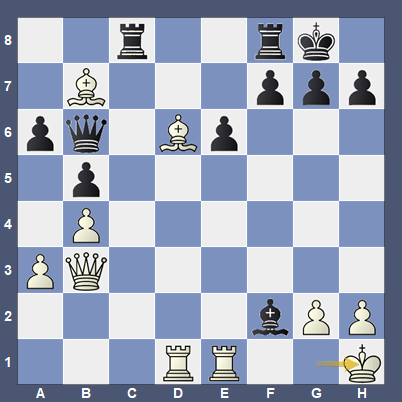
This is the key position from Lee’s game against Atkins. Atkins miscalculated by playing 22… Bxe1? (Qxb7 is only slightly better for White) 23. Bxc8 Rd8 24. Bc5 Qc7 25. Bxe6 and Black resigned as he’s going to end up a piece down.
His win against Michell is well worth looking at.
[Event “British CF-01 Championship: Hastings R7”]
[Date “1904.08.30”]
[White “Lee, Francis Joseph”]
[Black “Michell, Reginald Pryce”]
[Result “1-0”]
1. d4 d5 2. Nf3 Nf6 3. Bf4 e6 4. e3 Bd6 5. Bg3 O-O 6. Bd3 c5 7. c3 Nc6 8. Nbd2 b6 9. Ne5 Bxe5 10. dxe5 Nd7 11. f4 f5 12. Nf3 Qe8 13. b3 Bb7 14. a3 Qg6 15. Nh4 Qf7 16. Nf3 h6 17. h4 Rfd8 18. b4 Nf8 19. Qe2 a5 20. b5 Ne7 21. a4 Rac8 22. Kf2 d4 23. exd4 Bxf3 24. Qxf3 cxd4 25. c4 Nd7 26. Rhe1 Nc5 27. Kg1 Rc7 28. Bf2 Ng6 29. g3 Rcd7 30. Kh2 Qe7 31. Red1 Rc8 32. Bc2 Qd8 33. Ra3 Nf8 34. Bb1 g5 35. g4 Ng6 36. gxf5 Nxf4 37. Bg3 d3 38. Bxf4 gxf4 39. f6 Qf8 40. Ra2 Rcd8 41. Rg2+ Kh8 42. Rg6 Nxa4 43. Qxf4 Kh7 44. Rdg1 Nc3 45. Bxd3 1-0
Later that year, Lee undertook another tour of South West England, but 1905 started quietly. He was selected to take part in the Anglo-American cable match, but this was called off at short notice due to broken cables.
That summer, rather than playing in the British Championship, he took part in his first continental tournament, playing in the Masters B section of a massive event in Barmen, Germany.

His 50% score was again about par for the course, but, typically, he performed as well against the top half as he did against the bottom half. The two most familiar names to you, I guess, would be Spielmann, finishing level with Lee, and Nimzowitsch, who had a poor result. Both were young men who would do much better in future.
His win against Spielmann, using his favourite Caro-Kann Defence (I’m sure Horatio Caro himself would have been delighted) was an excellent game.
[Event “Barmen Masters B R6”]
[Date “1905.08.19”]
[White “Spielmann, Rudolf”]
[Black “Lee, Francis Joseph”]
[Result “0-1”]
1. e4 c6 2. d4 d5 3. Nc3 dxe4 4. Nxe4 Bf5 5. Ng3 Bg6 6. Nf3 Nd7 7. Bd3 e6 8. Bf4 Ngf6 9. O-O Be7 10. c4 Bxd3 11. Qxd3 O-O 12. Rfe1 Re8 13. Rad1 Nf8 14. Ne5 Qa5 15. a3 Rad8 16. b4 Qc7 17. Qe3 Bd6 18. c5 Bxe5 19. Bxe5 Qe7 20. Bd6 Qd7 21. Nf1 Ng6 22. h3 Nd5 23. Qb3 b5 24. a4 bxa4 25. Qa3 Qb7 26. Rb1 Qb5 27. Nd2 Rd7 28. Ne4 a5 29. bxa5 Qxa5 30. Rec1 f5 31. Ng5 h6 32. Nf3 Ra7 33. h4 Qd8 34. h5 Nh4 35. Ne5 Qg5 36. Qg3 Qxh5 37. Nxc6 f4 38. Bxf4 Nxf4 39. Qxf4 Rf7 40. Qe4 Qg5 41. Ne5 Rf4 42. Qc6 Ref8 43. Qxe6+ Kh7 44. g3 Rxf2 45. Qg4 Nf3+ 46. Kxf2 Nxe5+ 47. Qf4 Rxf4+ 48. gxf4 Qxf4+ 0-1
His game against the Italian representative was also very typical of his style.
[Event “Barmen Masters B R11”]
[Date “1905.08.25”]
[White “Lee, Francis Joseph”]
[Black “Reggio, Arturo”]
[Result “1-0”]
1. d4 d5 2. Nf3 e6 3. Bf4 c5 4. e3 Qb6 5. Qc1 Bd6 6. Bxd6 Qxd6 7. c3 Nd7 8. Nbd2 f5 9. Bb5 Ngf6 10. Ne5 O-O 11. Ndf3 a6 12. Be2 c4 13. O-O b5 14. Qc2 Bb7 15. g3 Qe7 16. Rfe1 Kh8 17. Bf1 Rg8 18. h4 Nxe5 19. Nxe5 g5 20. hxg5 Rxg5 21. Bg2 Rag8 22. Kf1 Ne4 23. Bxe4 fxe4 24. Ke2 Qf6 25. Rg1 Rh5 26. Rg2 Rf8 27. Rag1 Rf5 28. Ke1 Qh6 29. g4 Rg5 30. Qe2 a5 31. Qf1 Qg7 32. Rh2 Qc7 33. Rh6 b4 34. Rgh1 Rg7 35. Qh3 bxc3 36. bxc3 Kg8 37. Kf1 Qe7 38. g5 Qa3 39. Qxe6+ Rff7 40. Nxf7 1-0
In this game against a German master, though, he was on the wrong side of a spectacular miniature. Sadly, Post would later become the Nazis’ leading chess organiser: if you’d like to learn more I’d recommend this excellent book.
[Event “Barmen Masters B R12”]
[Date “1905.08.26”]
[White “Post, Ehrhardt”]
[Black “Lee, Francis Joseph”]
[Result “1-0”]
1. d4 d5 2. Nf3 Nf6 3. c4 e6 4. Nc3 Nbd7 5. Bf4 a6 6. e3 dxc4 7. Bxc4 b5 8. Bb3 b4 9. Na4 Bb7 10. O-O Rc8 11. Rc1 Nh5 12. d5 Nxf4 13. exf4 exd5 14. Bxd5 Bxd5 15. Qxd5 Be7 16. Rfd1 Bd6 17. Re1+ Be7 18. Rxe7+ Kxe7 19. Re1+ Kf8 20. Ng5 Qf6 21. Qxd7 Ra8 22. Nc5 h6 23. Qe8+ 1-0
Here, against a Dutch opponent, he escaped from a lost position by sacrificing a rook for a perpetual check.
[Event “Barmen Masters B R14”]
[Date “1905.08.29”]
[White “Leussen, Benjamin”]
[Black “Lee, Francis Joseph”]
[Result “1/2-1/2”]
1. d4 d5 2. c4 e6 3. Nc3 Nf6 4. Bg5 Be7 5. e3 Nbd7 6. Nf3 a6 7. Qc2 dxc4 8. Bxc4 b5 9. Be2 Bb7 10. O-O Rc8 11. Rad1 c5 12. Qb1 b4 13. Na4 Be4 14. Bd3 Bxf3 15. gxf3 c4 16. Bc2 Nd5 17. Bxe7 Qxe7 18. f4 f5 19. Kh1 O-O 20. Rg1 Qh4 21. Rg2 N7f6 22. Rdg1 Ng4 23. Qf1 c3 24. bxc3 Nxc3 25. Nc5 Rf6 26. f3 Nxe3 27. Rxg7+ Kh8 28. Qxa6 Rcf8 29. Nxe6 Rh6 30. Rg8+ Rxg8 31. Rxg8+ Kxg8 32. Qc8+ Kf7 33. Ng5+ Ke7 34. Qc7+ 1/2-1/2
In the last round he won another good game against the second place finisher.
[Event “Barmen Masters B R17”]
[Date “1905.09.01”]
[White “Swiderski, Rudolf”]
[Black “Lee, Francis Joseph”]
[Result “0-1”]
1. c4 e6 2. d4 d5 3. Nc3 Nf6 4. Bg5 Be7 5. e3 Nbd7 6. Nf3 c6 7. Qc2 O-O 8. Rd1 Re8 9. Bd3 dxc4 10. Bxc4 Nd5 11. Bxe7 Qxe7 12. O-O Nxc3 13. bxc3 Nf8 14. Rb1 Qc7 15. Bd3 f6 16. Rb2 Bd7 17. Nd2 Re7 18. f4 Rae8 19. Nf3 Bc8 20. Qd2 b6 21. Be4 Rd8 22. Qc1 Ba6 23. Re1 Bc8 24. Kh1 Bd7 25. Rf2 Be8 26. Bc2 c5 27. Bb3 Rc8 28. Qd2 Rd8 29. Ref1 Bg6 30. Kg1 Be4 31. Nh4 Kh8 32. Bc2 Bxc2 33. Qxc2 Red7 34. Qd3 Rd6 35. Rf3 Rc6 36. Rh3 Kg8 37. g4 cxd4 38. exd4 Rc8 39. Rff3 Qd6 40. Qd2 b5 41. Qb2 a6 42. Ng2 Rc4 43. f5 b4 44. cxb4 Rc2 45. Qb3 Qxd4+ 46. Qe3 Rc1+ 47. Kf2 R8c2+ 48. Kg3 Qd6+ 49. Nf4 g5 50. fxg6 hxg6 51. Qd3 Qc7 52. Rh6 g5 53. Rg6+ Kf7 54. Kh3 gxf4 55. Rxf6+ Kxf6 56. Qd4+ Kg5 57. Rxf4 Qxf4 0-1
You’ll see from these games that Lee was capable of producing interesting games from openings which might be considered slow, but not necessarily dull.
By November he was touring in Scotland, announcing that he was planning an extensive tour of the Colonies in the new year.
This time he ended up visiting Trinidad and Venezuela.

The visit to Trinidad may well have been instigated by the chess-playing Bishop of Trinidad and Tobago, John Francis Welsh. They met eleven times during Lee’s visit, mostly in simuls, with each player winning five games. Here’s one of the Bishop’s wins, in which he opted for the Lesser Bishop’s Gambit (my source names it the Limited Bishop’s Gambit, known in London, apparently as the Circumcised Bishop’s Gambit).
[Event “Simultaneous Display(?): Trinidad”]
[Date “1906.04.??”]
[White “Welsh, John Francis”]
[Black “Lee, Francis Joseph”]
[Result “1-0”]
1. e4 e5 2. f4 exf4 3. Be2 Nc6 4. Nf3 g5 5. d4 Bg7 6. c3 h6 7. O-O Nge7 8. Na3 d6 9. h3 Ng6 10. Nc2 O-O 11. Nce1 f5 12. Qb3+ Kh8 13. exf5 Rxf5 14. Bd3 Rf6 15. Qc2 Nce7 16. Nh2 d5 17. Ng4 Bxg4 18. hxg4 c5 19. g3 Qc7 20. gxf4 Nxf4 21. Qh2 Raf8 22. Nf3 c4 23. Bc2 Nc6 24. Bf5 Ne7 25. Nxg5 Nxf5 26. Bxf4 1-0
My source suggests Lee resigned in a lost position as 26… Ne3 would have been winning. Stockfish continues 26… Ne3! 27. Ne6! Nxf1 28. Rxf1 Qd7 29. Nxf8 Qxg4+ 30. Qg2 Qxg2+ 31. Kxg2 Rxf8 when Black is a pawn up in the ending but White should probably be able to hold the draw.
Lee had entered the 1906 Ostend megatournament, but was forced to withdraw for health reasons. Some reports suggested he was, for a second time, planning to visit Australia, but was now unable to do so. However, he had recovered in time to take part in the 3rd British Championships, which took place in Shrewsbury that August.

A score of 7/11 was enough for a share of third place: an excellent result considering his recent health problems.
Against Mercer his pet Stonewall/London formation again led to a winning kingside attack.
[Event “British CF-03 Championship: Shrewsbury R8”]
[Date “1906.08.14”]
[White “Lee, Francis Joseph”]
[Black “Mercer, Arthur Emerson”]
[Result “1-0”]
1. d4 d5 2. Nf3 Nf6 3. Bf4 e6 4. e3 Nbd7 5. Nbd2 Bd6 6. Ne5 O-O 7. Bd3 Qe7 8. Bg3 Re8 9. f4 Nf8 10. O-O N6d7 11. e4 Bxe5 12. fxe5 Ng6 13. a3 c5 14. c3 c4 15. Bc2 b5 16. Qh5 Ndf8 17. Rf2 Qb7 18. Raf1 Re7 19. Nf3 h6 20. exd5 exd5 21. Nh4 Nxh4 22. Bxh4 Rc7 23. g4 a5 24. g5 Ra6 25. Rg2 Bh3 26. gxh6 Bxg2 27. hxg7 Kxg7 28. Bf6+ Rxf6 29. exf6+ Kg8 30. Qg5+ 1-0
Here’s another example: it’s striking that even a strong player like Palmer didn’t really understand what was happening and eventually perished down the h-file.
[Event “British CF-03 Championship: Shrewsbury R11”]
[Date “1906.08.17”]
[White “Lee, Francis Joseph”]
[Black “Palmer, Wilfred Charles”]
[Result “1-0”]
1. d4 d5 2. Nf3 e6 3. Bf4 c5 4. e3 Nc6 5. c3 Bd6 6. Bxd6 Qxd6 7. Bb5 Bd7 8. O-O Nf6 9. Nbd2 O-O 10. Bxc6 Bxc6 11. Ne5 Nd7 12. f4 f6 13. Nxd7 Bxd7 14. Qb3 Bc6 15. Rae1 Kh8 16. Nf3 c4 17. Qc2 b5 18. g4 a5 19. Nh4 b4 20. Rf3 Kg8 21. Rh3 Qd7 22. Nf3 g6 23. Rg3 Rfb8 24. g5 f5 25. Ne5 Qe8 26. h4 b3 27. axb3 Rxb3 28. Qh2 Rab8 29. Re2 R3b7 30. h5 Kf8 31. hxg6 hxg6 32. Rh3 Ke7 33. Rh8 a4 34. Rxe8+ Bxe8 35. Qh8 Kd6 36. Qf8+ Kc7 37. Qc5+ Kd8 38. Qd6+ Kc8 39. Qxe6+ Bd7 40. Nxd7 Rxd7 41. Qa6+ 1-0
At the prizegiving, both Lee and Blackburne were presented with purses of gold for their services to chess.
In the autumn of 1906 and early 1907 he toured the north of England, Scotland and Ireland, including spending a week with the Edinburgh Ladies Chess Club. By February 1907 he was back in London, taking board 6 against Albert Whiting Fox in the Anglo-American Cable Match, back after a three year absence.
This was a long and well-played draw, but Lee missed an opportunity on his final move.
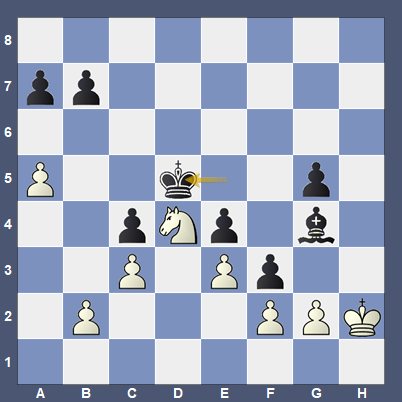
Fox (Black) had just played 65… Ke5-d5? instead of the correct fxg2. Now Lee missed the chance to play 66. gxf3! which should secure the full point because the pawn ending after 66… Bxf3 is winning.
By May he was well enough to cross the channel to Ostend, where another mammoth tournament was being held. The format was slightly more comprehensible than the previous year. A grandmaster section where six players (Tarrasch, Schlechter, Janowsky, Marshall, Burn and Chigorin) played each other four times, a 30-player all play all master section, three amateur sections and, like the previous year, a Ladies tournament. Lee was placed in the master section, which was reduced to a mere 29 players when Paul Johner withdrew after 7 rounds. Another player, Jacob, withdrew towards the end.
Here’s what happened.

Lee’s performance in such a strong field was only slightly disappointing, and he was in poor health again during what must have been a tiring event.
The players castled on opposite sides in this game, and Lee’s attack proved more successful.
[Event “Ostend Masters R5”]
[Date “1907.05.21”]
[White “John, Walter”]
[Black “Lee, Francis Joseph”]
[Result “0-1”]
1. d4 d5 2. c4 e6 3. Nc3 Nf6 4. Nf3 Nbd7 5. Bf4 a6 6. cxd5 exd5 7. e3 c6 8. Bd3 Be7 9. Qc2 O-O 10. h4 Re8 11. Ne5 Nf8 12. O-O-O Be6 13. Rdg1 c5 14. g4 cxd4 15. exd4 Rc8 16. Kb1 Qb6 17. Be3 Bb4 18. Qb3 Qa5 19. Ne2 Ne4 20. Nf3 Rc6 21. Ka1 Rb6 22. Qd1 Rc8 23. Bc2 Bc3 24. Bb3 Bb4 25. Nc1 Rbc6 26. Nd3 Bd6 27. Nfe5 R6c7 28. f4 f6 29. Nf3 Nd7 30. Qe2 Nb6 31. f5 Bd7 32. Qe1 Qb5 33. Nf4 Nc4 34. Ne6 Bxe6 35. fxe6 a5 36. g5 f5 37. g6 h6 38. Ng5 Nxe3 39. Qxe3 a4 40. Nxe4 fxe4 41. Bxa4 Qxa4 42. Rg2 Qe8 43. h5 Qxe6 44. Rf2 Be7 45. a3 Bg5 46. Qb3 Rc1+ 47. Rxc1 Rxc1+ 48. Ka2 e3 49. Rf7 e2 50. Qxb7 Bf6 51. Rd7 e1=Q 0-1
This is probably Lee’s best known game, which will be familiar to readers of Nimzowitsch’s My System.
[Event “Ostend Masters R22”]
[Date “1907.06.14”]
[White “Lee, Francis Joseph”]
[Black “Nimzowitsch, Aron”]
[Result “0-1”]
1. d4 Nf6 2. Nf3 d6 3. Nbd2 Nbd7 4. e4 e5 5. c3 Be7 6. Bc4 O-O 7. O-O exd4 8. cxd4 d5 9. Bd3 dxe4 10. Nxe4 Nxe4 11. Bxe4 Nf6 12. Bd3 Nd5 13. a3 Bf6 14. Qc2 h6 15. Bd2 Be6 16. Rae1 c6 17. Be3 Qb6 18. h3 Rad8 19. Rc1 Rd7 20. Rfe1 Rfd8 21. Qe2 Qc7 22. Bb1 Ne7 23. Ne5 Bxe5 24. dxe5 Qxe5 25. Bxa7 Qxe2 26. Rxe2 Rd1+ 27. Re1 Rxc1 28. Rxc1 Rd2 29. b4 Nd5 30. Be4 Nf6 31. Bc2 Nd5 32. Be4 Ra2 33. Bxd5 Bxd5 34. Rc3 f5 35. Kh2 Kf7 36. Bc5 g5 37. Rd3 b5 38. Bd4 Be4 39. Rc3 Bd5 40. Bc5 Kg6 41. Rd3 h5 42. Bb6 f4 43. Bd4 Kf5 44. f3 g4 45. hxg4+ hxg4 46. Kg1 Re2 47. fxg4+ Ke4 48. Rd1 Bb3 49. Rf1 Kxd4 50. Rxf4+ Re4 51. Rf6 Bd5 52. Rg6 Re2 53. Kh2 Rxg2+ 54. Kh3 Ra2 0-1
Lee’s opponent in this game was a German master who spent a lot of time in England before the First World War.
[Event “Ostend Masters R24”]
[Date “1907.06.17”]
[White “Lee, Francis Joseph”]
[Black “Schories, Georg”]
[Result “1-0”]
1. d4 d5 2. Bf4 c5 3. Bxb8 Rxb8 4. dxc5 e6 5. Qd4 Nf6 6. e3 Bd7 7. Nc3 Qc8 8. Bd3 Bxc5 9. Qf4 O-O 10. Nf3 Nh5 11. Qh4 g6 12. g4 Ng7 13. Ng5 h5 14. gxh5 Nxh5 15. Nxf7 Rxf7 16. Bxg6 Nf6 17. Rg1 Qf8 18. Bh7+ Kh8 19. Bg6+ Nh7 20. Bxf7 Qxf7 21. O-O-O Rg8 22. Ne2 e5 23. Rxg8+ Qxg8 24. Rg1 Qf8 25. Nc3 Be6 26. Qg3 Bd6 27. Qg2 Qf7 28. Rd1 Nf6 29. Qg5 Qg7 30. Qh4+ Kg8 31. Ne2 Kf7 32. Rg1 Qh7 33. Qg5 Bc7 34. Ng3 Bg4 35. h4 b5 36. f3 Be6 37. h5 Ng8 38. f4 Qg7 39. Ne4 Qh7 40. Nc5 Bb6 41. b4 exf4 42. Qxf4+ Qf5 43. Qg3 Ke7 44. Kb1 Nf6 45. h6 Bxc5 46. bxc5 Ng4 47. Qxg4 1-0
Here’s another game you might have seen before. Fred Reinfeld anthologised it in A Treasury of British Chess Masterpieces.
[Event “Ostend Masters R26”]
[Date “1907.06.20”]
[White “Lee, Francis Joseph”]
[Black “Znosko-Borovsky, Eugene”]
[Result “1-0”]
1. d4 d5 2. Bf4 e6 3. e3 Bd6 4. Bg3 Nf6 5. Nd2 O-O 6. Bd3 Qe7 7. f4 b6 8. Qe2 Bb7 9. Bh4 Nbd7 10. Ngf3 Qe8 11. Ne5 Ne4 12. Nxd7 Qxd7 13. O-O f5 14. Nf3 c5 15. c3 c4 16. Bc2 b5 17. a3 a5 18. Ne5 Qc8 19. g4 Ba6 20. gxf5 exf5 21. Kh1 Qe6 22. Rg1 Rac8 23. Rg2 Rc7 24. Rag1 Rb8 25. Qh5 Bf8 26. Bxe4 dxe4 27. d5 Qxd5 28. Ng4 Rb6 29. Nf6+ Rxf6 30. Bxf6 Qf7 31. Rxg7+ Bxg7 32. Rxg7+ Qxg7 33. Bxg7 Kxg7 34. Qxf5 Rf7 35. Qe5+ Kg8 36. Qe6 Bb7 37. Qe8+ Kg7 38. Qxb5 Re7 39. h4 Bc8 40. Qc5 Re8 41. Qxa5 Kf7 42. Qc7+ Kf6 43. Qc6+ Kf7 44. Qxc4+ Kf6 45. Qc6+ Kf7 46. Qd5+ Be6 47. Qh5+ Ke7 48. Qc5+ Kd8 49. f5 Bf7 50. f6 1-0
No sooner had he returned from Ostend than he was off on his travels again.

After spending time in Canada he sailed back, again visiting the north of England, Scotland and Ireland. His tour continued into the new year, but in May 1908 he returned to tournament play in a small tournament in Sevenoaks, Kent, where he was also called upon to give a simultaneous display.
The top section was split into two sections. Lee played in the A section, which was won by the future Sir George Thomas on 5½/6, two points clear of Lee, Shories and Muller, who shared second place.
He won this game with a stock queen sacrifice, but also missed some earlier tactical opportunities.
[Event “Sevenoaks”]
[Date “1908.04.??”]
[White “Dewing, Leslie Charles Gwyn”]
[Black “Lee, Francis Joseph”]
[Result “0-1”]
1. e4 c6 2. d4 d5 3. Nc3 dxe4 4. Nxe4 Bf5 5. Ng3 Bg6 6. Nf3 Nd7 7. Bc4 e6 8. O-O Ngf6 9. Qe2 Be7 10. Re1 Nd5 11. Bb3 O-O 12. Ne5 Nxe5 13. dxe5 Bc5 14. Ne4 Bxe4 15. Qxe4 f5 16. Qe2 Qh4 17. c3 f4 18. Qf3 g5 19. Bd1 Kh8 20. Rf1 Rf5 21. b3 Rxe5 22. Bb2 g4 23. Qxg4 Qxf2+ 0-1
Then it was on to the British Championships, held that year in Tunbridge Wells, again in Kent. Lee’s score of 6/11 was enough for a share of third place in what was, with the exception of Atkins, a closely fought contest.

A mistake in this position against Ward cost him a half point which would have left him, rather than his opponent, in the silver medal position.
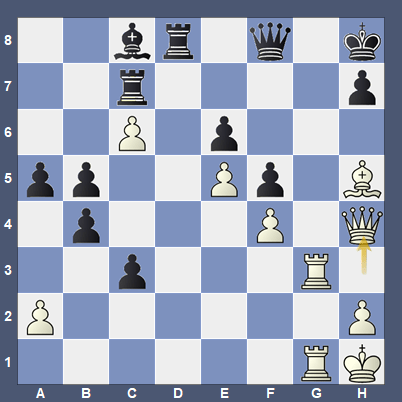
In this exciting position 34… c2 might have led to a perpetual check for White, but Lee erred with 34… Qe7?, and had to resign after the beautiful 35. Bf7!.
With his slow style of play, Lee wasn’t noted for winning miniatures in serious play, but here his opponent (whom I really ought to write about sometime) blundered on move 19, resigning two moves later.
[Event “British CF-05 Championship: Tunbridge Wells R5”]
[Date “1908.08.14”]
[White “Lee, Francis Joseph”]
[Black “Blake, Joseph Henry”]
[Result “1-0”]
1. d4 d5 2. Nf3 c5 3. c3 Nc6 4. Bf4 e6 5. e3 Nf6 6. Nbd2 Be7 7. Bd3 O-O 8. h3 Bd7 9. Ne5 Be8 10. O-O Kh8 11. Bh2 Rc8 12. f4 Nd7 13. Kh1 f6 14. Nxd7 Qxd7 15. Nf3 Bf7 16. Qe2 Rce8 17. g4 Rg8 18. Rg1 Bd6 19. Qf2 e5 20. Bxh7 exf4 21. Bf5 1-0
His game against Shoosmith reached an unusual ending when Black, in a blocked position, sacrificed two minor pieces for four connected passed pawns. Both players missed chances, but it was Shoosmith who made the final error.
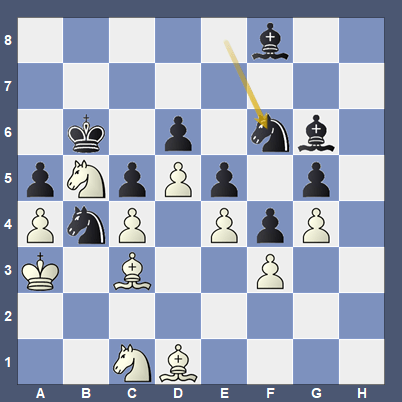
[Event “British CF-05 Championship: Tunbridge Wells R11”]
[Date “1908.08.21”]
[White “Lee, Francis Joseph”]
[Black “Shoosmith, Hector William”]
[Result “1-0”]
[SetUp “1”]
[FEN “5b2/8/1k1p1nb1/pNpPp1p1/PnP1PpP1/K1B2P2/8/2NB4 w – – 0 49”]
49. Kb3 Nxe4 50. fxe4 Bxe4 51. Be1 Nxd5 52. cxd5 Bxd5+ 53. Kc3 Bc6 54. Na3 d5 55. Kb2 c4 56. Bc3 Bd6 57. Ne2 Bd7 58. Ng1 Bxa3+ 59. Kxa3 d4 60. Be1 e4 61. Nh3 e3 62. Nxg5 d3 63. Ne4 Bc6 64. Nc3 f3 65. Bxf3 Bxf3 66. g5 d2 67. Bxd2 exd2 68. g6 Kc5 69. g7 Bd5 70. Kb2 Bf7 71. Kc2 Kb4 72. Kxd2 Kb3 73. Ne4 Bg8 74. Nc5+ Kb4 75. Ne4 Kb3 76. Nc5+ Kb2 77. Ne4 Bh7 78. Nc3 Kb3 79. Nd5 Kxa4 80. Nf6 Kb3 81. Nxh7 Kb2 82. g8=Q c3+ 83. Kd3 c2 84. Qg2 1-0
This was a quiet period in Lee’s life – perhaps he had further health problems – but he did visit Bradford in January 1909. Nothing more was heard of him until August when he was back in Yorkshire for the British Championships, held that year in Scarborough.

A score of 5/11 in a strong field was again a more than respectable performance, especially as he was clearly ailing in the second week.
Let’s look at his last three games.
In Round 9 he won a good game against Mackenzie, helped by a blunder on move 38.
[Event “British CF-06 Championship: Scarborough R9”]
[Date “1909.08.18”]
[White “Mackenzie, Arthur John”]
[Black “Lee, Francis Joseph”]
[Result “0-1”]
1. d4 d5 2. c4 e6 3. Nc3 Nf6 4. Bg5 Nbd7 5. e3 c6 6. Nf3 Qa5 7. Bxf6 Nxf6 8. Nd2 Ne4 9. Ndxe4 dxe4 10. Be2 Bd6 11. O-O f5 12. f3 exf3 13. Rxf3 O-O 14. a3 Qc7 15. g3 Qe7 16. Qc2 e5 17. Raf1 e4 18. R3f2 Qg5 19. Qc1 Be6 20. Kh1 h5 21. Rg1 Rad8 22. Nb1 Kh8 23. Qc3 Kh7 24. Nd2 c5 25. d5 Bc8 26. Rgg2 b6 27. Kg1 g6 28. Kf1 Qe7 29. Ke1 Be5 30. Qc2 a5 31. a4 Qg7 32. b3 Qh6 33. Nf1 g5 34. Bd1 Kh8 35. Qe2 Bc3+ 36. Nd2 f4 37. gxf4 gxf4 38. exf4 e3 39. Rf3 Bxd2+ 40. Kf1 Bg4 41. Qd3 Bxf3 42. Bxf3 Rxf4 43. Ke2 Rg8 44. Rxg8+ Kxg8 45. d6 Rd4 46. Bd5+ Kg7 47. Qf5 Qf6 0-1
In Round 10 he played his favourite Caro-Kann too passively, and Blake, gaining revenge for his defeat the previous year, used his space advantage to engineer a brilliant finish.
[Event “British CF-06 Championship: Scarborough R10”]
[Date “1909.08.19”]
[White “Blake, Joseph Henry”]
[Black “Lee, Francis Joseph”]
[Result “1-0”]
1. e4 c6 2. d4 d5 3. Nc3 dxe4 4. Nxe4 Bf5 5. Ng3 Bg6 6. Nf3 Nd7 7. h4 h6 8. Bd3 Bxd3 9. Qxd3 Ngf6 10. Bd2 e6 11. O-O-O Qc7 12. Rhe1 O-O-O 13. Qe2 Bd6 14. Ne5 Rhf8 15. Kb1 Kb8 16. f4 Qb6 17. Qf3 Qc7 18. Re3 g6 19. Rb3 Ka8 20. c4 h5 21. Ne2 Ne8 22. Nc3 Ng7 23. Ne4 Be7 24. g3 Nf5 25. Bc3 Nxe5 26. fxe5 Rd7 27. c5 Rb8 28. Nd6 Bxd6 29. cxd6 Qd8 30. Rd3 Rc8 31. Ra3 b6 32. Bd2 Rb7 33. b4 b5 34. Ra6 Rb6 35. Ra5 Kb7 36. Be1 Kb8 37. Rda3 Rb7 38. Bf2 Qb6 39. Ra6 Qd8 40. d5 c5 41. dxe6 Nd4 42. Bxd4 cxd4 43. d7 Rc4 44. exf7 Rbc7 45. Rb6+ 1-0
In the last round, the fast improving Yates took apart another of his favourite openings, the Stonewall Attack, concluding with an unstoppable Arabian Mate.
[Event “British CF-06 Championship: Scarborough R11”]
[Date “1909.08.20”]
[White “Lee, Francis Joseph”]
[Black “Yates, Fred Dewhirst”]
[Result “0-1”]
1. d4 d5 2. e3 Nf6 3. Bd3 e6 4. Nd2 Nbd7 5. f4 Bd6 6. Nh3 b6 7. O-O Bb7 8. Qf3 c5 9. c3 Rc8 10. Nf2 O-O 11. Re1 Re8 12. Nf1 Qc7 13. Bd2 Nf8 14. g4 N6d7 15. Re2 f6 16. Rae1 Kh8 17. Ng3 e5 18. fxe5 fxe5 19. e4 exd4 20. cxd4 dxe4 21. Bxe4 Ba6 22. Bd3 Rxe2 23. Nxe2 Bxd3 24. Nxd3 Ng6 25. Qh3 Rf8 26. Bc3 c4 27. Nb4 Nf6 28. Nc2 Ne4 29. Qh5 Bxh2+ 30. Qxh2 Qxh2+ 31. Kxh2 Rf2+ 32. Kg1 Nh4 0-1
Then, just three weeks later:


“… not one of the world’s really great chess players”. Not very generous for a death notice, I would have thought.
He regularly annotated games for the British Chess Magazine, who had rather more to say.

They might also have been more generous about the premature death of a valued contributor.
Again: “… never regarded in the foremost rank of chess masters…”: harsh but true, I suppose.
The obituary spoke about his gastric trouble, and he had also had lung problems in the past, but his death certificate reveals that neither was his cause of death.

Cerebral Meningitis (is there any other type): to the best of my knowledge indigestion isn’t a symptom.
The Wiener Schachzeitung provided a long and rather more sympathetic obituary.


Not very accurate, though. The 1881 Simpson’s Divan event seems to have been the 1890 event misdated, although there were 19, not 14 players and it was a handicap tournament. It was the short-lived Henry Lee (no relation as far as I know) who played in the London 1883 Vizayanagaram Tournament, not our man Francis Joseph Lee.
The layout could perhaps also have been improved. Swiderski died at the same time (by his own hand) and his obituary was immediately below that of Lee.
Let’s return for a moment to the BCM obituary: “Having, unfortunately, adopted chess as a profession, he sacrificed his imagination for a cramped, slow style of play instead of giving full scope to his chess ability.”
This suggests two reasons why he wasn’t universally popular. He was a professional at a time when professional sportsmen (they always were men in those days) were often, unless, like Blackburne they had winning personalities, scorned, and he preferred playing closed rather than open positions.
I consider this rather unfair. Although he played gambits in simuls and informal games, he was very much a player in the modern style, influenced in part by Steinitz. With White he favoured mostly d-pawn openings: the Stonewall and London Systems, often combined, as well as Queen’s Gambits and types of Colle System. With Black he defended against 1. e4 with, at various times, with the French, Caro-Kann and Scandinavian Defences. Understanding of closed positions, although they had been played by the likes of Philidor, La Bourdonnais and Staunton, was still rudimentary compared with today’s grandmasters, but it was the experiments of players like Lee which played an important role in the development of chess ideas.
You’ll also see that, although his games, and those of other similarly inclined players of his day, could descend into meaningless woodshifting, there were also positive ideas, in particular in building up slow kingside attacks. His games were often not short of excitement, but that was more likely to come at move 50 than move 15. I’d put it to you that his obituarist (Isaac McIntyre Brown?) failed to appreciate his games fully.
Of course he had his faults: he was prone to tactical oversights and, against the top players of his day, didn’t always understand what was happening positionally, but he was still in the world’s top 100 players for about 20 years. His fragile health must also have had an impact on his results, and his interview above suggests that he was temperamentally more suited to teaching than playing.
It’s interesting to compare his life with that of a journeyman chess professional today. He was probably never very well off, but he had various sources of revenue: teaching and lecturing, simultaneous displays, exhibition games, writing and journalism, and also sponsorship. An article by Mieses in the August 1941 BCM about former Prime Minister Andrew Bonar Law tells us that he was kindly disposed towards Lee and did a good deal quietly for his professional support. One would imagine that Lee was similarly supported by the likes of JH Parnell and the Bishop of Trinidad and Tobago. In his tours of chess clubs he was seen as being a friendly and courteous opponent.
The Cheltenham Chronicle (13 September 1919), writing just a decade after his death, referred to him as ‘another chess professional, now little remembered’. He’s certainly very little remembered or written about today.
I’d suggest that Francis Joseph Lee is very much worthy of your attention. Here was a man who clearly loved chess, and, despite ill health, devoted more than twenty years to promoting his favourite game throughout the British Isles, and in many other parts of the world as well. While he wasn’t one of the greatest players of his day he also produced some fine chess, along the way experimenting with new openings, some of which are now, a century and a quarter on, now back in fashion.
I hope you’ve enjoyed learning more about his life and looking at some of his games. Do join me in drinking a toast to Francis Joseph Lee, and also join me again soon for some more Minor Pieces.
Sources and references:
ancestry.co.uk
findmypast.co.uk/British Newspaper Archive
Wikipedia
chessgames.com: FJ Lee here
ChessBase/MegaBase 2024
Stockfish 16
EdoChess (Rod Edwards): FJ Lee here
British Chess Magazine (thanks to John Upham)
Wiener Schachzeitung


Leave a comment