Here’s another game played by Alfred Lenton (see here and here), from the 1936 British Championship in Bournemouth against Reginald Charles Noel-Johnson, the subject of this Minor Piece. Noel-Johnson seemed ill at ease against Lenton’s favourite Réti Opening. (Click here and paste the pgn to play through any game in this article.)
[Event “British Championship: Bournemouth R5”]
[Date “1936.06.12”]
[White “Lenton, Alfred”]
[Black “Noel-Johnson, Reginald Charles”]
[Result “1-0”]
1. Nf3 d5 2. c4 c6 3. b3 Nf6 4. Bb2 Bf5 5. g3 h6 6. Bg2 Nbd7 7. O-O e6 8. d3 Be7 9. Nc3 O-O 10. Re1 e5 11. cxd5 cxd5 12. e4 dxe4 13. dxe4 Bg6 14. Nh4 Nc5 15. Nxg6 fxg6 16. Nd5 Bd6 17. Rc1 b6 18. f4 Qb8 19. fxe5 Bxe5 20. Ne7+ Kh7 21. Nc6 Bxb2 22. Nxb8 Bxc1 23. Nc6 Ba3 24. b4 Rac8 25. bxc5 Rxc6 26. e5 Bxc5+ 27. Kh1 Re6 28. exf6 Rxe1+ 29. Qxe1 gxf6 30. Qe6 a5 31. Bd5 h5 32. Kg2 Kh6 33. Kf3 Kg7 34. Qd7+ Kh6 35. Bf7 Kg7 36. Be8+ Kh6 37. Qe6 Kg7 38. h3 Kh7 39. g4 hxg4+ 40. hxg4 Kh6 41. Qe4 Rg8 42. Bf7 Rg7 43. Qf4+ 1-0

You’ll see from the tournament chart (click on the link for further information) that Alfred’s opponent Reginald Charles Noel-Johnson finished on 50% – a very respectable performance. Unfortunately, the only complete games of his that appear to survive from this tournament are losses.
In this game against the up-and-coming Frank Parr, a blunder on move 31 allowed a fatal double threat.
[Event “British Championship: Bournemouth R3”]
[Date “1936.06.10”]
[White “Parr, Frank”]
[Black “Noel-Johnson, Reginald Charles”]
[Result “1-0”]
1. d4 d5 2. c4 c6 3. cxd5 cxd5 4. Nc3 Nf6 5. Nf3 Nc6 6. Qb3 Na5 7. Qc2 Bd7 8. Bg5 Rc8 9. Bxf6 exf6 10. e3 Bb4 11. Bd3 Bxc3+ 12. bxc3 Qc7 13. Rc1 b5 14. O-O h6 15. Nd2 O-O 16. Nb3 Nb7 17. Rfe1 Qb6 18. Nd2 a5 19. Qb3 Nd6 20. Qxd5 Be6 21. Qh5 Bxa2 22. e4 Bc4 23. Bb1 b4 24. cxb4 Qxb4 25. Nf3 Be2 26. e5 Bxf3 27. Qxf3 fxe5 28. dxe5 Rxc1 29. Rxc1 Rc8 30. Rd1 Ne8 31. h3 Qe7 32. Qf5 Qc5 33. Rd7 1-0
In this game another oversight gave allowed the eventual tournament winner a fine finish.
[Event “British Championship: Bournemouth R4”]
[Date “1936.06.11”]
[White “Noel-Johnson, Reginald Charles”]
[Black “Winter, William”]
[Result “0-1”]
1. d4 Nf6 2. e3 g6 3. Bd3 d6 4. Ne2 Bg7 5. O-O O-O 6. c4 e5 7. Nbc3 Nc6 8. d5 Nb4 9. e4 Nxd3 10. Qxd3 Nd7 11. Be3 f5 12. f3 f4 13. Bf2 g5 14. b4 Nf6 15. Kh1 g4 16. c5 Nh5 17. fxg4 Bxg4 18. Ng1 Qg5 19. Nf3 Qh6 20. Ne2 Rf7 21. Rac1 Raf8 22. Rc3 Qg6 23. cxd6 cxd6 24. b5 Nf6 25. Rc4 Bh6 26. Nh4 Qh5 27. Ng1 Bd7 28. a4 Ng4 29. Qe2 Bg5 30. Nhf3 Bd8 31. h3 Nxf2+ 32. Qxf2 Rg7 33. Rfc1 Rg3 34. Qf1 Bb6 35. R1c2 Bxg1 36. Nxg1 f3 37. Kh2 Qh4 38. gxf3 Rfxf3 39. Qxf3 Rxf3 40. Rg2+ Kh8 41. Nxf3 Qxh3+ 42. Kg1 Qxf3 43. Rc7 Bg4 44. Rxb7 h5 45. a5 h4 46. Rf2 Qg3+ 47. Rg2 Qe3+ 48. Rf2 Bf3 0-1
However, we do have the conclusion of this game, in which Reginald demonstrated excellent endgame technique to exploit his pawn advantage.
[Event “British Championship: Bournemouth R7”]
[Date “1936.06.15”]
[White “Israel, Harold”]
[Black “Noel-Johnson, Reginald Charles”]
[Result “0-1”]
[SetUp “1”]
[FEN “8/p4nkp/1p2p1p1/2p2p2/2Pn1PP1/1P1BK2P/P2N4/8 b – – 0 36”]
36… e5 37. gxf5 gxf5 38. fxe5 Kg6 39. b4 Nxe5 40. bxc5 bxc5 41. Bf1 Kf6 42. Nb1 Nd7 43. Nc3 Ke5 44. Nd5 Nc2+ 45. Kf3 Nb4 46. Nc3 Nf6 47. Ke3 Ne4 48. Nxe4 fxe4 49. Bg2 Nc2+ 50. Kd2 Nd4 51. Ke3 Nf5+ 52. Kd2 Kf4 53. Ke2 Ne3 0-1

Reginald Charles Noel-Johnson (pictured above) had an interesting story to tell. Let’s find out more.
We’ll start with his father, (William) Noel Johnson (no hyphen: that came later), a cellist, conductor and composer. Here’s how he was described in Brown & Stratton’s British Musical Biography (1897)


Again, from two years later:

Here we have a successful composer of music mostly for home consumption: songs, short pieces for cello and piano and so on. Music which, perhaps sadly, has now gone out of fashion: I haven’t been able to find any recordings of these songs, but a later work, comprising three short piano pieces, has been recorded for YouTube by Phillip Sear, a specialist in this type of repertoire.
Pleasant enough, I suppose, but they rather remind me of the pieces I was expected to practise when I was learning the piano many years ago. Hardly imaginative or profound but they served their purpose at the time.
Between the songs and the piano pieces, in 1902, Noel married Rosina (Rosie) Johnson, twenty years his junior and not related in spite of the shared surname, with four children being born in London: Reginald (1904), Kathleen (1906), Eric (1907) and (William) Brian (1908). The family then moved to Whitstable, Kent, where two further sons were born, Dennis (1913) and (George) Douglas (1915).

Many years later, in 1975, Kathleen would look back fondly on their time there.But the family’s idyllic seaside life was shattered in January 1916 when William Noel Johnson, now living near Southend, died suddenly of pneumonia, leaving Rosie a widow with six young children.
In the words of his last song, “Rosemary, that’s for remembrance”.

It can’t have been easy for Rosina, and it appears that the family also had financial problems.

The 1921 census found them, now having changed their surname to Noel-Johnson, perhaps to honour their late father, split up.
Rosie and Reggie, perhaps he’d just left the Masonic School, were living in a boarding house in South Kensington. Rosie had found work as a secretary, while her eldest son, following in his father’s footsteps, had an apprenticeship at Chappell’s, the music publishers, who had published some of Noel’s compositions.
Eric was at a boarding school on Clapham Common, just a few doors away from what is now Ray Keene’s residence. Kathleen, Brian and Douglas were ‘inmates’ at the Actors’ Orphanage in Langley, Buckinghamshire. Dennis had been adopted by a childless couple, Henry and Ethel Cullum (were they family friends?) and had taken on their surname.
It appears that, very soon afterwards, Reginald moved to somewhere in South or South East London, taking up chess at the same time. The first reference I can find is in February 1922, just a few days before his 18th birthday, playing on Board 13 in a county match between Kent and Essex. He must have gained rapid recognition as a pretty useful player. He seems to have been the only competitive chess player in his family so perhaps he learnt at school.
The following year he played on top board for a Men of Kent team in a friendly match against a Ladies’ Team, drawing his game against Miss Edith Charlotte Price. The Men of Kent were west of the River Medway, while the Kentish men were on the east.

In 1924 Noel-Johnson took part in his first public tournament, travelling to Weston-super-Mare for the West of England Championships where he was placed in the Second Class Section A tournament. This proved a great success, his score of 8½/9 demonstrated that he was already much more than a second class player. He also finished in second place in a Quick Play Tournament: clearly a young, ambitious and improving player.
The county selectors eventually noticed this and promoted him to one of the top boards in the county team.
He didn’t have far to go for his next tournament, the Kent County Championship held in Bromley in April 1925. The format of the top section was interesting: four sections each including six amateurs and two visiting European masters.

In the first round Reginald attracted considerable attention for the hard fight he put up against his Latvian opponent (retrospectively rated 2386 in 1925 by Rod Edwards.
He had a strong attack for the pawn early on and, much later, came close to drawing the ending.
[Event “Bromley Premier Section B R1”]
[Date “1925.04.11”]
[White “Noel-Johnson, Reginald Charles”]
[Black “Apscheneek, Fricis”]
[Result “0-1”]
1. e4 c6 2. d4 d5 3. Nc3 dxe4 4. Nxe4 Bf5 5. Ng3 Bg6 6. Nf3 Nd7 7. Bd3 Ngf6 8. O-O e6 9. b3 Bd6 10. Bb2 Qc7 11. c4 O-O-O 12. Qe2 c5 13. Rfd1 a6 14. Ng5 Bxg3 15. hxg3 Bh5 16. Nf3 cxd4 17. c5 Nb8 18. b4 e5 19. Bf5+ Nfd7 20. Rdc1 Rhe8 21. c6 bxc6 22. Be4 Re6 23. b5 axb5 24. a4 bxa4 25. Rxa4 Nb6 26. Ra3 g6 27. Rca1 Rd7 28. Qc2 f5 29. Bxf5 gxf5 30. Qxf5 Bf7 31. Ng5 Ree7 32. Ra7 Qd6 33. Ba3 c5 34. Rc1 Nc4 35. Rxc4 Bxc4 36. Qf8+ Rd8 37. Qxe7 Qxe7 38. Rxe7 Nc6 39. Rg7 Bd5 40. Bxc5 h6 41. Nf3 Bxf3 42. gxf3 Rd5 43. Bb6 d3 44. Be3 d2 45. Bxd2 Rxd2 46. Rg6 Nd4 47. Rxh6 Nxf3+ 48. Kg2 e4 49. Rh1 Kd7 50. Ra1 Ke6 51. Ra5 Ne5 52. Ra1 Kf5 53. Rh1 Ng4 54. Rh4 Nxf2 55. Rf4+ Ke5 56. Kf1 e3 57. Rf8 Ke4 58. Re8+ Kf3 59. Rf8+ Kxg3 60. Rg8+ Kf3 61. Rf8+ Ke4 62. Re8+ Kd3 63. Rd8+ Kc2 64. Re8 Nd1 65. Ke1 Rh2 66. Re7 Rh1+ 67. Ke2 Nc3+ 68. Kf3 e2 0-1
He finished on 3/7, an excellent score for someone with so little experience at that level.
The four section winners entered the final pool, with the remaining competitors playing three more rounds using the Swiss System to determine six further prize-winners. You’ll see that he won all three of these games.

Later in the year, he had a county match game published in the British Chess Magazine. His opponent’s name is remembered today through the Wernick Cup, awarded since 1922 to the winner of the fourth division of the Surrey individual championship. Jack Redon, who will be the subject of a future Minor Piece, won it in 1923, as did a certain RD Keene in 1962.
[Event “Kent v Surrey B5”]
[Date “1925.10.10”]
[White “Noel-Johnson, Reginald Charles”]
[Black “Wernick, George William John”]
[Result “1-0”]
1. d4 Nf6 2. c4 e5 3. dxe5 Ng4 4. e4 Nxe5 5. f4 Ng6 6. Nf3 Nc6 7. Be3 Bb4+ 8. Nbd2 Qe7 9. a3 Qxe4 10. Kf2 Bxd2 11. Qxd2 O-O 12. Bd3 Qe7 13. h4 h5 14. g4 hxg4 15. h5 Nh8 16. h6 g6 17. h7+ Kg7 18. f5 gxf3 19. Bh6+ 1-0
It would be some years, though, before he played another public tournament, but he remained very active in club and county chess, winning the county championship for the first time in 1927, and again in 1931 and 1932.
Here’s a position for adjudication from the decisive game of a 1931 county match: Noel-Johnson was white against John Harold Morrison of Middlesex.
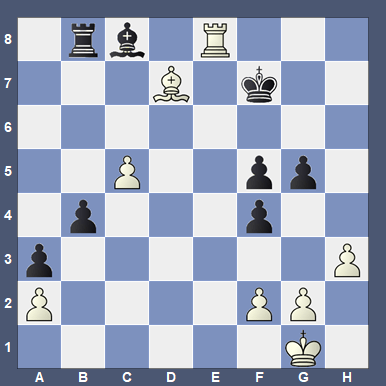
The players and spectators thought Black was winning but Yates gave White a win on adjudication.
White has two ways to win.
1. Rxc8 b3 (1… Rxc8 2. Bxc8 b3 3. Ba6 bxa2 (3… b2 4. Bd3) 4. Bc4+) 2. Rxb8 bxa2 3. Be6+! Kxe6 4. Re8+
or, perhaps more simply,
1. c6 b3 2. c7 Rb6 3. Rxc8 bxa2 4. Rf8+!
Although his main club was Lewisham, Reginald also played for Clapham Common, where his brother Eric had attended school.
Here he is, facing Richmond & Kew in an Alexander Cup (Surrey KO) match.

By the summer of 1933 he had time to take in another public tournament, travelling down to Hastings for the British Championships. He played in the Premier Reserves, in effect the third division, and, as you’ll see, finished a point clear of the field, drawing his first encounter with Alfred Lenton along the way.

In 1935 he won his fourth county title, defeating Walter Yeeles in the final. Here are the two games: he was close to winning in the first, but made no mistake in the second.
[Event “Kent County Championship Final”]
[Date “1935.??.??”]
[White “Yeeles, Walter James Eric”]
[Black “Noel-Johnson, Reginald Charles”]
[Result “1/2-1/2”]
1. Nf3 d5 2. d4 Nf6 3. Bf4 Bf5 4. e3 c5 5. Bb5+ Bd7 6. Bxd7+ Nbxd7 7. O-O e6 8. Nbd2 Rc8 9. c3 Be7 10. Qa4 a6 11. dxc5 Bxc5 12. Nb3 O-O 13. Nxc5 Nxc5 14. Qc2 Qe7 15. Rfd1 Rfd8 16. Qe2 Nfe4 17. Rac1 f6 18. Bg3 e5 19. c4 dxc4 20. Rxc4 Rxd1+ 21. Qxd1 Rd8 22. Qe2 Qd7 23. Kf1 b5 24. Rc2 Qd5 25. Ne1 Nxg3+ 26. hxg3 Ne4 27. Qg4 g6 28. Rc8 f5 29. Rxd8+ Qxd8 30. Qe2 Nd2+ 31. Kg1 e4 32. Nc2 Nc4 33. Nd4 Qa5 34. a3 Ne5 35. Nb3 Qc7 36. Qd2 Nd3 37. Nd4 Kf7 38. b4 Qc4 39. Kh2 Kf6 40. Kh3 Ke5 1/2-1/2
[Event “Kent County Championship Final”]
[Date “1935.??.??”]
[White “Noel-Johnson, Reginald Charles”]
[Black “Yeeles, Walter James Eric”]
[Result “1-0”]
1. d4 Nc6 2. Nf3 Nf6 3. c4 d6 4. g3 Bf5 5. Nc3 g6 6. Bg2 Bg7 7. O-O O-O 8. Nh4 Qd7 9. e4 Bh3 10. f3 Rae8 11. Be3 Bxg2 12. Nxg2 e5 13. d5 Nd4 14. Ne2 Nxe2+ 15. Qxe2 Nh5 16. g4 Nf6 17. c5 b6 18. b4 Nxd5 19. exd5 e4 20. c6 Qe7 21. Rad1 exf3 22. Qxf3 f5 23. Bf2 fxg4 24. Qxg4 Qe2 25. Qxe2 Rxe2 26. Bd4 Rxf1+ 27. Kxf1 Rxa2 28. Bxg7 Kxg7 29. Nf4 Rb2 30. Ne6+ Kf6 31. Nxc7 Rxh2 32. Nb5 a6 33. Nxd6 Ke5 34. Nc4+ Ke4 35. c7 Rh1+ 36. Ke2 Rh2+ 37. Ke1 1-0
1936 saw his only British Championship appearance, which you read about at the start of this article.
This was also the year when his club, Lewisham, won the London League for the first time (they’d repeat their success the following year). Noel-Johnson arranged a presentation to the match captain, in the presence of two world champions.

02 October 1936
In 1937, as well as taking the Kent title again (just as two years earlier, winning the second game against Yeeles after a draw) he took part in a small semi-international tournament to celebrate the centenary of Worcester Chess Club, finishing on 50%. At this point Rod Edwards on EdoChess gives him a retrospective rating of 2165.

18 September 1937
In 1938 Reginald took part in a simul against Alekhine at the Charing Cross Hotel. He’s pictured here at the left, alongside Elaine Saunders, C Chapman, HH Cole, H Israel and Walter Yeeles.

In the final of the 1938 Kent Championship, Noel-Johnson had the opportunity for a classic double bishop sacrifice, calculating accurately right to the end to give his opponent no chance.
[Event “Kent County Championship Final”]
[Date “1938.??.??”]
[White “Noel-Johnson, Reginald Charles”]
[Black “Tims Collins, Francis George”]
[Result “1-0”]
1. d4 d5 2. Nf3 Nf6 3. c4 c6 4. e3 e6 5. Nbd2 Nbd7 6. Bd3 Be7 7. O-O O-O 8. b3 b6 9. Bb2 Bb7 10. Qe2 c5 11. Rfd1 Rc8 12. Ne5 Qc7 13. Nxd7 Qxd7 14. Nf3 cxd4 15. Ne5 Qc7 16. exd4 dxc4 17. bxc4 Nd7 18. d5 Nxe5 19. Bxe5 Bd6 20. Bxh7+ Kxh7 21. Qh5+ Kg8 22. Bxg7 f6 23. Qh8+ Kf7 24. dxe6+ Kxe6 25. Qh3+ Kf7 26. Bxf8 Rxf8 27. Rxd6 Qxd6 28. Qh7+ Ke8 29. Re1+ 1-0
Francis Tims Collins would later join the RAF Volunteer Reserve, and was tragically killed on the evening of the 27th of November 1943, when the RAF Lancaster in which he was a navigator was shot down over Heuchelheim, Germany.
In November 1938 a weekend tournament was held in Bournemouth, with the players divided into groups of four. This would be called a quad tournament in the USA and elsewhere: I’ve often wondered why this format (extensively used at Richmond Junior Club for many years) has never taken off over here. The top two sections each featured four county champions, Noel-Johnson winning his section with 2½/3 against the champions of Devon, Hampshire and Essex.
As county champion again, he played on top board in this county match against Surrey, who fielded the confusingly named but unrelated Laurie Alexander and Frederick Forrest Lawrie Alexander on the top two boards.

27 January 1939
Here’s his game, a pretty clear-cut win.
[Event “Kent v Surrey B1”]
[Date “1939.01.21”]
[White “Noel-Johnson, Reginald Charles”]
[Black “Alexander, Laurie”]
[Result “1-0”]
1. c4 Nf6 2. Nc3 c6 3. d4 d5 4. e3 e6 5. f4 Bb4 6. Nf3 Ne4 7. Bd2 Nxd2 8. Qxd2 O-O 9. a3 Qa5 10. Rc1 Be7 11. Bd3 dxc4 12. Bxc4 c5 13. O-O Nc6 14. d5 exd5 15. Bxd5 Rd8 16. Qc2 c4 17. Bxc4 Qh5 18. Qe2 Bf5 19. Ne5 Qxe2 20. Bxf7+ Kf8 21. Nxe2 Rd2 22. Nxc6 bxc6 23. Ng3 Bc2 24. Rf2 Rxf2 25. Kxf2 Bd3 26. Bc4 Bg6 27. f5 Be8 28. Ne4 a5 29. Rc2 h5 30. Rd2 Rb8 31. Kf3 c5 32. Nc3 Bf6 33. e4 Bd4 34. Kf4 Rb6 35. e5 Bc6 36. g3 Ke7 37. h3 Rb8 38. g4 Rd8 39. Rd3 Bg2 40. g5 Bc6 41. f6+ gxf6 42. gxf6+ Kf8 43. e6 1-0
Noel-Johnson encountered young Elaine Saunders again in a living chess display in Croydon later in 1939.

Later that month, a match between Metropolitan Kent and West/Mid Kent resulted in an exciting finish. At the close of play the score was 25-24 in favour of the Mets, with just the top board, between Noel-Johnson and the long-lived Philip Coy, for adjudication.
The result was a win for Reginald, making the score 26-24.
[Event “West & Mid-Kent vs Metropolitan Kent”]
[Date “1939.06.17”]
[White “Noel-Johnson, Reginald Charles”]
[Black “Coy, George Philip Stanl”]
[Result “1-0”]
1. c4 Nf6 2. Nc3 d5 3. d4 c6 4. e3 Bf5 5. cxd5 Nxd5 6. Qb3 Nxc3 7. bxc3 Qb6 8. Nf3 Nd7 9. Bc4 e6 10. Nd2 Qxb3 11. axb3 Be7 12. e4 Bg6 13. f3 O-O 14. O-O Nb6 15. Ba3 Rfe8 16. Be2 Bxa3 17. Rxa3 f6 18. Nc4 e5 19. Rfa1 Nc8 20. dxe5 fxe5 21. Rd1 a6 22. Rd7 b5 23. Nd6 Nxd6 24. Rxd6 Rec8 25. Re6 Be8 26. Rxe5 Rd8 27. Ra2 Kf7 28. Kf2 Rd6 29. c4 Rdd8 30. f4 g6 31. Ke3 Kf6 32. g4 Bd7 33. g5+ Kf7 34. f5 Re8 35. Rxe8 Rxe8 36. Kf4 Bc8 37. Rd2 Re7 38. Rd8 Bxf5 39. Bd3 Be6 40. Ra8 Rd7 41. Ke3 Rc7 42. Rxa6 bxc4 43. bxc4 Bc8 44. Ra1 1-0
But then the Second World War intervened and Noel-Johnson’s chess career was mostly on hold, although he did take part in a tournament at the National Chess Centre in 1940. Here, players were grouped by the first letter of their surname, and he won the Rare Letters section ahead of Harold Israel.
In the fourth quarter of 1940 Reginald Charles Noel-Johnson married American born Jane Ann Richards in Kensington. And on 22 November that year he was appointed Pilot Officer in the Administrative and Special Duties branch of the RAF for the duration of hostilities.
His life had changed. He was no longer a bachelor working in music publishing and playing chess in his spare time, but a married man serving in the armed forces. You’ll find out what happened next in part 2 of Reginald’s story.
Sources & Acknowledgements:
ancestry.co.uk (family trees of Clive Noel-Johnson and Sally (Noel-Johnson) Giddings)
findmypast.co.uk/British Newspaper Library
Forces War Records
YouTube/Phillip Sear
Wikipedia
BritBase (John Saunders – thanks also for his RCNJ games collection)
chessgames.com
British Chess Magazine
EdoChess (Rod Edwards)
ChessBase


 Minor Pieces
Leave a reply to Minor Pieces 67: George Law Francis Beetholme – Minor Pieces Cancel reply