Then Ellis comes with rapid transit,
And few there are who can withstand it;
Some day soon he’s bound to land it.
You might recall these words from a poem read at Richmond Chess Club’s 1911 AGM. Arthur Compton Ellis was a man who lived his life, as well as playing his chess, with rapid transit. Although he spent little more than two years in the area, he flashed like a meteor across the Richmond and Kew chess scene.
Let’s find out more.
Our story starts on 20 September 1887, with the marriage between George Frederick Ellis, a surveyor aged 39 and Margaret Fraser, aged 31. Rather late for marriage in those days. Their only child, Arthur Compton Ellis’s birth was registered in the Pancras district of London in the first quarter of 1889.
In the 1891 census the family were living in Kentish Town. George was working as a Surveyor of Roads and Sewers, and they were doing well enough to employ a servant. By 1901 they’d moved a mile to the north, close to Parliament Hill Fields: George was now, just like James Richmond Cartledge would be a few years later, a Deputy Borough Engineer and Surveyor. Margaret was, perhaps unexpectedly, working as a Physician and Surgeon, while Arthur is at school. There were no domestic staff at home.
Arthur moved from school to the University of London, where he graduated with a BA in 1909, at the age of only 20. In the same year his father died: the death was registered in Camberwell, South London.
Perhaps he discovered the game of chess at university. He may also have discovered religion. In 1908 he was baptised at St Luke’s Church, Kew, with his address given as 40 West Park Road, right by Kew Gardens Station. At this point the family appeared to have connections, then, with both the Richmond/Kew area and South London.
He first turned up playing for Richmond Chess Club in December 1908, losing his game on bottom board in a London League match against Ibis. It looks like he joined the club on the completion of his studies. Although he seemed to be struggling in match play at this point, in April 1909 he finished second in a lightning tournament, which, that year, replaced the annual club dinner.
In 1910, now styling himself A Compton Ellis, he was advertising his tuition services in the Daily Telegraph. LCP was a teaching qualification.


By Summer 1910 he felt confident enough to take part in a tournament. The British Championships took place that year in Oxford, and Arthur was placed in the 3rd Class C section.With a score of 10½/11, it was clear that he was improving fast, and should have been in at least the 2nd Class division. The prizes were presented by none other than William Archibald Spooner.
A handicap tournament also took place there, in which he won first prize: a model of the earth with a clock inside, enabling him to ascertain the time of day in any part of the world. This prize was donated by its inventor, James Haddon Overton, a schoolmaster from Woodstock.
In September that year, not content with only playing at Richmond, where he had now reached top board in a match against Acton, he was one of the founders of a new club in Kew.

Richmond and Kew weren’t his only clubs, either. He was also a member of South London Chess Club, about which there’s very little information online.
In this London League game he fell victim to a brilliant queen sacrifice. Click here and paste the pgn to play the game through online.
[Event “South London v Lud Eagle LL”]
[Date “1910.11.??”]
[White “Ellis, Arthur Compton”]
[Black “Anspach, Frederick Law”]
[Result “0-1”]
1. e4 e6 2. d4 d5 3. Nc3 Nf6 4. Bg5 Be7 5. e5 Nfd7 6. Bxe7 Qxe7 7. Qd2 a6 8. f4 c5 9. dxc5 Nc6 10. Nf3 Nxc5 11. a3 O-O 12. Nd4 f6 13. Nxc6 bxc6 14. exf6 Qxf6 15. g3 Rb8 16. Rb1 e5 17. fxe5 Qxe5+ 18. Qe2 Qxc3+ 19. bxc3 Rxb1+ 20. Kd2 Ne4+ 21. Qxe4 Rbxf1 22. Rxf1 dxe4 23. Rxf8+ Kxf8 24. Ke3 Bf5 25. g4 Bg6 26. h4 h5 27. gxh5 Bh7 0-1
Arthur Compton Ellis was infectiously enthusiastic, ambitious and seemed to have contacts with a number of strong amateur players, mostly from the Civil Service, as is demonstrated by this event.


A win against our old friend Wilfred Hugh Miller Kirk was also evidence that Arthur was developing into a formidable player.
The 1911 census found Arthur and his mother still living at 40 West Park Road, Kew Gardens. Arthur gave his occupation as ‘Tutor’ while there was no occupation listed for Margaret.
By then it was time for another tournament. The Kent and Sussex Chess Congress, run by the Kent County Chess Association took place over Easter at this time. It’s little written about today, but it attracted some of the country’s top players. The top section in the 1911, for example, played in Tunbridge Wells, was won by Yates ahead of Gunsberg. The organising committee, coincidentally, included the Kent secretary Rufus Henry Streatfeild Stevenson, and the Sussex secretary, Harold John Francis Spink Stephenson. Arthur Compton Ellis took part in the third section down, the Second Class Open, where he was again too good for the opposition, finishing on 8½/10, half a point ahead of Battersea veteran Bernard William Fisher (1836-1914), who had been a master standard player back in the 1880s. Visitors included Frank Marshall, who gave a simul and a talk, and Joseph Blackburne, who gave simuls and played consultation games. Horace Fabian Cheshire gave a talk, with lantern slides, on chess players past and present, and also an exposition of the game of Go. It sounds like a good time was had by all.
Arthur persuaded Frank Marshall to visit Richmond and give a simul against members of local chess clubs, and that was duly arranged.
The AGM in September would report as follows:

Always eager to play in any event, he won the Dalgarno-Robinson chess trophy, competed for by members of local branches of the Association of Young Men’s Clubs, and played on top board when Richmond Chess Club visited Hastings, drawing his game against the aforementioned Mr Stephenson.
He decided to give the 1911 British Championship, held in Glasgow, a miss, though. Perhaps he wasn’t prepared to travel that far.
The Richmond Herald was now carrying less chess news, but we know from a report from the other end of Surrey that Kew Chess Club were becoming even more successful.

You’ll see that Ellis didn’t stand for re-election as captain. This seems to have been because Arthur and Margaret had moved from Kew to South London.
Over Easter 1912, though, he returned to Tunbridge Wells for the Kent and Sussex Easter Congress, this time promoted to the top (First Class Open) section. Now against stronger opposition, this time he found the going tough, only scoring 2½/8.
The winner was the future Sir George Thomas, who wasted little time of disposing of Ellis, who misplaced his queen’s knight on his 11th move.
[Event “Kent Congress Open Tunbridge Wells”]
[Date “1912.04.??”]
[White “Thomas, George Alan”]
[Black “Ellis, Arthur Compton”]
[Result “1-0”]
1. e4 e5 2. Nf3 Nc6 3. Bb5 a6 4. Ba4 Nf6 5. O-O Nxe4 6. d4 b5 7. Bb3 d5 8. dxe5 Be6 9. c3 Be7 10. Re1 O-O 11. Nd4 Na7 12. Bc2 Nc5 13. b4 Nb7 14. Nxe6 fxe6 15. Qh5 g6 16. Bxg6 hxg6 17. Qxg6+ Kh8 18. Re3 1-0
However, he did have the satisfaction of defeating Fred Brown, one of two chess playing brothers from Dudley. (He had a brother Frank, who was also a strong player. Understandably, in the days when newspapers only gave players’ initials, they were often confused.) Fred shared second place with future BCM editor Julius du Mont in this tournament.
[Event “Kent Congress Open Tunbridge Wells”]
[Date “1912.04.??”]
[White “Ellis, Arthur Compton”]
[Black “Brown, Fred”]
[Result “1-0”]
1. e4 c5 2. Nf3 Nc6 3. d4 cxd4 4. Nxd4 Nf6 5. Nc3 d6 6. Be3 g6 7. Be2 Bg7 8. O-O O-O 9. f4 Ne8 10. Rb1 Nc7 11. Nxc6 bxc6 12. Bd4 Ne6 13. Bxg7 Qb6+ 14. Kh1 Kxg7 15. f5 Nc7 16. f6+ exf6 17. Qxd6 Ne6 18. e5 fxe5 19. Qxe5+ f6 20. Qg3 Ba6 21. Bxa6 Qxa6 22. Rbe1 Rae8 23. Ne4 Nd4 24. Qc7+ Rf7 25. Qxf7+ Kxf7 26. Nd6+ Kg7 27. Nxe8+ Kh6 28. Nxf6 Nf5 29. g4 c5 30. Ng8+ Kg7 31. gxf5 Kxg8 32. f6 1-0
It seems that he was lucky here: his opponent resigned what may well have been a drawn position as he would have had chances of a perpetual check if he’d continued with 32… Kf7!. What do you think?
At the same event, Arthur and his friend from Kew, Montague White Stephens, played in a consultation simul against Blackburne. They were successful after the great veteran uncharacteristically missed a simple mate in 3 on move 19.
[Event “Consultation simul: Tunbridge Wells”]
[Date “1912.04.??”]
[White “Blackburne, Joseph Henry”]
[Black “Ellis, Arthur Compton & Stephens, Montague White”]
[Result “0-1”]
1. e4 e5 2. Nc3 Nc6 3. f4 exf4 4. Nf3 g5 5. h4 g4 6. Ng5 h6 7. Nxf7 Kxf7 8. Bc4+ d5 9. Nxd5 Be6 10. d4 Nf6 11. Bxf4 Bd6 12. Bxd6 Qxd6 13. O-O Bxd5 14. e5 Nxe5 15. dxe5 Qc5+ 16. Kh1 Qxc4 17. Rxf6+ Kg7 18. Qd2 Rhf8 19. Raf1 Qxf1+ 20. Rxf1 Rxf1+ 21. Kh2 Bc6 22. e6 g3+ 23. Kh3 Rg8 24. Qd4+ Kf8 25. Qd8+ Be8 26. e7+ Kg7 27. Kxg3 Kh7+ 28. Kh2 Rf2 29. Qd3+ Bg6 30. e8=Q Rxe8 31. Qd7+ Kg8 32. h5 Bxh5 33. Qxc7 Ree2 34. Qb8+ Kh7 35. Qxb7+ Bf7 36. Kh3 Kg6 37. Kg3 Rxg2+ 38. Kf3 Rgf2+ 39. Kg3 h5 40. Qc6+ Kg5 41. Qc5+ Rf5 42. Qd4 Ree5 43. Qh4+ Kh6 44. Qd4 Bd5 45. Qd2+ Kg7 46. Kh4 Rf4+ 47. Kg3 Rf3+ 48. Kh4 Re4+ 49. Kg5 Be6 0-1
Montague White Stevens (1881-1947) was only a club standard player, but he edited the 1914 Year Book of Chess and produced a revised edition of EA Greig’s Pitfalls on the Chess-Board.
In April 1912 a new Chess Divan opened in the Strand, replacing Simpson’s Chess Divan, which had closed a few years earlier, and Gunsberg was appointed its manager. Arthur, who would go almost anywhere for a game of chess, was soon involved. With lightning tournaments a regular feature, a devotee of rapid transit chess would be in his element.
In May’s lightning tournament there was a full house, with the participants ‘mostly first-class amateurs’. Arthur shared first place with future British Champion Roland Henry Vaughan Scott and future writer and historian Philip Walsingham Sergeant. Lightning chess was proving increasingly popular, and I would assume this tournament was played using a buzzer. But there was an announcement that the following week there would be a five-minute tournament ‘which affords such amusing play’. If you think five-minute chess is amusing, you should try bullet. Arthur would have loved that.
In June there were only 12 players in the lightning tournament, with Arthur Compton Ellis sharing first place with Harold Godfrey Cole, who had played in the previous year’s Anglo-American cable match and would, a couple of months later, take second place in the British Championship. It’s evident from these results that he was a formidable speed player.
He was, inevitably, involved in administration as well.

A strong and interesting line-up, you’ll agree, with players such as former World Championship candidate Isidor Gunsberg and top lady player Louisa Matilda Fagan amongst many well-known participants.
This wasn’t a standard all-play-all tournament: rather you could play as many games as you wanted against as many opponents as you wanted, with the player with the best percentage score of those who played at least 20 games winning. It sounds like you could improve your chances by playing lots of games against weaker players. On 22 June the London Evening Standard reported that Ellis had beaten Mrs Fagan and drawn with Scott.
There was further news in three weeks time, when some players had made a lot of progress with their games.

In this game against Scotsman John Macalister, a shorthand writer in the Admirality Court, he was winning but went wrong on move 19 in a complex position, eventually falling victim to a queen sacrifice.
[Event “Divan 1st Class Open”]
[Date “1912.07.??”]
[White “Ellis, Arthur Compton”]
[Black “Macalister, John”]
[Result “0-1”]
1. d4 c5 2. dxc5 e6 3. e4 Bxc5 4. Bd3 Nc6 5. Nf3 Nge7 6. c4 Ng6 7. Nc3 b6 8. a3 Nce5 9. Be2 Nxf3+ 10. Bxf3 Qf6 11. O-O Ne5 12. Be2 Bb7 13. Nb5 O-O 14. b4 Be7 15. f4 Nf3+ 16. Bxf3 Qxa1 17. Qxd7 Bf6 18. Qxb7 a6 19. Nc7 Qd4+ 20. Kh1 Qxc4 21. Rg1 Rac8 22. Nxa6 Qxc1 23. e5 Qe3 24. exf6 Rc1 25. Bd1 Rd8 26. Qf3 Qxg1+ 27. Kxg1 Rdxd1+ 28. Kf2 Rf1+ 0-1
By the end of August, Loman and Scott were both on 13/16, with 18 games now required for your score to count, but after that the trail goes dead. It looks to me like the whole concept was rather too ambitious to succeed.
But meanwhile, the 1912 British Championships had taken place in Richmond, familiar territory for Arthur Compton Ellis. This time he was placed in the 1st Class Amateurs A section.

He made a strong showing with 7/11, sharing 3rd place behind Surbiton ophthalmic surgeon Thomas Wilfrid Letchworth (Wilfred Kirk won the parallel 1st Class Amateurs B section), but at this point he seemed to be a stronger lightning player.
This game shared the prize for the best game played in the 1st, 2nd and 3rd class sections, judged by Thomas Francis Lawrence. The winning move seems pretty obvious to me, though. There is some doubt as to the exact identity of his opponent: three possibilities were put forward in a recent online debate, and you could perhaps add a fourth. I’ll discuss this further in a future Minor Piece.
[Event “BCF-ch 9th First Class A Richmond”]
[Date “1912.08.20”]
[White “Ellis, Arthur Compton”]
[Black “Beamish, Edmund Arthur”]
[Result “1-0”]
1. e4 e5 2. Nf3 Nc6 3. Bb5 a6 4. Ba4 Nf6 5. O-O Be7 6. Re1 b5 7. Bb3 d6 8. c3 O-O 9. d3 Kh8 10. h3 Ng8 11. Bd5 Qe8 12. d4 Bf6 13. Be3 Nge7 14. dxe5 dxe5 15. Bc5 Bb7 16. a4 Rg8 17. axb5 axb5 18. Rxa8 Bxa8 19. Na3 Nxd5 20. exd5 Na5 21. Nxe5 Bxe5 22. f4 f6 23. fxe5 fxe5 24. Bd4 Bxd5 25. Rxe5 Qd7 26. Rxd5 Qf7 27. Rxb5 Nc6 28. Nc2 Rd8 29. Qh5 Qf4 30. Qg5 Qf8 31. Rf5 Qe7 32. Qxe7 Nxe7 33. Rf7 1-0
He later provided brief annotations for the press, where it appeared immediately above a Very Famous Miniature which had been played a few days earlier. I’m sure you’ll recognise it.

This thrilling game against music professor Edward Davidson Palmer (he taught singing), in which Arthur ventured the King’s Gambit, is a good demonstration of his fondness for tactical play. His opening failed to convince and Palmer missed several wins, but he ultimately escaped with the full point.
[Event “BCF-ch 9th First Class A Richmond”]
[Date “1912.08.??”]
[White “Ellis, Arthur Compton”]
[Black “Palmer, Edward Davidson”]
[Result “1-0”]
1. e4 e5 2. f4 exf4 3. Bc4 f5 4. Bxg8 Rxg8 5. e5 Qh4+ 6. Kf1 b6 7. d4 Ba6+ 8. Ne2 g5 9. Kg1 f3 10. gxf3 g4 11. f4 g3 12. h3 Bb7 13. d5 Bc5+ 14. Kg2 Nc6 15. Nbc3 Ne7 16. Ng1 Bxg1 17. Rxg1 c6 18. Qd4 Rc8 19. Bd2 c5 20. Qc4 b5 21. Qxb5 Rc7 22. Qc4 Rg6 23. b3 Rb6 24. a3 Ba6 25. Qa4 c4 26. b4 Bb7 27. Qa5 Nc6 28. dxc6 Rcxc6 29. Nd5 Rc5 30. bxc5 Bxd5+ 31. Kf1 Qxh3+ 32. Ke1 Qh2 33. Be3 Rb7 34. Qc3 Rb2 35. Rc1 h5 36. Qd4 Bc6 37. Qxc4 Bb5 38. Qg8+ Ke7 39. Qg7+ Kd8 40. Qf8+ Kc7 41. Qd6+ Kc8 42. Qd2 Bc6 43. Qe2 h4 44. Kd2 g2 45. Qa6+ Bb7 46. Qd6 Qg3 47. e6 dxe6 48. Qxe6+ Kc7 49. Qe5+ Kc8 50. Qxb2 h3 51. Rb1 Qf3 52. Qh8+ Kc7 53. Qh7+ Kb8 54. Qd7 1-0
Over the next few months there’s little news of his chess playing, but then something unexpected happens. He turns up in, of all places, Stoke on Trent, or, to be precise, nearby Hanley.

Why Stoke on Trent? What was he doing there?
There are two possibilities. On Board 2 for Hanley was schoolmaster Joshua Walter Dixon, whom he had met in Oxford back in 1910: they were in different sections of the main event, but both competed in the handicap tournament. Perhaps he had been in touch to offer him employment there, either in a school or as a private tutor.
But look also at Arthur’s opponent from Mecca: George Tregaskis. It appears that Arthur and George were very close friends. They may well have met earlier: George was originally from South London before moving to Stoke for business reasons, so could well have been a member of the South London Chess Club at the time. He also visited the Divan in 1912 when returning to London to visit his family, so, again, they might have known each other from there. Who knows?
Here they are, in the same team, playing for Hanley in a whitewash over Walsall. Their top board, Joseph William Mellor, was a particularly interesting chap.

Here’s Arthur’s win. He was in trouble most of the way until his opponent went wrong right at the end.
[Event “Hanley v Walsall Hickman Cup”]
[Date “1913.03.01”]
[White “Ellis, Arthur Compton”]
[Black “Beebee, James Henry”]
[Result “1-0”]
1. e4 e5 2. f4 Bc5 3. Nf3 d6 4. c3 Qe7 5. b4 Bb6 6. a4 a6 7. Bc4 Nf6 8. fxe5 dxe5 9. d3 h6 10. Qe2 Bg4 11. Ba3 c5 12. Nbd2 cxb4 13. Bxb4 Bc5 14. Bxc5 Qxc5 15. Rb1 Qe7 16. Qe3 Nc6 17. Qb6 Nd8 18. O-O O-O 19. Nb3 Rc8 20. Na5 Nd7 21. Qa7 Bxf3 22. Rxf3 Qc5+ 23. Qxc5 Nxc5 24. Rf5 Nxa4 25. Rxe5 b5 26. Bd5 Nxc3 27. Ra1 Nxd5 28. Rxd5 Rc3 29. Kf2 Ne6 30. Kf3 Rd8 31. Ke3 Rxd5 32. exd5 Nc5 33. Rd1 Kf8 34. Kd4 Rc2 35. Re1 b4 36. Nc4 Nb3+ 37. Ke5 Nc5 38. Re3 Nxd3+ 39. Kd4 Nc1 40. d6 Ne2+ 41. Kc5 1-0
The Kent and Sussex tournament took place over Whitsun at Hastings in 1913. Arthur and George travelled down together, and were both placed in the First Class A tournament.

In his first round game against Inland Revenue man David Miller, Arthur switched from his usual e4 to d4, essaying the Colle-Zukertort Opening. It didn’t go well.
[Event “1st Class A Hastings”]
[Date “1913.05.12”]
[White “Ellis, Arthur Compton”]
[Black “Miller, David”]
[Result “0-1”]
1. d4 d5 2. Nf3 Nf6 3. e3 c5 4. b3 cxd4 5. exd4 Bg4 6. Bd3 Nc6 7. Be3 Ne4 8. O-O e6 9. c4 Bd6 10. h3 Bh5 11. cxd5 exd5 12. Nbd2 f5 13. Qc2 Rc8 14. Rac1 O-O 15. Bxe4 fxe4 16. Ne1 Nxd4 17. Qxc8 Ne2+ 18. Kh1 Qxc8 19. Rxc8 Rxc8 20. g4 Be8 21. Kg2 Bb5 22. a4 Nf4+ 23. Bxf4 Bxf1+ 24. Kxf1 Bxf4 25. Ke2 Rc3 0-1
Arthur had beaten George in a club match, and, when they were in the same team, played on a higher board, but here it was Tregaskis who came out on top after his opponent miscalculated a tactical sequence.
[Event “1st Class A Hastings”]
[Date “1913.05.14”]
[White “Tregaskis, George”]
[Black “Ellis, Arthur Compton”]
[Result “1-0”]
1. d4 d5 2. Nf3 Nf6 3. Bg5 Ne4 4. Bh4 g6 5. e3 Bg7 6. Nbd2 f5 7. Be2 O-O 8. Bg3 Nd7 9. Nxe4 fxe4 10. Nd2 c6 11. h4 e5 12. c3 exd4 13. cxd4 c5 14. Nb3 c4 15. Nd2 h5 16. Qc2 b5 17. Nxe4 dxe4 18. Qxe4 Qb6 19. Bf3 Rxf3 20. Qxa8 Rf8 21. Qd5+ Kh7 22. O-O Nf6 23. Qd6 Qa5 24. Qc7 Qa6 25. b3 Bb7 26. a4 Rc8 27. axb5 Qxb5 28. bxc4 Qb6 29. Qxb6 axb6 30. Ra7 Be4 31. Be5 Kg8 32. Rfa1 Rxc4 33. Rxg7+ Kxg7 34. Ra7+ Kh6 35. Bxf6 g5 36. hxg5+ Kg6 37. Ra6 Rc1+ 38. Kh2 Rb1 39. Bd8 Kf5 40. Rxb6 Rf1 41. Rf6+ Kg4 42. Rf4# 1-0
Here’s how it ended up.

Unsurprisingly, the masters, Yates and Thomas, outclassed the opposition, who were mostly, with the exception of Middleton and Sugden, strong club players.
A remarkable performance, though, by George Tregaskis in his first tournament, but perhaps slightly disappointing for Arthur Compton Ellis, whose progress seemed, temporarily, to have slightly stalled. Perhaps he needed, as chess teachers always tell their young pupils, to slow down and control his impulses.
With two young and talented new players in their ranks, the future for Staffordshire chess was looking bright. Hanley, after a lapse of three years, won the North Staffordshire League, ‘due in no small measure to the fact that the usual team was greatly strengthened by the inclusion of Mr. A. Compton Ellis, whose enthusiasm for the royal game is unlimited’, according to the Staffordshire Sentinel (4 June 1913).
But then, on 9 July: ‘Local players will hear with much regret that, owing to professional and business reasons, Messrs. A. Compton Ellis and G. Tregaskis have found it necessary to sever their connection with this district.’
George’s work took him to Bristol, as you’ll find out in a future Minor Piece. Arthur returned home to South London. Had he not wanted to remain in Stoke with his friend? Had his teaching work not gone as he’d hoped? We’ll never know.
The two friends kept in touch, playing two correspondence games, one with each colour, over the summer. Although he’d now left the area, Arthur kept in touch with the local paper, followed their chess columns, and submitted these games for publication.
In his game with White, Arthur experimented on move 6, unwisely following a Blackburne game, and, by the next move had a lost position. George concluded brilliantly.
[Event “Correspondence”]
[Date “1913.08.??”]
[White “Ellis, Arthur Compton”]
[Black “Tregaskis, George”]
[Result “0-1”]
1. e4 e5 2. Nc3 Nf6 3. f4 d5 4. fxe5 Nxe4 5. Qf3 f5 6. Nh3 Nc6 7. Bb5 Qh4+ 8. Kf1 Bc5 9. Nxd5 O-O 10. Bxc6 bxc6 11. Nxc7 f4 12. c3 Bxh3 13. d4 Bxg2+ 14. Kxg2 Ng5 15. Qd1 Be7 16. Nxa8 f3+ 17. Kf1 Ne4 0-1
In the game with colours reversed, Tregaskis improved on an Alapin game from the previous year, but went wrong in the ensuing complications. He then resigned a drawn position, missing the saving clause. Ellis’s opponents seemed to have a habit of resigning level positions!
[Event “Correspondence”]
[Date “1913.08.??”]
[White “Tregaskis, George”]
[Black “Ellis, Arthur Compton”]
[Result “0-1”]
1. e4 e5 2. Nf3 Nc6 3. Bb5 a6 4. Ba4 Nf6 5. Qe2 b5 6. Bb3 Bc5 7. a4 Rb8 8. axb5 axb5 9. Nc3 O-O 10. Nd5 d6 11. d3 Bg4 12. Bg5 Nd4 13. Bxf6 Ra8 14. Rxa8 Qxa8 15. Qd1 Nxb3 16. Be7 Qa5+ 17. c3 Re8 18. Qxb3 Qa1+ 19. Qd1 Qxb2 20. Qd2 Qb1+ 21. Ke2 Bxf3+ 22. gxf3 Qxh1 23. d4 Ba3 24. Qg5 exd4 25. cxd4 h6 26. Nf6+ Kh8 27. Qf5 g6 28. Qh3 Qc1 0-1
The 1913 British Championships took place in Cheltenham. Arthur Compton Ellis took part again, playing in the First Class B section, where he scored a half point more than the previous year.
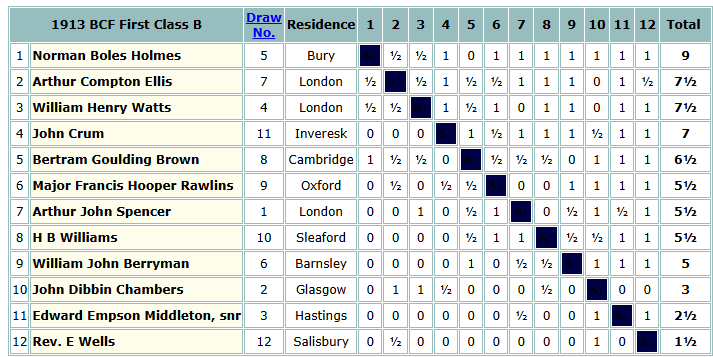
This left him in second place behind his Lancashire contemporary Norman Boles Holmes. George Tregaskis wasn’t playing, but his other Hanley friend, Joshua Walter Dixon, was there in First Class A.
Both Dixon and Ellis scored other successes there: Joshua won two problem solving competitions, while Arthur, although he only finished 7th in the handicap tournament, won a prize in a Kriegspiel (‘a peculiar, and modern, form of chess, unknown to more than 99 per cent. of chess players’) event.
Returning to London, Arthur Compton Ellis submitted two puzzles based on his games to the Staffordshire Sentinel. (The chess editor preferred to remain anonymous: perhaps it was Joshua Walter Dixon.)
It shouldn’t take you too long to find the mate in 4 here.

Two weeks later he offered a mate in 3, which has, although he seemed not to notice, two solutions, both involving attractive (but different) queen sacrifices. Can you find them both?

On 13 September Alekhine, on a brief visit to London, agreed to play a simul at the Divan in the Strand. Arthur, of course, was there.
He lost a pawn and was slowly ground down, but did anyone spot he had a fleeting opportunity for a draw in the pawn ending?
[Event “Simultaneous Display: Divan”]
[Date “1913.09.13”]
[White “Alekhine, Alexander”]
[Black “Ellis, Arthur Compton”]
[Result “1-0”]
1. d4 d5 2. Bg5 Nf6 3. e3 Ne4 4. Bh4 g5 5. Bg3 Bg7 6. Bd3 Bf5 7. f3 Nxg3 8. hxg3 Qd7 9. g4 Bxd3 10. Qxd3 h6 11. Ne2 Nc6 12. Nbc3 O-O-O 13. O-O-O Nb4 14. Qd2 e5 15. dxe5 Bxe5 16. a3 Bxc3 17. Nxc3 d4 18. Qxd4 Qxd4 19. Rxd4 Rxd4 20. exd4 Nc6 21. d5 Ne7 22. Kd2 Rd8 23. Rxh6 Nxd5 24. Nxd5 Rxd5+ 25. Ke2 Re5+ 26. Kd2 Kd7 27. Rf6 Ke7 28. Rf5 Rxf5 29. gxf5 Kf6 30. g4 Ke5 31. Ke3 c5 32. a4 a6 33. c3 b5 34. b3 bxa4 35. bxa4 a5 36. c4 f6 37. f4+ gxf4+ 38. Kf3 Kd4 39. g5 1-0
The following Monday he left London. He had a new job as an Assistant Master at Laxton Grammar School, part of the same foundation as Oundle School, but catering for local boys.
He soon encountered problems there, coming into conflict with the Headmaster, Rev Thomas Harry Ross. In November he was asked to hand in his notice.


What a tragic end to a short but eventful life. A life that promised much but ended far too soon. A man of great power and considerable ability. An impulsive young man. I think you can see that in his chess as well: at times brilliant, at times speculative, but almost always entertaining. You can also see how well he was thought of by his chess friends. Great power and considerable ability, yes, and also enthusiasm, energy and charisma. Looking back from a 2020s perspective you can perhaps see elements of ADHD and bipolar disorder, which tends to manifest itself between the ages of 20 and 25. Could Laxton have treated him better? Undoubtedly. You can only hope that, these days, someone like Arthur Compton Ellis would be better understood.
If he and his mother had chosen to remain in Kew, perhaps the history of chess in Richmond would have been very different. Had he devoted the next half century to playing and organising chess, you might have seen him as a British Championship contender, and perhaps an organiser of major chess events in my part of the world. If he’d lived a long life he might even have met me, and perhaps my life would have been different. I’d like to think that, as the founder of Kew Chess Club, which later merged with Richmond, some part of his spirit lives on in today’s Richmond & Twickenham Chess Club. Spare a thought for the short but frenetic life of a true chess addict: Arthur Compton Ellis.
There are a few loose ends to tie up. Arthur’s nemesis, Rev Thomas Harry Ross, in the years between the two World Wars, was Rector of Church Langton with Tur Langton and Thorpe Langton, where he would have ministered to the relations of Walter Charles Bodycoat, and perhaps to my relations as well. I’ll take up the story of Arthur’s friend George Tregaskis in a later article.
There’s one other mystery to look at.

St Albans? There’s nothing online yet about chess in St Albans at that time. He seems to have been in South London with his mother between leaving Stoke and arriving at Oundle. I suppose he might have been there late 1912/early 1913, when there was a gap of a few months in his chronology. We can also go back a few years, to May 1907, when AC Ellis, first from St Albans, then from Swindon, who was solving chess problems in the Bristol Times and Mirror. Was that our man? Was he, perhaps, in those towns for teaching practice? Who knows?
There’s an implication that the family were having some sort of financial problem. There’s also a slight mystery in that the coroner’s report gives his mother’s address as 12 Kilsworth Road Dulwich, while his probate record (he left £560 17s) gave his address as 12 Pickwick Road Dulwich Village. I can’t locate Kilsworth Road (or anything similar) so it may well be a mistake for Pickwick Road, which could also be considered to be in Herne Hill. By 1921 Margaret had returned to Kew, living on her own at 333 Sandycombe Road, just the other side of the railway from where she’d been living ten years earlier. It’s not at all clear when she died: there’s no death record close to Richmond and the family hasn’t been researched. There’s a possible death record in Islington in 1930: perhaps she’d returned to the area where she spent the first part of her life.
Join me again soon for some more Minor Pieces investigating the lives of some of Arthur Compton Ellis’s chess opponents.
Sources:
ancestry.co.uk
findmypast.co.uk/British Newspaper Library
Wikipedia
chessgames.com
BritBase (John Saunders)
Yorkshire Chess History (Steve Mann)
Various other sources quoted and linked to above


 Minor Pieces
Leave a reply to Minor Pieces 55: George Tregaskis – Minor Pieces Cancel reply