Last time we left William Ward at the time of the 1901 census, where he was staying overnight with one Isidore Wiener.
As we know he played for Richmond at the end of 1902, was he living in our part of London at that time?
But before that, in April 1902 William Ward played a match against rising American star Frank Marshall, who was visiting London at the time. The two players had met the previous year in the Anglo-American Cable Match, where Ward was successful. In this match, however, Marshall won four games to Ward’s two. The American was noted for his attacking skills but in this game he had no answer to his opponent’s kingside attack. (As usual, you can click here and paste the pgn to play through the game.)
[Event “Match Marshall-Ward London Game 4”]
[Date “1902.??.??”]
[White “Marshall, Frank James”]
[Black “Ward, William”]
[Result “0-1”]
1. d4 d5 2. c4 e6 3. Nc3 Nf6 4. Bg5 Be7 5. Nf3 Nbd7 6. e3 O-O 7. Rc1 b6 8. cxd5 exd5 9. Bd3 Bb7 10. O-O c5 11. Bb1 Ne4 12. Bf4 Rc8 13. Qc2 f5 14. Rcd1 Ndf6 15. dxc5 Bxc5 16. Nd4 Bxd4 17. exd4 Nxc3 18. bxc3 Ne4 19. Bd2 Ba6 20. Rfe1 Qh4 21. g3 Qh5 22. Qb2 Be2 23. Rc1 Nxf2 24. h4 Qf3 25. Kh2 Qg4 26. Bf4 Qh3+ 27. Kg1 Bf3 28. Kxf2 Qg2+ 29. Ke3 Qxb2 30. Kxf3 Rxc3+ 31. Rxc3 Qxc3+ 32. Re3 Qxd4 33. Bc2 Rc8 34. Bxf5 Rc3 35. h5 Rxe3+ 36. Bxe3 Qd1+ 37. Kf4 Qxh5 38. Be6+ Kf8 39. Bg4 Qf7+ 40. Ke5 Qc7+ 41. Kf5 g6+ 0-1
This season also witnessed William Ward’s first success in the City of London Chess Club Championship. It appears that he and Thomas Francis Lawrence shared first place, but that Ward won the play-off.
In the summer of 1904 Ward played a match in London against George Edward Wainwright, winning by a score of 5½-3½.
In this game Wainwright had the better of the opening, but, playing too fast, perhaps, miscalculated on moves 30 and 31, giving Ward the chance of a crisp finish.
[Event “Match Ward-Wainwright”]
[Date “1904.08.??”]
[White “Wainwright, George Edward”]
[Black “Ward, William”]
[Result “0-1”]
1. e4 c5 2. Nf3 Nc6 3. Nc3 g6 4. d4 cxd4 5. Nxd4 Bg7 6. Be3 d6 7. Be2 Nf6 8. O-O O-O 9. h3 Bd7 10. Qd2 Nxd4 11. Bxd4 Bc6 12. Bf3 Ne8 13. Rad1 e5 14. Be3 f5 15. Bc5 Rf6 16. Ba3 Bf8 17. Nd5 Rf7 18. exf5 gxf5 19. b3 Qh4 20. Kh2 Bh6 21. Qe1 Bg7 22. g3 Qh6 23. Bc1 Qe6 24. c4 Nf6 25. Nxf6+ Rxf6 26. Bd5 Bxd5 27. Rxd5 f4 28. gxf4 Raf8 29. Rg1 Kh8 30. Be3 Bh6 31. fxe5 Rf3 32. Rg3 Bxe3 33. fxe3 Rf1 34. Qc3 R8f2+ 35. Rg2 Qg6 0-1
The inaugural British Chess Championships took place in Hastings in 1904, giving masters an amateurs alike the chance for a two week summer chess holiday. William Ward didn’t play that year, but was selected for the Championship in Southport the following year.
Ward started slowly, losing his first three games, followed by a draw with Blackburne, before winning six in a row, finishing with a draw against Atkins, who ran out the clear winner on 8½/11. Ward’s score of 7 points was enough for a share of second place with another forgotten player, Charles Hugh Sherrard.
In this game he again demonstrates his affinity with the Queen’s Gambit.
[Event “British CF-02 Championship Southport R7”]
[Date “1905.08.21”]
[White “Ward, William”]
[Black “Wahltuch, Victor Leonard”]
[Result “1-0”]
1. d4 d5 2. c4 e6 3. Nc3 Nf6 4. Bg5 Nbd7 5. e3 Be7 6. Nf3 O-O 7. Bd3 b6 8. cxd5 exd5 9. Ne5 Bb7 10. f4 Ne4 11. Bxe7 Qxe7 12. O-O f5 13. Rc1 Nxe5 14. dxe5 Nxc3 15. bxc3 c5 16. h3 Rac8 17. Kh2 Rc6 18. Be2 Rh6 19. Bf3 Rd8 20. Qc2 Bc8 21. g3 c4 22. Rcd1 Qc5 23. Rd4 Rc6 24. Rfd1 Be6 25. e4 fxe4 26. Bxe4 dxe4 27. Rxd8+ Kf7 28. Qxe4 Qf2+ 29. Qg2 Qxg2+ 30. Kxg2 Rc5 31. g4 g6 32. Kf3 Ra5 33. R1d2 Ra3 34. Ke4 Rxc3 35. f5 1-0
The 1905-6 edition of the City of London Chess Club Championship was another big success for William Ward, his score of 10½/13 putting him two points clear of the field.
By now he had developed notable skill in building up a slow attack from a closed position. He missed the chance of a brilliancy in this game, but his opponent gave him another, simpler, opportunity a few moves later.
[Event “City of London CC Championship”]
[Date “1906.??.??”]
[White “Shoosmith, Hector William”]
[Black “Ward, William”]
[Result “0-1”]
1. d4 d5 2. c4 e6 3. Nc3 Nf6 4. Bg5 Nbd7 5. e3 Be7 6. Nf3 O-O 7. Bd3 a6 8. c5 Re8 9. O-O c6 10. h3 Nf8 11. Ne5 N6d7 12. Bxe7 Qxe7 13. f4 f6 14. Ng4 e5 15. fxe5 fxe5 16. b4 e4 17. Be2 Qg5 18. Qd2 Ng6 19. Rf2 h5 20. Nh2 Nf6 21. Kh1 Nh4 22. Rg1 Nf5 23. Nf1 Rf8 24. g3 Bd7 25. a4 Rf7 26. a5 Raf8 27. Nd1 h4 28. g4 Ng3+ 29. Nxg3 hxg3 30. Rfg2 Qh4 31. Rxg3 Nh5 32. Qe1 Nxg3+ 33. Qxg3 Qh6 34. Kg2 Rf3 35. Bxf3 Rxf3 36. Qh2 Qh4 37. Rh1 Bxg4 38. Qb8+ Rf8 39. hxg4 Qxh1+ 40. Kxh1 Rxb8 41. Kg2 Rf8 42. Nc3 Rf3 43. Nd1 Kf7 0-1
At some point round about 1905 Ward seems to have moved to North London, joining the Hampstead Chess Club, for whom he played successfully in the London League in the 1905-6 season. You can see him here, second from the right in the row of gentlemen seated on chairs.

The summer of 1906 was quiet: perhaps he was too busy with his legal work to take part in the British Championships in Shrewsbury. In the 1906-7 City of London Championship he failed to repeat the previous year’s success, sharing 3rd place behind the runaway winner George Edward Wainwright, with Hector William Shoosmith in second place.
William Ward didn’t have far to travel for the 1907 British Championships, which took place in Crystal Palace, but he failed to repeat his success of two years previously: this time he only managed 3½/11, sharing the tournament basement.
Here, we see that he had now joined Thames Valley Chess Club, here facing a teammate from five years earlier. Press reports of the 1908 cable match also describe him as being of Thames Valley Chess Club. (The Thames Valley Board 3, Frank Cheyne Papé, was a famous artist and illustator, whose son Lionel would play junior chess successfully in the 1920s.)
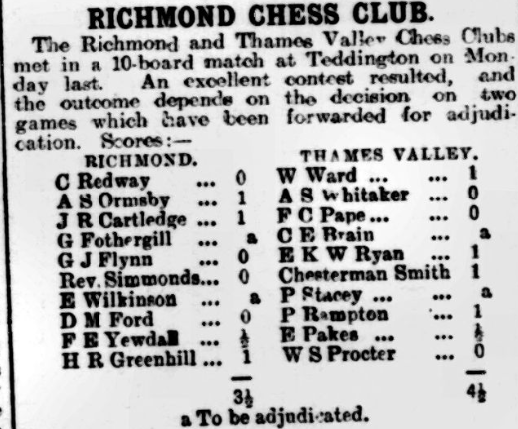
The 1907-8 championship of the City of London club provided a hat trick for players associated with Richmond Chess Club. Thomas Francis Lawrence won, with Ward and Wainwright taking the places.

In this game Ward experimented with what would much later become known as the Taimanov Variation of the Sicilian Defence, winning when his opponent failed to refute his unsound combination.
[Event “City of London CC Championship”]
[Date “1908.??.??”]
[White “Mongredien, Alfred Wornum”]
[Black “Ward, William”]
[Result “0-1”]
1. e4 c5 2. Nf3 e6 3. d4 cxd4 4. Nxd4 Nf6 5. Bd3 Nc6 6. Nxc6 dxc6 7. O-O e5 8. Bg5 h6 9. Bh4 Bc5 10. Nd2 Qe7 11. h3 g5 12. Bg3 g4 13. Bh4 Rg8 14. Kh2 gxh3 15. gxh3 Bxh3 16. Kxh3 Qe6+ 17. Kh2 Ng4+ 18. Kh1 Nxf2+ 19. Rxf2 Bxf2 20. Qf3 Bxh4 21. Bc4 Qd7 22. Rf1 O-O-O 23. Nb3 Rg3 24. Qf5 Qxf5 25. Rxf5 f6 26. Kh2 Re3 27. Bd3 Rg8 28. Nd2 Bg3+ 29. Kh1 Bf4 30. Bf1 Reg3 0-1
The 1908 British Championship took place in Tunbridge Wells, and, despite his result the previous year, he was again selected for the championship itself.
In the first two rounds Ward scored 2/2 with the Sicilian Dragon. It’s clear from this, admittedly not entirely accurate, game that he was well aware of the latent power of the fianchettoed bishop.
[Event “British CF-05 Championship Tunbridge Wells R1”]
[Date “1908.08.10”]
[White “Michell, Reginald Pryce”]
[Black “Ward, William”]
[Result “0-1”]
1. e4 c5 2. d4 cxd4 3. Nf3 Nc6 4. Nxd4 g6 5. Nc3 Bg7 6. Be3 d6 7. Qd2 Nf6 8. f3 Bd7 9. Nb3 O-O 10. Nd5 Ne8 11. c4 e6 12. Nc3 f5 13. exf5 gxf5 14. O-O-O Ne5 15. f4 Ng4 16. h3 Nxe3 17. Qxe3 Qf6 18. Kb1 Bc6 19. Nd4 e5 20. fxe5 dxe5 21. Nxc6 bxc6 22. c5 Rb8 23. Bc4+ Kh8 24. Bb3 a5 25. Rd7 e4 26. Rhd1 Rb4 27. Ra7 f4 28. Qf2 Qf5 29. Rxa5 Nc7 30. Qc2 Ne6 31. Bxe6 Qxe6 32. Ra7 Qc4 33. Na4 Rfb8 34. Qxc4 Rxc4 35. Rdd7 Bf8 36. Rxh7+ Kg8 37. Rab7 Rxb7 38. Rxb7 Rxa4 39. Rc7 Ra6 40. Rc8 Kf7 41. h4 Bxc5 42. h5 Bd4 43. h6 Kg6 44. Re8 e3 0-1

 vs Henry Atkins, and Joseph Blackburne vs Reginald Michell (W). Photo from BCM, Sept 1908, p372
This was the game which, in some ways, defined William Ward’s life. He exceeded the time limit on move 19 (the first time control was, strange as it might seem by today’s standards, on move 20) in a clearly better position. Atkins eventually won the title, finishing on 8/11, with Ward in second place on 6½/11. If he’d won the game, the title would have been his. Unlucky: perhaps he was distracted by the photographer!
The 1908-9 City of London Championship gave Ward his third title with an impressive score of 15/17 (no draws!), including wins over his nearest rivals, Blake, Wainwright and Edward Guthlac Sergeant, all players connected at some time in their lives with the Kingston area.

The 1909 British Championships took place in Scarborough: Atkins and Blake shared first place on 8½/11, with the Leicester born schoolmaster Atkins winning the tie-break. William Ward took third place a point behind, again, losing a game on time on move 19, this time against Blake. Admittedly on this occasion he stood rather worse. One wonders what was the reason for his problems with clock handling in these games.
Here’s a long and exciting game against the young Fred Yates, in which he met 1. e4 with e5 rather than the Sicilian.
[Event “British CF-06 Championship Scarborough R8”]
[Date “1909.08.17”]
[White “Yates, Fred Dewhirst”]
[Black “Ward, William”]
[Result “1/2-1/2”]
1. e4 e5 2. Nf3 Nc6 3. Bb5 a6 4. Ba4 Nf6 5. O-O Be7 6. Re1 d6 7. d4 Nd7 8. c3 O-O 9. Nbd2 Bf6 10. Nf1 Nb6 11. Bc2 Bg4 12. d5 Ne7 13. Ne3 Bd7 14. b3 Kh8 15. h3 g6 16. Kh2 Ng8 17. Qe2 Bg7 18. Ng1 f5 19. c4 f4 20. Nd1 Nf6 21. b4 g5 22. g4 h5 23. f3 Rf7 24. a4 Bf8 25. Nf2 Rh7 26. Bb2 Qe8 27. Rec1 Bxa4 28. Bd3 Bd7 29. c5 Nc8 30. Ra3 Qg6 31. c6 bxc6 32. dxc6 Be6 33. Bxa6 Nb6 34. Bd3 Rxa3 35. Bxa3 Qh6 36. Kg2 hxg4 37. Nxg4 Qg7 38. Bb2 Nh5 39. Bc3 Qf7 40. Be1 Ng7 41. b5 Bxg4 42. fxg4 Ne6 43. Bf2 f3+ 44. Qxf3 Nf4+ 45. Kf1 Be7 46. Be2 Bd8 47. Bxb6 cxb6 48. Ra1 Bc7 49. Ke1 Kg7 50. Bf1 Qe7 51. Qa3 Kg6 52. Rd1 Rh8 53. Rd2 Rf8 54. Bc4 Qf6 55. Kd1 Rd8 56. Rf2 Qh8 57. Ra2 Qg7 58. Bd5 Rf8 59. Bc4 Qf6 60. Rf2 Qh8 61. Qa7 Qg7 62. Rd2 Rh8 63. Rh2 Rd8 64. Rd2 Rh8 65. Rf2 Rd8 66. Ne2 d5 67. Nxf4+ exf4 68. Bxd5 Qd4+ 69. Rd2 Qg1+ 70. Kc2 Qc5+ 71. Kb1 Qxb5+ 72. Kc1 Qc5+ 1/2-1/2
As we move towards 1910 we can summarise William Ward’s chess career up to this point.
Now 42 years old, he was generally recognised as one of the strongest players in the country, having represented his country in five Anglo-American cable matches, having played four times in the British Championship, finishing in second place twice and in third place once, and having won the prestigious City of London Chess Club Championship on four occasions.
He played regularly for Middlesex, and occasionally for other counties, his home county of Hertfordshire, and also appearing on occasion for Kent and Sussex. As well as playing regularly for City of London he represented a number of other clubs: Richmond, Hampstead, Thames Valley and West London, for example, as well as the National Liberal Club: was that an indication of his political views, I wonder?
He was increasingly being called upon to give talks and simultaneous displays, so seems to have been a well respected member of the chess community as well as a formidable player.
Rod Edwards’ retrospective 1909 rating list makes interesting reading: the leading English players, according to his calculations (and excluding the English-born Horatio Caro, who played most of his chess in Germany) were:
21. Atkins 2508
28. Burn 2485
56. Ward 2428
66. Richmond 2411
69. Blackburne 2405
79. Yates 2392
88. Blake 2384
92. Thomas 2379
101. Lawrence 2375
102 Gunsberg 2374
104 Shoosmith 2371
108 Wainwright 2362
120 Griffith 2354
123 Wahltuch 2353
131 Michell 2350
The veterans Burn, Blackburne and Gunsberg had been world class players in their day, but their peak had been back in the 1880s. Yates and Thomas, on the other hand, would only reach their peak in the 1920s.
The unfamiliar name here might be George William Richmond, at this point about to move to Scotland, who was strong but played in very few competitions.
Join me next time to find out what happened next to William Ward in the last of this series of articles.
Acknowledgements:
ancestry.co.uk
findmypast.co.uk
BritBase
EdoChess (Ward’s page here)
British Chess Magazine
The City of London Chess Club Championship (Roger Leslie Paige)
Graham Stuart for information on Ward’s games against Hampshire.


 Minor Pieces
Leave a reply to Minor Pieces 36: William Ward (3) – Minor Pieces Cancel reply