Here’s something you might have seen before: Twickenham Chess Club’s 1896 victory over Metropolitan.
Regular readers will have met several of these players already, but not Twickenham’s Board 6: E B Schwann.

Edward Bagehot Schwann was born in Hampstead in 1872, probably towards the end of September. Edward came from a privileged background. His father, Frederick Sigismund Schwann, himself the son of a German born merchant, had been born in Huddersfield, famed in Hampshire for a while before moving to London and working as a Commission Merchant. His mother, Mary Watson Halton Bagehot, was a first cousin of Walter Bagehot, best remembered as the author of The British Constitution.

The 1881 census found Frederick and Mary living in West Heath Lodge, Branch Hall Park, Hampstead, with five children, two cousins, a governess and six servants.
Young Edward was educated at Bromsgrove School where he excelled at cricket. A brother, Henry Sigismund, would go on to represent Oxford University at cricket. An uncle, Charles Ernest Schwann, was a prominent Liberal politician, noted for his radical views, and MP for Manchester North between 1886 and 1918.
Edward must have excelled at chess as well as cricket at school, as he first came to the attention of the chess world in 1886 as a problem solver. Perhaps solving chess problems was popular with the cool kids back in the day.
It wasn’t long before Edward started composing problems himself: direct mates mostly in 2 or 3 moves. Here’s an early example.
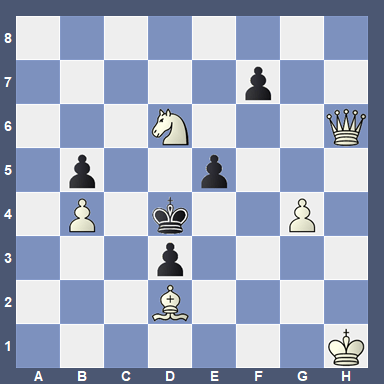
A typical problem by a novice composer of the day, I’d say, but he would soon add more complexity to his compositions. (You’ll find the solutions to the problems at the end of the article.)
In 1890 Edward completed his education at Bromsgrove School, achieving a Higher Certificate in Latin, Elementary and Additional Mathematics, English and History, and, rather than proceeding to Oxford or Cambridge, returned home to his family in London.
By this point they’d moved from Hampstead to Wimbledon, living in Park House, Inner Park Road. The house itself no longer exists, but it was just off the A219 across the road from Putney Heath. The 1891 census records Frederick and Mary along with six of their children, including Edward, described as a Scholar (perhaps he was at London University) and no less than eight servants. They were clearly living in some style.
By the following year, Edward had joined the City of London Chess Club. The first mention of him I can find is from July 1892, where, described as ‘the rising young problem composer’, he won a game in a simul given by the strong amateur Percy Howell.
In January 1893 he had a game from the City of London Club Championship published in the Morning Post, although it must be admitted that White’s opening play was pretty feeble and that his queen sacrifice, while attractive, was not the only way to win. As a problemist, though, he might have had no choice. (Click here and paste the pgn to play through any game in this article.)
[Event “City of London Chess Club”]
[Date “1892.??.??”]
[White “Ray, HJ”]
[Black “Schwann, Edward Bagehot”]
[Result “0-1”]
1. d4 c5 2. Nf3 d5 3. e3 Nc6 4. Be2 Bf5 5. a3 e6 6. O-O Nf6 7. h3 g5 8. dxc5 Bxc5 9. b4 Bb6 10. Bb2 Rg8 11. Bb5 g4 12. Ne5 gxh3 13. g3 Qc7 14. Nxc6 Rxg3+ 15. Kh1 Be4+ 16. f3 bxc6 17. Bxf6 Rg2 18. Bxc6+ Kf8 19. f4 Rf2+ 20. Kg1 Qxf4 21. exf4 h2# 0-1
By 1893 he was playing in matches for his club: here he is in a match against Oxford University. (I suspect A F Fox is a typo for A M Fox.)

In October that year Blackburne visited the City of London Club to play an 8-board blindfold simul: the only winner was ‘a rising talented player and problem composer’ – E B Schwann. (One of the three players who drew was recorded as Dr J K Leeson: this may have been a typo for Dr J R Leeson, who will feature in a future Minor Piece.) By now Edward was playing for the Metropolitan club as well as City of London.
In 1894 he represented the winning team, Surrey, in the final of the inter-county championship against Gloucestershire – but his affiliation is given as S.C.A. (Surrey Chess Association), suggesting he wasn’t, at that point, a member of any Surrey club.
In October 1894 a 50 board match took place between the Metropolitan and City of London clubs. Edward played as a reserve for City of London, finding himself matched with W H Gunston, a player of genuine master strength.
[Event “Metropolitan v City of London”]
[Date “1894.10.20”]
[White “Gunston, William Hewison”]
[Black “Schwann, Edward Bagehot”]
[Result “1-0”]
1. e4 e5 2. Nf3 Nc6 3. Bb5 Nf6 4. O-O Nxe4 5. d4 Be7 6. Qe2 Nd6 7. Bxc6 bxc6 8. dxe5 Nb7 9. Nc3 Nc5 10. Nd4 O-O 11. Rd1 Qe8 12. Be3 f6 13. exf6 Rxf6 14. Bg5 Ba6 15. Qe5 d6 16. Qe3 Rf7 17. Re1 Qd7 18. b4 Bxg5 19. Qxg5 Nb7 20. Re3 Bc4 21. Rae1 Raf8 22. Re7 h6 23. Rxd7 hxg5 24. Rxf7 Kxf7 25. Nxc6 a6 26. Re7+ 1-0
The newspaper report rather unhelpfully reported the match in alphabetical order of the Metropolitan players rather than in board order.

Meanwhile Edward’s problem career was continuing to grow: this problem was a first prize winner.
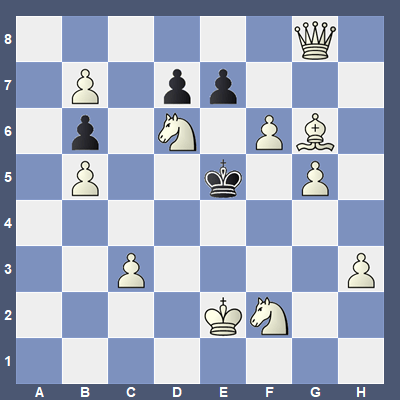
He seemed to be present in almost every club or county match going, as well as composing regularly. He was particularly successful over the board in the 1895-6 season: maybe one of his friends, Arthur Makinson Fox, perhaps, suggested that he might be prepared to make the journey from Wimbledon to Twickenham to join the local club, with the result that you saw at the top of this article.
In 1897 Frederick Richard Gittins published his book The Chess Bouquet. Here’s what he had to say about Edward Bagehot Schwann.

His improved form had come to the notice of the selectors and, in a match against Cambridge University, he found himself on board 2, where he lost to a most interesting opponent, E A Crowley.

Yes, this was Edward Alexander, better known as Aleister Crowley, star of The (Even More) Complete Chess Addict. You can read more about his chess career here.
Soon after this match, Edward disappeared from the London chess scene, spending a year in Munich learning more about the German School of chess composition from the experts there, and also visiting Prague, where he played this game.
[Event “Prague”]
[Date “1897.??.??”]
[White “Schwann, Edward Bagehot”]
[Black “Moucka, Frantisek”]
[Result “0-1”]
1. e4 e5 2. Nf3 Nc6 3. Bc4 Nf6 4. d4 exd4 5. O-O Bc5 6. e5 d5 7. exf6 dxc4 8. Re1+ Be6 9. Ng5 Qd5 10. Nc3 Qf5 11. Nce4 Bb6 12. g4 Qg6 13. fxg7 Rg8 14. Nxe6 fxe6 15. Bg5 Rxg7 16. Nf6+ Ke7 17. h4 Rf7 18. Qe2 e5 19. Ne4+ Kd7 20. Qxc4 Raf8 21. h5 Qe6 22. Qxe6+ Kxe6 23. Bh4 h6 24. Kg2 Rf4 25. Kh3 Kd5 26. Nd2 d3 27. cxd3 Bxf2 28. Re4 Bxh4 29. Kxh4 Rf2 30. Nc4 R8f3 31. Ne3+ Ke6 32. g5 Nd4 33. gxh6 Rxe3 34. Rxe3 Nf5+ 35. Kg4 Nxe3+ 0-1
Here’s another prizewinning mate in 3. Was it influenced by his time in Germany?
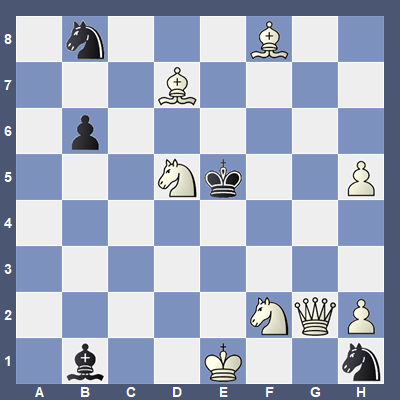
By the time he returned in early 1898 Twickenham Chess Club had transitioned into Thames Valley Chess Club, and, while rejoining his now Teddington based colleagues he also decided to join the new Richmond Chess Club, which was, as we’ll see in future articles, becoming more ambitious.

Here he is, in late 1899, in one of Richmond’s regular matches against Windsor, where he met another famous opponent who could hardly have been further removed from Crowley: Sir Walter Parratt.
In this game from a county match in January 1900, he preferred 9… g6 to the more popular 9… Qd5 in the famous Max Lange Attack. Today’s engines agree with him, preferring Black after this move.
[Event “Sussex v Surrey”]
[Date “1900.01.13”]
[White “Durant, Thomas”]
[Black “Schwann, Edward Bagehot”]
[Result “0-1”]
1. e4 e5 2. Nf3 Nc6 3. Bc4 Nf6 4. d4 exd4 5. O-O Bc5 6. e5 d5 7. exf6 dxc4 8. Re1+ Be6 9. Ng5 g6 10. Qg4 Qd5 11. Nxe6 fxe6 12. Rxe6+ Kf7 13. Re4 Rae8 14. f3 Nb4 15. Na3 d3+ 16. Kh1 dxc2 17. h4 Qd1+ 18. Kh2 Bg1+ 19. Kh3 h5 20. Qf4 Nd5 21. Qg5 Rxe4 22. fxe4 Qd3+ 23. Qg3 Nf4+ 24. Bxf4 Qd7+ 0-1
From the same period, here’s a loss against tinned milk pioneer Arthur James Maas from the Surrey Challenge Cup. The game seemed to feature a lot of rather inconsequential manoeuvring typical of those days of limited positional understanding before Black came out on top.
[Event “Surrey Challenge Cup”]
[Date “1900.??.??”]
[White “Schwann, Edward Bagehot”]
[Black “Maas, Arthur James”]
[Result “0-1”]
1. e4 e5 2. Nf3 Nc6 3. Bc4 Bc5 4. c3 Nf6 5. d3 d6 6. Nbd2 O-O 7. O-O Ne7 8. d4 exd4 9. cxd4 Bb6 10. Re1 Bg4 11. Qb3 d5 12. exd5 Nexd5 13. Ne5 Be6 14. Ndf3 h6 15. Qd3 c6 16. Bd2 Rc8 17. Bb3 Ba5 18. Bc2 Bxd2 19. Qxd2 Qd6 20. Nd3 b6 21. Nh4 Rcd8 22. Rad1 Ne7 23. Nc1 Rd7 24. h3 Rfd8 25. Qe2 g5 26. Nf3 Nf5 27. g4 Ng7 28. b3 Bd5 29. Ne5 Re7 30. Qd2 Ne6 31. Ne2 c5 32. Qc3 cxd4 33. Nxd4 Rc7 34. Qb2 Nxd4 35. Rxd4 Re7 36. Rd3 Rde8 37. Rde3 Bb7 38. Rd1 Qc7 39. Rde1 Nd5 40. Re4 Nc3 41. Rc4 Rxe5 0-1
In September 1900 Edward decided the time had come to take part in a tournament against stronger oppostion. He entered the top section of the Southern Counties Chess Union championship in Bath, but found the event tough going, eventually finishing in 12th place on 3½/14. The great Henry Ernest Atkins was the winner on 12½/14, a point ahead of Herbert Levi Jacobs. Although a decent county standard player, he was no match for those of master strength. Undaunted, he entered the City of London Championship, but was again unsuccessful. EdoChess considers him to have been roughly 2000 strength, which feels about right.
The 1901 census recorded Edward as still living with his parents, three sisters and eight servants in Wimbledon, and working as a Publisher’s Clerk. By now he was very much respected not just as a composer of problems, but as a leading authority called upon to act as a judge in composing competitions.
He was also continuing to play in club and county matches: clearly a true chess addict, and, given that he was still in his 20s, there was every chance that he would add to his reputation over the next few decades.
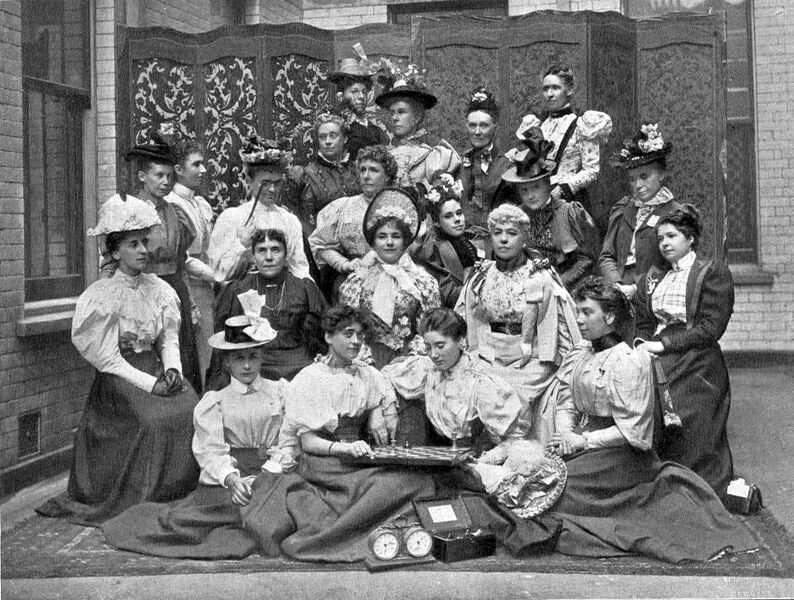
He had also, at round about this time, fallen in love, and would soon announce his engagement to Miss Rita Fox (no relation to A M Fox) of the Ladies’ Chess Club (also here and here) a lady of rather mysterious origins. I hope to write a series of articles about some of the Ladies’ Chess Club members when time permits. Rita is on the left of the front row, wearing a hat, in this group photograph from the 1897 Ladies’ International Chess Congress.
But then, on 7 September 1902, at the age of only 30, his life came to a very premature end.

Some press reports claimed, incorrectly, that he died of heart failure. The inquest into his death, which was reported locally, tells the tragic truth.
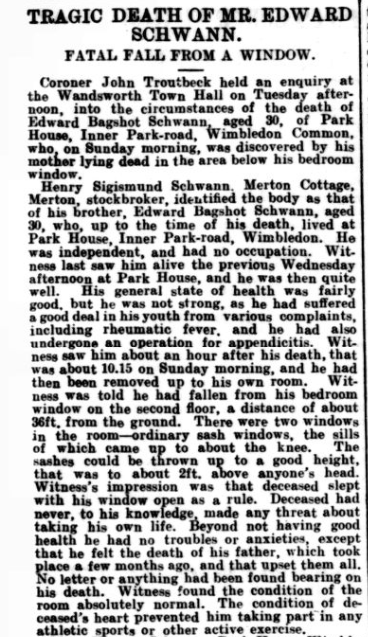
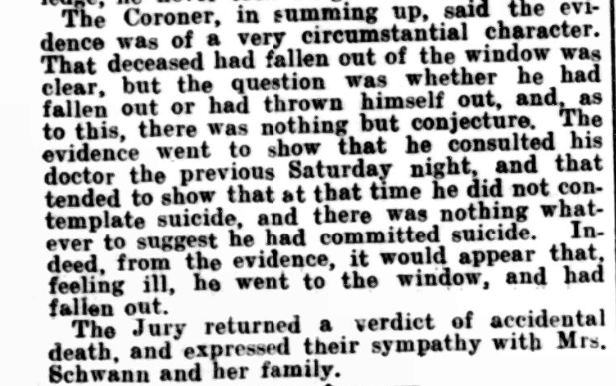
Obituaries noted his kindly, courteous manner, which earned him friends wherever he went. He had made a will a couple of months, perhaps because of his indifferent health. The value of his estate was £20370, about £2.67 million today, and he ensured his fiancée was well provided for. He also left a bequest to the celebrated master Richard Teichmann, who was struggling with both financial and health matters, and was, as a result, able to afford an operation. Russell Scott junior was a schoolmaster at Bedales School, Peterfield, not obviously related so presumably a friend.


There are some more stories to be told. Due to the prevalence of anti-German sentiments during the 1910s, many possessors of German surnames chose to change them. Several members of the Schwann family simply dropped the ‘ch’, becoming Swann. Edward’s brother Ernest, however, preferred to use his mother’s maiden name: Bagehot. Ernest married Ethel Caroline Pollock, whose mother, Amy Menella Dodgson, was a first cousin of Charles Lutwidge Dodgson, better known today as Lewis Carroll. Carroll was himself a keen chess player and used the game in Through the Looking Glass. Ethel’s second cousin once removed, Algernon Pollock Aris, married Janet Alicia Elford, my third cousin once removed (here‘s their oldest son). So, if my tree is correct, Edward Bagehot Schwann, one of the first members of Richmond Chess Club, is the brother-in-law of the 2nd cousin 1x removed of the husband of my 3rd cousin 1x removed!
Another coincidence: some years ago I taught a boy named Adam Swann, whose parents were, and still are, family friends. His young son is now an enthusiastic player. His name, of course, is Edward Swann.
Perhaps he’ll follow in the footsteps of his near namesake, a true chess enthusiast who, in his tragically short life, became a pretty useful player, and, more importantly, a leading authority on and composer of chess problems.
Come back soon for more stories of the early members of Richmond Chess Club.
Acknowledgements and sources:
ancestry.co.uk
findmypast.co.uk
edochess.ca
chessgames.com
chess.com
BritBase
Yet Another Chess Problem Database
Wikipedia
The Chess Bouquet (thanks to Tim Harding)
Various other online resources linked in the text
Solutions:
Problem 1:
1. Qf6! Kd5 2. Nf5! Ke4 (2… e4 3. Ne3#) (2… Kc4 3. Qxf7#) 3. Qc6#
Problem 2:
1. Qb7!
1… Ke5 2. Bf6+ ♔e4 3. Nd2#
1… Kd4 2. Nd2 2… Ke5 3. Bf6# 2… e5 3. Be3# 2… e×d5 3. Qg7# 2… e×f5 3. Bf6#
1… Kf3 2. Ne3+ d5 3. Nd2#
1…e5 2. Nd2+ Kd4 3. Be3#
1… e×d5 2. Nd2+ 2… Kd4 3. Qg7# 2… Ke5 3. Qg7# 1… e×f5 2. Ne3+ 2… Kd4 3. Bf6# 2… Ke5 3. Qd5# 2… d5 3. Q×d5#
Problem 3:
1. Nc3! threat 2. Qd5+ 2… Kf4 3. Bh6# 2… Kf6 3. Ng4# 1… Be4 2. Q×e4+ Kf6 3. Qf5# 3. Qe7# 3. Qf4#
1… Ba2 2. Qe4+ Kf6 3. Qf5#/3. Qe7#/3. Qf4#
1… N×f2 2. Qg7+ Kf4 3. Qg3#
1… Kd4 2. Ne2+ 2… Ke3 3. Bh6# 2… Ke5 3. Ng4# 2… Kc4 3. Qg8#
1… Kf4 2. Ne2+ 2… Ke3 3. Bh6# 2… Ke5 3. Ng4#


 Minor Pieces
Leave a reply to Minor Pieces 47: George Archer Hooke (2) – Minor Pieces Cancel reply