
You saw this result in my recent article about the Coward family. There are some other names of interest in this Twickenham team.
On board 5 for Twickenham was Sydney Meymott. Many players, like Arthur and Randulph Coward, only play competitive chess for a few years before moving on to another stage in their lives. There are others for whom chess is a lifelong obsession: the Complete Chess Addicts (now that would make a great book title!), and Sydney was one of those, with a chess career lasting almost half a century.
He came from a distinguished family. His grandfather, John Gilbert Meymott was a prominent lawyer, and his father Charles Meymott a doctor whose other interests included cricket and chess.
Charles played two first class cricket matches for Surrey, but without success. Against the MCC in 1846 he was dismissed without scoring in the first innings and made 4 not out in the second innings. Against Kent the following year he failed to trouble the scorers in either innings. He also failed to take any wickets in either match.
In 1848 he submitted a ‘beautiful study’ to Bell’s Life, as you can see below.

A few weeks later the solution was published, failing to provide any moves but just saying that White will win a pawn and the game.
But as you can demonstrate for yourself (or verify using tablebases) this is complete nonsense: the position is drawn with best play.
A celebrated cricketer who composed a beautiful study? I think not.
Earlier in 1848, he’d submitted a mate in 4 to the Illustrated London News, which was at least sound, if not very interesting. You can solve it yourself if you want: the solution is at the end of the article.
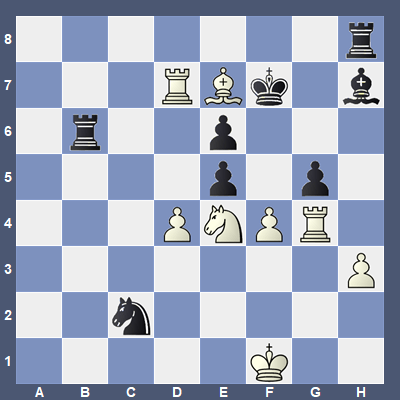
#4 Illustrated London News 12 Feb 1848
In about 1859 Charles, his wife Sarah (née Keene, no relation, as far as I know, to Ray) and their three daughters (a son had died in infancy) emigrated to Australia, where his brother Frederick was a judge. The family must have been well regarded there. If you visit the suburb of Randwick today, not far from Coogee Beach, you’ll find a residential road there named Meymott Street, with Frederick Street running off it.
From there Charles submitted another mate in 4, slightly more sophisticated this time.
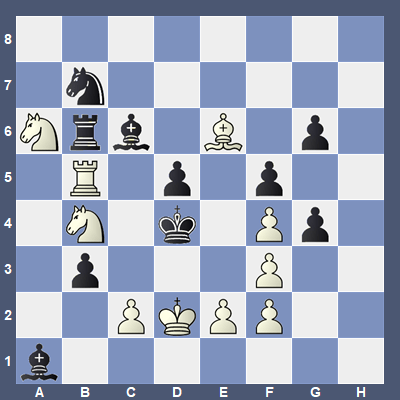
#4 Illustrated London News 26 Nov 1859
The following year, Sarah gave birth to a son, who was given the name of his home city: Sydney.
Charles Meymott had started out in conventional medicine but at some point he had converted to homeopathy. You can find out a bit more here, although some of the links no longer work.
Charles died in 1867 at the age of 54, and his widow and children decided to return to England. I wonder if he’d been able to teach his young son how the pieces moved.
In 1871 Sarah and young Sydney were living in Queen Street (now Queen’s Road) Twickenham: perhaps the girls only returned to England later.
By 1881 the oldest girl had married and moved to Scotland, but Sarah and her three youngest children were now at 4 Syon Row, Twickenham, right by the river.
The road is so well known that a rather expensive book has been written about it.

It was from there, then that, at some point in 1883 or 1884, the 23-year-old Sydney Meymott joined Twickenham Chess Club.
Here he is again, in a match played in October, now on Board 2 against Brixton. You’ll see George Ryan on top board, with Wallace Britten and the Coward brothers lower down. Young Edward Joseph Line (not Lyne), born in 1862, who had played for Isleworth against Twickenham earlier in the year, was on Board 3, although he was one of only two Twickenham players to lose.

If you’re interested in this part of the world, you might want to check out my good friend Martin Smith’s new book Movers and Takers, a history of chess in Streatham and Brixton. You can download the pdf for free here.
Syd had decided on a career as a bank manager, and his training would have involved working at different branches gaining more experience before managing a larger branch himself. This was perhaps to be his last appearance for Twickenham, but we’ll follow the rest of his life in this article.
Just a couple of weeks later he wrote to the Morning Post:

Disraeli Road is conveniently situated just round the corner from Putney Station, with its frequent trains to Waterloo. Impressive houses they are too: young Sydney was doing well for himself.
The new chess club in Putney rapidly became very successful. Inevitably, they invited Blackburne to give a blindfold simul in February 1886: Meymott was the only player to draw.
In December the same year, Sydney issued a challenge to his old club, with Putney winning by 5 games to 3.
Here’s what happened in the return match in the new year.

He was soon on the move again, leaving the good chess players of Putney to their own devices. Without their leading light the club struggled on for a few years before apparently folding. This time, Syd’s work took him to Honiton, Devon, where again he started a chess club. By now he was writing regularly to the Morning Post, solving their problems and sometimes submitting problems of his own – which were not considered suitable for publication.
In this game he demonstrated his knowledge of Légal’s Mate. You can play through this and any game in this article by copying the pgn and posting it here.
[Event “Honiton”]
[Date “1888.??.??”]
[White “Meymott, Sydney”]
[Black “Mr A”]
[Result “1-0”]
1. e4 e5 2. Nf3 Nc6 3. Bb5 d6 4. O-O Bg4 5. h3 Bh5 6. Nc3 a6 7. Bc4 Nd4 8. Nxe5 Bxd1 9. Bxf7+ Ke7 10. Nd5# 1-0
Source: Morning Post 17 Dec 1888
Here, he was able to show off his attacking skills in the Evans Gambit, giving rook odds to another semi-anonymous opponent.
[Event “Honiton”]
[Date “1891.??.??”]
[White “Meymott, Sydney”]
[Black “C”]
[Result “1-0”]
[SetUp “1”]
[FEN “rnbqkbnr/pppppppp/8/8/8/8/PPPPPPPP/1NBQKBNR w Kkq – 0 1”]
{[#]} 1. e4 e5 2. Nf3 Nc6 3. Bc4 Bc5 4. b4 Bxb4 5. c3 Bc5 6. O-O d6 7. d4 exd4 8. cxd4 Bb6 9. Nc3 Na5 10. Bd3 Bg4 11. Qa4+ Bd7 12. Qd1 Nf6 13. e5 dxe5 14. Ba3 e4 15. Re1 Bf5 16. Nh4 Qxd4 17. Bb5+ c6 18. Qxd4 Bxd4 19. Nxf5 Bxc3 20. Rd1 Nd7 21. Nd6+ Kd8 22. Nxf7+ Kc8 23. Be2 b6 24. Bg4 Nc4 25. Rxd7 1-0
Source: Western Morning Post 26 Feb 1891
By now it was time for Sydney to move on again, this time back to West London, to Ealing the Queen of the Suburbs, where he’d remain for the next 40 years. He’d eventually become the Manager of the Ealing Broadway branch of the London and South Western Bank.
This time he didn’t need to start up a chess club: there already was – and still is – one there, founded in 1885. As a bank manager, he was soon cajoled, as bank managers usually are, into taking on the role of Honorary Treasurer.
In this game from a local derby against Acton, Black’s handling of the French Defence wasn’t very impressive, allowing Meymott to set up a Greek Gift sacrifice.
[Event “Ealing v Acton”]
[Date “1895.??.??”]
[White “Meymott, Sydney”]
[Black “Connor, J.”]
[Result “1-0”]
1. e4 e6 2. d4 d5 3. Nc3 Nf6 4. Bg5 Be7 5. Bxf6 Bxf6 6. Nf3 c6 7. Bd3 O-O 8. e5 Be7 9. h4 f5 10. exf6 Bxf6 11. Bxh7+ Kxh7 12. Ng5+ Bxg5 13. hxg5+ Kg8 14. Qh5 Qd7 15. g6 1-0
Source: London Evening Standard 25 Nov 1895
Meymott commented: … it may interest some of the younger readers and stimulate them to ‘book’ learning, the game being a forcible example of the utility of ever being alert to the well-known mating positions… Fifteen years later, the young Capablanca played the same sacrifice in the same position (Capablanca – AB Davis Chicago Simul 1910). Perhaps he’d read the Evening Standard. Learning and looking out for the well-known mating positions is still excellent advice today.
In May 1896 Sydney made the headlines in the local press for reasons unconnected with either chess or banking. He was one of those stuck for 16 hours on the Great Wheel at Earl’s Court, and was interviewed at length about his experiences by the Middlesex County Times (30 May 1896 if you want to check it out). Fortunately, a lady in his car managed to let down a reel of cotton, so that they were able to receive refreshments, in the shape of stale buns and whisky and soda, from the ground.
A match against Windsor in 1897, where he was described as a ‘bold dashing player’ saw him pitted against an illustrious opponent in Sir Walter Parratt, organist and Master of the Queen’s Musick, and a possible subject of a future Minor Piece.

Life at Ealing chess club continued with a diet of inter-club matches, internal tournaments and simultaneous displays, with Sydney often successful in avoiding defeat against the visiting masters.
In 1899, approaching his forties, he married Annie Ellen Nash. They stayed together for the rest of his life, but had no children.
In this 1902 match against Richmond, Ealing scored an emphatic victory helped by the non-appearance of Richmond’s board 2. A future series of Minor Pieces will introduce you to some of the Richmond players from that period in the club’s history.

While he often did well in simuls against visiting masters, in 1910 he lost this game to the veteran Blackburne.
[Event “Simul: Ealing Chess Club”]
[Date “1910.11.29”]
[White “Blackburne, Joseph Henry”]
[Black “Meymott, Sydney”]
[Result “1-0”]
1. e4 c5 2. Nf3 e6 3. d4 cxd4 4. Nxd4 a6 5. Be2 Nf6 6. Bf3 e5 7. Ne2 h6 8. O-O Be7 9. Nbc3 b5 10. Ng3 Bb7 11. Nf5 O-O 12. Bxh6 gxh6 13. Qd2 Ne8 14. Qxh6 Bg5 15. Qh3 Qf6 16. Rad1 Ng7 17. Rd6 Ne6 18. Nd5 Bxd5 19. exd5 Nf4 20. Qg4 Qd8 21. h4 f6 22. hxg5 fxg5 23. Be4 Rxf5 24. Qxf5 Qe7 25. Rh6 Qg7 26. Rh7 Qg6 27. Qxg6+ Nxg6 28. Bxg6 {Source: Middlesex County Times 03 December 1910} 1-0
As he settled into comfortable middle age, life continued fairly uneventfully for Sydney and Annie. The 1911 census found them at 18 Uxbridge Road, Ealing, which seems to have been in the town centre, possibly above the bank.
Many clubs closed down during the First World War, but Ealing, with Sydney Meymott still balancing the books, kept going. Here’s a game from their 1916 club championship.
[Event “Ealing Club Championship”]
[Date “1916.04.??”]
[White “Meymott, Sydney”]
[Black “Hennell, James Edward”]
[Result “1-0”]
1. e4 e5 2. Nf3 Nc6 3. Bc4 Nf6 4. Ng5 d5 5. exd5 Na5 6. Bb5+ c6 7. dxc6 bxc6 8. Be2 h6 9. Nf3 e4 10. Ne5 Qd4 11. f4 Bc5 12. Rf1 Qd8 13. c3 Nd5 14. d4 Qh4+ 15. g3 Qxh2 16. Qc2 Qxg3+ 17. Kd1 Bh3 18. Qxe4 O-O-O 19. Qf3 Qxf3 20. Rxf3 Bg2 21. Rg3 Bxd4 22. cxd4 Nxf4 23. Ba6+ Kc7 24. Bxf4 Rxd4+ 25. Nd3+ Kb6 26. Be3 Kxa6 27. Bxd4 Be4 28. Nc5+ Kb5 29. Nc3+ {Source: Middlesex County Times 08 April 1916} 1-0
Meymott had a particular fondness for sharp tactical lines in the Italian Game. In this 1919 encounter, as inter-club matches were starting to take place again after the war, his opponent’s knowledge of Giuoco Piano theory was insufficient.
[Event “Ealing v Ibis”]
[Date “1919.12.10”]
[White “Meymott, Sydney”]
[Black “Williams, A”]
[Result “1-0”]
1. e4 e5 2. Nf3 Nc6 3. Bc4 Bc5 4. c3 Nf6 5. d4 exd4 6. cxd4 Bb4+ 7. Nc3 Nxe4 8. O-O Bxc3 9. d5 Ne5 10. bxc3 Nxf3+ 11. Qxf3 Nf6 12. Re1+ Kf8 13. d6 cxd6 14. Ba3 Qc7 15. Qe2 Qd8 16. Bxd6+ Kg8 17. Qe7 Qxe7 18. Rxe7 h6 19. Rxf7 Kh7 20. Bd3+ Kg8 21. Rf8# {Source: Middlesex County Times 13 December 1919} 1-0
By the time of the 1921 census Sydney had retired and was living at 23 Woodville Road, Ealing: very nice it looks too. A spacious detached house just for the two of them, which, a century on in 2021, sold for £2575000. In 1921, he was in trouble with the law, though, receiving a fine for not having his dog muzzled.
He now had more time for chess, and time to resume submitting games for publication. In his sixties, when many players would be thinking about hanging up their pawns, Meymott, always the chess addict, took up tournament chess.
Hastings 1922-23 was what might have been Meymott’s first tournament. Unfortunately he had to retire ill with 1½/6 in First Class B section, but not before he’d lost this game to Edith Holloway.
[Event “Hastings First Class B”]
[Date “1922.12.??”]
[White “Meymott, Sydney”]
[Black “Holloway, Edith Martha”]
[Result “0-1”]
1. e4 e5 2. Nf3 Nc6 3. Bb5 Bc5 4. O-O d6 5. d3 Nge7 6. Bg5 O-O 7. Bxc6 bxc6 8. Be3 Bb6 9. Nc3 Ng6 10. Bxb6 axb6 11. Qd2 f5 12. exf5 Bxf5 13. Ne4 h6 14. h3 Bxh3 15. Ng3 Qd7 16. Qe3 Be6 17. a3 Qf7 18. Rfe1 Bd5 19. Nh2 Nf4 20. Ne4 Be6 21. c4 Qg6 22. Qg3 Qxg3 23. Nxg3 Nxd3 24. Re2 Bxc4 0-1
In 1925 he visited Scarborough, playing in the Major A section. He won a few games but didn’t finish among the prizewinners.
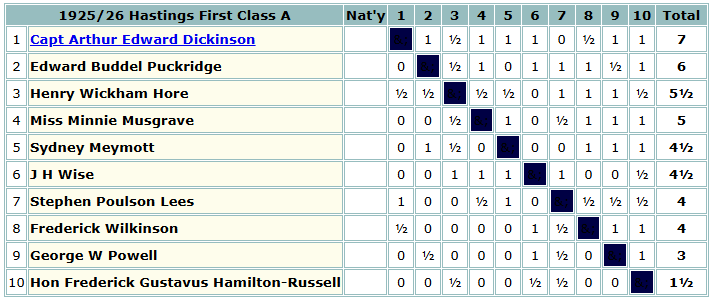
Here he is, at Hastings a few months later, scoring a respectable 50% in the First Class A section. You’ll see he was successful against the tail-ender, who donated the trophy competed for in the Open section of the chess olympiad.
In 1926, using his favourite French Defence, he managed to beat Fred Yates in a simul. The complications towards the end are intriguing: do take a look.
[Event “Simultaneous Display: Ealing Chess Club”]
[Date “1926.01.12”]
[White “Yates, Fred Dewhirst”]
[Black “Meymott, Sydney”]
[Result “0-1”]
1. d4 e6 2. e4 d5 3. Nc3 Nf6 4. Bg5 Be7 5. e5 Nfd7 6. Bxe7 Qxe7 7. Nb5 Nb6 8. c3 a6 9. Na3 c5 10. Nc2 Nc6 11. f4 Bd7 12. Nf3 h6 13. Bd3 c4 14. Be2 Rc8 15. O-O g6 16. Ne3 Kd8 17. Ng4 Kc7 18. b3 Na7 19. bxc4 Nxc4 20. Bxc4 dxc4 21. Nf6 Bc6 22. d5 Qc5+ 23. Kh1 exd5 24. Nd4 Nb5 25. f5 Nxc3 26. Qd2 Ne4 27. Nxe4 dxe4 28. fxg6 Rcd8 29. Rxf7+ Kc8 30. g7 Rhe8 31. Ne6 Rxd2 32. Nxc5 e3 33. Rf8 e2 34. Rg1 Bxg2+ 35. Rxg2 Rd1+ 36. Rg1 Rxg1+ 37. Kxg1 e1=Q+ 38. Kg2 Qd2+ 39. Kf1 Qd8 40. Ne6 Qd3+ 41. Kf2 Qg6 42. Nf4 Qb6+ 43. Kg3 Qd8 44. Ne6 Rxf8 45. gxf8=Q Qxf8 46. Nxf8 c3 0-1
Source: Middlesex County Times 23 Jan 1926
That Easter Meymott took part in one of the First Class sections of the West of England Championship at Weston-Super-Mare, finishing in midfield.
Later the same year, representing the Rest of Middlesex against Hampstead, he played this game against Ernest Montgomery Jellie. White’s 11th move looked tempting but turned out to be a losing mistake: Jellie’s knight was very shaky on d6 and his position soon wobbled.
[Event “Hampstead v Rest of Middlesex”]
[Date “1926.10.09”]
[White “Jellie, Ernest Montgomery”]
[Black “Meymott, Sydney”]
[Result “0-1”]
1. e4 e6 2. d4 d5 3. Nc3 Nf6 4. Bg5 Be7 5. e5 Nfd7 6. h4 c5 7. Qg4 cxd4 8. Bxe7 Qxe7 9. Qxg7 Rf8 10. Nb5 Kd8 11. Nd6 Nc6 12. f4 f6 13. Qxe7+ Kxe7 14. Nxc8+ Raxc8 15. exf6+ Rxf6 16. O-O-O Nb4 17. Bd3 Rxf4 18. Nf3 Nc5 19. Bxh7 d3 20. c3 Ne4 21. Bxe4 dxe4 22. Ne5 Rf5 23. Ng6+ Kf6 24. g4 Rf2 25. h5 e3 26. Rhf1 d2+ 27. Kb1 Nd3 28. Kc2 Rd8 29. Nh4 e2 30. Rxf2+ Nxf2 31. Rxd2 e1=Q 32. Rxd8 Nxg4 0-1
Source: Middlesex County Times 16 Oct 1926
At this point it’s worth taking a slight detour to consider Meymott’s opponent. Ernest Montgomery Jellie and his wife Emily, who sadly died young, had three Jellie babies. Their daughter Dorothy married Sidney Stone, and one of their sons, Chris, inherited his grandfather’s love of chess.
I knew Chris very well back in the day, when he was involved with Pinner Junior Chess Club, where his son Andrew was one of their star players. Chris was an enthusiast rather than a strong player himself, but Andrew is both. He’s been a 2200 strength player for many years, representing Streatham in the London League as well as his local club, Watford.
You can read much more about the Jellie-Stone connection here (Martin Smith again).
After Christmas 1926, Meymott went down to Hastings where he took second prize in the Major C section with a score of 7/9. Well played, Sydney!
On his return, he played this game. This seems to have been in a handicap tournament, where, instead of giving knight odds, the players agreed that Meymott would play blindfold.
[Event “Ealing Chess Club (W blindfold)”]
[Date “1927.??.??”]
[White “Meymott, Sydney”]
[Black “Mr X”]
[Result “1-0”]
1. e4 e5 2. f4 Bc5 3. Nf3 Nf6 4. Nc3 Nc6 5. Bc4 O-O 6. fxe5 Ng4 7. d4 Nxd4 8. Nxd4 Nxe5 9. Be2 d6 10. O-O a6 11. Kh1 h6 12. Na4 Ba7 13. b3 c5 14. Nf3 Nxf3 15. Bxf3 Qf6 16. Bb2 Qg5 17. Qe1 b5 18. Nc3 Re8 19. Rd1 Bb7 20. Nd5 Bxd5 21. Rxd5 Qd8 22. Qg3 g6 23. Rh5 Kh7 24. Rxh6+ Kxh6 25. Qh3+ Kg5 26. Bd1 Rxe4 27. Bc1+ Rf4 28. Rxf4 Qd7 29. Rf5# 1-0
Source: Acton Gazette 14 Jan 1927
At Hastings 1927-28 he scored 50% in the First Class B section. Easter 1928 saw him back at the West of England Championships, held that year in Cheltenham, where he galloped to victory in the Class IIB section, scoring 7½/9.
The British Championships in July 1928 took him further west, to Tenby, where he played in the First Class A section, sharing third prize with the aforementioned Ernest Montgomery Jellie on 6½/9, but again beating him in their individual game.

He was back at Hastings 1929-30, where he was unfortunate in the First Class B section.
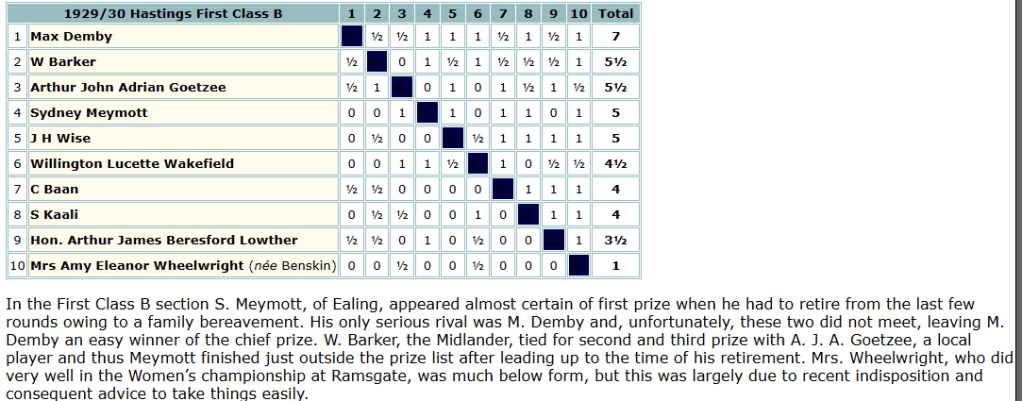
The family bereavement was the death of his unmarried sister Sarah Ellen Meymott on 2 January.
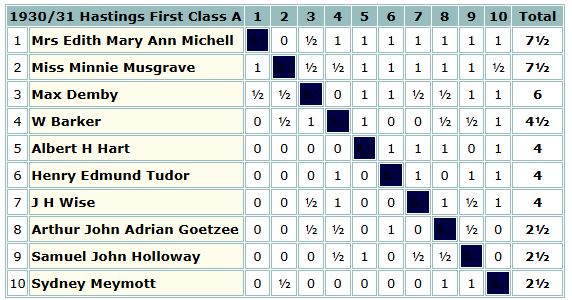
The following year he was promoted to the First Class A section, where he found life a lot harder. You’ll note that first place was shared between two ladies.
In September 1931 he did what many chess players of that period did: he retired to Hastings, after four decades living and playing chess in Ealing. He was soon playing for his local club.
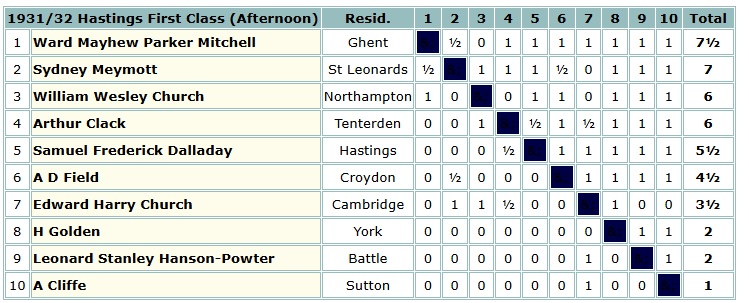
Now in his 70s, finishing second in this (slightly weaker) section would surely have delighted him.
In a match against Brighton in 1932 his opponent was Kenneth Gunnell, who would much later become, briefly, a rather controversial member of both Richmond and Twickenham Chess Clubs.
That would be one of his last games. On 7 February 1933 Sydney Meymott died at the Warrior House Hotel, St Leonards on Sea.
Writing about Ernest Montgomery Jellie, Martin Smith summed him up beautifully:
… he turns out to be an exemplary specimen of an ordinary decent chesser, the sort often overlooked in histories of the game. He and other enthusiasts like him, then and now, are the body-chessic upon which the chess bug spawns and beneficently multiplies. Stir E.M. Jellie together with the rest and you get the thriving chess culture that we all know: the one that germinates the few blessed enough to rise to the top.
Replace E.M. Jellie with Sydney Meymott, and the same sentiments apply. A good player, but not a great player. For almost half a century a stalwart of club, county, and, later, congress chess. A club treasurer for many years, but in his younger days also a founder and secretary of two clubs.
In these days of chess professionalism, even at primary school level, of obsession with grandmasters, prodigies and champions, we’re at risk of losing the likes of Jellie and Meymott. We should be developing chess culture in order to develop champions, not the other way round. And that celebration of chess culture is one of the reasons why I’m writing these Minor Pieces. My friends at Ealing Chess Club today should certainly raise a glass to Sydney Meymott.
Solutions:
1.
1. Bxg5+ Kg6 2. Bf6+ Kh5 3. Ng3+ Kh6 4. Bg7#
2.
1. Nxd5 gxf3 (1… Rxb5 2. e3+ Kc4 3. Nb6#) (1… Bc3+ 2. Nxc3 Bd5 3. e3+ Kc4 4. Bxd5#) (1… Bxb5 2. e3+ Kc4 3. Nxb6#) 2. e3+ Ke4 (2… Kc4 3. Ndc7+ (3. Nc3+ Bd5 4. Bxd5#) 3… Bd5 4. Bxd5#) 3. c3 Rxb5 (3… Bxd5 4. Bxd5#) 4. Nf6#


Leave a comment