Aleister Crowley’s co-star in the first pages of The Complete Chess Addict to be written, Harold Francis Davidson, was an almost exact contemporary.
Davidson was just three months older, born near Southampton on 14 July 1875 (58 years and 14 days before Mike Fox, 75 years and 14 days before me).
He came from a clergy family: his father Francis was the Vicar of Scholing, a working-class parish, and his mother came from the same family as Thomas Arnold. Young Harold was brought up strictly, on the assumption that he would follow the family tradition. He, however, had other plans.
He was educated locally until 1890, when he was sent to live with two maiden aunts in Croydon, completing his secondary education at Whitgift School, which would later count Leonard Barden as one of its most celebrated alumni. At Whitgift, Harold became interested in the stage, considering a career as a stage comedian, and also worked at Toynbee Hall, helping the poor in the East End of London. His extracurricular activities gave him insufficient time for his studies, and, to the disappointment of his father, he failed his Oxford entrance exam in 1894.
Undeterred, he took to the stage, appearing in shows like Charley’s Aunt.
Wikipedia:
During his theatrical days, Davidson maintained high standards of personal morality, observed strict teetotalism and gave regular Bible readings to the elderly in the towns in which he performed on tour. He later gave an account of an incident from November 1894 when he was performing in London. While walking along the Thames Embankment in a thick fog, he said, he encountered a 16-year-old girl who was about to throw herself into the Thames. After preventing her suicide attempt, Davidson learned that she had run away from home near Cambridge, was penniless and without shelter. He paid her fare home: “Her pitiful story made a tremendous impression on me … I have ever since … kept my eyes open for opportunities to help that kind of girl.”
In 1898 he finally agreed to study for holy orders: although he didn’t have the necessary qualifications, he was offered a place through the influence of a family friend.
Wikipedia again:
At Oxford, Davidson’s behaviour was notably eccentric; he displayed considerable energy but disregarded rules, was persistently unpunctual and regularly failed his examinations. He continued to appear on the stage when he could, and decorated the walls of his rooms with autographed pictures of actresses. He once claimed he had left behind a salary of £1000 per year, for a relatively paltry £3 per week as a curate.
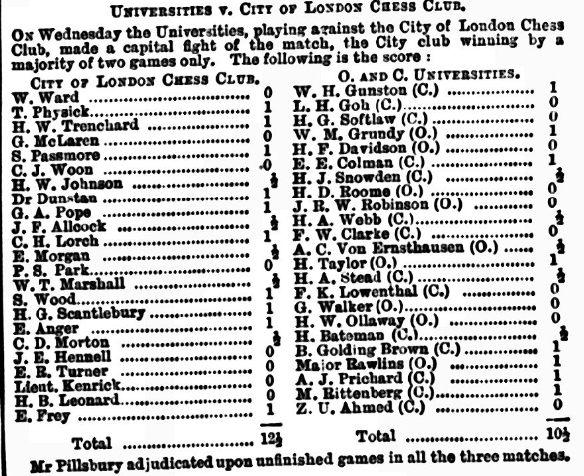
I don’t know when Davidson learnt chess, but the first mention I can find of him is in this 1900 match, where he played for a combined Oxford and Cambridge University team against the City of London Club.
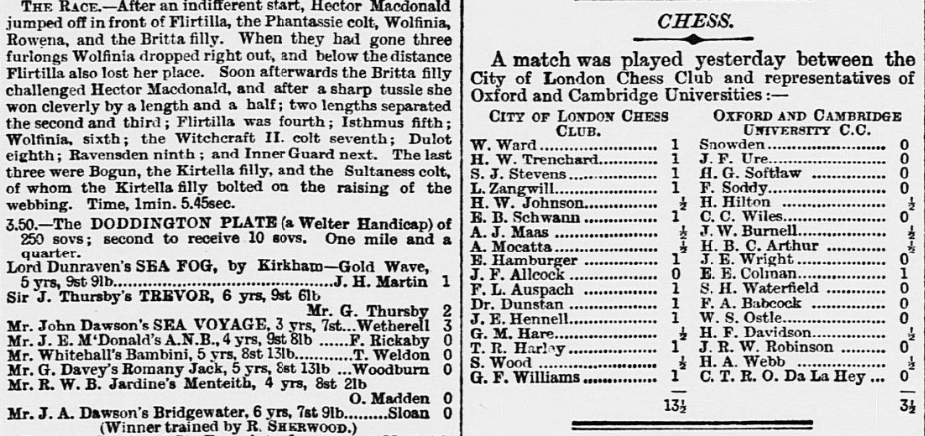
(Note, on your left, the result of the 3:50 at Lincoln. The horse finishing second, named Trevor, was owned by Sir J Thursby, who was almost certainly Sir John Hardy Thursby, the father of Sir John Ormerod Scarlett Thursby, a future president of the British Chess Federation. The jockey, George Thursby, was JOC Thursby,s half-brother.)
He must have made more progress with his chess studies than with his academic studies. The following year he had the honour of being elected President of the University Chess Club.
It was the tradition at the time for a combined Universities team to play matches against leading London clubs before the Varsity Match, and Davidson played in two of these.
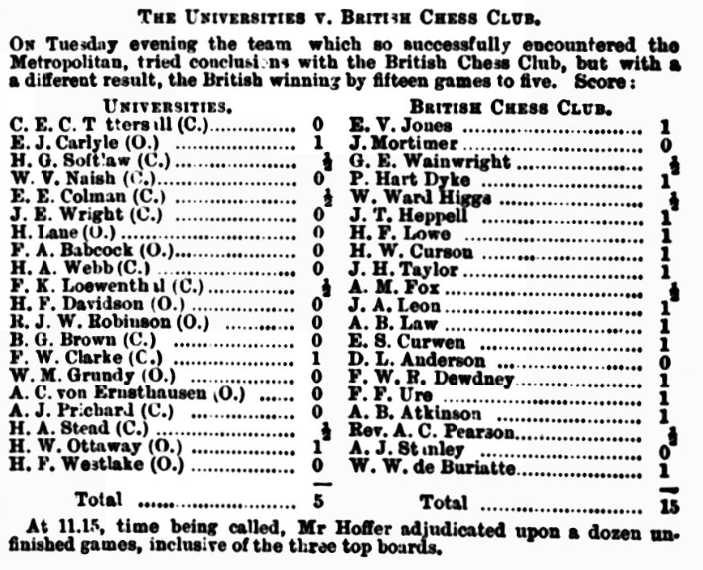
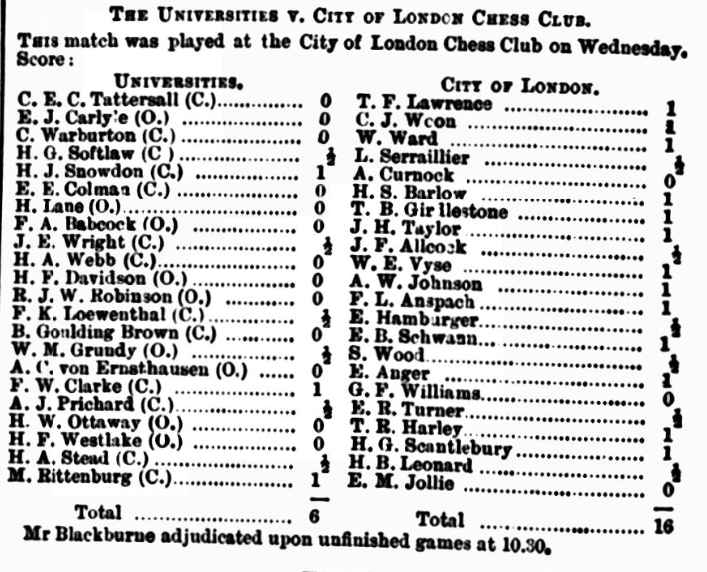
Despite his lack of success here he was selected to play on Board 3 in the Varsity Match. Here’s what happened.
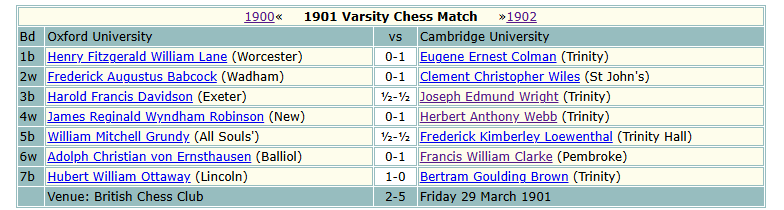
Here’s the game. Davidson selected a counter-gambit which was played occasionally at the time, and was rewarded with a half point after an evenly contested encounter.
[Event “Oxford Univ v Cambridge Univ B3”]
[Date “1901.03.29”]
[White “Wright, Joseph Edmund”]
[Black “Davidson, Harold Francis”]
[Result “1/2-1/2”]
1. e4 e5 2. Nf3 d6 3. d4 Bg4 4. dxe5 Nd7 5. exd6 Bxd6 6. Be2 Qe7 7. Nc3 Ngf6 8. Bg5 O-O-O 9. Qd2 h6 10. Bxf6 Nxf6 11. Bd3 g5 12. Qe3 Bc5 13. Qe2 Bb4 14. h3 Bh5 15. g4 Bg6 16. Nd2 h5 17. f3 hxg4 18. fxg4 Rhe8 19. Kf1 Bxc3 20. bxc3 Nxe4 21. Nxe4 Bxe4 22. Bxe4 Qxe4 23. Qxe4 Rxe4 24. Re1 Rf4+ 25. Ke2 Rd6 26. Rhf1 Re6+ 27. Kd2 Ref6 28. Re8+ Kd7 29. Rfe1 Rf2+ 30. Kc1 Rf1 31. Kd2 Rd6+ 32. Kc1 Rc6 33. R8e3 Rcf6 34. Kb2 Rb6+ 35. Kc1 Rbf6 1/2-1/2
He also took part in the Anglo-American Universities Cable Match, winning his game by outplaying his opponent in the ending: ‘a very good game which promises will for the future chess career of the Oxonian’.
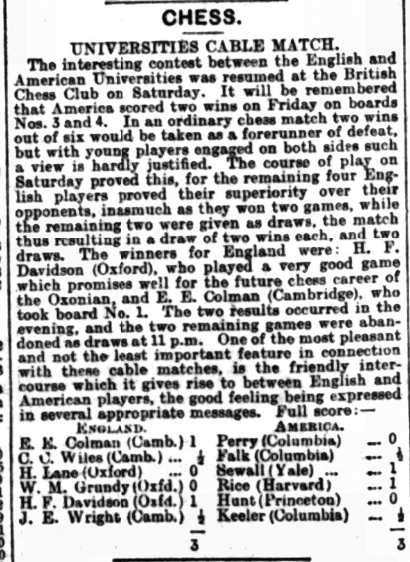
Here is it: see what you think.
[Event “3rd Anglo-American universities cable match”]
[Date “1901.04.26”]
[Result “1-0”]
[White “Davidson, Harold Francis”]
[Black “Hunt, James B”]
1. e4 e5 2. Nf3 Nf6 3. d4 Nxe4 4. Nxe5 d5 5. Qf3 Be6 6. Bd3 Nf6 7. Bg5 Be7 8. O-O Nbd7 9. Nc3 c6 10. Rfe1 O-O 11. Re3 Nxe5 12. dxe5 Ng4 13. Bxe7 Qxe7 14. Re2 Nh6 15. h3 Rae8 16. Qh5 f6 17. Rae1 Bf7 18. Qh4 fxe5 19. Qxe7 Rxe7 20. Rxe5 Rxe5 21. Rxe5 Re8 22. Rxe8+ Bxe8 23. g4 Bd7 24. f4 g6 25. Kf2 Kg7 26. Ke3 Kf7 27. Kd4 Ke6 28. Ne2 Kd6 29. b4 b6 30. Ke3 c5 31. c3 c4 32. Bc2 Ng8 33. Ng1 Ne7 34. Nf3 h5 35. Ne5 hxg4 36. hxg4 g5 37. Nxd7 gxf4+ 38. Kxf4 Kxd7 39. Ke5 a5 40. b5 Ke8 41. Ke6 Kd8 42. g5 Ke8 43. g6 d4 44. cxd4 c3 45. Kf6 Nd5+ 46. Kg7 Ne3 47. Kh8 Nxc2 48. g7 1-0
That year, having failed his exams, he was, if you believe Wikipedia, required to leave Exeter College, but continued studying at a private hall.
He was still representing the university at chess though: we can pick Davidson up here.
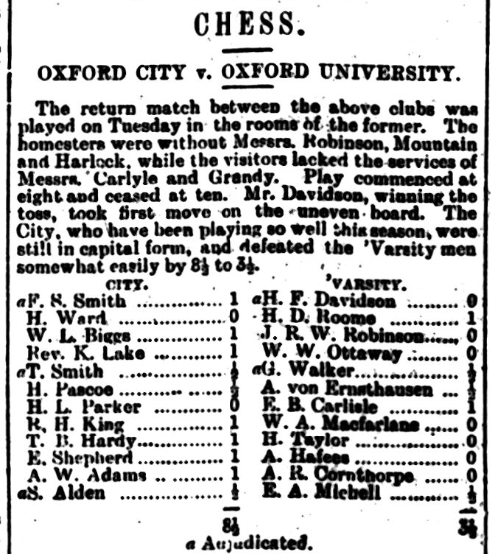
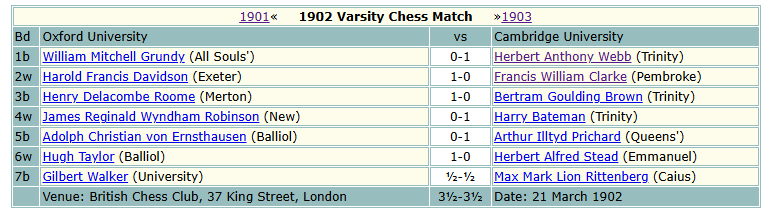
As the 1902 Varsity March approached, Davidson took part in three practice matches, with no success.
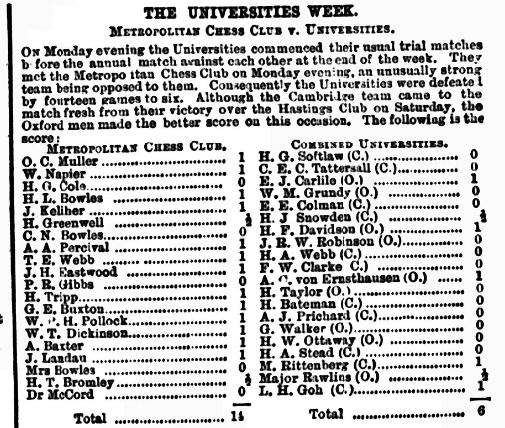
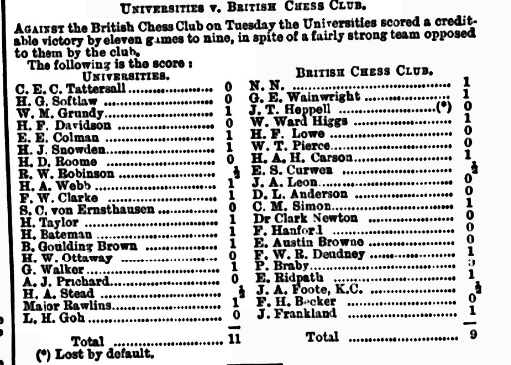
In the Varsity Match itself, he had rather more luck, his fortunate victory enabling the Dark Blues to share the spoils.
Black’s 38th move, simply hanging a piece in a winning position was an extraordinary oversight. An Act of God, perhaps.
[Event “Oxford Univ v Cambridge Univ B2”]
[Date “1902.03.23”]
[White “Davidson, Harold Francis”]
[Black “Clarke, Francis William”]
[Result “1-0”]
1. e4 e5 2. Nf3 Nc6 3. d4 exd4 4. Nxd4 Nf6 5. Bg5 h6 6. Bh4 g5 7. Nxc6 dxc6 8. Qxd8+ Kxd8 9. e5 Ng4 10. Bg3 Bg7 11. Nc3 Nxe5 12. O-O-O+ Bd7 13. Rd2 Kc8 14. Be2 Be6 15. Rhd1 b5 16. a3 a5 17. Ne4 Bd5 18. Bxe5 Bxe5 19. Bg4+ Kb8 20. Re2 Bf4+ 21. Kb1 Ka7 22. g3 Be5 23. Nc5 Bd6 24. Nb3 h5 25. Bf5 Bf3 26. Rde1 Bxe2 27. Rxe2 Kb6 28. Nd4 Rae8 29. Rd2 Re7 30. f3 c5 31. Ne2 Rhe8 32. Nc3 Re1+ 33. Ka2 b4 34. axb4 axb4 35. Nd5+ Kb7 36. Nf6 R8e2 37. Be4+ Kb8 38. Rd5 c6 39. Rxd6 Rxh2 40. Rxc6 Ree2 41. Rxc5 h4 42. Nd7+ Ka7 43. Ra5# 1-0
This report was rather scathing, understandably, about the standard of play.
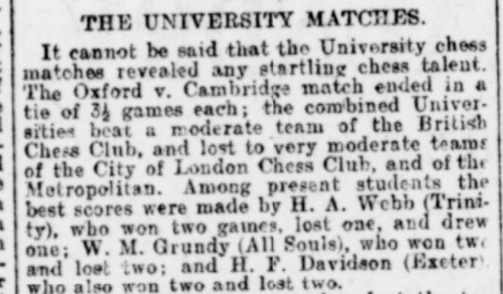
However, it claims that Davidson scored two wins and two defeats, contradicting the reports above. I have no idea which is correct.
The play of the Brits in the Anglo-American Universities cable match was also deemed to be rather disappointing.
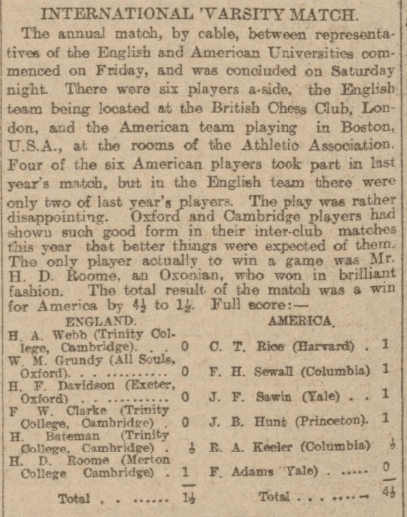
Davidson’s opening was far from impressive, but after losing material he, perhaps inadvertently, obtained what should have been a winning attack. In an exciting but inaccurate game he missed his chances and went down to defeat.
[Event “4th Anglo-American universities cable match”]
[Date “1902.04.25”]
[White “Davidson, Harold Francis”]
[Black “Sawin, James F”]
[Result “0-1”]
1. e4 e6 2. d4 d5 3. Nc3 dxe4 4. Nxe4 Nf6 5. Ng3 c5 6. Be3 Qb6 7. b3 Nc6 8. Nf3 Nd5 9. dxc5 Bxc5 10. Bxc5 Qxc5 11. Ne4 Qb4+ 12. Nfd2 Nc3 13. Qf3 Nxe4 14. Qxe4 Qc3 15. Rd1 Nb4 16. Bb5+ Kf8 17. O-O Nxa2 18. Nf3 g6 19. Rd3 Qf6 20. Rfd1 Kg7 21. Qa4 Nc3 22. Rxc3 Qxc3 23. Rd4 Qxc2 24. Qa1 f6 25. Ng5 Qc7 26. Rh4 Qe5 27. Qa3 Qc7 28. Qa1 Qc5 29. Ne4 Qe5 30. Qa3 Qc7 31. Qa1 e5 32. f4 Qb6+ 33. Kh1 Qxb5 34. g4 Qd5 0-1
The next season Davidson was still at Oxford.
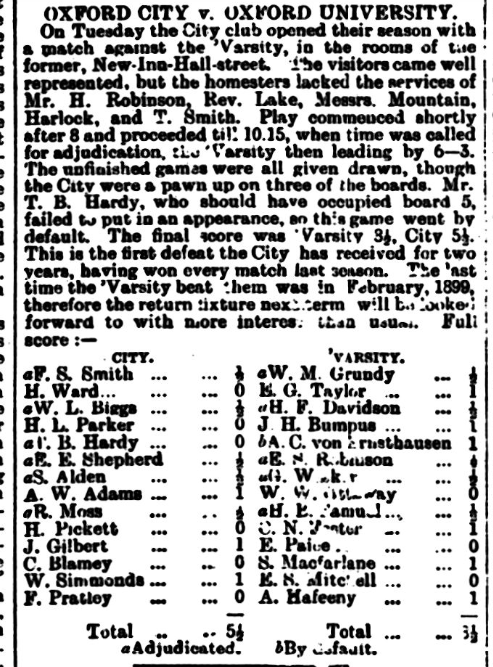
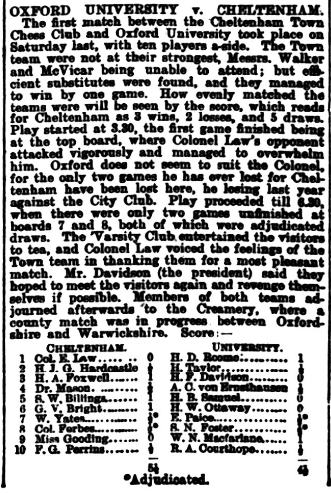
In this match against Cheltenham, Annie Mabel Gooding was amongst the opposition.
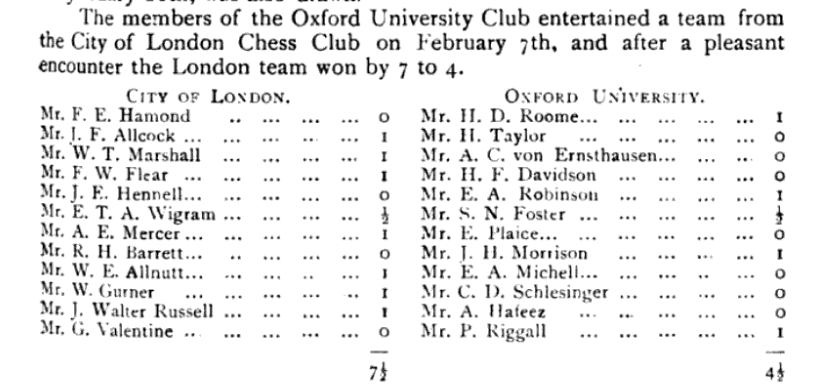
You’ll notice Mr (later Rev) FE Hamond here and elsewhere: the bearer of a surname that will feature later in Davidson’s story.
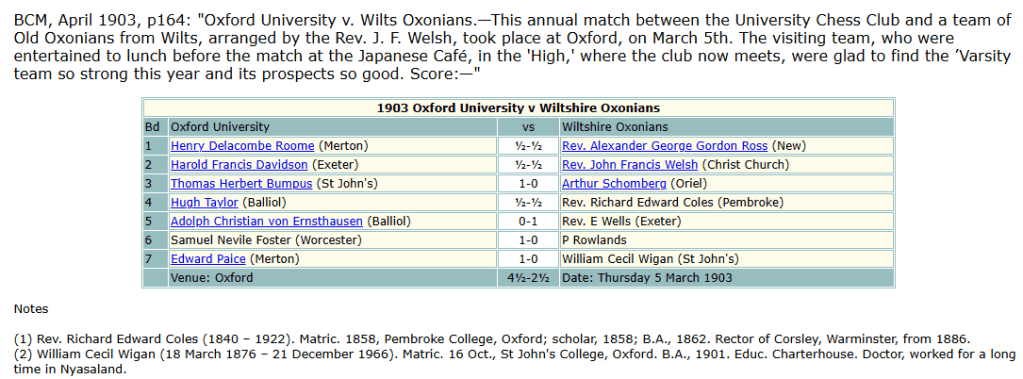
Davidson’s opponent in this match later became the Bishop of Trinidad and Tobago (Wikipedia).
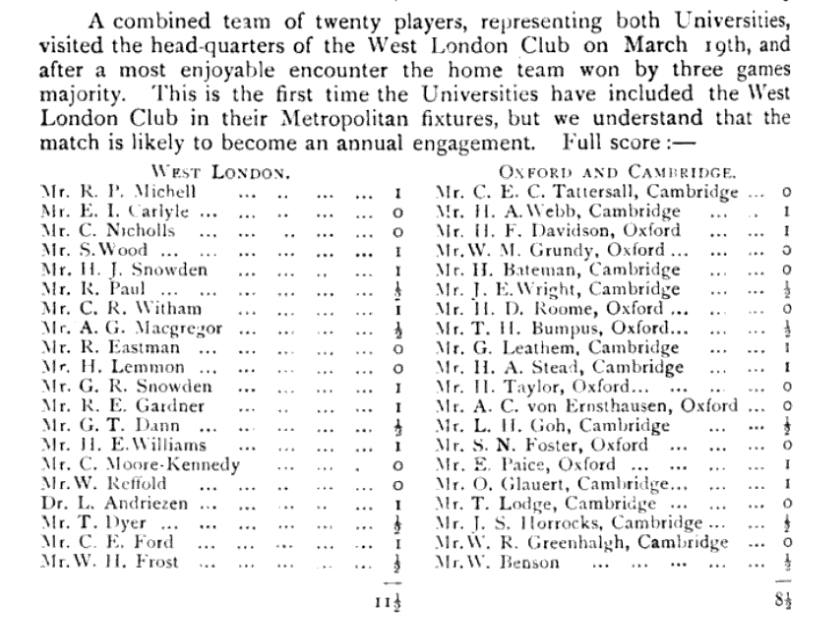
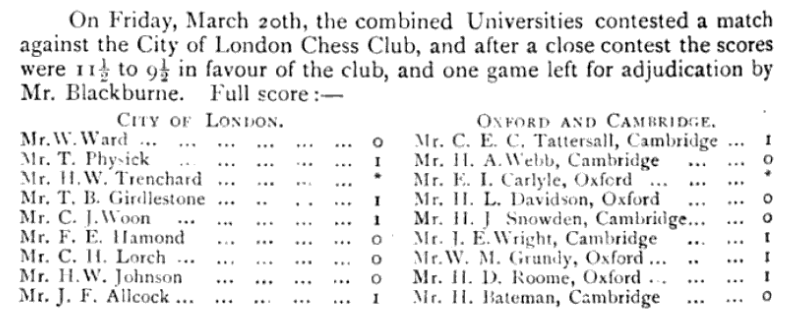
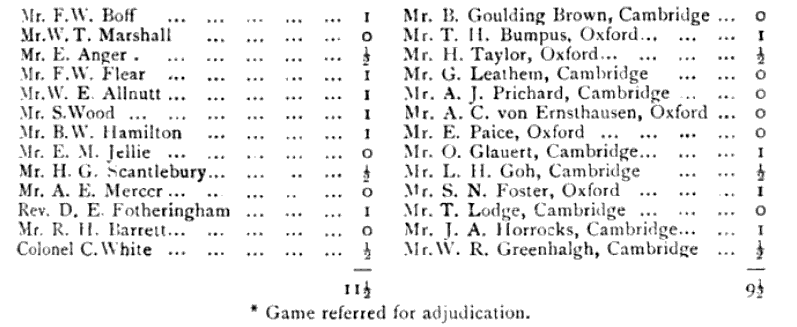
He played on top board in that year’s varsity match.
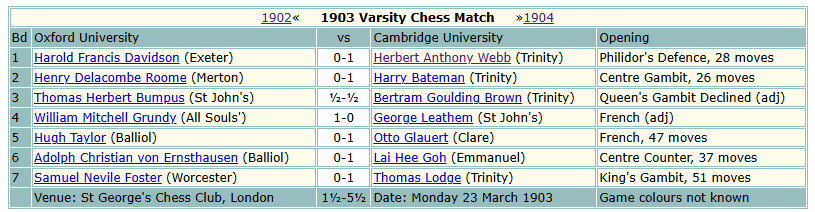
Unfortunately, none of the games from this match were recorded. We know that his game was the first to finish, losing in 28 moves in a Philidor Defence. Circumstantial evidence suggests that he probably had the black pieces: perhaps he used the same rather dubious counter-gambit that he had essayed in 1901.
In that year’s universities cable match he faced the same opponent as in 1902, and was able to avenge the previous year’s defeat.
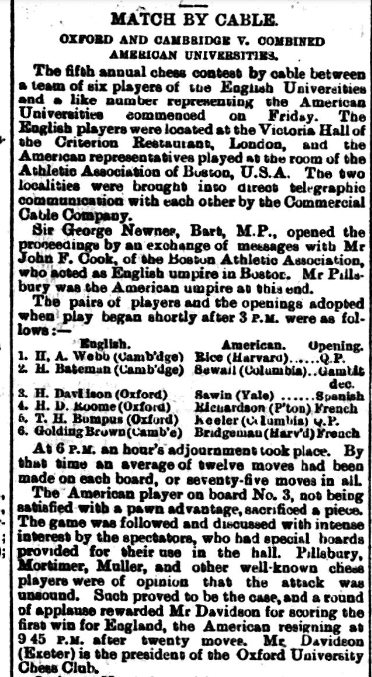
Pillsbury and his colleagues were quite correct: the sacrifice was totally unsound, as you’ll see here.
[Event “5th Anglo-American universities cable match”]
[Date “1903.03.27”]
[White “Sawin, James F”]
[Black “Davidson, Harold Francis”]
[Result “0-1”]
1. e4 e5 2. Nf3 Nc6 3. Bb5 a6 4. Ba4 Bc5 5. O-O Nf6 6. c3 b5 7. Bc2 d5 8. d4 exd4 9. e5 Ne4 10. cxd4 Bb6 11. Re1 Bf5 12. Nc3 Nb4 13. Bxe4 dxe4 14. Nxe4 Qd5 15. Qe2 Rd8 16. Nf6+ gxf6 17. exf6+ Be6 18. Ng5 Rg8 19. Qg4 Kd7 20. Qf4 Nd3 0-1
That, it seems, was the end of Davidson’s brief career in competitive chess. All we have is three varsity matches, three cable matches and a handful of games for university teams, and just five published scores. The rest of his life would take a very different course.
He finally passed his exams that year, and was ordained by the Bishop of Oxford. His first curacy was at Holy Trinity Windsor, from where he took time off to visit the 1904 Varsity Match.
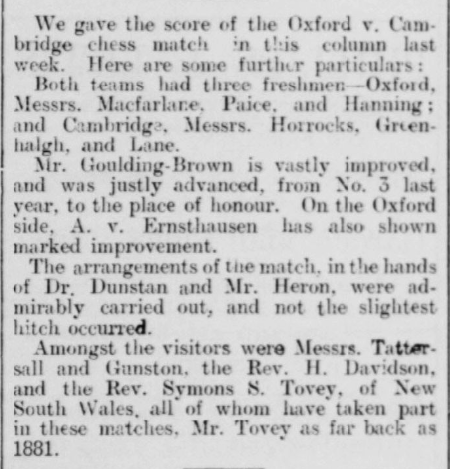
You’ll see that another of the visitors was Crowley’s old adversary Mr Tattersall.
In 1905 Davidson was transferred to London as Curate of St Martin in the Fields: ministry at such prestigious churches suggest that he had friends in high places.
This was confirmed in 1906, when Harold Francis Davidson was appointed Rector of Stiffkey, a wealthy (and amusingly named) parish in North Norfolk. Some claim that it’s pronounced Stewkey or Stookey, but residents seem to pronounce it as it’s written.
Davidson’s living also included the neighbouring parish of Morston, a tiny village a few miles to the east. If you continue in that direction you’ll reach Blakeney, a name which might be familiar to you if you’re either a nature lover or a devotee of horse racing. Blakeney Point is where you go if you want to watch seabirds or seals. A horse named Blakeney won the Epsom Derby in 1969, a feat repeated by his half-brother Morston in 1973.
Now with a large rectory, a lot of land and a generous income, he was able to marry Moyra (Molly) Saurin, an Irish actress he’d met in 1901. They had four children between 1907 and 1913, even though Harold was only around on Sundays.
He spent much of each week in London, returning to the East End and resuming his social work there. He also became chaplain to the Actors’ Church Union, and was often seen backstage trying to save the showgirls’ souls. In 1910, he extended this mission to Paris, frequently visiting the Folies Bergère. Many of these girls were invited to visit the rectory at Stiffkey, sometimes as many as twenty at a time. The parishioners were, understandably, not entirely happy with this, his main antagonist being Major Philip Hamond, a churchwarden at Morston. I haven’t been able to find any close relationship with the aforementioned Reverend Francis Hamond, also from Norfolk, although I’d assume, given that they were both from Norfolk and shared the same unusual spelling of their surname, they were distant cousins.
In 1915 he left Stiffkey to become a Royal Navy Chaplain. This wasn’t entirely successful: on one occasion he was arrested by the naval police in a Cairo brothel.
Returning home in 1919, he found his wife pregnant, but accepted the child as his own. He returned to his pre-war lifestyle, spending six days a week in London, approaching waitresses, theatre workers and prostitutes, piquing their interest by telling them they resembled famous actresses.
Wikipedia:
Many rejected his advances; a number of teashops considered him a pest and barred him. Landladies took exception to his habit of visiting their female tenants at all hours of the night. Commentators have found little evidence that he behaved indecently, or molested the girls; he bought them tea, found them rooms, listened to their problems and sometimes found them work on the stage or in domestic service. He styled himself the “Prostitutes’ Padre”, and asserted to his bishop that this was “the proudest title that a true priest of Christ can hold”.
Meanwhile, Davidson was running into financial difficulties, not helped by falling for a con man’s tricks. He was also becoming more and more unpopular with his parishioners. His old enemy, Major Hamond, submitted a complaint to the Bishop of Norwich, Bertram Pollock (no relation as far as I can tell, to William Henry Krause Pollock, but he was, I believe, the 2nd cousin once removed of the husband of my 3rd cousin once removed), and, after extensive enquiries, in which several actresses said all sorts of incriminating things to the bishop, he was put on trial at an ecclesiastical court in 1932, charged with immorality. The trial took the nation by storm: the popular press was full of lurid stories, and, inevitably, I suppose, on account of the massive publicity, Davidson was found guilty and defrocked.
He then returned to the world of entertainment, and, not finding work in theatres, exhibited himself in a barrel on Blackpool’s Golden Mile, along with other attractions such as Mariana the Gorilla Girl, the Bearded Lady from Russia and Dick Harrow, the world’s fattest man. On 28 July 1933, Blackpool couple Basil and Amy Fox welcomed their son Michael into the world. History doesn’t record whether he was taken to the freak show.
On 28 July 1937 young Michael celebrated his 4th birthday, but by that time Harold Davidson had moved across the country to Skegness, where he was exhibited in a cage with two lions, Freddie and Toto. Freddie attacked him, breaking a bone in his neck, and he died in hospital two days later. A strange and tragic end to a strange and tragic life.
Comparisons with his felllow sinner Crowley are interesting. They were born within a few months of each other, both sons of strict and deeply religious parents. While Harold was brought up and remained within the established church, Aleister was brought up by evangelical non-conformists, later founding his own religion. Crowley billed himself as The Great Beast, while Davidson lost his life after being attacked by a great beast. They were both Presidents of their University Chess Clubs, both playing on top board in Varsity Matches, so, one would imagine, of similar strength (round about 2000-2100 by today’s standards), but, because Davidson was there as a mature (in only one sense) student, they never met. Crowley was a chess addict from early childhood to the end of his life, while Davidson’s only recorded chess activity was during his time at Oxford. Crowley was academically gifted, but chose not to complete his degree: Davidson wasn’t academically gifted, but eventually managed to do so.
Was either of them really a sinner at all, though? Davidson was undoubtedly what we’d call today a sex pest, but we live in very different times now and comparisons of this nature might not be helpful. There’s no evidence that he went any further than that, and, to this day, his descendants proclaim his innocence. You might prefer to see him as a holy fool, a naive and innocent man who genuinely thought he was doing God’s will.
Davidson is rather a forgotten figure these days: perhaps such eccentricity has gone out of fashion. His ambition was always to become a comic actor, and, in one sense, that was exactly what he was throughout his life. In today’s climate, he’d be seen very differently from the figure of fun he was considered then, and that is how we also presented him when writing The Complete Chess Addict. Times change.
If you’d like to know more about Davidson, start with Wikipedia. This 2007 biography is still available if you’re interested.
After our dalliance with the murky worlds of Crowley and Davidson, we’ll return to more wholesome fare in future Minor Pieces. Make sure you don’t miss out.
Sources and Acknowledgements:
ancestry.co.uk
findmypast.co.uk/British Newspaper Library
Wikipedia (Davidson here)
BritBase (John Saunders: Davidson here)
chessgames.com (Davidson here)
EdoChess (Davidson here)
Note that MegaBase 2026 mistakenly attributes games played by the American Harry Davidson between 1875 and 1905, along with two games played by the Dutch master Jacques Davidson in Hamburg in 1910 to Harold Francis Davidson.

 Minor Pieces
Leave a comment