Last time we left Aleister Crowley climbing mountains in Austria in September 1894, approaching his 19th birthday.
He returned to Eastbourne six months later, playing in just one club match, sharing the points in a McArthur Cup match against Horsham. He also spent time in London, where, if you believe his claim he frequently beat Bird at Simpson’s (giving him, if you include casual games, a Morphy Number of 2).
In October 1895 he started a three year course at Trinity College Cambridge, at first studying Philosophy but later switching to English Literature.
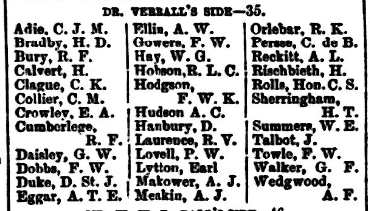
Here he is on ‘Dr Verrall’s Side’, along with another of Mike Fox’s future biographical subjects, Hon. Charles Stewart Rolls (as in Rolls-Royce).
In his student years he had plenty of time to pursue his passions: poetry, mountaineering – and chess.
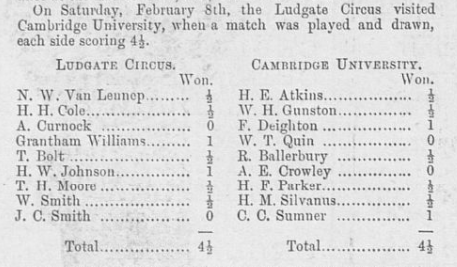
Playing for a university past/present team against Ludgate Circus, he had an illustrious teammate in the great HE Atkins. I’ll tell you more about my connection with Harold Miles Silvanus another time.
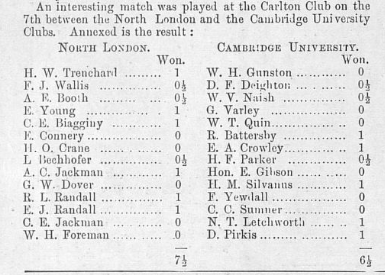
Another of his university teammates, for example in this match, was future Richmond Chess Club secretary Francis Yewdall.
By then it was time for the 24th Varsity match, where Crowley played on board 4 against Harold Northway Robbins.
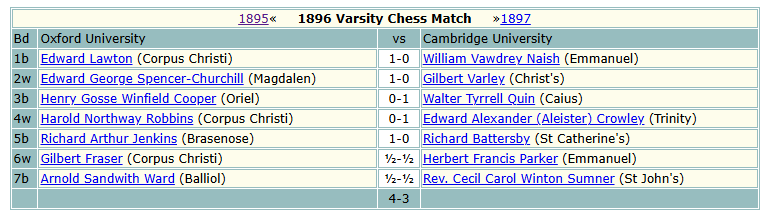
There’s much more information about this match on Britbase here.
Crowley won his game when his opponent exceeded the time limit in a winning position. Black magic?
[Event “24th Oxford – Cambridge Varsity match: B4”]
[Date “1896.03.27”]
[White “Robbins, Harold Northway”]
[Black “Crowley, Aleister”]
[Result “0-1”]
1. e4 e5 2. d4 exd4 3. Qxd4 Nc6 4. Qe3 Nf6 5. Bd2 d6 6. Nc3 Be7 7. h3 O-O 8. O-O-O Nd7 9. g4 Nc5 10. f4 Bf6 11. f5 Bd4 12. Qe1 Bxc3 13. Bxc3 Na4 14. Ne2 Nxc3 15. Nxc3 Ne5 16. Qg3 Bd7 17. h4 f6 18. g5 Bc6 19. Bg2 b5 20. Rhg1 b4 21. Ne2 a5 22. Nf4 Qe7 23. Ne6 Rfc8 24. Bh1 fxg5 25. Qxg5 Qxg5+ 26. Rxg5 g6 27. fxg6 hxg6 28. Nf4 Kh7 29. Rdg1 Rg8 30. h5 Be8 31. Nd5 Rg7 32. Nf4 Bf7 33. hxg6+ Bxg6 34. Nxg6 Rxg6 35. Rxg6 Nxg6 36. e5 Rd8 37. Be4 Rg8 0-1
White had been better throughout: the game might have concluded 38. exd6 cxd6 39. Bxg6! Rxg6 40. Kd2! when White will triumph in the resulting pawn ending.
Robbins, like Crowley, was an author with esoteric tendencies. A solicitor in his day job, he also wrote, under the pseudonym Cassius Minor, a science fiction novel, The Finding of Mercia (1909), a Utopia run by strict Christians in favour of state ownership but not money (source). He was residing in Barnes in the 1939 Register and lived to the great age of 98.
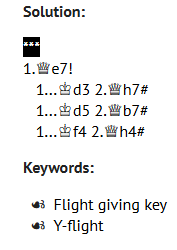
At the end of 1896 Crowley had another problem published (you’ll find the solution at the end of this article).
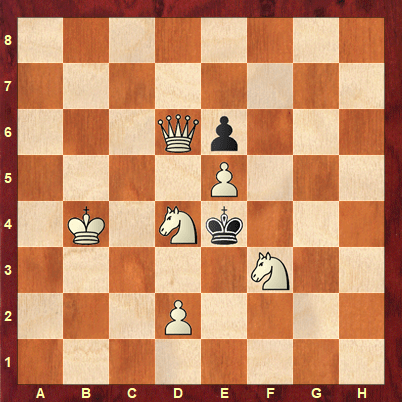
Catholic Gazette 1896
The Catholic Gazette seems to have been a very short-lived publication. There’s no mention of it’s chess column in Tim Harding’s authoritative book British Chess Literature to 1914. This problem was published as by AC of Amsterdam (perhaps he was spending Christmas there), along with a game Crowley – Gunston, so it’s assumed Crowley was the composer. Ot was also published in the British Chess Magazine January 1897, in both cases with a white pawn on f2 rather than d2, allowing Qxe6 as a second solution. This correction, as given here, is by Luke Neyndorff (source).
The university chess season soon came round again, with the charismatic Crowley appointed President of the club.
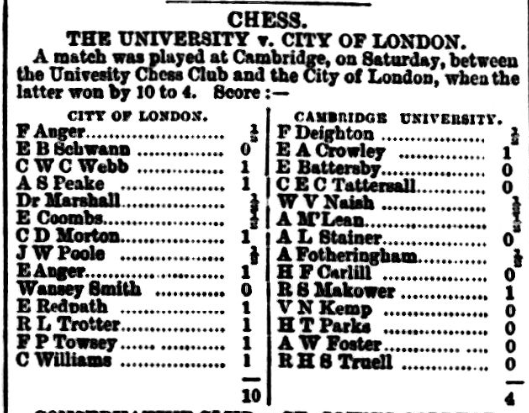
Playing on board 2 in this match, he defeated Rita Fox‘s future fiancé Edward Bagehot Schwann.
It was soon time for the 1897 Varsity match.
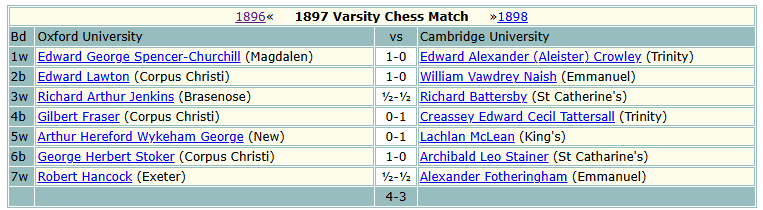
Now on top board, he faced Edward George Spencer-Churchill (the hyphen is optional). His father was a son of the 6th Duke of Marlborough, and the half-brother of the 7th Duke of Marlborough, who was the father of the chess playing Randolph Churchill and the grandfather of the chess playing (as a boy) Winston Churchill.
As always, Britbase will tell you a lot more about the match.
Here’s the game.
[Event “25th Oxford – Cambridge Varsity match: B1”]
[Date “1897.04.02”]
[White “Spencer-Churchill, Edward George”]
[Black “Crowley, Aleister”]
[Result “1-0”]
1. e4 e5 2. Nf3 Nf6 3. Nxe5 d6 4. Nf3 Nxe4 5. d4 d5 6. Bd3 Nc6 7. c3 Bg4 8. h3 Bh5 9. Be3 Bd6 10. Nbd2 f5 11. Nb3 Qe7 12. Qe2 f4 13. Bd2 Bxf3 14. gxf3 Nxd2 15. Qxe7+ Nxe7 16. Kxd2 O-O-O 17. Rae1 Rde8 18. Re6 Nc6 19. Rxe8+ Rxe8 20. Bxh7 b6 21. Rg1 Re7 22. Bg8 Nd8 23. Bxd5 c6 24. Be4 Kc7 25. Kd3 Ne6 26. Nd2 c5 27. d5 Nf8 28. Nc4 b5 29. Nxd6 Kxd6 30. b3 Nd7 31. Rg6+ Kc7 32. d6+ 1-0
Black was doing fine from the opening, but some injudicious exchanges led to the loss of two pawns and, eventually, the game.
And that seemed to be that: the end of his competitive chess career. He stayed on for his third year at Cambridge, but didn’t take his degree.
His Confessions give us a few clues as to what happened.
From Chapter 16:
On this, the son of a church furnisher named Tattersall, who had insinuated himself into Trinity, circulated the rumour that I had been expelled from a London club. He hated me because I, as president of the Cambridge University Chess club, did not see my way to allow him to become secretary. He was an excellent player, but unsuitable for conducting official correspondence with other clubs. I went to his rooms with a heavy malacca and demanded that he should retract his falsehood or fight. He refused to do either, so I thrashed him soundly then and there. He complained to my tutor, who halled me, made a few remarks on the desuetude of the duel, changed the conversation to Ibsen and asked me to dinner.
He was, it appears, expelled from the chess club for assaulting (Creassy Edward) Cecil Tattersall, later renowned as an endgame expert.
And again, from the same chapter:
I was to find very shortly that the most innocent personal relations could be taken by filthy minds as the basis for their malicious imagination. The story of how this came about dominates my third year at the university, as will appear. It seems as if my destiny were preparing me for my appointed {139} work by clearing inessential factors out of the way. My one serious worldly ambition had been to become the champion of the world at chess. I had snatched a game from Blackburne in simultaneous play some years before. I was being beaten in the Sicilian Defence. The only chance was the sacrifice of a rook. I remember the grand old master coming round to my board and cocking his alcoholized eye cunningly at me. “Hullo,” said he, “Morphy come to town again”! I am not coxcomb enough to think that he could not have won the game, even after my brilliancy. I believe that his colossal generosity let me win to encourage a promising youngster.
I had frequently beaten Bird at Simpson’s and when I got to Cambridge I made a savagely intense study of the game. In my second year I was president of the university and had beaten such first-rate amateurs as Gunston and Cole. Outside the master class, Atkins was my only acknowledge superior. I made mincemeat of the man who was champion of Scotland a few years later, even after I had given up the game. I spent over two hours a day in study and more than that in practice. I was assured on all hands that another year would see me a master myself.
I had been to St. Petersburg to learn Russian for the Diplomatic Service in the long vacation of 1897, and on my way back broke the journey in Berlin to attend the Chess Congress. But I had hardly entered the room where the masters were playing when I was seized with what may justly be described as a mystical experience. I seemed to be looking on at the tournament from outside myself. I saw the masters — one, shabby, snuffy and blear-eyed; another, in badly fitting would-be respectable shoddy; a third, a mere parody of humanity, and so on for the rest. These were the people to whose ranks I was seeking admission. “There, but for the grace of God, goes Aleister Crowley,” I exclaimed to myself with disgust, and there and then I registered a vow never to play another serious game of chess. I perceived with praeternatural lucidity that I had not alighted on this planet with the object of playing chess.
Well, there you go. Given his reputation as a fantasist, I’m not sure how much of that one should believe.
Despite his ‘savagely intense study’, he wasn’t all that strong: probably about 2000-2100 rating by the standard of his day, and a long way short of master level. His two varsity games don’t make a very positive impression.
Although he gave up competitive chess in favour of his literary and magical interests, which we won’t discuss here (there’s much available online and elsewhere, of course, if you’re really interested), he retained his interest, playing casually wherever he went.
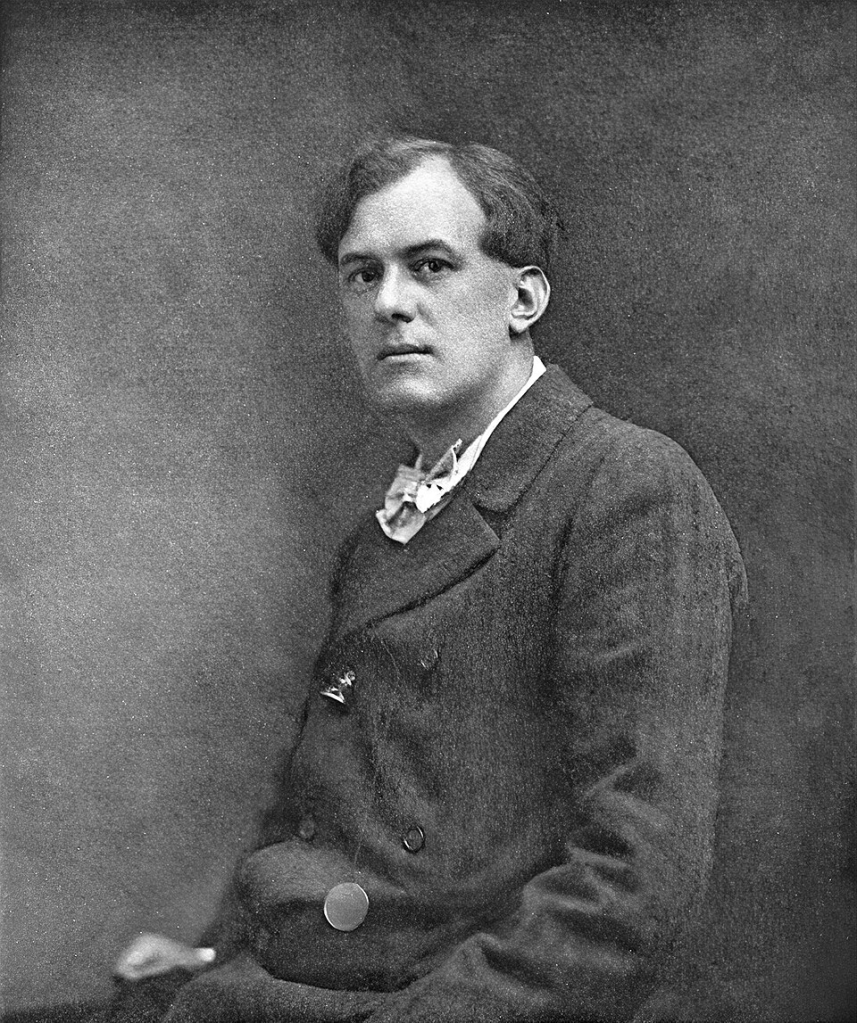
Here he is as a young man.
Jumping forward almost two decades, Crowley spent the years between 1914 and 1919 in the United States. When visiting Washington DC in 1916, he encountered another member of The (Even More) Complete Chess Addict‘s Sinners team, Norman Tweed Whitaker.
They played four games, with Whitaker, a genuine master strength player as well as a genuine sinner, winning them all. One of the scores has survived, suggesting that Crowley was rather out of his depth.
[Event “Casual game: National Press Club, Washington”]
[Date “1916.05.26”]
[White “Crowley, Aleister”]
[Black “Whitaker, Norman Tweed”]
[Result “0-1”]
1. e4 e5 2. Nf3 f5 3. Nxe5 Qf6 4. d4 d6 5. Nf3 fxe4 6. Ng5 d5 7. Nc3 Bb4 8. Be3 Ne7 9. Qd2 O-O 10. a3 Bxc3 11. Qxc3 Nbc6 12. O-O-O h6 13. h4 hxg5 14. hxg5 Qg6 15. Be2 Bf5 16. Rh2 Qe6 17. Rdh1 Ng6 18. f3 Rae8 19. g4 exf3 20. gxf5 Rxf5 21. Bd3 Qxe3+ 22. Kb1 Rxg5 23. Bxg6 Rxg6 24. Qc5 Rg1+ 25. Ka2 Rxh1 26. Rxh1 Qxd4 0-1
Jumping forward again, this time to 1930…
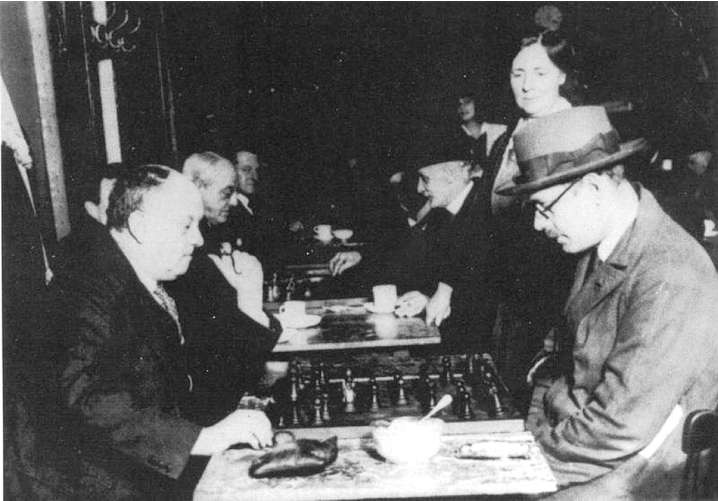
Here’s Crowley, on the left, seated at the chessboard. Some sources claim his opponent is the exiled Portuguese writer Fernando Pessoa, but this is believed to be incorrect. It’s been suggested that he is actually Crowley’s colleague Robert Aloysius Starr.
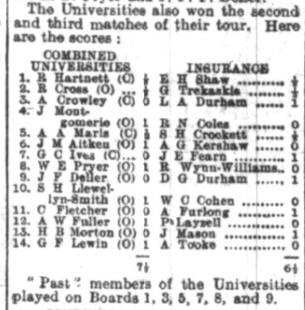
In Germany in 1930-31 he played casually against Jacques Mieses, Paul Johner and Kurt Richter. Moving to London, with no money and in poor health, Crowley rapidly became part of the chess community, playing against Yates, whom he beat twice and drew with once, and Winter, whose wife seduced him. It was here that he returned to competitive chess, playing on third board for a combined Oxford and Cambridge team against the Insurance club. His results from this period suggest that he had maintained much of his previous strength.
In July 1934 Aleister Crowley was found guilty of receiving stolen letters, as you can see from this article published just two days before young Michael Basil Fox’s 1st birthday.
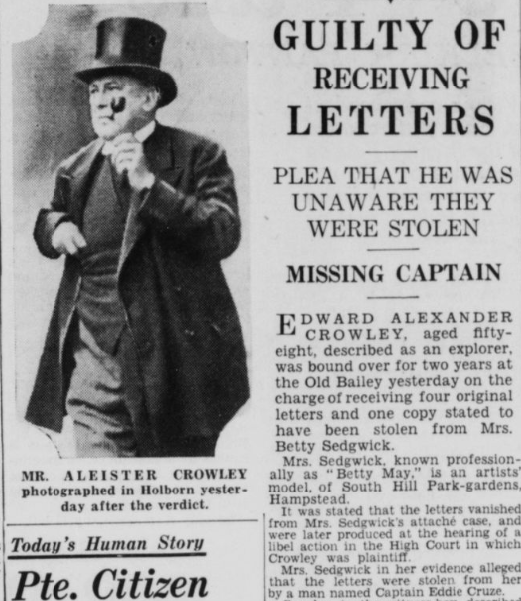
The case was extensively reported in the press at the time. Crowley was given a conditional discharge but ordered to pay a sum not exceeding 50 guineas towards the costs of the prosecution.
This might go some way to explaining this, the ramifications of which would continue until 1992.
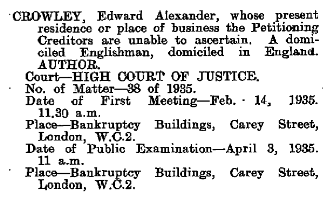
By the end of 1934 Crowley had joined West London Chess Club, playing for them in this London League match.
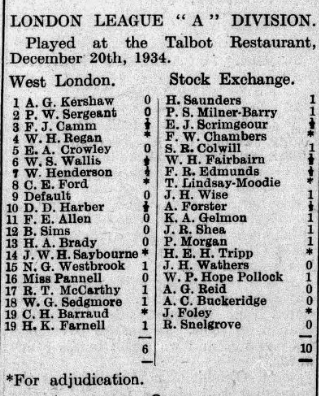
04 January 1935
We have a few of his games from this period. A copy of eight handwritten pages by Crowley on chess has been made available here, transcribed and edited by Robert T Tuohey.
These writings included some advice, which you may or not find helpful:
Knight at R4 is often a strong defensive position.
Knight at R5 is often a strong aggressive position.
But don’t let them be blocked out of the game, or remain idle after the first emergency is past.
Bishops supporting advanced pawns good, but avoid their being blocked by them.
Don’t disperse your forces, or allow your foe to do so.
Every piece should be employed for attack and defense simultaneously, at least when an attack is well started. To use a piece for one purpose only is to halve its value.
Keep at least one smaller piece, besides the rook and the unbroken pawns, to guard the king when the main conflict is elsewhere. (This, of course, early in the game.)
Be always watchful for sacrificial BxP or BxP check, especially if there is a file open for your knight.
Rooks are like heavy artillery; most powerful at long range. They are easily shut out, or boxed up. They are at the mercy of attacking minor pieces and pawns; their only resource is to move out of danger, and they are clumsy to handle. “Give them air!”
There are also five games, three of which we can identify as being from London League games from early 1935.
This match was played on 24 January.
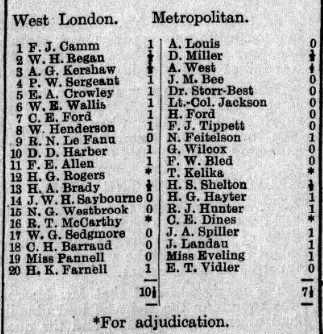
01 February 1935
His opponent, Dr Lloyd Storr-Best, seems to follow me everywhere. I must write about his chess playing family at some point.
The game must be this one, in which he gave his opponent’s name as Lloyd.
[Event “West London v Metropolitan LL B5”]
[Date “1935.01.24”]
[White “Storr-Best, Lloyd”]
[Black “Crowley, Aleister”]
[Result “0-1”]
1. e4 Nf6 2. Nc3 d5 3. e5 d4 4. exf6 dxc3 5. bxc3 gxf6 6. Ne2 e5 7. Bb2 Bf5 8. Ng3 Bg6 9. Be2 Nc6 10. O-O Qd7 11. Bf3 O-O-O 12. d3 f5 13. Qe2 Re8 14. Rfe1 Bg7 15. Nh5 f6 16. Rab1 e4 17. Nxg7 exf3 18. Qxe8+ Bxe8 19. Ne6 Ne5 20. Nc5 Qg7 21. g3 Qg4 22. Ne6 h5 23. Nf4 Rg8 24. h3 Qxf4 25. Kh2 Qd2 26. Rf1 h4 27. g4 fxg4 28. d4 g3+ 0-1
The next match was against Hampstead.
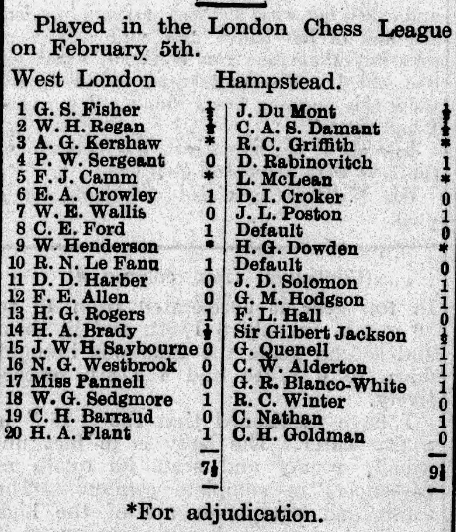
Again, we have the game.
[Event “West London v Hampstead LL B6”]
[Date “1935.02.05”]
[White “Crowley, Aleister”]
[Black “Croker, Douglas Ian”]
[Result “1-0”]
1. c4 e5 2. Nc3 Nf6 3. g3 Bc5 4. Bg2 Nc6 5. Nf3 e4 6. Nh4 g5 7. Nf5 d6 8. Ne3 Qe7 9. Ned5 Nxd5 10. cxd5 Ne5 11. Nxe4 f5 12. Nxc5 dxc5 13. d4 Nf7 14. dxc5 Qxc5 15. O-O Qd6 16. Qd4 Rg8 17. f4 c5 18. Qe3+ Kd8 19. b3 Bd7 20. Bb2 Re8 21. Qd3 Qb6 22. Rf2 gxf4 23. gxf4 Nh6 24. h3 Bb5 25. Qd2 Kd7 26. Be5 Rg8 27. a4 Ba6 28. Qc3 Rac8 29. Rc1 Qg6 30. Qe3 Qh5 31. Rxc5 Qh4 32. Rxc8 Rxc8 33. b4 b6 34. b5 Bb7 35. a5 Rg8 36. Qd4 Rg3 37. Bf6 Qxh3 38. Bg5 Nf7 39. axb6 axb6 40. e4 Nxg5 41. Qg7+ Kc8 42. Rc2+ Kd8 43. Qc7+ Ke8 44. Qb8+ Kf7 45. Qxb7+ Kg6 46. Qxb6+ Kh5 47. fxg5 1-0
In this match he was also successful.
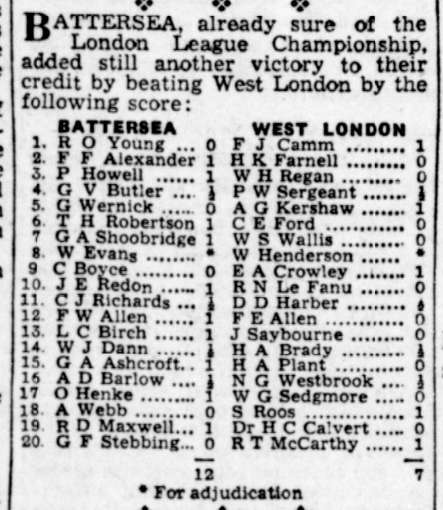
You’ll see he was one board away from playing my old friend Jack Redon.
Again, we appear to have the game.
[Event “West London v Battersea LL B9”]
[Date “1935.04.??”]
[White “Crowley, Aleister”]
[Black “Boyce, Charles”]
[Result “1-0”]
1. c4 d5 2. cxd5 Qxd5 3. Nc3 Qd8 4. d4 e6 5. e4 Bb4 6. Nf3 Nf6 7. Bd3 Nc6 8. O-O O-O 9. Bc2 Qe7 10. e5 Ne8 11. Bxh7+ Kh8 12. Bc2 g6 13. Bh6 Rg8 14. Ne4 f5 15. exf6 Qh7 16. Nfg5 Qd7 17. f7 Rf8 18. Bxf8 Bxf8 19. fxe8=Q Qxe8 20. Qf3 Nxd4 21. Qh3+ 1-0
There are two plausible men named C Boyce in the Battersea area in the 1939 Register, both of whom were Charles Boyce.
I haven’t been able to find out any more about the other two games, but they were probably played in West London’s London League matches in early 1935.
[Event “?”]
[Date “1935.??.??”]
[White “Brown”]
[Black “Crowley, Aleister”]
[Result “1/2-1/2”]
1. e4 Nf6 2. Nc3 d5 3. exd5 Nxd5 4. Ne4 Bf5 5. d3 e6 6. Nf3 h6 7. Be2 Nd7 8. O-O N7f6 9. Ng3 Bh7 10. Ne5 Bd6 11. f4 c6 12. c3 Qc7 13. d4 O-O 14. c4 Ne7 15. c5 Bxe5 16. fxe5 Ne4 17. Nh5 Rad8 18. Bf3 Nxc5 19. Bxh6 Nf5 20. Bxg7 Rxd4 21. Qc2 Nd3 22. Bxf8 Qxe5 23. Qe2 Kxf8 24. Qxe5 Nxe5 25. Nf6 Bg6 26. Be2 Rd2 27. Rae1 Ne3 28. Rf2 Rxb2 29. Bf1 Rxf2 30. Kxf2 Nxf1 31. Rxe5 Nxh2 32. Ke1 Ke7 33. Ng8+ Kd6 34. Ra5 Ng4 35. Rxa7 b5 36. Ne7 Bh5 37. Nc8+ Kd5 38. Rd7+ Kc5 39. Rd2 Ne3 40. Nd6 Bg6 41. Kf2 Nc4 42. Nb7+ Kb4 43. Rd8 Be4 44. Rf8 f5 45. Nd8 Bd5 46. Nf7 Nd2 47. Ne5 Ne4+ 48. Ke3 c5 49. Nd3+ Ka3 50. Rb8 c4 51. Nf4 Nf6 1/2-1/2
No result was given but the final position is drawn.
There were several London League players named Brown at the time. E Brown played for North London, HV Brown played for Athenaeum, HR Brown for Brixton
Finally, this game presents a mystery.
[Date “1935.??.??”]
[White “Crowley, Aleister”]
[Black “?”]
[Result “1-0”]
1. d4 Nf6 2. c4 e6 3. Bg5 d5 4. e3 Be7 5. Nd2 O-O 6. Bd3 Nbd7 7. f3 h6 8. Bh4 a6 9. Ne2 dxc4 10. Nxc4 b5 11. Nd2 c5 12. Bf2 c4 13. Bc2 e5 14. O-O Bb7 15. b3 Nb6 16. Re1 c3 17. Nxc3 exd4 18. exd4 Rc8 19. Nde4 Bb4 20. Qd3 Nbd5 21. Nc5 g6 22. Nxb7 Qc7 23. Nc5 1-0
After 23. Nc5 Black is better, but 23. Nxd5 Nxd5 24. Nc5 is winning for White.
A few years ago a collection of chess-related Crowley material was sold, perhaps to a private collector. This included four scoresheets, one of which can be dated to December 1935, as well as handwritten scores of two wins and a draw in friendly games against Fred Yates, which would have been from several years earlier.
You can find more information here.
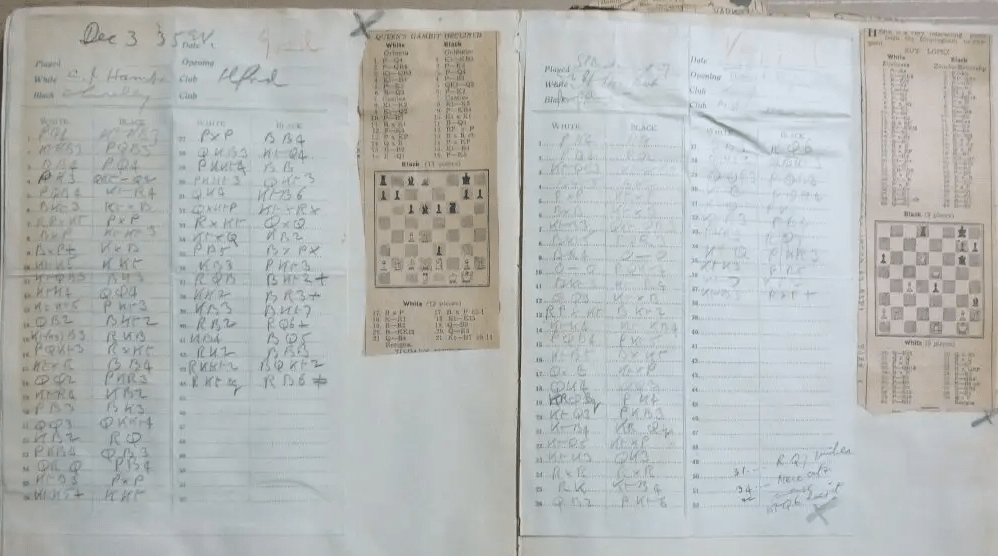
The game on the left can be identified as a win with Black from this match.
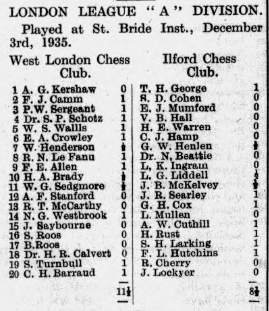
13 December 1935
Would anyone like to have a go at deciphering it? Or, even better, does anyone know who the purchaser was?
I can make nothing of the game on the right.
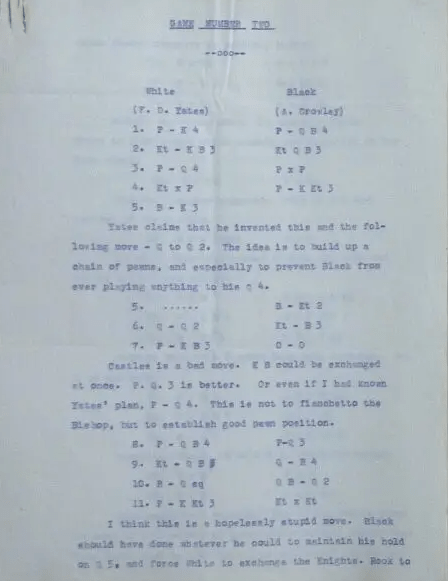
Here we have the opening of one of his games against Yates (‘hopelessly stupid’), which must have been played several years earlier, in 1932.
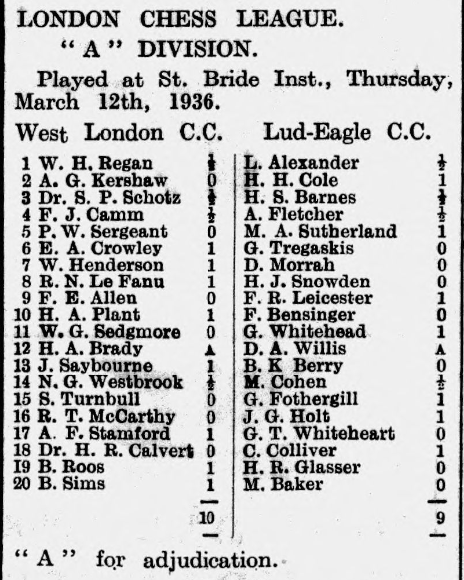
Moving on to 1936, in a closely fought match against Lud-Eagle, Crowley scored a vital point for his team by defeating George Tregaskis.
He continued playing regularly for West London into the 1937-38 season. His team were crushed by a very strong Hampstead squad in this match, but Crowley managed to draw his game.
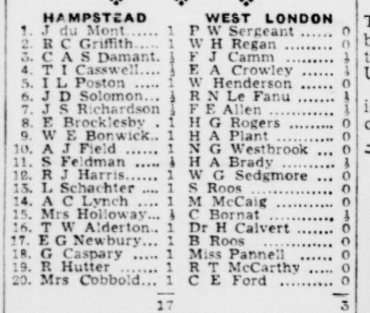
I drew with Thomas Ivor Casswell (1902-1989) in a Richmond v Hampstead London League match in 1974, giving me an Aleister Crowley number of 2. Casswell was awarded a CBE in the 1967 New Year Honours List for his role as Senior Land Registrar in the Lord Chancellor’s Department.
The last game I’ve been able to find in which Crowley played for West London was in February 1938. Perhaps he fell out with them.
In November 1939 the opening of the tragically shorr-lived National Chess Centre occasioned this verse about Vera Menchik, about whom no one else ever had a bad word to say:
“Stop! Look! & listen! ere you enter
the grand new National Chess Centre.
For there you will find as manag’ress
The most unGodly cow in chess.”
In September 1940 he moved to Torquay, but wasn’t impressed with the chess club. There is now no real opposition to me in the club but then lost the last game through culmination of rage at the dotard babblings of the unsoaped sub-simian non-player at the next table. I’m sure they weren’t impressed with him either.
He returned to London in the summer of 1941, and then, in 1945, made his final move, to a boarding house near Hastings. Joining the chess club there he encountered an infant horror, a fussy little ass, a Queer Old Bird, a super-dud, and a “snailish dud” along with the “ghastly jabber of dud idiots”
We have results for a couple of club matches, and finally this match, in which he bowed out with a win.
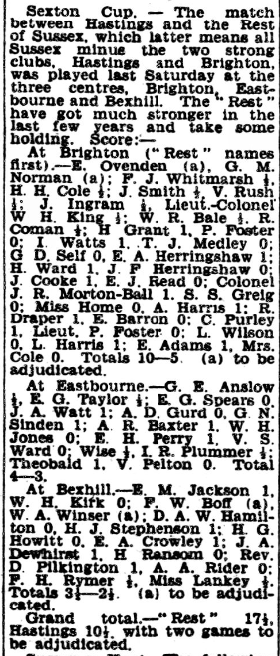
18 May 1946
His last recorded visit to the club was on 22 November that year, and he died just over a year later, on 1 December 1947, at the age of 72. His effects were valued at just £18 0s 6d.

The executors were friends and associates: Frieda Harris is here and Louis Wilkinson here.
More than two decades later, there was a final probate record, taking into account his literary works.

How should we assess Crowley today? He comes across as a charismatic but unpleasant man with an addictive personality. Today, he might be diagnosed with with all sorts of things, and he certainly had a collection of what would be described in some circles as Cluster B Personality Disorders, perhaps caused in part by his abusive childhood.
With his addictions to sex and drugs he fitted into the 1960s counter-culture, appearing on the cover of the Beatles’ Sgt Pepper album. By the 1980s he had become a figure of fun: we felt able to laugh at him in The (Even More) Complete Chess Addict. Now, through a 2020s lens, we might see him more as a tragic figure, narcissistic, deluded, obsessive, living in poverty and poor health for the last 14 years or so of his life. Returning to competitive chess at this time must have brought him, but maybe not his opponents, some happiness.
These articles have attempted to paint as full as possible a picture of his competitive chess career, using information from a variety of different sources. There may still be a lot more information out there in archives or private collections. The game against Gunston published in the Catholic Gazette might come to light at some point, and the papers documenting some of his later games, along with his 1932 games against Yates are out there somewhere.
If you have any more information I’d love to know.
Join me again soon to meet his equally unsavoury contemporary Harold Francis Davidson.
Sources and Acknowledgements:
There have been two important articles about Crowley’s chess career: by Robert T Tuohey and by Chris Ravilious, which first appeared in CHESS (December 1997). You can find them combined on the Hastings & St Leonards Chess Club website here. There’s also more from Tuohey here.
ancestry.co.uk
findmypast.co.uk/British Newspaper Archives
Wikipedia (Crowley here)
chessgames.com (Crowley here)
yacpdb.org (Yet Another Chess Problem DataBase: Crowley here)
Hastings & St Leonards Chess Club website
Problem Solution (pasted from yacpdb.org)

 Minor Pieces
Leave a comment