Here’s young Charles Masson Fox at home with his family in 1871.
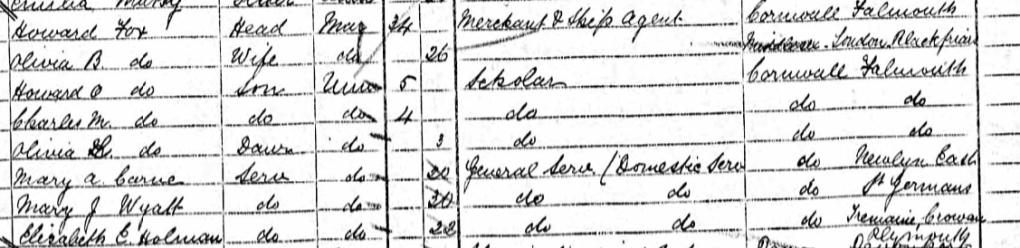
You might want to admire his father Howard’s bespoke shoes. Perhaps they were custom made by a local cordwainer: a skilled craftsman producing leather footwear for the gentry, for families like the Foxes who would have been well known throughout the community.
I’d like to think they might have been made by George Barnes, a cordwainer from the village of Mawnan Smith, a few miles to the south. If you walked there from Rosehill, where CM Fox spent his final years, you’d pass Penjerrick, another Fox Garden, and continuing beyond the village a short distance towards the coast you’d reach Glendurgan and Trebah Gardens.

Here they are, also in 1871. George and Elizabeth had four sons: only the third, George Junior, was still at home, working for the Post Office. The youngest son, Matthew, was similarly employed, both both would disappear from UK records after 1881. Perhaps they emigrated.
Their oldest son, Stephen, was the only one for whom we have marriage records. He married and moved to Portsmouth, where he worked as a brewer’s agent, later running a pub.
Their second son, Robert Henry Barnes, born on 2 October 1849, was, unlike the rest of his family, academically inclined.
The 1871 census found the 21 year old Robert inland, in Launceston, working as an assistant master at Horwell’s Endowed School. It seems that he was a teacher of modern languages, a subject which this school promoted strongly (along with Mensuration of Superfices, Stones, Haystacks &c.).
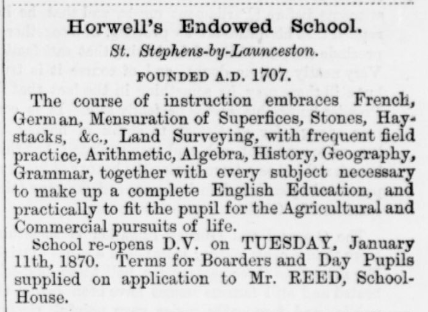
01 January 1870
The Cornish economy was struggling in the latter half of the 19th century, and many young men made the choice to emigrate. The declining tin and copper mining industry encouraged many to move abroad, working in the mines of America, Australia, South Africa and elsewhere. Show of Hands’ iconic song Cousin Jack describes this well. According to Wikipedia, ‘it is estimated that 250,000 Cornish migrated abroad between 1841 and 1901’. Others would move elsewhere in England, sometimes changing their occupation, like Peter Shenele, the chess playing copper miner who became a copper.
Robert Henry Barnes was one of those who migrated abroad, but probably for cultural and social rather than economic reasons. At some point in the late 1870s he left Cornwall, moving to Germany. JF Kennedy famously claimed to be a Berliner. Johannes Brahms was a Hamburger. Robert Henry Barnes became a Frankfurter.
Frankfurt was then, as now, a centre of education and culture, and, as a young man who enjoyed and taught modern languages, a move from the cultural backwater of Cornwall must have seemed an attractive challenge.
He was also, as you might have guessed, a chess player. In the days before Charles Masson Fox and his friends founded a chess club in Falmouth, he would have had no local opportunity to practise his favourite game competitively.
Chess in Germany was becoming well organised: the Deutscher Schachbund (German Chess Federation) was founded in 1877, ab0ut the time when Barnes emigrated. The first national championship had taken place back in 1861. Frankfurt was the venue of the 12th West German Chess Congress in 1878: Barnes didn’t take part, but perhaps he visited as a spectator, where he would have witnessed Louis Paulsen scoring 8/9, half a point ahead of Adolf Schwarz, with Anderssen way back in 3rd place on 6/9. There would also have been coffee houses there, where chess enthusiasts like Robert could enjoy a game over a cup of coffee and a cigar.
In July 1884 the 3rd South West German Congress took place in Frankfurt, and it was here that Barnes made his tournament debut.
His participation suggests that he was already recognised as a strong player.
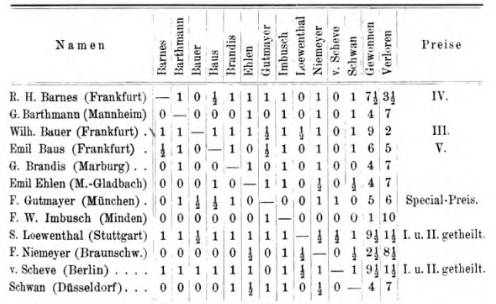
Of the joint winners, Loewenthal had shared 2nd place, just behind Tarrasch, in the previous year’s German championship, while von Scheve was also a recognised master. Although losing to the top three players, Barnes was remorseless against the lesser lights. He was clearly, even with so little experience, clearly close to master standard.
In this game he broke through on the kingside after his opponent erroneously closed the position on move 22.
[Event “3rd Southwest German Congress Frankfurt: 1st Hauptturnier”]
[Date “1884.07.13”]
[White “Barthmann, G”]
[Black “Barnes, Robert Henry”]
[Result “0-1”]
[Source “Frankfurter Schachzeitung, 1884.08.02”]
1. e4 e6 2. d4 d5 3. exd5 exd5 4. Nf3 Nf6 5. Bd3 Bd6 6. O-O O-O 7. c3 Re8 8. Bg5 Nbd7 9. Qc2 Nf8 10. Nbd2 Be6 11. Ne5 h6 12. Bh4 g5 13. Bg3 Nh5 14. f4 Nxg3 15. hxg3 f6 16. Ng6 Kg7 17. Nf3 Bf7 18. Nxf8 Rxf8 19. Qd2 c6 20. Kf2 Bg6 21. Rh1 Rh8 22. f5 Bf7 23. g4 Qc7 24. Rh3 Bf4 25. Qc2 h5 26. Rah1 hxg4 27. Rxh8 Rxh8 28. Rxh8 Kxh8 29. Nd2 Qe7 30. Nf1 g3+ 31. Kg1 Be3+ 32. Kh1 Bf2 33. Qe2 Qf8 34. Qg4 Qh6+ 35. Qh3 Kg7 36. Be2 Qh4 37. Nd2 Qf4 38. Nf1 Qc1 39. Qg4 Qxb2 40. Nxg3 Bxg3 41. Qxg3 Qxe2 42. Qc7 Qf1+ 43. Kh2 Qf4+ 0-1
This game followed an Anderssen game from a few years previously up to move 16. White’s 20th move generously donated the e5 square to a black knight.
[Event “3rd Southwest German Congress Frankfurt: 1st Hauptturnier”]
[Date “1884.07.15”]
[White “Niemeyer, Friedrich”]
[Black “Barnes, Robert Henry”]
[Result “0-1”]
[Source “Frankfurter Schachzeitung, 1884.08.02”]
1. e4 e5 2. Nf3 Nc6 3. Bc4 Bc5 4. b4 Bxb4 5. c3 Bc5 6. O-O d6 7. d4 exd4 8. cxd4 Bb6 9. d5 Na5 10. Bb2 Ne7 11. Bd3 O-O 12. Nc3 Ng6 13. Ne2 c5 14. Qd2 Bd7 15. Ng3 f6 16. Rac1 Bc7 17. Ne1 c4 18. Be2 b5 19. Nc2 Nb7 20. f4 Nc5 21. f5 Ne5 22. Nd4 Ncd3 23. Bxd3 Nxd3 24. Ne6 Bxe6 25. fxe6 Ba5 26. Qe2 Nxc1 27. Qg4 Ne2+ 28. Nxe2 g6 29. Ng3 Kh8 30. Bc1 Bc3 31. Ne2 Be5 32. Rf3 Rc8 33. Rh3 Qe8 34. Bh6 Rg8 35. Bd2 Rg7 36. Bh6 Re7 37. Nf4 c3 38. Nd3 c2 39. Bc1 Bd4+ 40. Kf1 a5 41. Qf4 Be5 42. Nxe5 fxe5 43. Qf6+ Kg8 0-1
In this defeat he was holding until his 35th move, Qg2 (either Rc3 was equal) which lost the vital d-pawn.
[Event “3rd Southwest German Congress Frankfurt: 1st Hauptturnier”]
[Date “1884.07.18”]
[White “Barnes, Robert Henry”]
[Black “von Scheve, Theodor”]
[Result “0-1”]
[Source “Frankfurter Schachzeitung, 1884.08.02”]
1. e4 e6 2. d4 d5 3. exd5 exd5 4. Nf3 Nf6 5. Bd3 Bd6 6. O-O O-O 7. Bg5 Be6 8. Ne5 c5 9. c3 Nc6 10. f4 cxd4 11. cxd4 h6 12. Nxc6 bxc6 13. Bh4 Qb6 14. Kh1 Ng4 15. Qd2 f5 16. h3 Nf6 17. Bxf6 Rxf6 18. Be2 Rb8 19. b3 Re8 20. Nc3 Bc8 21. Na4 Qc7 22. Bf3 Kh7 23. g3 Rg8 24. Rac1 Rd8 25. Nc5 h5 26. h4 Bxc5 27. Rxc5 Qf7 28. Rfc1 Rdd6 29. Qd1 Kh6 30. Kh2 g6 31. Qh1 Ba6 32. Qd1 Qe7 33. Qd2 Rfe6 34. R1c2 Re3 35. Qg2 Qf6 36. Rd2 Bd3 37. Rc1 Qxd4 38. Rcd1 Qc3 39. Qf2 Rde6 40. Kg1 Be4 41. Bxe4 fxe4 42. Kh2 Rf3 43. Qg2 Rd3 44. Rc2 Qd4 45. Re1 e3 46. Rce2 Rd2 47. Rxd2 Qxd2 48. Qxd2 exd2 49. Rd1 Re2+ 50. Kh3 c5 51. g4 c4 52. g5+ Kg7 53. Kg3 c3 0-1
Here’s a casual game played in 1885.
[Event “Casual Game: Frankfurt Chess Club”]
[Date “1885.??.??”]
[White “Barnes, Robert Henry”]
[Black “NN”]
[Result “1-0”]
[Source “Chess Monthly via Frankfurter Schachzeitung 1885”]
1. e4 e5 2. Nf3 Nc6 3. Bc4 Bc5 4. b4 Bb6 5. a4 a6 6. a5 Ba7 7. b5 axb5 8. Bxb5 Qe7 9. Nc3 Nf6 10. d3 Qc5 11. Qd2 Nd4 12. Ba3 Nxf3+ 13. gxf3 Qd4 14. O-O c5 15. Bc4 Qd6 16. f4 Nh5 17. fxe5 Qxe5 18. f4 Qf6 19. f5 Qh4 20. Nd5 O-O 21. Bb2 Bb8 22. Rf2 Kh8 23. f6 g6 24. Qh6 Re8 25. Ne7 Rg8 26. Nxg8 Bf4 27. Qf8 Bxh2+ 28. Rxh2 Qg3+ 29. Rg2 Qe3+ 30. Kf1 Qf3+ 31. Ke1 Qe3+ 32. Kd1 Qf3+ 33. Re2 Qf1+ 34. Re1 Qf3+ 35. Kc1 Qf4+ 36. Kb1 h6 {White mates in 2 moves (with Ne7+ and Qg8#)} 1-0
In 1887 Frankfurt hosted a major international tournament, one of the strongest yet held, with Mackenzie taking first place ahead of Weiss and Blackburne. You’ll find some puzzles taken from games played in this event in Chess Heroes: Puzzles Book 2.
There was also a Hauptturnier (Major Tournament) run in two parallel sections: Barnes took part in Section A, with the following result.
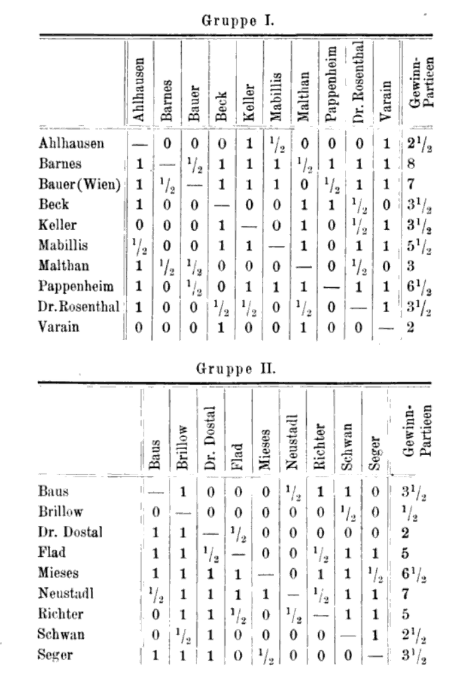
You’ll see that he won his section, but in the final pool, featuring the top three from each group, he was less successful, only scoring 1/5.
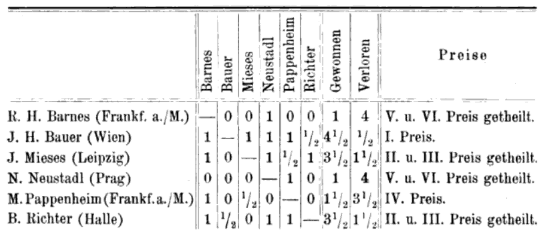
His loss to Mieses here gives me a Barnes Number of 3 (I played Barden, who played Mieses, who played Barnes, along with almost everyone else from Bird onwards).
In the first round of the finals he lost a flawed brilliancy against Bernhard Richter.
White’s 10th move was misguided and his 11th move disastrous. Black should have simply recaptured on move 13, instead of offering his queen. Now 14. Nxd8 would have lost to Bxf2+, but 14. Nxc5 instead would have kept him in the game.
[Event “DSB Kongress-05 B Final Pool Frankfurt”]
[Date “1887.07.25”]
[Round “1”]
[White “Barnes, Robert Henry”]
[Black “Richter, Bernhard”]
[Result “0-1”]
[Source “ChessBase”]
1. e4 e5 2. Nf3 Nc6 3. Bb5 a6 4. Ba4 Nf6 5. O-O Nxe4 6. d4 b5 7. Bb3 d5 8. dxe5 Be6 9. c3 Bc5 10. Bf4 g5 11. Bg3 h5 12. Nd4 h4 13. Nxe6 hxg3 14. Nd4 gxf2+ 15. Rxf2 Nxf2 16. Kxf2 g4 17. Qd3 Rxh2 18. Nd2 Qg5 19. Nf1 Qf4+ 20. Kg1 Rh5 21. Ng3 Rxe5 22. Rf1 Qg5 23. Bc2 Re3 24. Qd2 Qe5 25. Nh5 O-O-O 26. Nf4 Rh8 27. Bd3 Bxd4 28. cxd4 Qxd4 29. Rf2 g3 0-1
At this point, Rod Edwards in EdoChess gives Barnes a retrospective rating of 2455, placing him 39th in the world. Pretty good for the cordwainer’s son from the far corner of England.
Now, he took a break from competitive chess, only returning in 1894, when he travelled to Leipzig for the 9th DSB Congress. The master section was a triumph for Tarrasch, ahead of Lipke and Teichmann. Barnes was again playing in Hauptturnier A.
There were four groups of six players each, with the top two from each qualifying for the final pool.
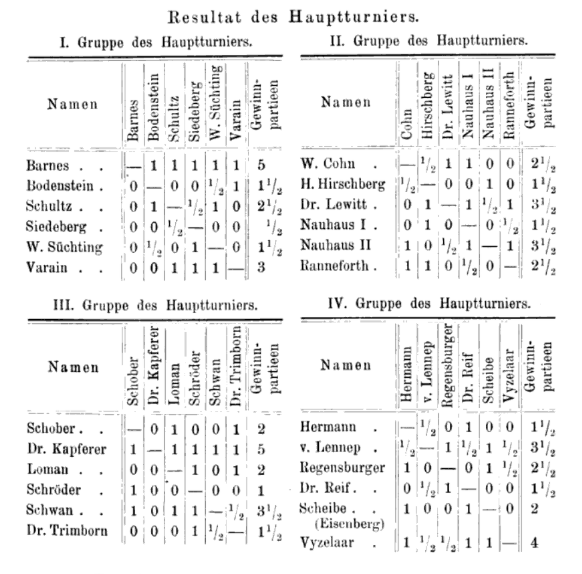
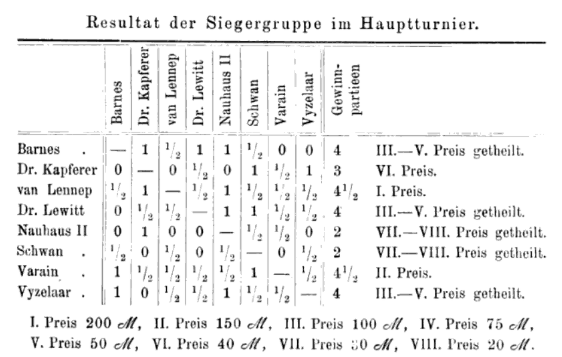
Barnes made a clean sweep in his section, and this time shared third place in the final.
He beat Nauhaus in only 12 moves using Legal’s mate.
[Event “DSB Kongress-09 Leipzig HT Siegergruppe”]
[Date “1894.09.??”]
[Round “5”]
[White “Barnes, Robert Henry”]
[Black “Nauhaus, Max”]
[Result “1-0”]
[Source “ChessBase/BCM 1894”]
1. e4 e5 2. Nf3 Nc6 3. Bb5 a6 4. Ba4 d6 5. d4 Bd7 6. Nc3 Nf6 7. Bb3 Bg4 8. dxe5 Nxe5 9. Bf4 Nfd7 10. Nxe5 Bxd1 11. Bxf7+ Ke7 12. Nd5# {BCM 1894, 410} 1-0
The ill-fated Dutchman Norman van Lennep, you’ll notice, won the play-off.
In 1896, Robert Henry Barnes again travelled to what would later become East Germany, this time to Eisenach, best known, at least to me, as the birthplace of Johann Sebastian Bach. This was the venue for the 10th DSB Congress, and this time he was placed in the Master section, although, to be fair, it wasn’t the strongest of renewals.
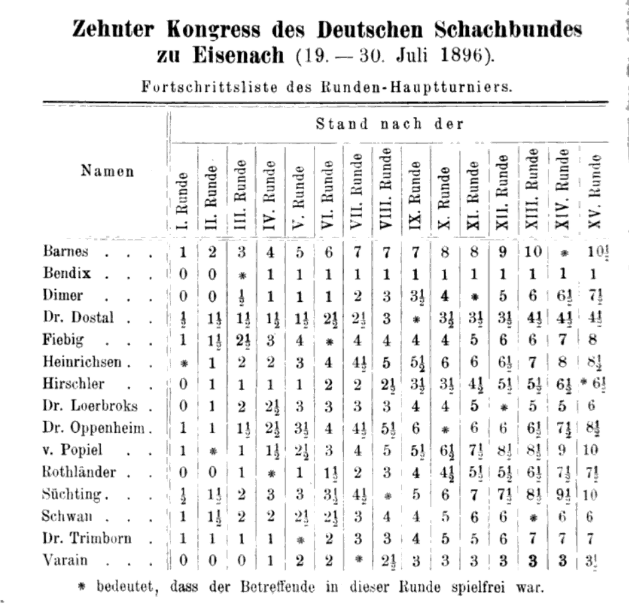
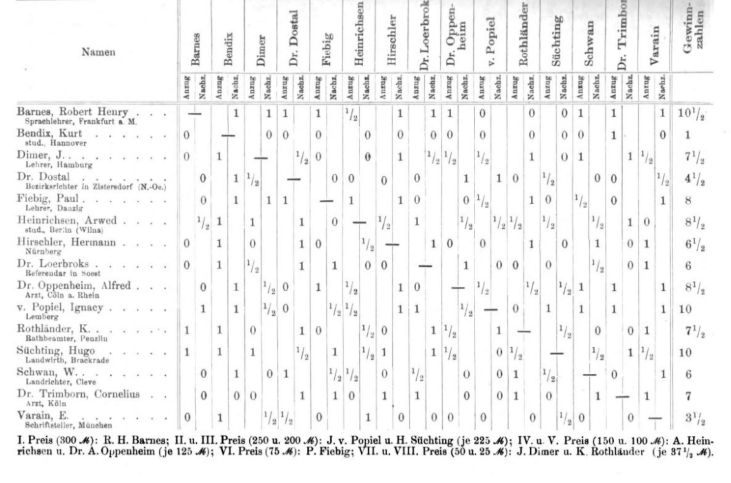
At least eight of his games, six wins and two defeats, were published.
Here, his opponent played a passive opening followed by an attempted fishing pole style attack, which really wasn’t a good idea.
[Event “DSB Kongress-10 Eisenach: Hauptturnier”]
[Date “1896.07.??”]
[White “Barnes, Robert Henry”]
[Black “Dostal, Karl”]
[Result “1-0”]
[Source “ChessBase”]
1. e4 e6 2. d4 d5 3. Nc3 Nf6 4. Bd3 dxe4 5. Nxe4 Nxe4 6. Bxe4 c6 7. Nf3 Nd7 8. O-O Nf6 9. Bd3 Bd6 10. c3 h6 11. Bc2 Bc7 12. Qe2 Ng4 13. h3 h5 14. Re1 Qd6 15. Ne5 f6 16. hxg4 fxe5 17. dxe5 Qe7 18. Bg6+ Kf8 19. Qf3+ Kg8 20. Bg5 hxg4 21. Qxg4 Qf8 22. Re3 Bb6 23. Rf3 Bxf2+ 24. Rxf2 Rh1+ 25. Kxh1 Qxf2 26. Qh5 1-0
A long game in which Barnes slowly exploited a space advantage in impressive style.
[Event “DSB Kongress-10 Eisenach: Hauptturnier”]
[Date “1896.07.??”]
[White “Barnes, Robert Henry”]
[Black “Oppenheim, Alfred”]
[Result “1-0”]
[Source “ChessBase”]
1. e4 e5 2. Nf3 Nc6 3. Bb5 Nf6 4. d3 Bc5 5. c3 O-O 6. Bg5 d6 7. Nbd2 a6 8. Ba4 b5 9. Bc2 Qe7 10. Qe2 Nd8 11. d4 Ba7 12. O-O Ne6 13. Be3 Nd7 14. a4 c6 15. Rfd1 Bb7 16. Nf1 g6 17. Qd2 Rfd8 18. Ng3 Kh8 19. Kh1 f6 20. axb5 cxb5 21. Bb3 Nb6 22. d5 Ng7 23. Qe2 Rdc8 24. Nd2 Qd7 25. f4 Rf8 26. Rf1 Qe7 27. f5 Nd7 28. Bh6 Rf7 29. Qg4 Nf8 30. Bc2 Bc8 31. Qf3 Bb6 32. Bd3 Bd7 33. Qe2 Qe8 34. c4 b4 35. b3 a5 36. Be3 Qb8 37. Ra2 Qc7 38. Rfa1 Bxe3 39. Qxe3 g5 40. Nf3 Be8 41. Ne1 Nd7 42. Bc2 Nc5 43. Nd3 Nxd3 44. Bxd3 Kg8 45. Bc2 Rf8 46. Ne2 Bf7 47. Nc1 Rfb8 48. Nd3 Ne8 49. c5 Rb5 50. c6 Kf8 51. Nb2 Ke7 52. Na4 h5 53. Bd3 Rbb8 54. Nb2 Ra7 55. Nc4 Rba8 56. Qb6 Kd8 57. Be2 h4 58. h3 Ng7 59. Qe3 Bh5 60. Bd3 Bf7 61. Nb6 Nh5 62. Nxa8 Rxa8 63. Bb5 Ng3+ 64. Kh2 Bh5 65. Ra4 Qb8 66. Rxa5 Rxa5 67. Rxa5 Qxb5 68. Ra8+ 1-0
This was a nice kingside attack against an opponent who played the opening too passively.
[Event “DSB Kongress-10 Eisenach: Hauptturnier”]
[Date “1896.07.??”]
[White “Barnes, Robert Henry”]
[Black “Schwan, Wilhelm”]
[Result “1-0”]
[Source “ChessBase”]
1. e4 e5 2. Nf3 Nc6 3. Bb5 d6 4. d4 exd4 5. Nxd4 Bd7 6. Nc3 Nf6 7. Bf4 Ne5 8. Bxd7+ Qxd7 9. f3 Be7 10. Qe2 Ng6 11. Be3 O-O 12. g4 c6 13. O-O-O Qc7 14. Nf5 Rfd8 15. h4 d5 16. h5 Ne5 17. g5 Ne8 18. exd5 Bb4 19. Bd4 Nd7 20. Kb1 Nb6 21. g6 cxd5 22. gxh7+ Kxh7 23. Rdg1 Bf8 24. Qd2 Nc8 25. Bxg7 Rd6 26. Nxd6 1-0
Another impressive performance here, sacrificing an exchange for long-term kingside pressure.
[Event “DSB Kongress-10 Eisenach: Hauptturnier”]
[Date “1896.07.??”]
[White “Dimer, Julius”]
[Black “Barnes, Robert Henry”]
[Result “0-1”]
[Source “ChessBase”]
1. e4 e5 2. Nf3 Nf6 3. d4 Nxe4 4. Bd3 d5 5. dxe5 Be7 6. O-O Nc5 7. Nc3 Ne6 8. Ne2 Nc6 9. c3 h6 10. Qc2 Ng5 11. Bxg5 hxg5 12. Ng3 Be6 13. Rfe1 Qd7 14. Nd4 Nxd4 15. cxd4 g6 16. Rac1 c6 17. Ne2 O-O-O 18. Qa4 Kb8 19. b4 Bf5 20. Bxf5 gxf5 21. Qb3 f4 22. Rb1 Rh6 23. h3 Rdh8 24. Kf1 Qf5 25. Qf3 Rxh3 26. gxh3 Rxh3 27. Ng3 Qh7 28. Kg1 fxg3 29. fxg3 Rh2 30. Rbd1 Qc2 31. Rc1 Qxa2 32. Ra1 Qc2 33. Rac1 Qh7 34. Re2 Rh6 35. b5 g4 36. Qg2 Bg5 37. Rce1 Qd3 38. bxc6 bxc6 39. Qf2 Rh3 40. Kg2 Qh7 41. Rb2+ Kc8 0-1
He was on the wrong side of this game, where he failed to find a defence to his opponent’s kingside attack.
[Event “DSB Kongress-10 Eisenach: Hauptturnier”]
[Date “1896.07.??”]
[White “Rothlaender, Karl”]
[Black “Barnes, Robert Henry”]
[Result “1-0”]
[Source “ChessBase”]
1. e4 e6 2. d4 d5 3. Nc3 Nf6 4. e5 Nfd7 5. f4 c5 6. dxc5 Bxc5 7. Qg4 O-O 8. Bd3 f5 9. Qh3 Nc6 10. g4 Nb4 11. Nf3 Nxd3+ 12. cxd3 Be7 13. d4 b5 14. O-O b4 15. Nd1 Ba6 16. Rf2 Bd3 17. Ng5 Bxg5 18. Qxd3 Bh4 19. Rg2 Be7 20. Ne3 Nb6 21. gxf5 exf5 22. Nxf5 g6 23. Nxe7+ Qxe7 24. f5 Qh4 25. Bg5 Qe4 26. Qxe4 dxe4 27. f6 Kf7 28. Re1 Ke6 29. Rxe4 a5 30. Bh6 Rf7 31. Rc2 Na4 32. Ree2 Kd5 33. Bg5 Re8 34. Rc1 Re6 35. Be3 Rb6 36. Bf2 g5 37. Rc8 Rd7 38. Ra8 Nc3 39. bxc3 bxc3 40. Rxa5+ Kc4 41. Rc5+ Kd3 42. Re3+ Kxd4 43. Rexc3+ Ke4 44. R5c4+ 1-0
His French Defence was more successful here, but he wasn’t entirely convincing in defeating the tournament bunny.
[Event “DSB Kongress-10 Eisenach: Hauptturnier”]
[Date “1896.07.20”]
[White “Bendix, Kurt”]
[Black “Barnes, Robert Henry”]
[Result “0-1”]
[Source “ChessBase”]
1. e4 e6 2. d4 d5 3. Nc3 Nf6 4. Bg5 Be7 5. e5 Nfd7 6. Bxe7 Qxe7 7. Nb5 Nb6 8. a4 a6 9. a5 Nc4 10. Bxc4 dxc4 11. Nc3 Bd7 12. Nf3 b5 13. axb6 cxb6 14. d5 O-O 15. d6 Qe8 16. Nd2 b5 17. O-O Bc6 18. Nde4 Nd7 19. Qd4 Qb8 20. Rfe1 Qb7 21. Re3 Qb6 22. Qxb6 Nxb6 23. Nc5 a5 24. Ne2 Nd7 25. Nxd7 Bxd7 26. Rea3 a4 27. b3 b4 28. R3a2 cxb3 29. cxb3 a3 30. Rc2 Rfc8 31. Rxc8+ Rxc8 32. Rc1 Ra8 33. Nd4 f6 34. exf6 e5 35. Nf3 gxf6 36. Kf1 Ra6 37. Rd1 Kf7 38. Ne1 Rc6 39. f3 Ke6 40. Ke2 Rxd6 41. Rxd6+ Kxd6 42. Nc2 a2 43. Na1 Bf5 44. Kd2 Kd5 45. Ke3 Bb1 46. h4 f5 47. g3 h5 0-1
This fascinating game was annotated – pretty accurately – by Tarrasch some 18 months later. Barnes overreached with his early kingside attack, which seems to have been something of a trademark for him, but sacrificed two pieces for a king hunt, driving the enemy king right across to the other side of the board. He was somehow able to survive, but, after finding safety, Black erred on move 38 (Rxe8 was winning), giving White the opportunity of winning a piece with 40. Re1 or Qe2, which he failed to take.
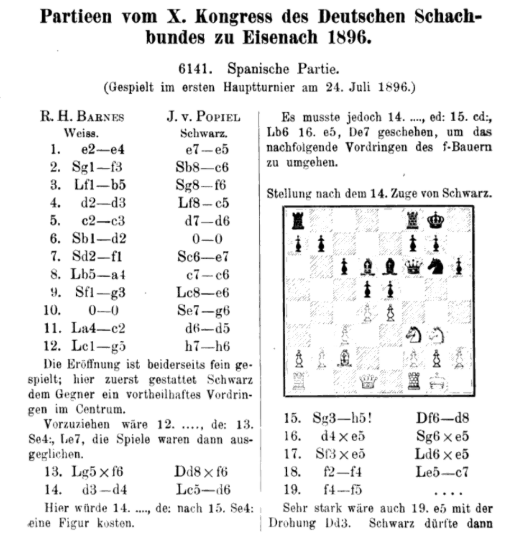
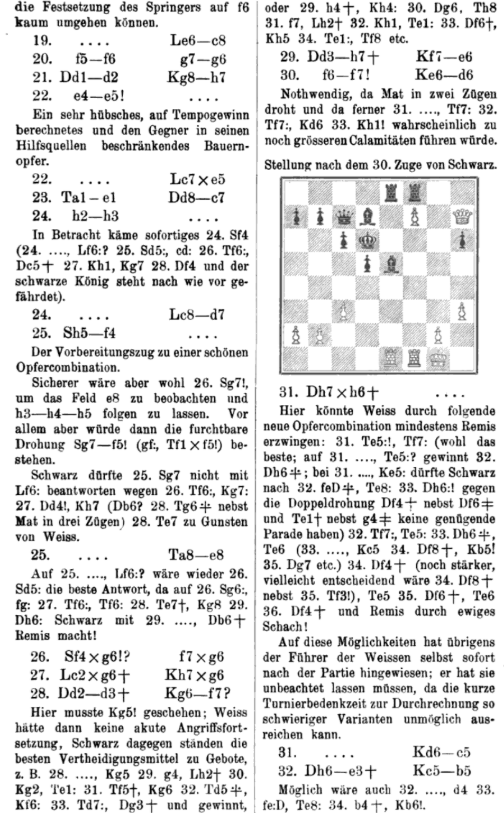
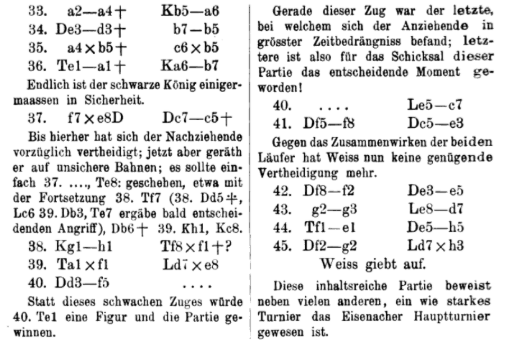
[Event “DSB Kongress-10 Eisenach: Hauptturnier”]
[Date “1896.07.24”]
[White “Barnes, Robert Henry”]
[Black “Von Popiel, Ignatz”]
[Result “0-1”]
[Source “Deutsche Schachzeitung February 1898”]
1. e4 e5 2. Nf3 Nc6 3. Bb5 Nf6 4. d3 Bc5 5. c3 d6 6. Nbd2 O-O 7. Nf1 Ne7 8. Ba4 c6 9. Ng3 Be6 10. O-O Ng6 11. Bc2 d5 12. Bg5 h6 13. Bxf6 Qxf6 14. d4 Bd6 15. Nh5 Qd8 16. dxe5 Nxe5 17. Nxe5 Bxe5 18. f4 Bc7 19. f5 Bc8 20. f6 g6 21. Qd2 Kh7 22. e5 Bxe5 23. Rae1 Qc7 24. h3 Bd7 25. Nf4 Rae8 26. Nxg6 fxg6 27. Bxg6+ Kxg6 28. Qd3+ Kf7 29. Qh7+ Ke6 30. f7 Kd6 31. Qxh6+ Kc5 32. Qe3+ Kb5 33. a4+ Ka6 34. Qd3+ b5 35. axb5+ cxb5 36. Ra1+ Kb7 37. fxe8=Q Qc5+ 38. Kh1 Rxf1+ 39. Rxf1 Bxe8 40. Qf5 Bc7 41. Qf8 Qe3 42. Qf2 Qe5 43. g3 Bd7 44. Re1 Qh5 45. Qg2 Bxh3 0-1
Do have a look at this game for yourself: MegaBase only gives the first 19 moves so you might want to make the necessary amendment.
Our final specimen was a fluctuating game. 36. Rd6 would have maintained White’s extra pawns, and 45. Rf1 took away a vital square from the white king, costing him the game.
[Event “DSB Kongress-10 Eisenach: Hauptturnier”]
[Date “1896.??.??”]
[White “Varain, Ernst”]
[Black “Barnes, Robert Henry”]
[Result “0-1”]
[Source “London Evening Standard 1896.09.28”]
1. d4 e6 2. c4 d5 3. Nc3 Nf6 4. Bg5 Be7 5. e3 O-O 6. Rc1 c6 7. Nf3 Nbd7 8. cxd5 exd5 9. Bd3 Re8 10. O-O Ne4 11. Bxe4 Bxg5 12. Bb1 Bh6 13. Qc2 g6 14. Rce1 Nf6 15. Ne5 Ne4 16. Nxe4 dxe4 17. a3 Be6 18. f3 f6 19. Ng4 Bg7 20. Qe2 Qc7 21. Nf2 exf3 22. Qxf3 f5 23. Nd3 Bd5 24. Qg3 Qe7 25. Nf4 Bc4 26. Qh3 Rad8 27. Rc1 Qf7 28. Rf3 Re7 29. Qh4 Bf6 30. Qg3 Bd5 31. Nxd5 cxd5 32. Rxf5 Rde8 33. Rcf1 Re6 34. Ba2 Qg7 35. Rxd5 Kh8 36. Rc1 Qh6 37. Qf4 Qxf4 38. exf4 Re4 39. Rd1 Rxf4 40. Rd7 b6 41. g3 Rfe4 42. Bf7 Rc8 43. Rd6 Bg5 44. Bd5 Re2 45. Rf1 Be3+ 46. Kh1 Rcc2 47. Rd8+ Kg7 0-1
As as result of winning this tournament, Barnes was considered the German Chess Champion. Yes, the strongest players weren’t taking part, one reason being a clash with the great Nuremberg tournament (also featured in Chess Heroes: Puzzles Book 2), but as the pre-tournament meeting was described as ‘stormy’, there may have been other issues as well.
After the event, his club held a celebration in honour of their champion.
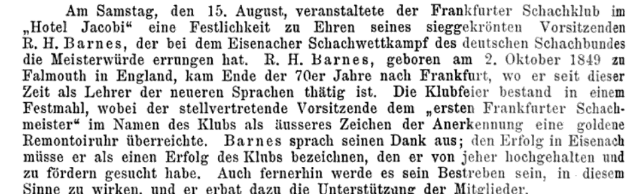
On Saturday, 15 August, the Frankfurt Chess Club held a celebration at the “Hotel Jacobi” in honour of its victorious chairman, R H Barnes, who had won the master title at the Eisenach chess tournament of the German Chess Federation. R H Barnes, born on 2 October 1849 in Falmouth, England, came to Frankfurt at the end of the 1870s, where he has since worked as a teacher of modern languages.
The club celebration consisted of a banquet, during which the vice‑chairman presented the “first Frankfurt chess master” with a gold pocket watch as an outward sign of recognition on behalf of the club. Barnes expressed his thanks; he said that the success in Eisenach must be regarded as a success of the club, which he had always held in high esteem and sought to promote. He added that it would continue to be his endeavour to work in this spirit, and he received the support of the members for this.
His win even made the news in London. The two annotated games they published were those against Varain and Dostal.
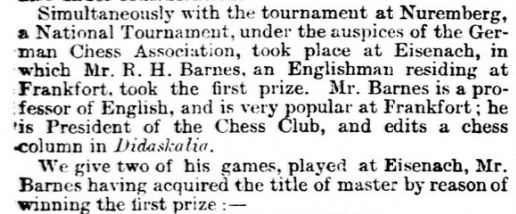
After this success, did he go on to try his strength in top level competitions, against the strongest players of his day?
No, he didn’t. This was to be the last public tournament he played in. Perhaps he was content to rest on his laurels once he had acquired the master title. The only further information we have is a few results from internal club competitions and simultaneous displays.
We do have this game from 1897, in which Black missed a win with 20… Nxd5.
[Event “Frankfurt”]
[Date “1897.??.??”]
[White “Barnes, Robert Henry”]
[Black “von Holzhausen, Walther”]
[Result “1-0”]
[Source “Westminster Gazette 1897.12.18”]
1. e4 e5 2. Nf3 Nc6 3. Bc4 Bc5 4. O-O Nf6 5. c3 d6 6. d4 Bb6 7. Bg5 Qe7 8. Bb5 a6 9. Ba4 O-O 10. d5 Nb8 11. Qe2 Bg4 12. h3 Bh5 13. g4 Bg6 14. Kg2 h6 15. Bh4 Bh7 16. Nbd2 g5 17. Nxg5 hxg5 18. Bxg5 c6 19. f4 exf4 20. Rxf4 Qe5 21. Nf3 Bxe4 22. Rf5 Bxf3+ 23. Qxf3 Qe4 24. Bxf6 Qxa4 {‘White mates in 3 moves with Rh5’} 1-0
(Rg5+ is mate in 3: Rh5 only mate in 5 after Qc2+)
We have very little information about the rest of his life. I can only assume he continued to live quietly in Frankfurt, teaching modern languages and playing chess. I have no evidence that he ever married.
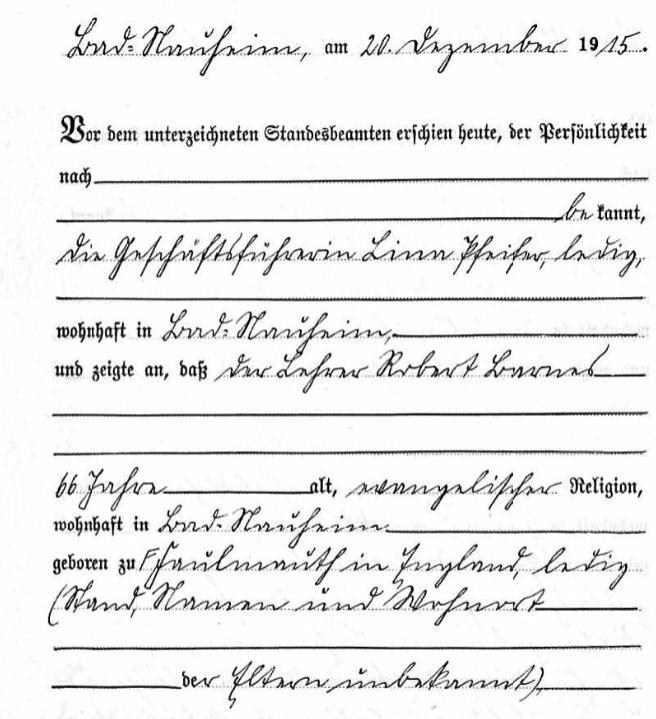
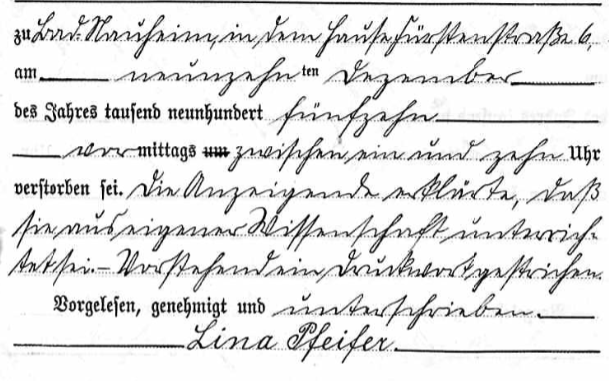
Robert Henry Barnes died, after a long illness, in the nearby spa town of Bad Nauheim (the scene of strong tournaments in 1935, 1936 and 1937) on 19 December 1915, at the age of 66. It’s a reasonable assumption that he’d moved there for health reasons.
Here’s his death certificate.
The Deutsche Schachzeitung published a brief obituary:
Aus Frankfurt a. M. In Bad Nauheim ist kürzlich der Frankfurter Schachmeister R. H. Barnes im Alter von 66 Jahren gestorben. Barnes hat mit Erfolg an mehreren Hauptturnieren des Deutschen Schachbundes teilgenommen. 1887 gewann er in Frankfurt a/M. den vierten Preis. 1894 teilte er in Leipzig den dritten und vierten Preis. 1896 errang er in Eisenach den ersten Preis und damit die Meisterwürde des Deutschen Schachbundes. Er war langjähriger Vorsitzender des Frankfurter Schachklubs.
(The Frankfurt chess master R H Barnes has recently died in Bad Nauheim at the age of 66. Barnes took part with success in several Major Tournaments of the German Chess Federation. In 1887 he won fourth prize in Frankfurt am Main. In 1894 he shared third and fourth prizes in Leipzig. In 1896 he won first prize in Eisenach and thereby the master title of the German Chess Federation. He was for many years chairman of the Frankfurt Chess Club.)
You could certainly argue that Robert Henry Barnes was, before Mickey Adams, the strongest chess player on retrospective ratings to come out of Cornwall. Rod Edwards (EdoChess) gives him a rather higher rating than the much more prolific Reginald Pryce Michell.
Here was a man who had a career lasting just a dozen years only four tournaments, but performed in the 2400-2450 region throughout: the equivalent of an International Master today, being ranked in the world top 50 throughout that time. His surviving games bear witness to a player with a particular fondness for kingside attacks. He was President of his local chess club for many years, edited a newspaper column and was, by all accounts a well respected and popular member of his local chess community. In his role as a teacher of modern languages, I’d imagine he was also well known to the wider population as well.
But, because he played all his chess in his adopted country he’s forgotten today. If you’re interested in 19th century British chess history he may well be the strongest English player you’ve never heard of.
His nephew Wallis John Harold Barnes emigrated to South Africa: some of his descendants have been researching the family history. I suspect that Wallace Barnes, who added a Find a Grave entry for Robert, is from this branch. It’s good to know that, although he seems to have been forgotten by chess historians from his native country, some of his extended family are still interested in his life.
A shoemaker’s son from the far south west of England, many miles away from any competitive chess when he was growing up, who went on to become German champion and a world top 50 player. Quite an achievement, I think you’ll agree. Robert Henry Barnes deserves your attention and our remembrance.
Join me again soon to celebrate the 100th Minor Piece.
Sources and Acknowledgements:
ancestry.co.uk
findmypast.co.uk/British Newspaper Library
Wikipedia (Barnes here)
Google Books
EdoChess (Barnes here)
chessgames.com (Barnes here)

 Minor Pieces
Leave a comment