Rita Fox, whom you met last time, was, assuming Charles James Fox was her biological father, not the only member of her family with an interest in chess.
Let’s first go back to her great grandfather Joseph Fox. He had a brother named Richard, whose great grandson Hugh Courtney (or Courtenay) Fox had some problems published between 1898 and 1904 (see here and here). He was, like many of his family, a doctor, living in London, where his father had moved from Cornwall.
For this story, though, we’re going to go back another generation, to the older Joseph Fox, who had a brother named George Croker Fox. He married Mary Were, and, in the custom of the family, several of their sons were given Were as a middle name. Yes, Robert, William and Thomas Were Fox.
A werefox, by the way, is a thing just as much as a werewolf is. The folk song Reynardine (it’s Roud 397 for those of you who are, like me, concerned about this sort of thing). The last time, at least at the time of writing, I heard it in concert, it was performed by these people.
Robert Were Fox married Elizabeth Tregelles of Tregelles Manor: their eldest son, also Robert Were Fox, married Maria Barclay, from the Quaker Barclay banking family, and also closely related to prison reformer Elizabeth Fry. Robert junior was a geologist, natural philosopher and inventor, remembered today for his gardens at Rosehill and Penjerrick. Another son, Charles, was involved in the family’s mining business as well as his garden at Trebah. Part of their mining empire was Gunnislake copper mine, where chess player and problemist Peter Shenele worked before moving to London.
A third son, Alfred, was responsible for Glendurgan Garden, and married Sarah Lloyd, yes, from the Quaker Lloyd banking family. Alfred was a merchant involved with many of the family businesses: iron, coal and much else. He had three sons and five daughters: it’s his youngest son, Howard, who interests us.
Howard, who was involved in the family shipping business, married Olivia Blanche Orme: their children were Howard Orme Fox, Charles Masson Fox, Olivia Lloyd Fox and Stella Fox. As the second son, Charles’s responsibility was the family timber merchants, although he was also on the board of the shipping business. Born on 9 November 1866 he was a pioneer of chess in Cornwall as a young man, and, in the last decade of his life, a pioneer chess problemist.
In the far south west of England, Cornwall has always been a long way from the main centres of chess. It wasn’t until 1893 that Falmouth had a chess club.
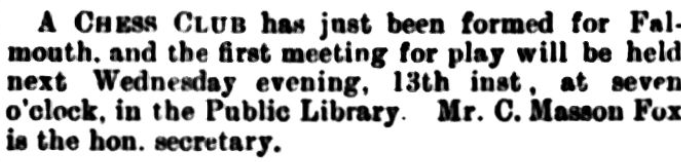
09 December 1893
Charles Masson Fox, at the age of 27, was there right at the start.
There was a shortage of clubs in their vicinity for them to play against, but in 1895 they staged a simul in Uncle Robert’s garden, with Charles’s mother on hand to provide the sumptuous refreshments.
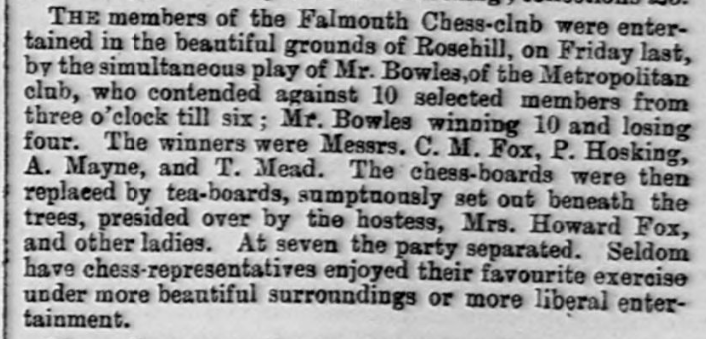
Mr Bowles’s wife, Rhoda, would soon get to know Charles’s cousin Rita very well through the Ladies’ Chess Club: one wonders if Charles and Rita were aware that they were (presumably) related.
In 1898 Fox was involved in arranging a visit from the World Champion.
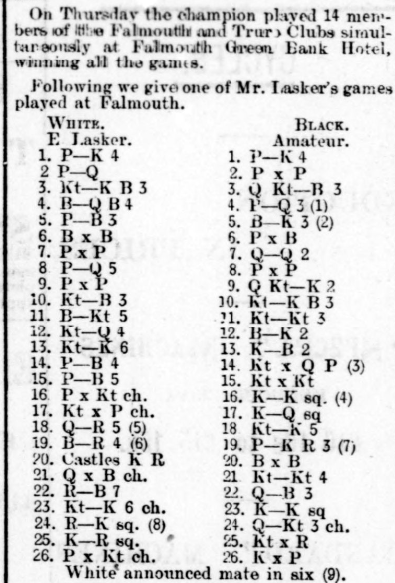
Here’s the game.
[Event “Lasker Emanuel sim tour: Falmouth”]
[Date “1898.11.17”]
[White “Lasker, Emanuel”]
[Black “NN”]
[Result “1-0”]
1. e4 e5 2. d4 exd4 3. Nf3 Nc6 4. Bc4 d6 5. c3 Be6 6. Bxe6 fxe6 7. cxd4 Qd7 8. d5 exd5 9. exd5 Nce7 10. Nc3 Nf6 11. Bg5 Ng6 12. Nd4 Be7 13. Ne6 Kf7 14. f4 Nxd5 15. f5 Nxc3 16. fxg6+ Ke8 17. Nxg7+ Kd8 18. Qh5 Ne4 19. Bh4 h6 20. O-O Bxh4 21. Qxh4+ Ng5 22. Rf7 Qc6 23. Ne6+ Ke8 24. Re1 Qb6+ 25. Kh1 Nxf7 26. gxf7+ Kxf7 1-0
Lasker announced mate in 6 after Nd8+: Stockfish announces mate in 5 after Qf4+.
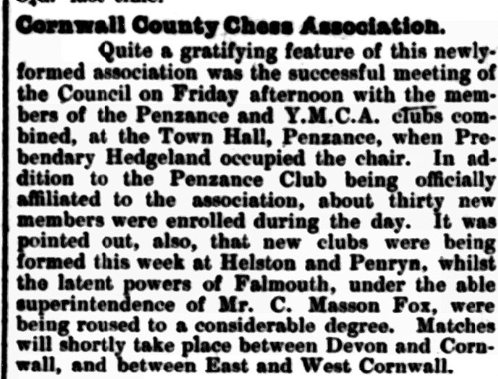
02 May 1902
Here we have the new Cornwall County Chess Association, with Charles Masson Fox again involved.
Their first county match was a great success.
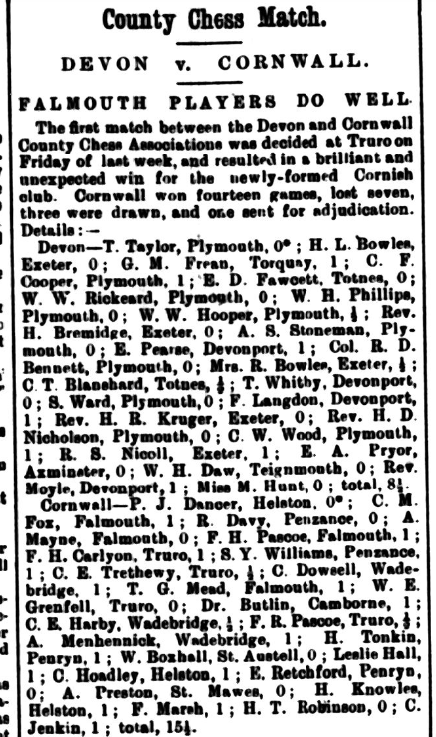
11 October 1902
There’s Fox on Board 2, defeating Henry Bowles. You’ll see Rhoda drawing her game on a lower board.
The Devon Board 5, E Douglas Fawcett (here and here) was still playing chess in 1960: I really ought to write about him at some point.
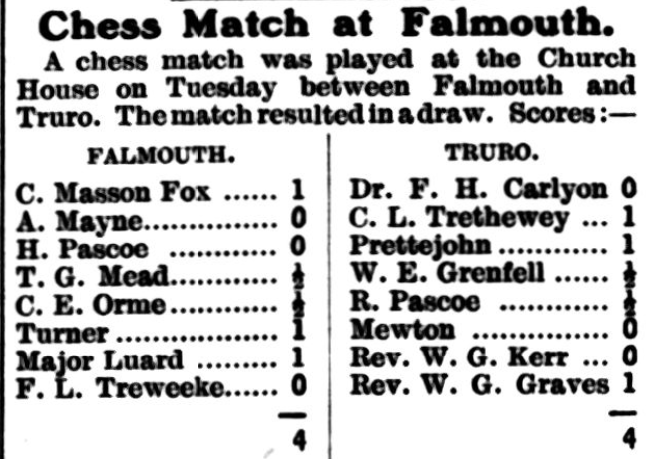
18 October 1902
In this club match, he won on top board against Truro. CE Orme was probably his uncle Charles, a retired doctor visiting from London.
Next January, thanks to the organisational skills of Bowles and Fox, Pillsbury was in town. There was much to report.
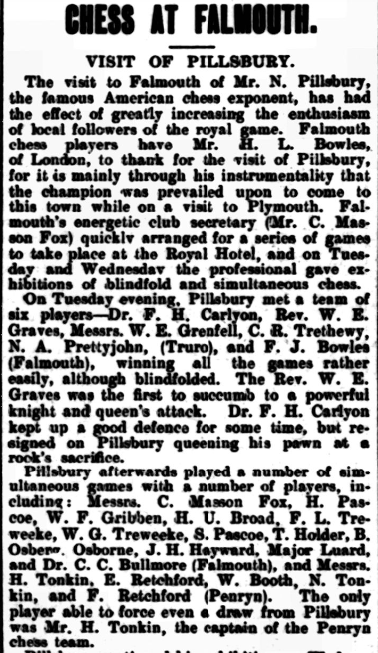
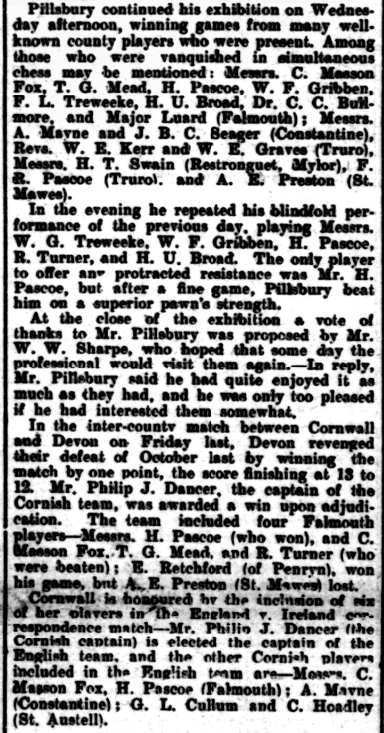
30 January 1903
Philip James Dancer (1861-1911), a schoolmaster born in Portsea Island, near Portsmouth, was another of the prime movers in the foundation of the county chess association. Sadly, he didn’t live long enough to play Jan Hein Donner and discover who was the strongest of Santa’s original eight reindeer.
The conclusion of this letter strikes a chord today.
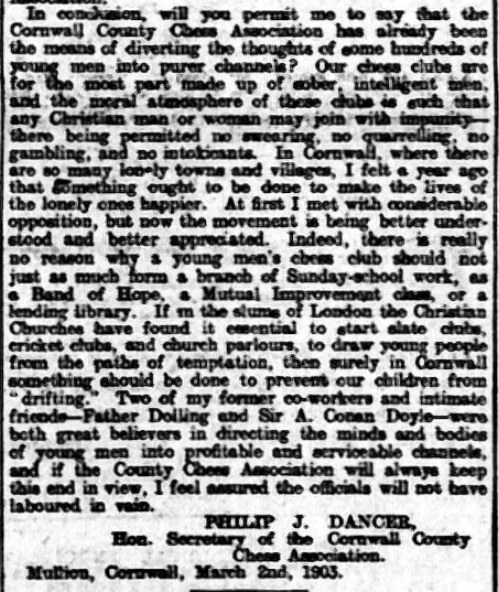
Chess, he claimed attracted ‘sober, intelligent men’ with ‘no swearing, no quarrelling, no gambling, and no intoxication’. ‘In Cornwall’, he added, ‘where there are so many lonely towns and villages, I felt a year ago that something ought to be done to make the lives of the lonely ones happier.’
Today, where claims are made that we’re witnessing an epidemic of loneliness amongst young people, perhaps we should be promoting chess clubs for similar reasons.
Chess in Cornwall continued in the same way over the next few years: club matches and county matches, both over the board and by correspondence.
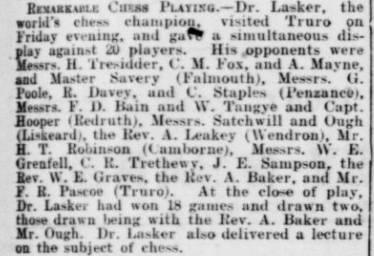
Lasker returned to the county in 1908.
09 March 1908
Master Savery (sic) would have been barrister’s son John Tanzia Dalzell Savary (1893-1959).
Charles Masson Fox continued his involvement with playing chess in Cornwall up to the First World War, but his name was mentioned less often in the press. One reason for this was that he was spending time both in London and abroad.
Fox would have known the artist Henry Scott Tuke very well. Tuke, a fellow Falmouth resident although he had been born in York, had much in common with him. They were both from prominent Quaker families with strong medical connections. The Tuke family had very close business and family relationships with the Rowntree family, who, along with the Cadbury and Fry families, dominated the UK confectionary industry for many decades
They had something else in common as well: they were both gay, with a particular interest in adolescent boys. The south coast of Cornwall, with its mild climate and sandy beaches, was an ideal place for Tuke to find inspiration.
Between 1904 and 1906, for instance, Fox had a relationship with a teenage boy, Ernest Wagner, who at the time was working as a clerk in a London garage: something which would later come back to haunt him.
Another place which was attractive to those with Fox’s interests was Venice. You may recall that it was where Gustav von Aschenbach’s infatuation with a boy led to his death in Thomas Mann’s 1912 novella, later filmed by Visconti starring Dirk Bogarde, and turned into an opera by Britten.
In 1909 Fox travelled to Venice with a friend, where he met the eccentric Frederick Rolfe, aka Baron Corvo, who was there for the same reason. Rolfe’s letters to Fox survive and are readily available should you be interested.
In January 1912, Charles Masson Fox’s world was turned upside down. He received a letter from Edith Wagner, Ernest’s mother, accusing him of ruining her son’s life and demanding £150 in compensation. Perhaps foolishly, he paid up, and, six months later, she wrote again, demanding another £150. This time, Fox took legal advice and the case went to court the following year.
The story was in all the papers, both local and national.
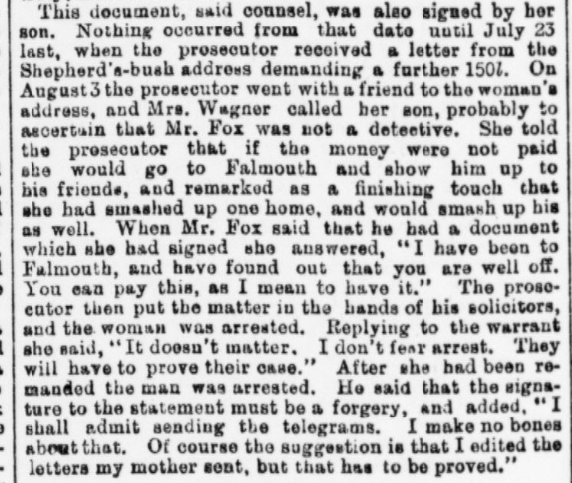
Edith and Ernest were both found guilty: Edith received five years in prison, and Ernest one year with hard labour. This report provides evidence that they’d been making a living out of blackmail for several years.
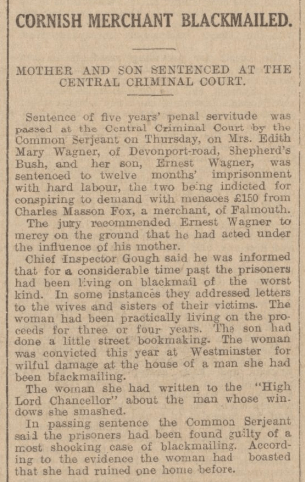
The Wagner family, by the way, is slightly mysterious.

I think this was them in Fulham in the 1901 census, and his mother’s maiden name was, I believe Egan. It’s hard to find out more, or about what happened to John Ernest Wagner later in life. Edith and Ernest disappeared from history, but Charles Masson Fox certainly didn’t.
Jumping forward a few years, it was in the last decade or so of his life that saw the work by which he is still remembered.
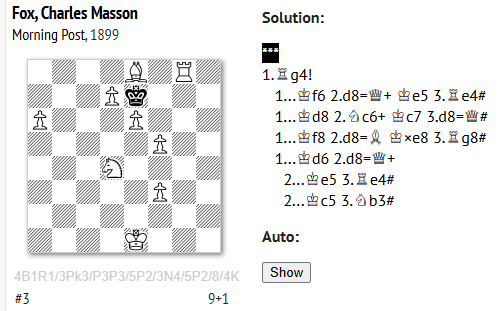
Fox had always had an interest in chess problems, having this mate in 3 published in 1899. You’ll find the solutions to all problems at the foot of the article: note that helpmate solutions start conventionally with a black move.
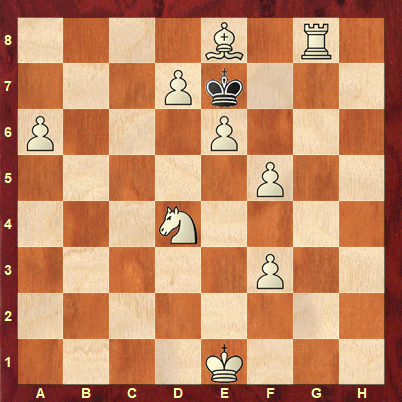
Morning Post 1899
In 1906 he had another three-mover, this one with only four pieces on the board, published in the Western Daily Mail, but it was anticipated by two earlier problems from 1888.
In the 1920s he returned to chess problems, at first quietly, but later in a big way. He was particularly attracted to the growing world of Fairy Chess: chess with different aims, pieces or rules.
At the time, helpmates (both sides combine to reach a position where Black is checkmated) and selfmates (White forces a reluctant Black to deliver checkmate) were both incorporated within Fairy Chess: now they are treated separately.
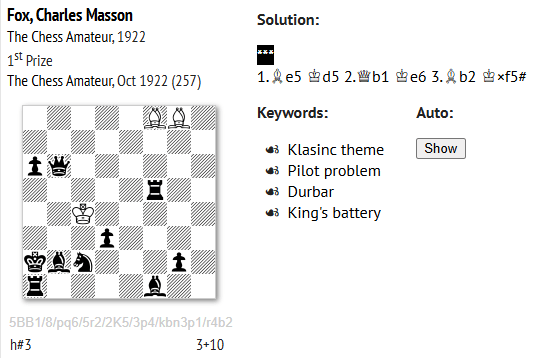
This problem won him a 1st prize. It’s a helpmate in 3: you’re looking for a BWBWBW sequence ending in mate.
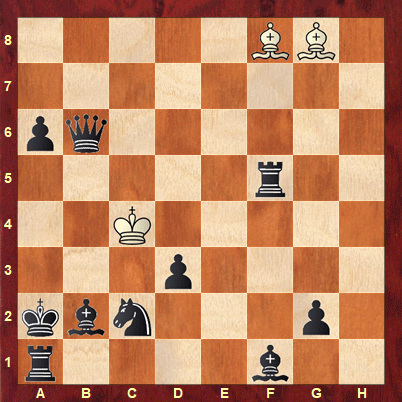
1st Prize The Chess Amateur 1922
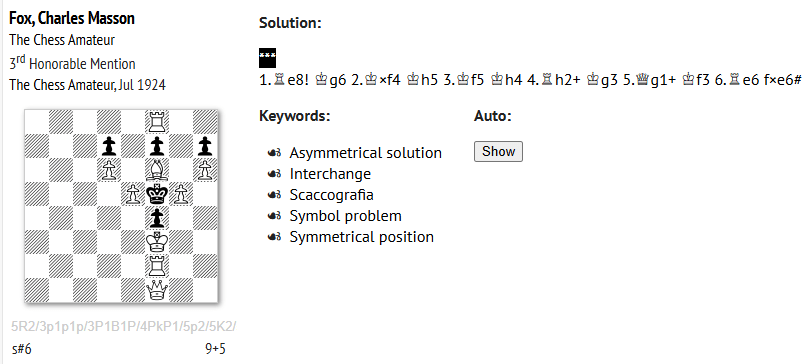
Now we have a tree-shaped selfmate in 6: you’re looking for a sequence with White playing the first move where Black is reluctantly forced to mate on move 6.
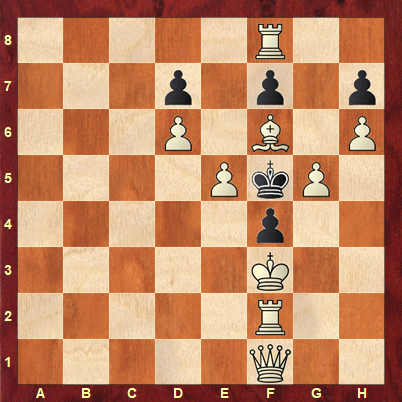
3rd Honourable Mention The Chess Amateur 1924
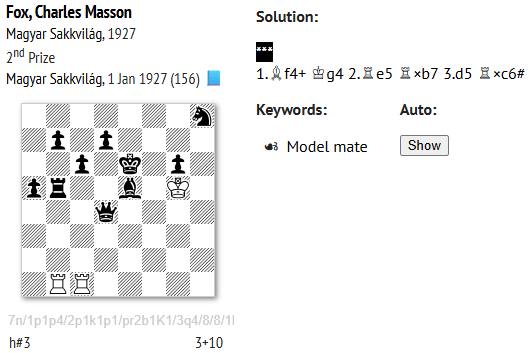
This helpmate in 3 won a prize in a Hungarian competition.
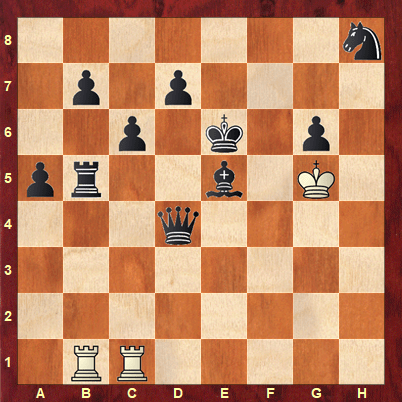
2nd Prize Magyar Sakkvilág 1927
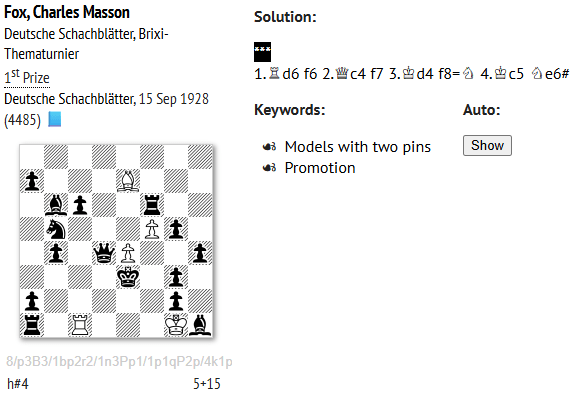
The next problem won first prize in a German competition.
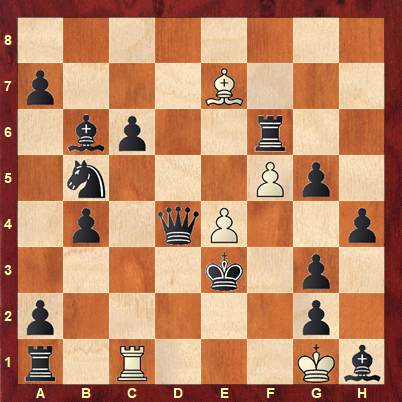
1st Prize Deutsche Schachblätter Brixi-Thematurnier
15 Sep 1928
The formation of the British Chess Problem Society in 1918, followed by the launch of their magazine The Problemist in 1926 did much to develop a community of problemists, and through this Charles Masson Fox formed a close friendship with the great Thomas Rayner Dawson.
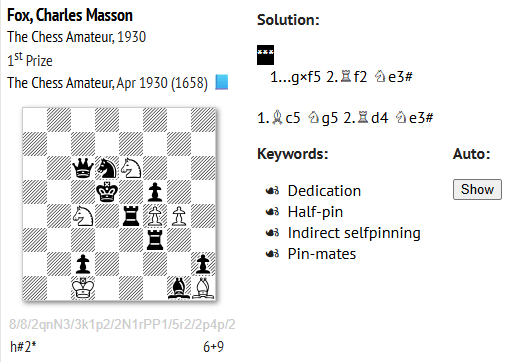
This first prizewinning problem was dedicated to him. It’s a helpmate in two with set play (indicated by the asterisk: for a full solution you have to find a sequence with White to play (WBW#) as well as the expected sequence with Black to play (BWBW#).
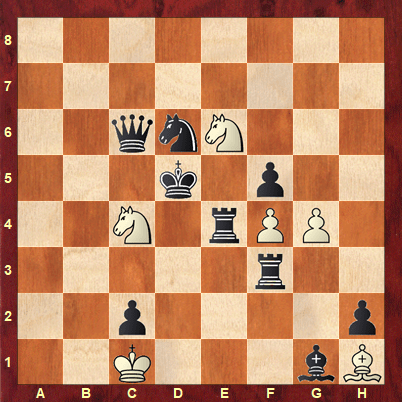
1st Prize The Chess Amateur 1930
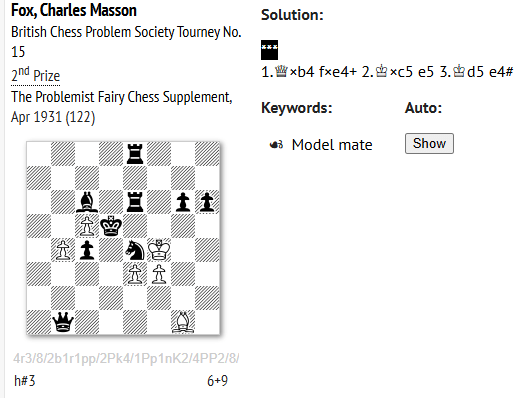
This helpmate in 3 took second prize in a British Chess Problem Society competition.
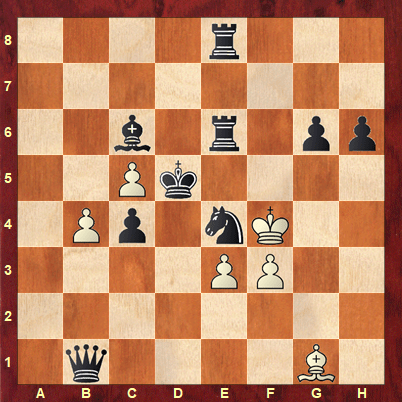
2nd Prize BCPS Tourney No. 15 1931
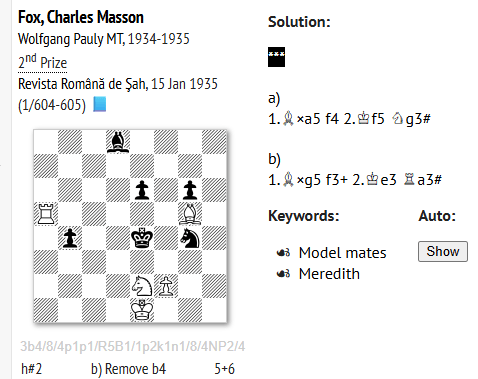
Finally, a prize winner from a Romanian tournament. This problem, like many helpmates, has two parts. Once you’ve solved the helpmate in 2 from the diagram you remove the pawn on b4 and solve it again.
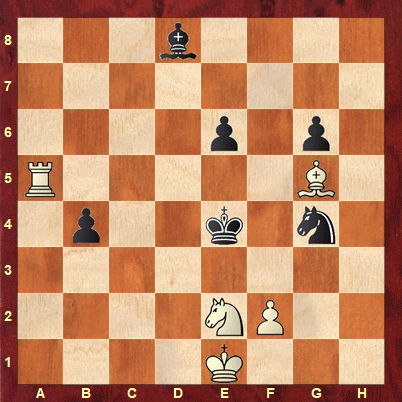
2nd Prize Wolfgang Pauly MT, 1934-1935
b) Remove b4
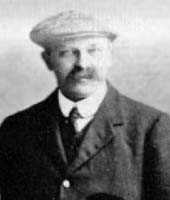
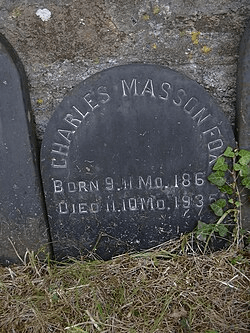
Charles Masson Fox died at the age of 68 on 11 October 1935, after a long illness.
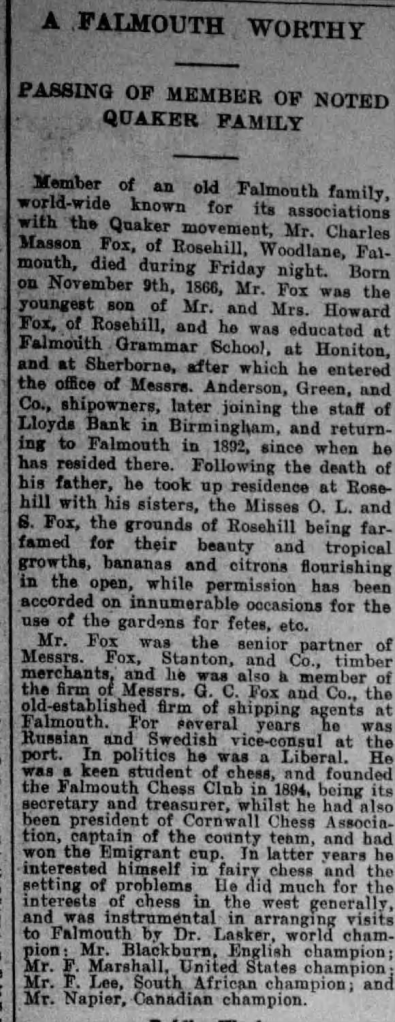
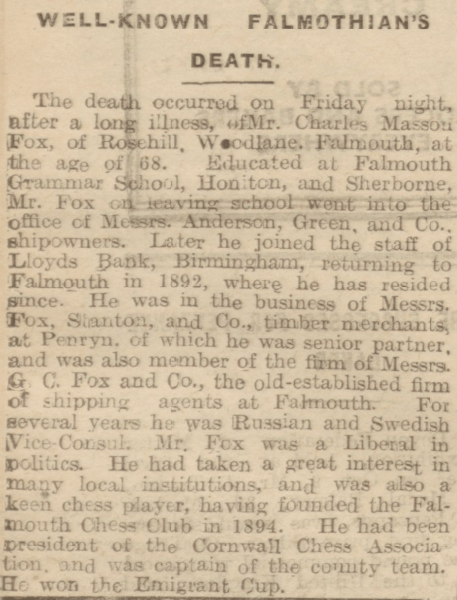
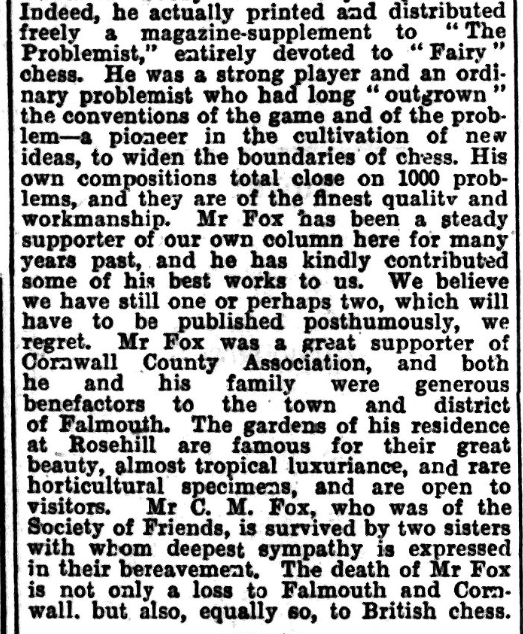
The always excellent Archibald Neilson, whose column in the Falkirk Herald and Linlithgowshire Gazette was the leading British chess column in the inter-war period, paid effusive tribute.
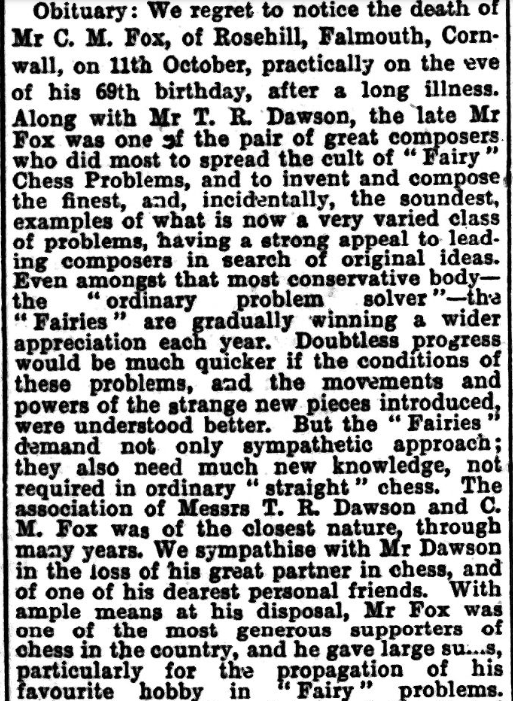
As you would expect from a member of the Society of Friends, he was generous to his employees.
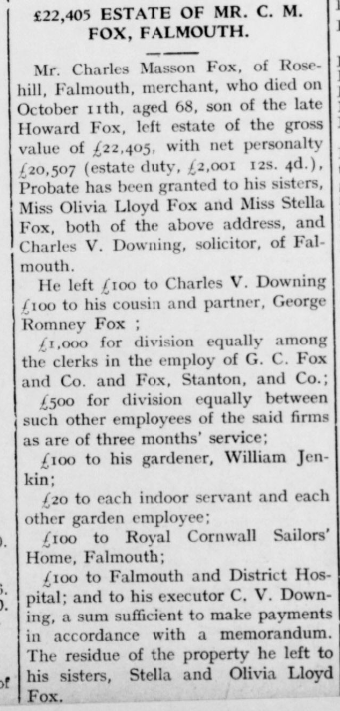
04 December 1935
His friend Thomas Rayner Dawson described him as a friendly man, kind, mellow, lovable, bringing peace and comfort and serene joy with him.
We should certainly remember this friendly and kind man for his efforts in establishing competitive chess in Cornwall, and, most of all for his place in the history of Fairy Chess.
You might, though, want to turn your thoughts back to the Ernest Wagner affair. Although Ernest was 16 when their relationship started, if Frederick Rolfe’s letters are to be believed Fox preferred younger boys. Times have changed: our attitudes to both sex and childhood are very different now from what they were in his day. Then, and for several decades afterwards, a relationship with another man would put you in jail, while young people were neither protected nor believed in the way they are, quite rightly, now.
There are other, more wholesome stories, as well.
I’ll take you right back to George Fox and Anna Dobell. As well as Joseph Fox, the (presumed) ancestor of Rita Fox and George Croker Fox, the ancestor of Charles Masson Fox, they had a daughter called Sarah. She married Joel Cadbury, from an Exeter Quaker family, and, after her early death Joel married Sarah Moon. One of their sons, Richard Tapper Cadbury, moved to Birmingham where he started a drapery business. He in turn financed his son, John, to start a tea and coffee business next door. This eventually became the Cadbury’s chocolate company we all know and love. John’s daughter, another Sarah, married John Barrow: one of their descendants, Sampson Low, is the current secretary of Richmond & Twickenham Chess Club. On the other side of his family, he’s descended from the Sampson Low whose publishing company included a few chess books amongst its titles. (John Cadbury, by the way, the chocolate company founder, is an ancestor of Ruth Cadbury, herself a Quaker, at the time of writing the MP for Brentford and Isleworth.)
Here’s another story. Rita’s (presumed step-)mother had a family connection with the Hennah family, another Cornish surname. We can follow one line of that family to Australia, and to one James Humphrey Ferguson, born in Victoria in 1921. His wife, Louise Merle Gillon, was, if my tree is correct, my 5th cousin once removed (and, entirely coincidentally, her mother’s name was Fox).
Some more golden threads which link both Sampson and myself with the chess-playing and problemist Falmouth Foxes.
I’ll return to Falmouth briefly next time, and have something special in mind for Minor Piece 100. Don’t miss it.
Sources and Acknowledgements:
ancestry.co.uk
findmypast.co.uk/British Newspaper Library
Wikipedia (here)
Yet Another Chess Problem Database (Fox here)
MESON Chess Problem Database (Fox here)
British Chess Problem Society (Fox here)
British Chess News (Fox here)
Problem Solutions (copied and pasted from yacpdb.org):
Problem 1:
Problem 2:
Problem 3:
Problem 4:
Problem 5:
Problem 6:
Problem 7:
Problem 8:

 Minor Pieces
Leave a comment