I’ve written in the past how, back in the 1930s, chess was used in a variety of ways to help those with a range of disadvantages. We visited the Royal Star and Garter Home for Disabled Ex-Servicemen in Richmond, where chess was popular amongst the residents. We travelled to Leicester to meet the members of the Cripples Guild and the naughty boys of Desford Approved School, who, perhaps unexpectedly, excelled at chess. The blind boys at Worcester Royal College also excelled, at an even higher level.
The inmates of Parkhurst Prison on the Isle of Wight also enjoyed chess in the 1930s.
Wilfred Macartney was a left-wing journalist found guilty of spying for the USSR, spending ten years in Parkhurst.
On his release he wrote a book, Walls Have Mouths, describing his experiences there. Here, published in Reynold’s News (13 December 1936), he tells us about chess in Parkhurst.

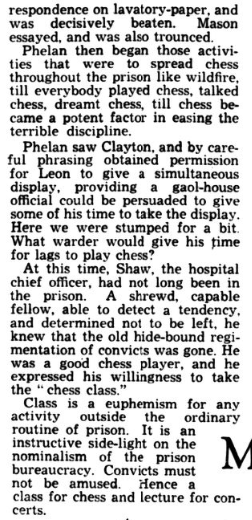
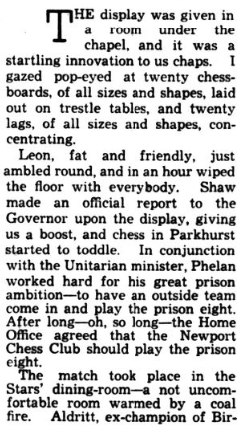

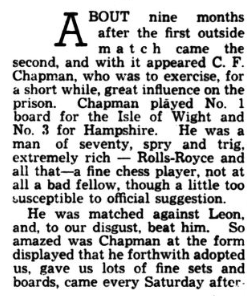

Jim Phelan would later achieve some fame as a chess playing tramp. Perhaps I should write more about him at some point. There was a Leon Hopeon Leapman in neighbouring Camp Hill Prison in the 1939 Register, who may well have been Leon, but I can find neither any chess connection nor any indication of what he was doing there.
I was more interested in finding out more about CF Chapman. It wasn’t so easy. There were two players named Charles Chapman, of fairly similar age, both active in Southern England, and of similar playing strength. This has, understandably, caused confusion in some circles.
Both also had interesting stories and unusual lives, so I’ll introduce you to both of them here.
I’ll return to Parkhurst and CF Chapman later, but let’s start with plain Charles Chapman, who lived most of his life in Sevenoaks, Kent.
He was born in Woolwich, South London, on 15 September 1875, into a chess playing family: his brother Richard also played. His father worked in the coal trade, but, by 1891 young Charles was learning plumbing. His future life, however, would soon take a different course.
We first hear about him in October 1895, when a decision was made to amalgamate the chess clubs in Orpington and (St Mary) Cray. Charles, aged just 20, was appointed the Hon Secretary of the new club, where Richard was also a member, suggesting that, by this time, the family had moved out of London.
The following year he took part in the Third Class of the Southern Counties Congress, held that year in Clifton, Bristol, scoring 2½/7. The section winner, with 5½/7, was Charles Frederick Corke, from nearby Sevenoaks. They may possibly have travelled together: if they weren’t already good friends, they soon would be.

Sevenoaks Chess Club had been founded three years earlier, and Corke was one of founder members.
Soon, both men were playing for both Crays & Orpington and Sevenoaks Clubs, where Chapman, clearly improving very quickly, won the Sevenoaks Club Championship the following year. (Source: Kent Messenger 05 June 1897)
[Event “Sussex Chess Congress”]
[Date “1897.02.??”]
[White “Chapman, Charles”]
[Black “Bowley, Albert Alexander”]
[Result “1-0”]
1. e4 e5 2. Nf3 Nf6 3. Nc3 Nc6 4. Bb5 a6 5. Bxc6 dxc6 6. O-O Bd6 7. d3 Bg4 8. h3 Be6 9. Bg5 h6 10. Bh4 g5 11. Bg3 g4 12. Nxe5 gxh3 13. f4 Rg8 14. Qf3 Bc5+ 15. Kh1 hxg2+ 16. Kxg2 Ng4 17. f5 Nxe5 18. Qf4 Qe7 19. fxe6 Qxe6 20. Ne2 Bd6 21. Nd4 Qg6 22. Nf5 O-O-O 23. d4 Ng4 24. e5 Bb4 25. c3 Bf8 26. e6 Bd6 27. Ne7+ Kb8 28. Nxg6 Bxf4 29. Nxf4 Ne3+ 30. Kh3 Nxf1 31. Rxf1 fxe6 32. Nxe6 Rde8 33. Rf6 h5 34. Bxc7+ Ka7 35. Bf4 Rg4 36. Nc5 Re7 37. Be5 Rg1 38. Nd3 Reg7 39. Rf2 1-0
For the rest of their lives the two Charleses were both very active in the chess world. In the period up to the First World War they were regularly playing in tournaments as well as club matches. Soon Sevenoaks, with Chapman on top board, became one of the county’s leading clubs.
By 1901 Chapman had moved into the Corke household. 38 year old Corke was a House Agent and Auctioneer, and 25 year old Chapman was a House Agent’s Clerk. The head of the household, 77 year old John Corke, was, like Chapman’s father, working in the coal trade, and there were three other unmarried sons also living at home.
1901 was first year in which Chapman won the county championship. He would win it again on five more occasions: 1902, 1903, 1909, 1910 and 1915.
Here are two games from the 1902 event (source: http://www.chessgames.com).
[Event “Kent CCA Championship Tunbridge Wells”]
[Date “1902.05.??”]
[White “Brooke, William Montagu”]
[Black “Chapman, Charles”]
[Result “0-1”]
1. e4 e5 2. Nf3 Nc6 3. Bb5 Nf6 4. O-O d6 5. d4 Bd7 6. Nc3 exd4 7. Nxd4 a6 8. Bc4 Be7 9. Be3 O-O 10. Qd2 Ne5 11. Bb3 c5 12. Nf3 Nxf3+ 13. gxf3 Bh3 14. Rfe1 Qc8 15. Bd5 Ng4 16. Bf4 Ne5 17. Qe3 Kh8 18. Kh1 Ng6 19. Bg3 f5 20. f4 Ra7 21. f3 b5 22. a3 fxe4 23. fxe4 Qg4 24. Rg1 Qh5 25. Ne2 Bg4 26. Rg2 Bf3 27. Rag1 Nh4 28. Bxh4 Bxh4 29. b4 Rf6 30. f5 Bg5 31. Nf4 Qg4 32. h3 Rh6 33. Kh2 Bxf4+ 0-1
[Event “Kent CCA Championship Tunbridge Wells”]
[Date “1902.05.??”]
[White “Tillard, George Henry”]
[Black “Chapman, Charles”]
[Result “0-1”]
1. e4 e5 2. Nf3 Nc6 3. c3 d5 4. Qa4 f6 5. Bb5 Nge7 6. exd5 Qxd5 7. O-O e4 8. Ne1 Bd7 9. d3 exd3 10. Nxd3 O-O-O 11. Be3 a6 12. Bxa6 Na5 13. Bxb7+ Kxb7 14. Qb4+ Kc8 15. c4 Nxc4 16. Nc3 Qxd3 17. Rfd1 Nc6 18. Qb5 Qf5 19. Qa6+ Kb8 20. Rd5 Qxd5 21. Nxd5 Nxe3 22. fxe3 Na7 23. Nxc7 Bc5 24. Qc4 Bxe3+ 25. Kh1 Bc6 26. Na6+ Ka8 27. Re1 Rd7 28. h3 Bb6 29. Qb3 Rb7 30. Rc1 Re8 31. Qa3 Rbe7 32. Qg3 Bb5 33. Qd6 Re1+ 34. Rxe1 Rxe1+ 35. Kh2 Bg1+ 36. Kg3 Re3+ 37. Kg4 Be2+ 38. Kf4 Bh2+ 39. Kxe3 Bxd6 40. Kxe2 Kb7 0-1
Here are the 1902 and 1903 crosstables (Source: BritBase)


Simultaneous displays and consultation games, often with famous guests, were a feature of many congresses, including the annual Kent events, at this time.
Here’s an example, where Chapman and a friend were playing as a team in a blindfold simul given by Pillsbury. (Source: http://www.chessgames.com, which adds a note after Black’s 27th move: “Forcing the exchange of queens and winning a pawn two moves later. The time allotted to the blindfold play had expired previously to this, and Mr Pillsbury was finishing the game over the board.”)
[Event “Blindfold Simul: Kent Congress Canterbury”]
[Date “1903.06.??”]
[White “Pillsbury, Harry Nelson”]
[Black “Chapman, Charles & Brooke, William Montague”]
[Result “1/2-1/2”]
1. e4 e5 2. Nf3 Nf6 3. d4 d5 4. Nxe5 Nxe4 5. Bd3 Bd6 6. O-O O-O 7. c4 c6 8. Nc3 Bf5 9. Qc2 Bxe5 10. dxe5 Na6 11. Nxe4 Nb4 12. Qe2 Nxd3 13. Nd6 Qd7 14. Rd1 dxc4 15. Nxc4 Nxc1 16. Raxc1 Qe7 17. Nd6 Be6 18. b3 Bd5 19. f4 Rad8 20. Nf5 Qe6 21. Qg4 g6 22. Nh6+ Kg7 23. Qh4 f5 24. Rd3 Rd7 25. Rg3 Be4 26. Re1 Rfd8 27. Rge3 Qe7 28. Qxe7+ Rxe7 29. Ng4 Bxg2 30. Nf6 Rd2 31. h3 Bd5 32. h4 Rxa2 33. Rd1 Ra5 34. Red3 Rb5 35. h5 Rxb3 36. h6+ Kf7 37. Nxh7 Rxd3 38. Rxd3 Re8 39. Ng5+ Ke7 40. h7 Rh8 41. Rh3 a5 42. Rh6 Bf7 43. e6 Be8 44. Rh3 b5 45. Ra3 a4 46. Rc3 Kf6 47. Kf2 Rf8 48. Ke3 b4 49. Rc4 c5 50. Rxc5 b3 51. Kd2 a3 52. Kc3 a2 53. Ra5 Bc6 54. Kxb3 Bd5+ 55. Kc2 Bxe6 56. Ra6 a1=Q 57. Rxa1 Bd5 1/2-1/2
[Event “Kent Congress 1st Class Open Tunbridge Wells”]
[Date “1906.04.??”]
[White “Thomas, George Alan”]
[Black “Chapman, Charles”]
[Result “0-1”]
1. e4 e5 2. Nf3 Nc6 3. Bc4 Bc5 4. d3 Nf6 5. Nc3 d6 6. Ne2 d5 7. exd5 Nxd5 8. Bb5 O-O 9. Bxc6 bxc6 10. O-O Bd6 11. Ng3 f5 12. Re1 f4 13. Ne4 c5 14. b3 Bg4 15. Bb2 Rf5 16. Ned2 Qf6 17. Nc4 Rh5 18. h3 Qh6 19. Kf1 Rxh3 20. Ke2 Rxf3 21. gxf3 Bxf3+ 22. Kxf3 Qh5+ 23. Kg2 f3+ 24. Kg3 e4+ 25. Nxd6 Qg5+ 26. Kh3 Nf4+ 27. Kh2 Qg2# 0-1
On 2 January 1908 Chapman was involved in an international match, playing two games against Walter de Havilland, the champion of Yokohama, winning one game and drawing the other.
That year, Sevenoaks hosted the county championships, with Chapman the congress secretary. Among the guests was the World Champion himself, who gave a simul, losing four games, including this one. (Source: http://www.chessgames.com)
[Event “Simultaneous Display Sevenoaks”]
[Date “1908.04.20”]
[White “Lasker, Emanuel”]
[Black “Chapman, Charles”]
[Result “0-1”]
1. e4 e5 2. d4 exd4 3. c3 d5 4. exd5 Qxd5 5. cxd4 Nc6 6. Nf3 Bg4 7. Be2 O-O-O 8. Nc3 Bb4 9. O-O Qa5 10. Be3 Nge7 11. Nd2 Bxe2 12. Qxe2 Bxc3 13. bxc3 Qxc3 14. Rfc1 Qa5 15. Nb3 Qd5 16. Nc5 Nf5 17. Rab1 Ncxd4 18. Qb2 b6 19. Na6 Rd7 20. a4 Rhd8 21. a5 Nb3 22. Re1 Nxe3 23. Rxe3 Nxa5 24. Qxg7 Qd1+ 0-1
The crosstable of the 1910 county championship is available on BritBase:

The 1911 census records Corke and Chapman, both single, sharing two rooms above their Estate Agents’ business in the heart of Sevenoaks. Other rooms there were occupied by a married couple: James and Helen Gurr.
As the First World War approached, Chapman’s life continued in very much the same way, playing regularly on top board for his club, and on a high board (typically between 3 and 5) for his county. Here’s a county match game from this period.
[Event “Kent v Essex B4”]
[Date “1913.12.06”]
[White “Chapman, Charles”]
[Black “Randall, Ernest John”]
[Result “1-0”]
1. e4 e5 2. Nf3 Nc6 3. Bb5 a6 4. Ba4 Nf6 5. O-O Nxe4 6. Re1 d5 7. Bxc6+ bxc6 8. d3 Nc5 9. Nxe5 Ne6 10. Nxc6 Qf6 11. Nc3 Bb7 12. Nxd5 Qf5 13. Re5 Qg6 14. Rxe6+ fxe6 15. Nxc7+ Kd7 16. Ne5+ Kxc7 17. Nxg6 hxg6 18. Bf4+ Kd7 19. Qg4 Be7 20. Re1 Rae8 21. Qxe6+ Kd8 22. Qb6+ Kd7 23. Qc7# 1-0
Towards the end of the conflict he spent some time serving his country, but was soon back over the board again.
Along with his chess interests, Chapman was very much involved in the Boy Scouts, and, in 1921, while Corke and the Gurrs were still above the business, he was at a nearby Scout Camp along with eight scouts, aged between 12 and 17.
Perhaps the most interesting member of Sevenoaks Chess Club was Lord Dunsany (wiki), who was the club president for 54 years from 1903 onwards. Like Chapman, he was also very much involved in Scouting.
Charles Frederick Corke died suddenly in 1935, but Charles Chapman continued running their business – and playing chess.

In 1937 Sevenoaks played a telephone match against Rochdale, and, th following year, he defeated his second world champion in a simul.

There are some interesting names here, notably “12-years-old Elaine Saunders, of Twickenham”. I note also Felix Firmin Jacquier, whom I beat in a very bad game in 1972.
Skinner and Verhoeven, in their authoritative collection of Alekhine’s games, give Alekhine’s score as +27 =1 -2, even though the above article names the two players who drew. No games from the display were, as far as I know, published at the time: Skinner and Verhoeven provide the game against HH Cole, from his archives.
Many years after his last tournament, in 1946, Chapman returned to tournament chess, playing in Section 4 of the Major Open at the British Championships in Nottingham, where he only managed to score 3/11.
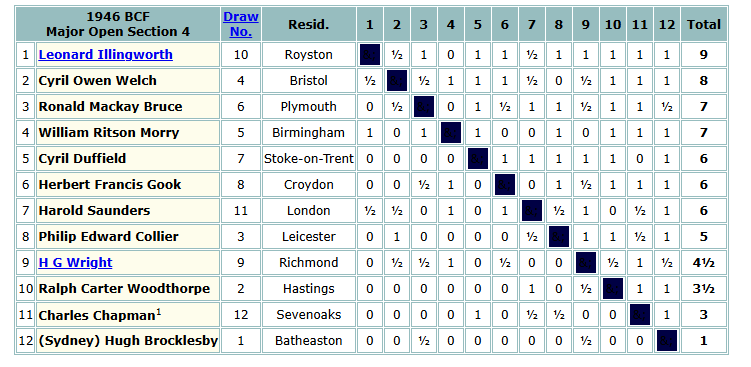
You can find three of his losses on BritBase here. Only a few weeks later, he was dead.

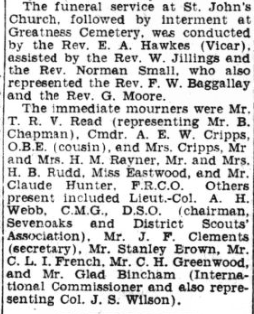
Charles Chapman was a man who devoted half a century to his favourite game, playing club, county and tournament chess, correspondence chess, consultation games and simultaneous displays, both as a giver and a participant. He beat Lasker and Alekhine in simuls, and the likes of Sir George Thomas in one to one combat. Retrospective ratings suggest he was, at his best, about 2100 strength: a strong club/county player. He also devoted half a century to the community through voluntary work, as a chess administrator and organiser, as well as his work in scouting.
Looking back at his life, you’d see a bachelor who lived for many years with another man and who spent a lot of time with teenage boys. Someone like that would today be a target of suspicion. I have no idea whether Chapman and Corke’s relationship went beyond their business partnership, and in those days, when sexual relationships between men were illegal, you wouldn’t ask. Perhaps we shouldn’t either: there’s no evidence that either gentleman led anything other than an admirable life of community service.
Charles Chapman’s service to the chess community in Kent is still remembered today by Sevenoaks Chess Club (which currently meets just a few yards from where he was living at the time of the 1939 Register) as well as what is now Petts Wood & Orpington Chess Club, and quite rightly so too.
In the years before WW1, newspaper columnists were eager to publish games submitted by amateurs, and Chapman often submitted his better efforts. Quite a lot of his games have survived: if you’d like to see more, let me know and I can send you my file.
That was Charles Chapman, but now it’s time to return to Charles Frederick Chapman, the man who promoted chess in Parkhurst Prison.
While Charles stayed put most of his life, Charles Frederick moved around. A lot.
Charles Frederick was older than his namesake, born in London on 24 October 1864. If I’ve found the right family, he was originally just Charles: the Frederick came later. There’s also some doubt as to the identity of his mother.
We can pick him up in the 1901 census, on the island of Guernsey, living with his 25 year old wife Madge and a servant: his occupation looks like ‘company tenancies’.
By 1911 he was living in a mansion flat in Chiswick with his 36 year old wife Mary and a servant. I have no idea whether or not Madge and Mary were the same person. His occupation was now a turf accountant – a bookmaker.
1921 found him living in a large house in the most exclusive area of Kingston, with Mary and two servants. His occupation is now a turf commissioner, again a bookie. Three months earlier his neighbours Dorothy and Malcolm Campbell had welcomed the birth of their son Donald. Their house is now Canbury School: a plaque on the wall honours the Campbell family.
And then, in January 1925, at the age of 60, he suddenly exploded onto the Brighton chess scene, playing at a pretty high level.
In this match he lost to Tolstoy’s friend and biographer Aylmer Maude.
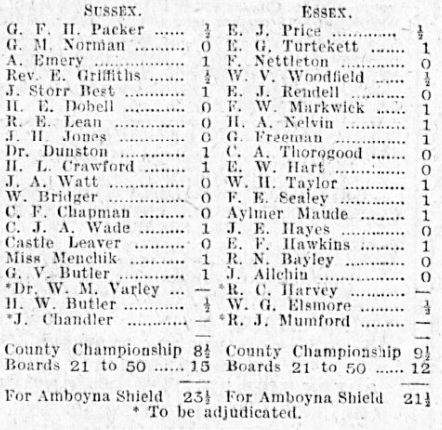
In this game from the 1926 Brighton Championship he used the London System to great effect.
[Event “Brighton CC Championship”]
[Date “1926.??.??”]
[White “Chapman, Charles Frederick”]
[Black “Stockens, Ernest Emerson”]
[Result “1-0”]
1. d4 d5 2. Nf3 Nf6 3. Bf4 Bf5 4. e3 e6 5. Nbd2 Nbd7 6. Bd3 Bg4 7. h3 Bxf3 8. Nxf3 h6 9. O-O Be7 10. c3 Nh5 11. Bh2 g5 12. Ne5 Ng7 13. Qf3 Nxe5 14. Bxe5 f6 15. Bg6+ Kd7 16. Bh2 Qf8 17. Bd3 h5 18. e4 dxe4 19. Bxe4 g4 20. Qe2 c6 21. c4 f5 22. Bc2 Bd6 23. Be5 a6 24. Rad1 Bxe5 25. dxe5+ Kc7 26. Rd6 gxh3 27. Rfd1 Rc8 28. Qe3 Ne8 29. Rd7+ Kb8 30. Qb6 Nc7 31. Ba4 Qg8 32. g3 Qg4 33. Bxc6 1-0
By 1927 he’d moved along the south coast to Bill House, in the seaside town of Selsey, south of Chichester, which is now a care home for the elderly.

A week later, the new club was up and running, with Chapman donating 20 guineas and being elected President.
By December 1928, though, Chapman had moved again, further west along the south coast to Parkstone, Poole, Dorset. Again, there was no club there, so he wasted no time starting one up.

Not content with that, he revived the Dorset county chess team, being elected as President of his new county as well as his new club.

By October that year, Chapman had moved back to Sussex, for whom he was again playing in county matches, while playing club chess on top board for Eastbourne, scoring a quick win with the Torre Attack here.
[Event “McArthur Cup Final Eastbourne v Christ Church II”]
[Date “1930.05.31”]
[White “Chapman, Charles Frederick”]
[Black “Stacey, Charles Herbert”]
[Result “1-0”]
1. d4 Nf6 2. Nf3 e6 3. c3 b6 4. Bg5 Be7 5. e3 Bb7 6. Bd3 Ne4 7. Bxe7 Qxe7 8. O-O O-O 9. Nbd2 f5 10. Qc2 d5 11. Ne5 c5 12. f3 c4 13. fxe4 cxd3 14. Qxd3 Ba6 15. c4 fxe4 16. Rxf8+ Qxf8 17. Qe2 dxc4 18. Rf1 Qc8 19. Qh5 1-0
He also resumed his connection with Brighton, where he played another powerful attack in this game.
[Event “Brighton CC Championship”]
[Date “1930.??.??”]
[White “Chapman, Charles Frederick”]
[Black “Watson, Arthur Tijou”]
[Result “1-0”]
1. d4 d5 2. Nf3 Nf6 3. Bg5 Ne4 4. Bf4 e6 5. e3 Nd7 6. c3 Be7 7. Bd3 f5 8. Nbd2 O-O 9. Be5 c5 10. O-O c4 11. Bc2 b5 12. a3 Bb7 13. h3 Ndf6 14. Nh2 Nxd2 15. Qxd2 Ne4 16. Qe1 Bd6 17. f4 Bxe5 18. dxe5 g5 19. Bxe4 fxe4 20. Qg3 Rf5 21. h4 h6 22. hxg5 hxg5 23. Ng4 gxf4 24. Nf6+ Kf7 25. Rxf4 Rxf4 26. Qxf4 Ke7 27. Rf1 Qh8 28. Qg5 Rd8 29. Nxd5+ Kd7 30. Qe7+ 1-0
Here he is, on 23 March 1931, representing Hastings Chess Club in a match against a combined Oxford and Cambridge Universities team.
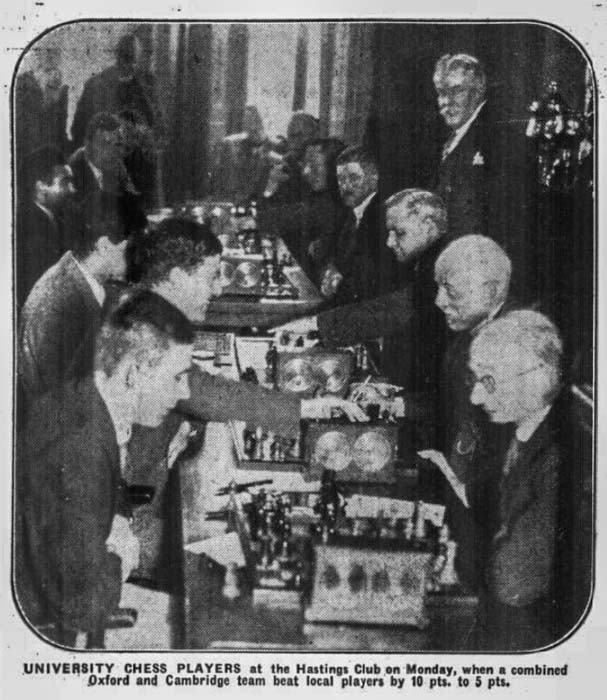
You can see Chapman front right, on his way to defeat against Cambridge man James Edmund Frank Hope, who would sadly lose his life at the age of 30 while on active service in France.
This photo is taken from BritBase: see here for further information.
Two years later, he was on the move again, now living in Southsea, and representing Portsmouth in club and Hampshire in county matches.
By May 1933 Chapman had crossed the Solent, now living in Sandown, on the Isle of Wight.
It was from there that he would have visited Parkhurst Prison to promote chess, which is where we came in.
Although chess had been played in Parkhurst earlier, the first 1930s reference we have is concerning this match in 1933. Chapman may well have been involved in setting it up.

Two years later, Parkhurst was again in the chess news, when Sir George Thomas (who knew Charles Chapman, as well as Charles Frederick Chapman) paid them a visit. Sir George was always eager to promote chess in this way: you might recall that he also visited the Royal Star and Garter Home.

Shortly afterwards, under the name Autolycans, they played a match against Portsmouth. This time we have the names of the players.

You’ll notice Jim Phelan there, but no sign of Leon. To the best of my knowledge, I’m not related to either A James from Portsmouth, or E James from Parkhurst.
At the end of the year, they invited another master to give a simul.

And then, nothing. It seems like, after Chapman retired from chess, Parkhurst seemed to lose interest.
We have some information about one of their team against Portsmouth, sourced from Edward Winter here.
From page 34 of CHESS, December 1940:
‘“Perfect Prisoner” – A Chess Addict
Percival Leonard Taylor was released from Parkhurst recently after serving 12 years’ penal servitude. He had been sentenced to death in 1928, with two others, for the murder of a 67-years-old Brighton druggist. They declared their innocence. They were reprieved within 13 hours of the time fixed for execution. Taylor acted as an ordinary convict for two years. Then he decided to become a “model prisoner”; and thenceforth earned one remission after another. “I am going to live”, he said to himself, “so that every man here will be my friend. When I get outside, I will be able to turn to any of them to speak for me.”
“I think it was chess that saved my reason. A man taught me to play, and I got all the library books. I used to sit hour after hour working out problems. I captained chess and draughts teams.”
He gained a remission of one year for stopping a runaway horse and saving the lives of three children.’
Here’s one of CF Chapman’s last games, this time using the Colle System.
[Event “Hampshire v Gloucestershire B9”]
[Date “1936.02.01”]
[White “Chapman, Charles Frederick”]
[Black “Steadman, Anthony Clifford”]
[Result “1-0”]
1. d4 Nf6 2. Nf3 d5 3. e3 e6 4. Bd3 c5 5. c3 Nc6 6. O-O Bd6 7. Re1 O-O 8. Nbd2 a6 9. e4 dxe4 10. Nxe4 cxd4 11. Nxf6+ gxf6 12. Nxd4 f5 13. Nxc6 bxc6 14. Re3 c5 15. Rh3 Qf6 16. f4 Kh8 17. g4 Rg8 18. g5 Qe7 19. Rxh7+ 1-0
He may or may not have moved back to the mainland when this game was played, but by October he certainly had.
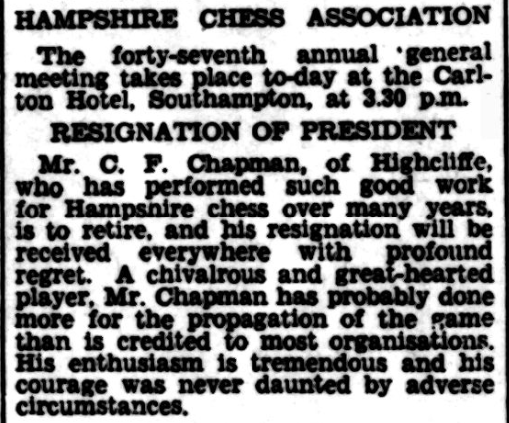
Highcliffe is a small coastal town to the east of Bournemouth and Christchurch, then in Hampshire, now in Dorset. One wonders what exactly the adverse circumstances were.
That resignation marked the end of his meteoric chess career. one that lasted a little under 12 years, taking him through his sixties and into his seventies.
By 1939, he’d returned to the Isle of Wight, now living with his wife Gladys, 35 years his junior. I’m not sure what happened to Mary.

It sounds as if Mary and Jill might have been daughters from his previous marriage, but I haven’t been able to find anything definitive. There’s a possible marriage to Gladys in Newport Pagnell (not exactly on the South coast) in 1926.
The amount he left was the equivalent to somewhere approaching £5 million today.
Here was a man who had a long and, it seems, rather picaresque life, although there’s much I haven’t been able to discover. He was certainly wealthy: ‘Rolls-Royce and all that’, Macartney recalled. But why did he move house every 18 months or so? How many times, and to whom, was he married? Where was he in 1891? Who was his mother?
It was certainly unusual, even in those days, for someone to start playing competitive chess at the age of 60 and immediately find success in strong club championships, on top board for his club, and in county matches. He must have studied a lot, and played a lot of casual chess. Not many of his games survive, but it’s clear that he excelled in queen’s pawn games: the London System, Torre Attack and Colle System, turning these quiet openings into vicious kingside attacks. Outside of his comfort zone, he seemed to struggle. Wherever he moved he joined the chess club, or, if there wasn’t one nearby, started one up, donating generously to both club and county chess, and, as a result, being elected President: cash for honours!
He may or may not have been the CF Chapman who, back in 1882, played for the 4th class of the City of London Chess Club against the 3rd class. (It’s interesting to note that the 4th class team included BG Laws, later one of the leading problemists of his generation, and Charles Joseph Woon, later a strong London amateur player.)
He merited an obituary in the British Chess Magazine in May 1949. He will be remembered as a Past President of Dorset C.A. and Hampshire Chess Association, and a Vice-President of Sussex. At different times he held the championship of the Brighton, Bournemouth, Parkstone, Eastbourne, Chichester, and Isle of Wight clubs; but perhaps he will be best remembered for his work in introducing chess to Parkhurst Prison during his sojourn in the Isle of Wight.
It’s easy to get confused between Charles and Charles Frederick Chapman, but there were other prominent chess players around at the same time with similar names
There was a problemist and player from Cardiff named CF Chapman, who was active as a composer between 1927 and 1950. You can find some of his problems here. I haven’t yet been able to identify him with certainly as there were several CF Chapmans (Chapmen?) living in Cardiff at the time, mostly with the first name Charles. There was also a South African problemist named C Chapman, and another Charles Chapman who represented Cambridge in the 1877 and 1878 varsity matches.
Come back soon for future Minor Pieces, which may or may not, like this article, attempt to sort out people with similar names.
Sources and Acknowledgements
ancestry.co.uk
findmypast.co.uk/British Newspaper Archives
Wikipedia
Google Maps
BritBase (John Saunders)
chessgames.com
EdoChess (C Chapman here, but there is some confusion with his namesake)
Chess Notes (Edward Winter)
Yet Another Chess Problem Database (YACPDB)
Special thanks to Brian Denman for kindly sending me his file of games played by both Charles and Charles Frederick Chapman


 Minor Pieces
Leave a comment