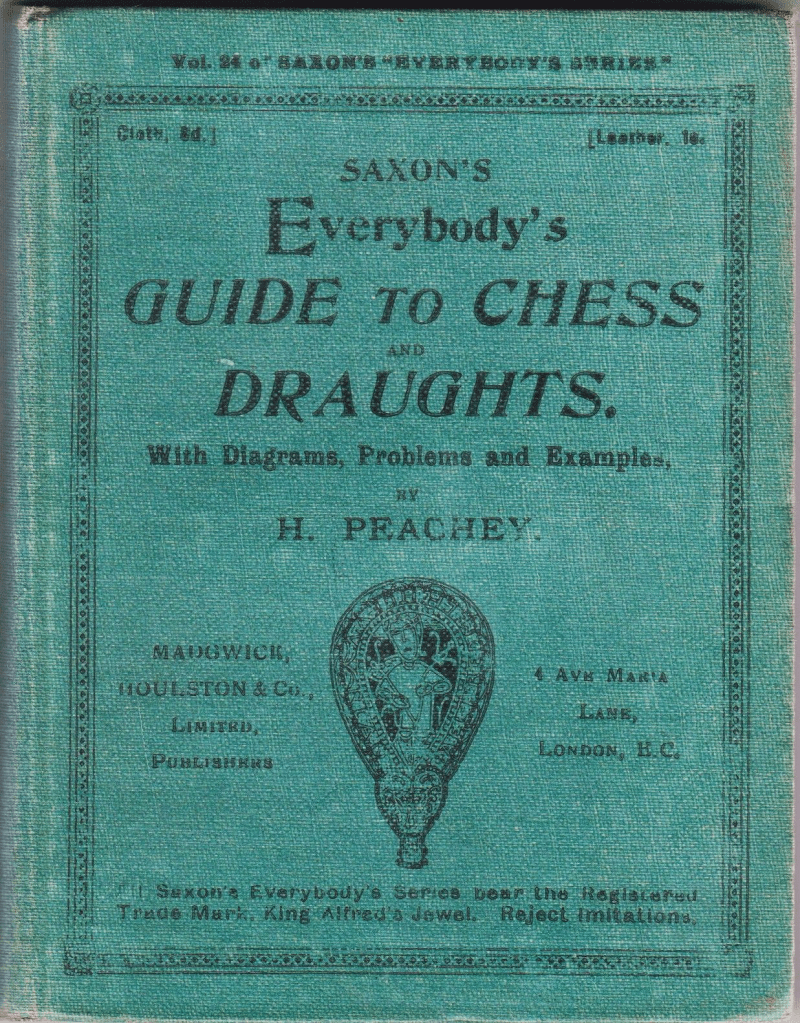
Here’s a book from the English Chess Federation Library.
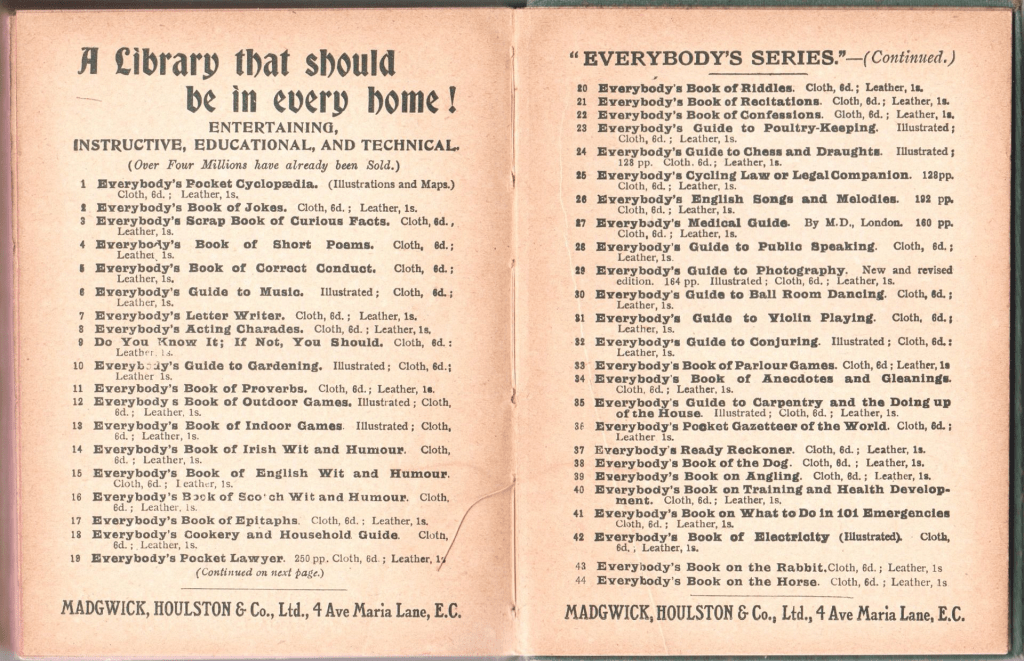
It was one of a series: a library that should be in every home!
Of course I wanted to know more about Mr Peachey, and soon discovered that he had a relatively brief chess career in the 1890s, at first living in North London, a member of Athenaeum and City of London clubs, before moving to Surrey, where he became county champion in 1896.
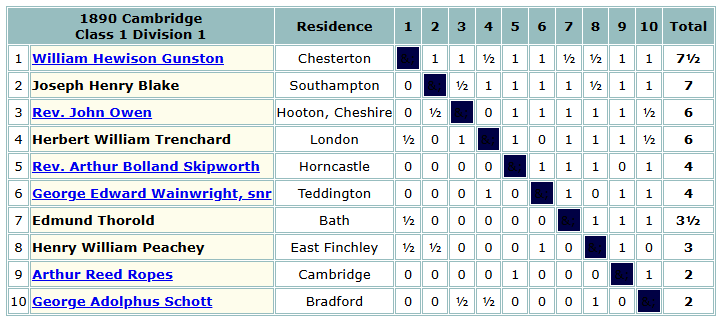
Here he is, taking part in his first public tournament.
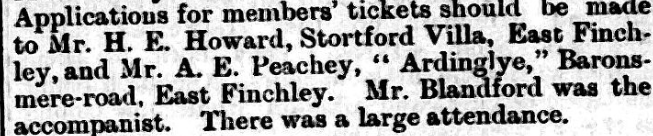
I found an address for Henry:

There was another Peachey at the same address, involved with the inaugural meeting of the East Finchley Artistic and Mutual Improvement Association.
It’s time to find out more.
Let me introduce you to George Richards Elkington, the man who took out the first patent for a commercial eletroplating process back in the early 1840s.
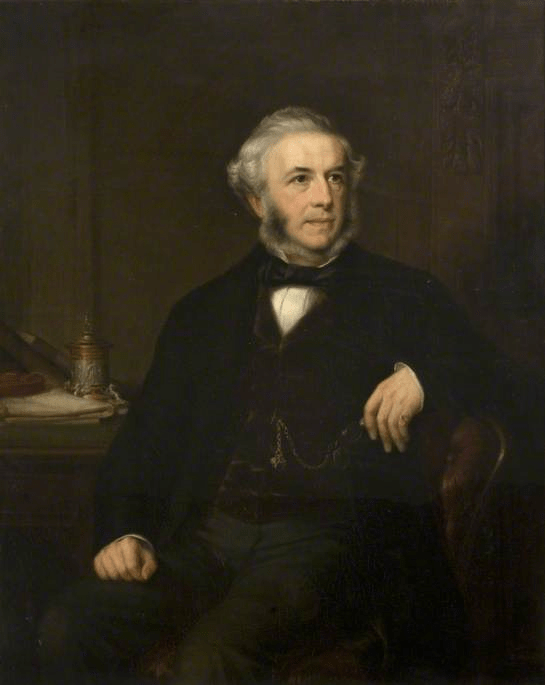
His wife, Mary Auster Balleny, whose family were jewellers, had a brother named John. Here’s a trade card from 1858.
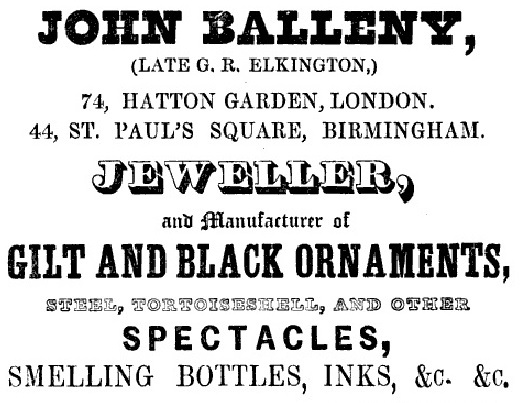
You’ll see that John had taken over George’s business, combining their talents to make a wide variety of objects, and that they were based, not just in the Birmingham Jewellery Quarter but also in Hatton Garden, the centre of the London jewellery trade.
I suspect this was somewhere near the Johnson Building: a short walk up to the corner of Clerkenwell Road will take you to where I worked in the 1970s.
John’s children were John Augustus, who continued the family business, and Mary Elizabeth, who married William George Peachey, the son of a silversmith, who worked as John Balleny’s assistant.
William and Mary’s children were Lilian Mary (1861-1959), our man Henry William (1863-1920), Gertrude Agnes (1868-1929) and the aforementioned Arthur Edwin (1871-1898). By 1871 they’d moved from Hatton Garden to 21 Thornhill Road Islington, although I suppose they may still have been carrying on their business there: no one was recorded at that address.
In 1881 they were still in Islington, where 18-year-old Henry had left school and was working as a clerk to a tea broker.
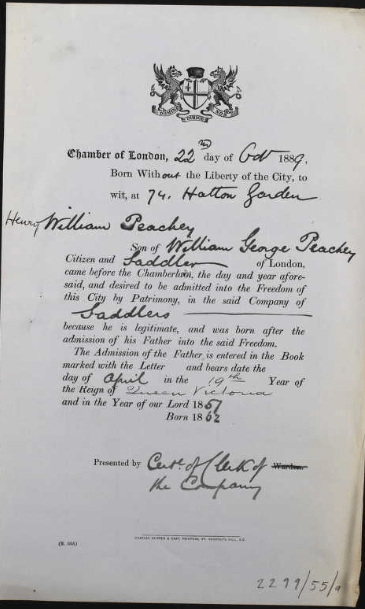
Moving forward to 1889, he was awarded Freedom of the City of London by patrimony: his father was a member of the Company of Saddlers (even though he was a silversmith).
The earliest reference I can find to Henry as a chess player is in November 1885, where he won his game on bottom board playing for Athenaeum against the Railway Chess Club. In 1887 he was elected Hon Secretary of the Athenaeum Chess Club.
He must have made rapid progress as, playing in his first public tournament in 1890, he took part in the top section: you can see the results above.
This was a pretty strong event: EdoChess estimates Gunston and Blake’s ratings as over 2400 at the time, so it was quite an achievement for Henry to draw with both of them.
Here’s his loss against Thorold. (Source: chessgames.com)
[Event “Counties Chess Association Cambridge”]
[Date “1890.06.26”]
[White “Thorold, Edmund”]
[Black “Peachey, Henry William”]
[Result “1-0”]
1. f4 d5 2. e3 Nf6 3. Nf3 b6 4. b3 Bb7 5. Bb2 e6 6. Be2 Bd6 7. O-O Nc6 8. Ne5 Ne7 9. d4 Nf5 10. Bb5+ Kf8 11. Qe1 h5 12. Nd2 Bxe5 13. fxe5 Ng4 14. Rf3 Qg5 15. Nf1 g6 16. Rd1 Kg7 17. Bc1 Qe7 18. h3 Ngh6 19. Bd3 c5 20. c3 c4 21. Bc2 cxb3 22. axb3 Rac8 23. Ng3 h4 24. Nxf5+ Nxf5 25. Bxf5 gxf5 26. g4 fxg4 27. hxg4 Qg5 28. Rf4 h3 29. Qd2 h2+ 30. Kh1 Qg6 31. Rdf1 Rc7 32. Qf2 Kg8 33. Rf6 Qg7 34. Qe2 Qh7 35. R6f4 Rxc3 36. Qb5 Bc6 37. Qb4 Qd3 38. Qe7 Qg6 39. Ba3 f5 40. gxf5 Qg7 41. Qxe6+ 1-0
In this club game from December 1890 Peachey lost to a celebrated oarsman (The Field 20.12.1890).
[Event “Athenaeum v British Chess Club”]
[Date “1890.12.11”]
[White “Woodgate, Walter Bradford”]
[Black “Peachey, Henry William”]
[Result “1-0”]
1. e4 e5 2. Nf3 Nc6 3. Bc4 Bc5 4. O-O d6 5. Nc3 Bg4 6. Bb5 a6 7. Be2 Nf6 8. d3 Qd7 9. Bg5 h6 10. Bxf6 gxf6 11. Nd5 Qd8 12. Nh4 Bxe2 13. Qxe2 Nd4 14. Qd1 c6 15. Ne3 Qd7 16. c3 Ne6 17. Ng4 O-O-O 18. Nf5 Rdf8 19. d4 exd4 20. cxd4 Ba7 21. Rc1 Nf4 22. Qf3 Ng6 23. Nxf6 Qe6 24. Nd5 Re8 25. Qg3 Rd8 26. Nc3 d5 27. Ng7 Qf6 28. Nxd5 Rxd5 29. exd5 Qxg7 30. dxc6 f5 31. cxb7+ Kxb7 32. Qf3+ Kb8 33. Rc6 Ne7 34. Qb3+ Ka8 35. Rc7 1-0
William had died in 1887, by which time the family had moved to East Finchley. The 1891 census tells us that his wholesale jewellery business was now being run by Mary, with Henry acting as her manager. Arthur was working as a publishers’ clerk, which might explain why Henry was asked to write his book.
The 1891 Counties’ Chess Association meeting moved from Cambridge to Oxford, with Peachey again in the top section, meeting several of the same players as the year before.
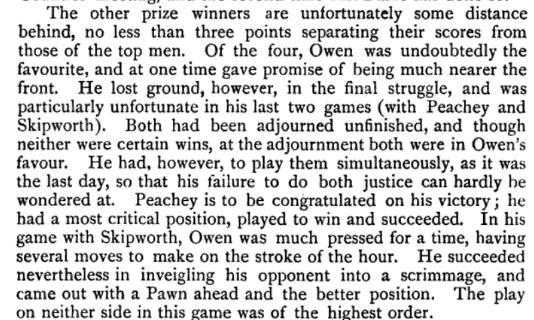
The BCM reports:
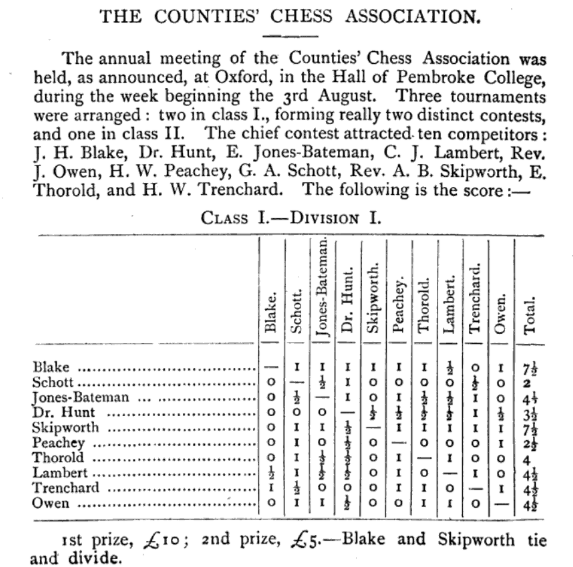
He was lucky against Owen, who had to play off two adjournments simultaneously on the last day.
This time he was well beaten by Blake (Illustrated Sporting and Dramatic News 31.10.1891).
[Event “Counties Chess Association Oxford”]
[Date “1891.08.??”]
[White “Blake, Joseph Henry”]
[Black “Peachey, Henry William”]
[Result “1-0”]
1. e4 e5 2. Nf3 Nc6 3. d4 exd4 4. Nxd4 Bc5 5. Be3 Qf6 6. c3 Nge7 7. Qd2 h6 8. Nb5 Bxe3 9. Qxe3 Kd8 10. Nd2 a6 11. Na3 Re8 12. O-O-O d6 13. Ndc4 Ng6 14. g3 Bg4 15. Be2 Bxe2 16. Qxe2 b5 17. Nd2 b4 18. Nab1 bxc3 19. Nxc3 Rb8 20. f4 Nd4 21. Qxa6 Rb6 22. Qa8+ Kd7 23. Qa4+ Rc6 24. Nc4 Ne2+ 25. Kc2 Nxc3 26. bxc3 Rxe4 27. Nb6+ cxb6 28. Qxe4 Qxc3+ 29. Kb1 Rc4 30. Qb7+ Rc7 31. Qxb6 Rc6 32. Qb5 Qc2+ 33. Ka1 Qc3+ 34. Qb2 Qa5 35. Rc1 Rb6 36. Qc3 Qb5 37. Qc7+ Ke6 38. Rhe1+ Ne5 39. Rb1 1-0
The BCM added that ‘Peachey’s style is lively and improving, but he needs perhaps to rise a little to the strength of his class’.
By 1892 Henry had joined the City of London Chess Club, but he maintained his post as secretary of the Athenaeum Club, where he gave a simul that July, and was also involved with the administration of the nascent Southern Counties Chess Union.
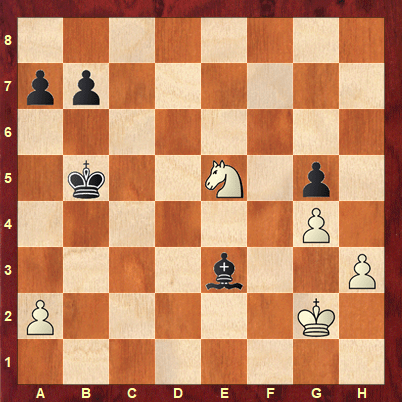
The following January, a megamatch took place in Birmingham between teams representing the North and South of England. I’d recommend the British Chess Magazine for February 1893 (from which the position below is taken) and the Birmingham Daily Post of 30 January 1893, wh0 both provided colourful reports of this event. Peachey was on Board 61 for the South, facing a future President of the British Chess Federation, winning his game when his opponent moved his king backwards rather than forwards before trading off into a lost pawn ending.
[Event “North v South B61”]
[Date “1893.01.28”]
[White “Derbyshire, Job Nightingale”]
[Black “Peachey, Henry William”]
[Result “0-1”]
[SetUp “1”]
[FEN “8/pp6/8/1k2N1p1/6P1/4b2P/P5K1/8 w – – 0 1”]
1. Kf3 Bc1 2. Nd3 Bd2 3. Ke2 Bc3 4. Kd1 Kc4 5. Kc2 Kd4 6. Nc5 Kxc5 7. Kxc3 0-1
In this game from a club match his sacrificial attack brought home the full point after his opponent misdefended: 33… Bg5, exploiting White’s back rank weakness was the nicest of many reasonable options. (Source: Herts Advertiser 18.02.1893.)
[Event “Athenaeum v St Albans”]
[Date “1893.02.11”]
[White “Peachey, Henry William”]
[Black “Rogers, John”]
[Result “1-0”]
1. e4 c5 2. Nc3 Nc6 3. Bc4 g6 4. f4 Bg7 5. Nf3 d6 6. O-O Nf6 7. e5 dxe5 8. fxe5 Nxe5 9. Bb5+ Nfd7 10. Nxe5 Bxe5 11. Qe1 Bd4+ 12. Kh1 O-O 13. Nd5 e6 14. Nf4 a6 15. Bc4 b5 16. Qe4 Rb8 17. Bd3 Bb7 18. Qe2 Bg7 19. c3 Nf6 20. Bc2 Qd7 21. d3 Nd5 22. a4 b4 23. cxb4 Nxb4 24. Bb1 Rbc8 25. Ra3 e5 26. Nh5 gxh5 27. Qxh5 f5 28. d4 Qf7 29. Qh4 e4 30. Rh3 Bf6 31. Qh6 Kh8 32. Rxf5 Qg7 33. Qh5 Bxd4 34. Bh6 Rxf5 35. Bxg7+ 1-0
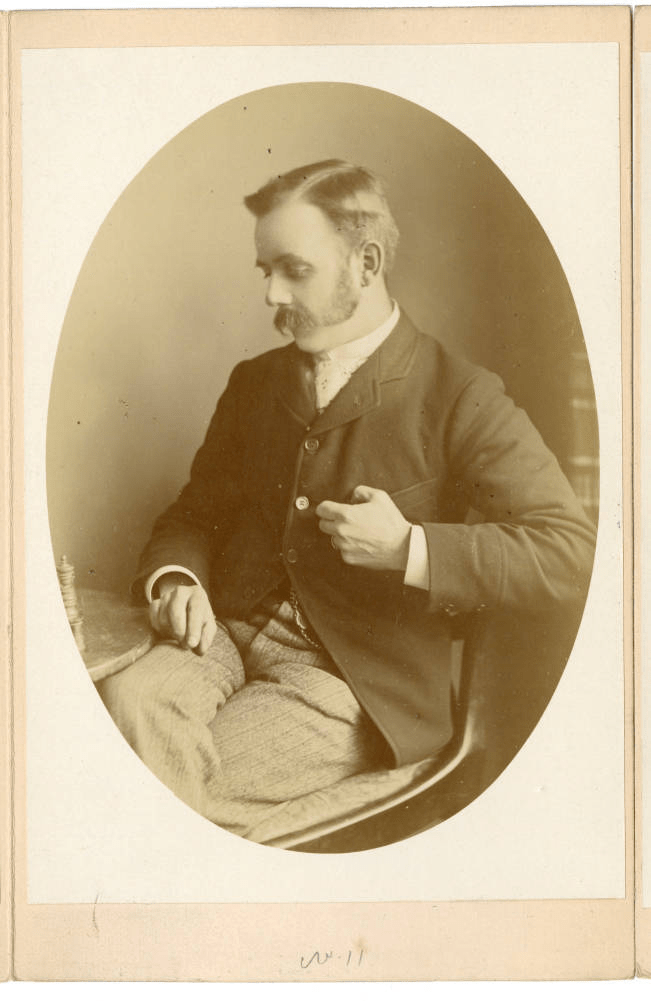
Here he is, pictured in The Chess Album No. 3: January 1894:
… which also provides this undated game.
[Event “?”]
[Date “????.??.??”]
[White “Peachey, Henry William”]
[Black “Amateur”]
[Result “1-0”]
1. e4 e5 2. d4 exd4 3. Qxd4 Nc6 4. Qe3 g6 5. Bd2 Bg7 6. Nc3 d6 7. a3 Ne5 8. f4 Nc6 9. Nf3 Nce7 10. Bd3 Nh6 11. h3 f5 12. Ng5 c6 13. e5 dxe5 14. fxe5 Nd5 15. Nxd5 Qxd5 16. Nf3 Nf7 17. Bc3 O-O 18. O-O f4 19. Qd2 Qc5+ 20. Kh1 Qe7 21. Rad1 Nh6 22. Qf2 c5 23. Bc4+ Kh8 24. Rfe1 Nf5 25. Rd6 Nxd6 26. exd6 Qxd6 27. Ne5 Be6 28. Nxg6+ hxg6 29. Qh4+ Kg8 30. Rxe6 1-0
By 1894 he had moved south of the Thames, now representing Surrey in county matches. In 1895 he returned to tournament chess, taking part in one of the subsidiary sections of the great Hastings tournament.
This was itself a pretty strong event, but it has been little written about and few games seem to have been published. There were 32 players grouped into four roughly equal sections of 8 players. The four section winners then played an all-play-all tournament for the leading places, while the four runners-up played in a consolation tournament.
In addition, there was a Ladies’ Major Tournament: two groups of six ladies, with the top two in each group playing off in the final, and a second Ladies’ Tournament with another eight players.
At least two of the players in the Amateur Tournament, Maroczy (1st) and Atkins (2nd=), would not have been out of place in the Masters Tournament. Peachey was in Section 4, which resulted as follows:
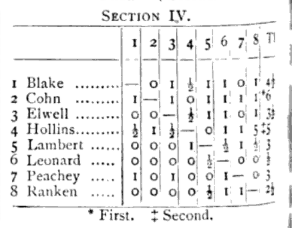
He was lucky against Blake, who blundered when trying to win a drawn position.
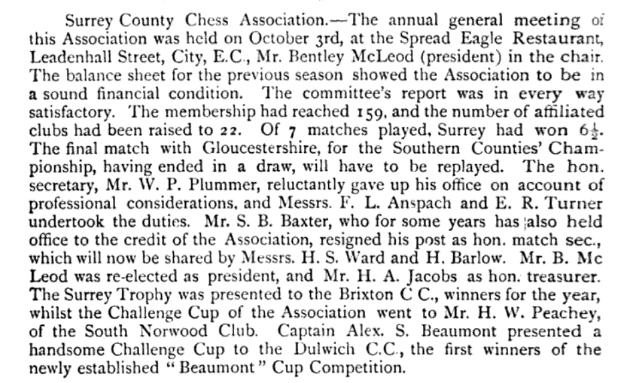
1896 was, for two reasons, a big year for Henry Peachey: the first highlight was winning the Surrey Championship: this report in the BCM is all the information I’ve been able to find.
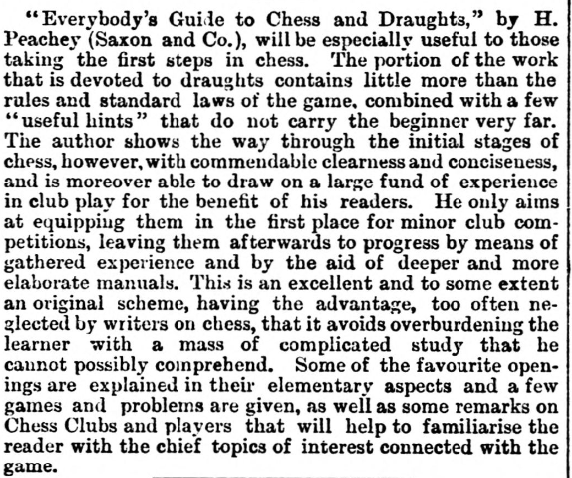
The second highlight was the publication of his book on chess and draughts, reviewed here by Antony Guest.
The book itself doesn’t seem to be available to read online, although second hand copies can be bought from the usual sources.
An extract was published in the centenary history of the Metropolitan Chess Club, which can be found here.
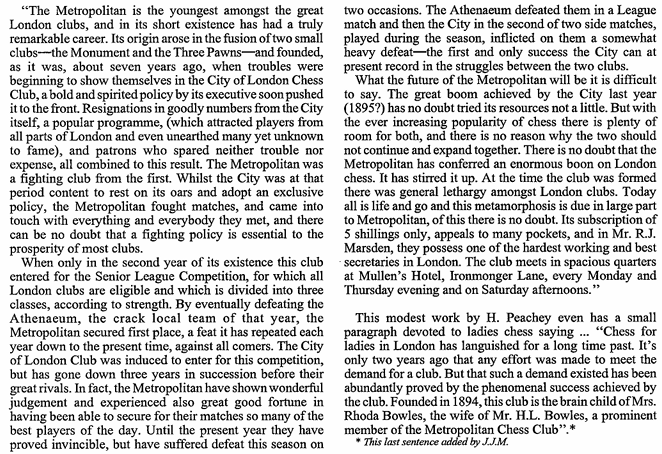
Edward Winter, in this article, offers a brief quote:
‘My advice to you as a young player is, pay chief attention to attack, for you will learn far more by doing so. Try and have an object in every move you make. Do not bother about your own king too much whilst learning the game, but go for your opponent’s. When experience has come to you you can judge for yourself. You may then if you choose, although I trust you will not, play that slow “wood-shifting”, “stone-wall” kind of game that is, I regret to say, adopted by so many, but, for the present at any rate, play lively and “make things hum”.’
I don’t think he’d have approved of the London System which is so fashionable today. Nor would he have been amused when his opponent in this game from the City of London Club Championship later that year crushed him with, yes, the Stonewall Attack. (Source: Kentish Mercury 25.12.1896)
[Event “City of London CC ch”]
[Date “1896.12.??”]
[White “Cole, Henry Holwell”]
[Black “Peachey, Henry William”]
[Result “1-0”]
1. d4 d5 2. e3 e6 3. Bd3 c5 4. c3 Nc6 5. f4 Nf6 6. Nd2 cxd4 7. exd4 Bd6 8. Ndf3 Nh5 9. g3 Nf6 10. Qc2 Bd7 11. Ne5 Qa5 12. Ngf3 h6 13. O-O Qb6 14. Kg2 Rf8 15. Re1 Nh5 16. f5 Bxe5 17. Nxe5 Nxe5 18. Rxe5 O-O-O 19. fxe6 fxe6 20. Rxh5 Rf6 21. Re5 1-0
Brian Denman provides this county match game (West Sussex Gazette 21.1.1897 and Illustrated London News 06.02.1897)
[Event “Surrey v Sussex B7”]
[Date “1897.01.09”]
[White “Bowley, Albert Alexander”]
[Black “Peachey, Henry William”]
[Result “1-0”]
1. e4 e5 2. Nf3 Nc6 3. Bb5 f5 4. d4 fxe4 5. Bxc6 bxc6 6. Nxe5 Nf6 7. O-O c5 8. f3 exf3 9. Qxf3 Ba6 10. Re1 Be7 11. Nc6 dxc6 12. Qxc6+ Kf8 13. Qxa6 Qxd4+ 14. Be3 Qxb2 15. Nd2 Qxc2 16. Rac1 Qf5 17. Rf1 Qd7 18. Ne4 Rd8 19. Nxc5 Bxc5 20. Bxc5+ Kf7 21. Qxa7 Ra8 22. Qb7 Rxa2 23. Rce1 Qd2 24. Qb3+ Kg6 25. Qg3+ Qg5 26. Qd3+ Kh5 27. Rf5 Rxg2+ 28. Kh1 Rxh2+ 29. Kxh2 Ng4+ 30. Kg3 1-0
We also have three rather drastic defeats from the City of London tournament the following summer.
[Event “City of London CC Summer t”]
[Date “1897.07.??”]
[White “Peachey, Henry William”]
[Black “Lawrence, Thomas Francis”]
[Result “0-1”]
1. e4 e5 2. Bc4 Nf6 3. d3 Nc6 4. f4 Bc5 5. Nf3 d6 6. h3 Be6 7. Bxe6 fxe6 8. fxe5 dxe5 9. Bg5 O-O 10. Nc3 b5 11. Qd2 Qe8 12. Be3 Nd4 13. O-O Rd8 14. Nxe5 b4 15. Rf4 Qh5 16. Na4 Ne2+ 17. Kh2 Bxe3 18. Qxe3 Nxf4 19. Qxf4 Nd7 0-1
(Source: Westminster Gazette 31.07.1897)
[Event “City of London CC Summer t”]
[Date “1897.07.23”]
[White “Blackburne, Joseph Henry”]
[Black “Peachey, Henry William”]
[Result “1-0”]
1. e4 e5 2. f4 exf4 3. Bc4 Qh4+ 4. Kf1 g5 5. Qf3 h5 6. Qc3 Rh7 7. Nf3 Qg4 8. d4 Nc6 9. Qd3 h4 10. e5 h3 11. Rg1 Rg7 12. Nc3 f5 13. Bxg8 Nb4 14. Qe2 Rxg8 15. a3 hxg2+ 16. Rxg2 Qh3 17. Ng1 f3 18. Qxf3 Qxf3+ 19. Nxf3 Nc6 20. Nd5 Kd8 21. Bxg5+ Be7 22. Nxe7 1-0
(Source: chessgames.com)
[Event “City of London Summer t”]
[Date “1897.07.??”]
[White “Physick, Thomas”]
[Black “Peachey, Henry William”]
[Result “1-0”]
1. e4 e5 2. Nf3 Nc6 3. d4 exd4 4. Nxd4 d6 5. Nxc6 bxc6 6. Bd3 Nf6 7. Qe2 Be7 8. Bf4 O-O 9. O-O Re8 10. h3 Rb8 11. Nd2 Rxb2 12. Nb3 d5 13. Bc1 Rxb3 14. axb3 Nxe4 15. Bxe4 dxe4 16. Rxa7 Bc5 17. Ra8 Qe7 18. Be3 Bd6 19. Bd4 h6 20. Bxg7 Qg5 21. Bxh6 Qe5 22. g3 Bxh3 23. Rxe8+ Qxe8 24. Qh5 1-0
(Source: Knowledge : An Illustrated Magazine of Science, Literature, and Art 01.10.1897)
One of his wins was also published:
[Event “City of London Summer t”]
[Date “1897.07.??”]
[White “Peachey, Henry William”]
[Black “Evans, William John”]
[Result “1-0”]
1. e4 e5 2. Nf3 Nc6 3. Bc4 Nf6 4. d3 Be7 5. O-O d6 6. c3 Be6 7. Bxe6 fxe6 8. Qb3 Qc8 9. Ng5 Nd8 10. f4 exf4 11. Bxf4 h6 12. Nf3 e5 13. Bd2 Qe6 14. Qa4+ c6 15. Nh4 Ng4 16. Nf5 O-O 17. Qd1 Nf6 18. Rf3 Nf7 19. Rg3 Ne8 20. Rg6 Qd7 21. Qg4 Kh8 22. Rxg7 Nf6 1-0
(Source: Hampshire Telegraph 29.10.1898)
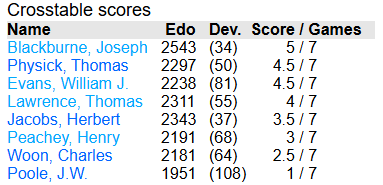
Here’s the crosstable, taken from EdoChess, who in turn took it from Di Felice. Peachey ended up in his usual position below half way.
Henry also took part in the club championship the following winter. We have several games available. In this game his opening gambit may have been dubious but, with some help from his opponent (read about his son here), he won with a sacrificial attack.
[Event “City of London CC ch”]
[Date “1898.??.??”]
[White “Peachey, Henry William”]
[Black “Serraillier, Lucien”]
[Result “1-0”]
1. e4 e6 2. d4 d5 3. c4 dxe4 4. f3 Nf6 5. Nc3 Bb4 6. Bg5 Bxc3+ 7. bxc3 exf3 8. Nxf3 c6 9. Bd3 Qa5 10. Qc2 Nbd7 11. O-O h6 12. Bh4 Qh5 13. Bg3 O-O 14. Bd6 Re8 15. Rae1 Qa5 16. Ne5 Qd8 17. c5 Nf8 18. Qf2 N8h7 19. Nxf7 Kxf7 20. Bxh7 Rh8 21. Qc2 Rxh7 22. Qxh7 Bd7 23. Rxf6+ Kxf6 24. Rf1+ Kg5 25. Qxg7+ Kh5 26. Be7 Qg8 27. g4#
(Source: chessgames.com)
Here he again played a dubious opening, managed to equalise, but then miscalculated a tactical variation.
[Event “City of London CC ch”]
[Date “1898.??.??”]
[White “Woon, Charles Joseph”]
[Black “Peachey, Henry William”]
[Result “1-0”]
1. e4 e5 2. Nf3 Nc6 3. Bc4 f5 4. d4 exd4 5. Nxd4 Nxd4 6. Qxd4 Qe7 7. Nc3 c6 8. O-O fxe4 9. Bxg8 Rxg8 10. Nxe4 d5 11. Bg5 Qf7 12. Rfe1 Be6 13. Kf1 Kd7 14. c4 b6 15. cxd5 Bxd5 16. Rad1 Re8 17. Qa4 Kc8 18. Bh4 Kb7 19. Re3 b5 20. Qd4 h6 21. a4 g5 22. Bg3 Bg7 23. Nd6+ Ka8 24. Nxf7 Bxd4 25. Rxe8+ Rxe8 26. Nd6 Bxb2 27. Nxe8 Bc4+ 28. Kg1 bxa4 29. Rd8+ 1-0
(Source: chessgames.com)
Trenchard (whom I really should write about at some point) finished this game with some neat tactics.
[Event “City of London CC ch”]
[Date “1898.??.??”]
[White “Trenchard, Herbert William”]
[Black “Peachey, Henry William”]
[Result “1-0”]
1. e4 e5 2. Nf3 Nc6 3. Bb5 d6 4. d4 Bd7 5. Nc3 Nf6 6. O-O exd4 7. Nxd4 Be7 8. f4 O-O 9. Bxc6 bxc6 10. f5 Rb8 11. b3 c5 12. Nde2 Ng4 13. h3 Ne5 14. Nf4 c6 15. Nh5 f6 16. Ne2 c4 17. Be3 Qa5 18. Nef4 a6 19. Bd4 Qd8 20. Ne6 Bxe6 21. fxe6 Kh8 22. Qe2 Qe8 23. g4 a5 24. Ng3 a4 25. Nf5 cxb3 26. axb3 axb3 27. cxb3 Rxb3 28. Ra7 Ng6 29. g5 Rg8 30. Nxg7 Nf4 31. Rxf4 Rxg7 32. Kh2 Qg6 33. Rxe7 Rxe7 34. Rxf6 1-0
(Source: Bristol Times and Mirror 07.05.1898)
He chose the sharp Schliemann Defence in reply to his opponent’s Spanish in this game, which proved a good fit for his attacking skills.
[Event “City of London CC ch”]
[Date “1898.??.??”]
[White “Jones, Edward Owen”]
[Black “Peachey, Henry William”]
[Result “0-1”]
1. e4 e5 2. Nf3 Nc6 3. Bb5 f5 4. d3 d6 5. O-O Nf6 6. Nc3 Be7 7. Bg5 O-O 8. Bc4+ Kh8 9. a3 Qe8 10. Bxf6 Bxf6 11. Nd5 Bd8 12. Qd2 fxe4 13. dxe4 Qg6 14. Qd3 Bg4 15. Nd2 Bg5 16. Kh1 Bxd2 17. Qxd2 Qxe4 18. Bb3 Nd4 19. f3 Nxf3 20. Qf2 h6 21. Ne3 Nxh2 22. Qxf8+ Rxf8 23. Rxf8+ Kh7 24. Re1 Bd7 25. Bd5 Qh4 26. g3 Qh3 27. Bg2 Bc6 28. Kg1 Qxg3 29. Re2 h5 30. Nf5 Nf3+ 31. Kf1 Qf4 32. Bh3 Bb5 33. Rf7 Bxe2+ 34. Kxe2 Ng1+ 0-1
(Source: Bristol Times and Mirror 07.05.1898)
Finally, up against Lawrence again, he once again experimented in the opening, and, facing unavoidable mate, had to resign on move 12.
[Event “City of London CC ch”]
[Date “1898.04.??”]
[White “Lawrence, Thomas Francis”]
[Black “Peachey, Henry William”]
[Result “1-0”]
1. d4 c5 2. d5 d6 3. e4 g6 4. f4 f5 5. e5 e6 6. Nc3 dxe5 7. fxe5 exd5 8. Nxd5 Qh4+ 9. g3 Qe4+ 10. Kf2 Qxh1 11. Nc7+ Kf7 12. Bc4+ 1-0
(Source: Illustrated Sporting and Dramatic News 30.04.1898)
This rather amusing miniature did the rounds of the chess columns at the time, but the rest was silence.
It seems he gave up competitive chess very suddenly at this point. There was an H Peachey playing briefly for West London in October 1899, but that, I suspect, was a different player.
Was he humiliated by the above rather embarrassing fiasco, or was his jewellery business now taking up more of his time?
His mother died in February 1901 in Weston-Super-Mare, where his brother Arthur had died three years previously: it may or may not be significant that probate was granted to her son-in-law, Lilian’s husband, rather than to Henry. The 1901 census found Henry still working in jewellery at 3 Gaywood Street, close to Southwark Cathedral and what was then the Bethlem Royal Hospital but is now the Imperial War Museum, just a short stroll from Waterloo Station. This was a large house seemingly comprising five apartments. This location would have made him eligible to play for Surrey, but was some way from his Surrey club: South Norwood.
He then returned to North London, where, in 1907 at the age of 44, he married Devon born Florence Ellen Newmarch. The 1911 census records Henry and Florence at 21 Clarence Road, Wood Green, just under 3 miles from his earlier address in East Finchley. He was no longer working, being described as ‘of Private Means’, but they weren’t employing a live-in servant. I note that Florence signed the census return on behalf of her husband: perhaps he was away at the time.
The remainder of his life seems to have passed quietly: his death was recorded in the fourth quarter of 1920 at the age of 57, apparently forgotten by the chess world. Florence lived on uneventfully until 1946.
Henry William Peachey had a rather brief chess career, lasting little more than a decade, but during that time he wrote a book, became a county champion and crossed swords, with occasional success, against many of the leading English players of his day.
Most of his surviving games were losses, but we can see that he was a strong player (EdoChess rates him just under 2200) who had some tactical ability, but hampered his chances by playing dubious openings and making calculation errors.
Sources and Acknowledgements
ancestry.co.uk
findmypast.co.uk/British Newspaper Library
Wikipedia
Google Maps
chessgames.com (Peachey here)
EdoChess (Rod Edwards: Peachey here)
BritBase (John Saunders)
British Chess Magazine (via Google Books)
Chess Notes (Edward Winter)
English Chess Federation Library/De Montfort University
A History of the Metropolitan Chess Club 1890-1990 (Moore & Deery)
http://www.925-1000.com (Hallmarks Database and Silver Research)
Gerard Killoran (who posted several games I’d missed on the English Chess Forum)
John Saunders, Brian Denman and Jon D’Souza-Eva

 Minor Pieces
Leave a comment