If you share my interest in the subject of child prodigies, I’d probably start by referring you to this article by Edward Winter.
One name missing from this article, though, is that of Harry Jackson, who, in the late 1870s, was billed as the Yorkshire Morphy.
You might have met him briefly and seen one of his games in my previous Minor Piece, but I’m sure you want to know where he came from, and what happened next.
Our story starts in what was in the 19th century the thriving mill town of Dewsbury in West Yorkshire, south of Leeds and Bradford, north east of Huddersfield.
Among those working in the cloth industry in the middle of the century was John Jackson. He and his wife Hannah had four sons and a daughter. While two of his sons, Samuel and Joshua, graduated into the middle classes, becoming solicitor’s clerks, the other boys pursued different careers. Abraham worked as a labourer before emigrating to Canada where he became a farmer. John, the youngest son, became (like my paternal grandfather in Leicester) a painter and decorator.
It was John who was the chess player, although I’d guess the whole family played socially. He and his wife, another Hannah, had a large family, three of whom played competitive chess. Harry, the Yorkshire Morphy, was his oldest son, born 16th December 1863. We’ll return to him later.
The next chess player in the family was William Ewart Jackson (1867-1951), his name suggesting that the family were supporters of the Liberal Party.
William (known as Willie) played for Dewsbury in the 1880s before moving to Leeds, where he worked for William Pape, a firm of glass merchants, and joining the local club. He was active in Leeds chess, both over the board and correspondence, until at least 1918.

In what may have been one of his last matches (the Woodhouse Cup was suspended between 1916 and 1919) he was privileged to watch Atkins beating Yates in masterly fashion on top board.
Here are two games. Click here if you’d like to copy and paste the pgns and play through the games online.
[Event “West Yorkshire Chess Association Leeds”]
[Date “1884.04.26”]
[White “Tate, Thomas William”]
[Black “Jackson, William Ewart”]
[Result “0-1”]
1. e4 e5 2. Bc4 Bc5 3. Nf3 d6 4. d3 h6 5. d4 exd4 6. Nxd4 Nf6 7. Qd3 Nbd7 8. Be3 O-O 9. Nf5 Ne5 10. Qd2 Nxe4 11. Nxh6+ gxh6 12. Qe2 Bxe3 13. Qxe3 Nxc4 14. Qxh6 Qf6 15. Qxf6 Nxf6 16. O-O Re8 17. Nc3 c6 18. b3 Ne5 19. f4 Neg4 20. h3 Ne3 21. Rf2 Bf5 22. Rc1 Ned5 23. Ne2 Ne4 24. Rf3 Kh8 25. c4 Ndf6 26. Nd4 Bd7 27. f5 c5 28. Nc2 Nd2 29. Rf2 Nfe4 30. Rf4 Ng5 31. Rh4+ Nh7 32. Rd1 Re2 33. g4 Bc6 34. Ne3 Nf3+ 35. Kf1 Rxe3 36. Rh6 Rae8 37. Rdxd6 Nh2+ 38. Kf2 Rf3+ 39. Kg1 Rg3+ 40. Kxh2 Rg2+ 41. Kh1 Re1#
[Event “Correspondence: Leeds Mercury Weekly Supplement”]
[Date “1904.??.??”]
[White “Skirrow, William”]
[Black “Jackson, William Ewart”]
[Result “0-1”]
1. e4 e5 2. Nf3 Nc6 3. Bb5 a6 4. Ba4 d6 5. d4 Bd7 6. c3 Nge7 7. Bg5 f6 8. Bh4 Na5 9. Nbd2 b5 10. Bc2 Qc8 11. a3 Ng6 12. Bg3 Be7 13. Nf1 Bd8 14. Ne3 Nc6 15. Qd2 Nce7 16. Rd1 c6 17. O-O Be6 18. h3 Bc7 19. d5 cxd5 20. exd5 Bd7 21. Bb3 O-O 22. c4 Bb6 23. Rc1 Bxe3 24. fxe3 bxc4 25. Rxc4 Qd8 26. Rfc1 Rb8 27. Ba2 Rb7 28. b4 Qb8 29. R1c3 Rc8 30. e4 Rbc7 31. Bf2 Nf4 32. Rxc7 Rxc7 33. Rxc7 Qxc7 34. Be3 Neg6 35. Ne1 Bb5 36. Kh2 Qc8 37. Qc2 Qxc2 38. Nxc2 Bd3 39. a4 Bxc2 40. b5 axb5 41. axb5 Nf8 42. Ba7 Bxe4 43. g3 Bxd5 0-1
White unnecessarily sacrificed a piece on move 39 when he might have held by going after the a-pawn.
The youngest of the chess-playing Jackson brothers was Joshua (1878-1935).
Joshua had an unusual competitive chess career, most of it taking place towards the end of his life.
There’s a J Jackson playing alongside Harry for Dewsbury in 1889, but it’s not clear whether this was John or Joshua.
It seems, though, that he only really started to take chess seriously after the First World War. In 1921 he entered the Yorkshire Championship, and also ventured to Manchester for the Northern Counties championship, where he was rather out of his depth, scoring only 1/7 against opponents such as Yates and Wahltuch, who shared first prize.
He was also playing correspondence chess, in 1922 winning his game for Yorkshire against Eric Augustus Coad-Pryor, whose father was at the time Vicar of Hampton Hill.
In 1923 he played again in the Northern Counties Championship, this time in Liverpool. That year the top section was a strong master tournament headed by Mieses, Maroczy, Thomas and Yates. Joshua played in the Major section, scoring 4½/9. Much interest was generated by the participation of 15-year-old Gerald Abrahams, who beat him in the first round.
[Event “NCCU Major: Liverpool”]
[Date “1923.03.31”]
[White “Abrahams, Gerald”]
[Black “Jackson, Joshua”]
[Result “1-0”]
1. e4 c5 2. Nf3 e6 3. c3 d5 4. Be2 dxe4 5. Qa4+ Bd7 6. Qxe4 Nc6 7. d4 h6 8. Be3 Qb6 9. Qc2 Rc8 10. Na3 cxd4 11. Nc4 Qc7 12. Nxd4 Na5 13. Nxa5 Qxa5 14. O-O Nf6 15. Rfe1 Bd6 16. h3 b5 17. Qd3 b4 18. c4 Ke7 19. c5 Bb8 20. Bf3 Qc7 21. g3 Rhd8 22. c6 Bxc6 23. Nxc6+ Qxc6 24. Qxd8+ Kxd8 25. Bxc6 Rxc6 26. Rac1 Kd7 27. Red1+ Nd5 28. Rc5 a6 29. Kf1 Bd6 30. Rxc6 Nxe3+ 31. fxe3 Kxc6 32. Kf2 a5 33. b3 Kc7 34. e4 Be5 35. g4 Kc8 36. Ke2 Kc7 37. Kd3 Kb7 38. Kc4 Kc8 39. Kb5 Bc7 40. Kc6 f5 41. gxf5 exf5 42. exf5 Bd8 43. Re1 Kb8 44. Re8 Kc8 45. Rh8 1-0
In 1925 Scarborough Chess Club decided to run what they hoped would be the first of an annual series of tournaments over the Whitsun holiday. Joshua entered the major tournament, which was split into A and B sections along with another group for late entrants. The top two players in each section advanced to the play-offs.
Not all the results were recorded, but we know that he drew with Frank Schofield of Leeds, who won both his section and the play-offs, and beat both Sydney Meymott and Stephen Ludbrooke of Rotherham. As he didn’t qualify for the play-offs, I’d guess he may well have been third in the Major A section. A highly commendable result for someone in his late forties with, as far as I can tell, little competitive experience.
The 1926 Scarborough tournament was graced by the presence of the great Alekhine, who duly won the top section. Joshua again played in the Major, this time coming second to Edith Holloway in his section, and, second again in the play-off for 4th, 5th and 6th places. There were always several ladies competing in Scarborough.
I note that J Jackson of Dewsbury’s Yorkshire Terriers won a lot of prizes in the Belfast Dog Show that year. Is this also Joshua, I wonder?
He didn’t take part in 1927, but was back again in 1928, scoring 5/9 in his section of the Major tournament.
In 1929 they were struggling for strong players, due, in part, to the local corporation withdrawing their support, so the top section was very much a mixed affair. There were two genuine masters, Tartakower and Sir George Thomas, two strong amateurs in Harold Saunders and Victor Wahltuch, and four lesser players, one of who was Joshua Jackson. Unexpectedly, he had made the big time late in life.
While he was no match for the top players, he managed a win and two draws against the other lesser lights of the tournament, scoring a respectable 2/7.
The games were all recorded by Tinsley and have now been published in a book by Tony Gillam and by John Saunders (no relation to Harold) on BritBase.
Joshua played the Old Indian Defence too passively against both Saunders and Wahltuch and was duly squashed.
Here’s the Saunders game.
[Event “Scarborough Premier R2”]
[Date “1929.05.20”]
[White “Saunders, Harold”]
[Black “Jackson, Joshua”]
[Result “1-0”]
1. d4 Nf6 2. c4 d6 3. Nc3 Nbd7 4. e4 e5 5. d5 Be7 6. Bd3 O-O 7. Be3 Nb6 8. h3 h6 9. g4 Nbd7 10. Nf3 g5 11. Ne2 b6 12. Ng3 Re8 13. Qd2 Nf8 14. Nf5 Bxf5 15. gxf5 Nh5 16. Bc2 Bf6 17. Ba4 Nd7 18. Bc6 Rb8 19. Nh2 Nf4 20. Ng4 Kg7 21. O-O-O Ng2 22. Nxf6 Kxf6 23. f4 Nxe3 24. fxg5+ hxg5 25. Qxe3 Rh8 26. Rdg1 Rh5 27. Qf3 Rh8 28. Qg4 Rg8 29. h4 Ke7 30. hxg5 f6 31. Rh7+ 1-0
Against both Tartakower and Thomas he sacrificed a piece unsoundly thinking he was going to regain it but missing a fairly obvious tactic.
Here’s the Tartakower game.
[Event “Scarborough Premier R5”]
[Date “1929.05.23”]
[White “Jackson, Joshua”]
[Black “Tartakower, Saviely”]
[Result “0-1”]
1. e4 c5 2. Nf3 Nf6 3. e5 Nd5 4. c4 Nc7 5. d4 cxd4 6. Nxd4 Nc6 7. Bf4 g6 8. Nc3 Bg7 9. Nxc6 bxc6 10. Qd2 Ne6 11. Bg3 Qa5 12. Ne4 Qc7 13. f4 Rb8 14. Be2 Qb6 15. O-O-O O-O 16. Bf2 c5 17. Nxc5 Nxc5 18. b4 Nb3+ 19. axb3 Qxf2 20. g3 d6 21. exd6 exd6 22. b5 Bf5 23. Rdf1 Qc5 0-1
He played out a steady, uneventful draw against Edith Holloway, concluding in a level pawn ending. Against Bolland he seemed to agree a draw in a winning position with two extra pawns.
His one win came from an instructive ending, when his opponent chose the wrong queen trade, going for a lost rather than a drawn pawn ending. There were further mutual blunders on move 42.
[Event “Scarborough Premier R7”]
[Date “1929.05.25”]
[White “Jackson, Joshua”]
[Black “Cadman, Henry Ashwell”]
[Result “1-0”]
1. e4 e5 2. Nf3 Nc6 3. Bb5 a6 4. Ba4 Nf6 5. O-O d6 6. Bxc6+ bxc6 7. d4 exd4 8. Nxd4 Bd7 9. Nc3 Be7 10. Bg5 O-O 11. Re1 Re8 12. f4 Rb8 13. b3 c5 14. Nf5 Bxf5 15. exf5 Qd7 16. Qd3 h6 17. Bh4 Nh5 18. Bxe7 Rxe7 19. Rxe7 Qxe7 20. Nd5 Qd7 21. g4 c6 22. gxh5 cxd5 23. Qxd5 Qe7 24. Qd3 Re8 25. Rd1 Qh4 26. Qf3 Re1+ 27. Rxe1 Qxe1+ 28. Kg2 Qd2+ 29. Qf2 Qd5+ 30. Kg3 Qxf5 31. Qe2 a5 32. Qe8+ Kh7 33. Qe2 d5 34. Qd3 Qe4 35. Qxe4+ dxe4 36. f5 g6 37. hxg6+ fxg6 38. fxg6+ Kxg6 39. Kf4 Kh5 40. c3 Kh4 41. Kxe4 Kh3 42. Kf5 h5 43. Kg5 h4 44. a3 Kxh2 45. Kxh4 Kg2 46. Kg4 Kf2 47. Kf4 Ke2 48. Ke4 Kd2 49. b4 axb4 50. axb4 1-0
Among the other competitors was the 15-year-old Maurice Winterburn, also from Dewsbury, who may well have travelled there with Joshua.
Scarborough hosted the British Championships in 1930, although the championship itself was replaced by an international tournament. Joshua didn’t take part this time, but continued to play both over the board and by correspondence into the 1930s.
Chess was now becoming increasingly popular with teenage boys, and Joshua, as Dewsbury’s star player, served as a mentor to the youngsters coming through the door.
One of those was Maurice Child, who joined as a 15-year-old in 1932, and, 75 years later, had very fond memories of Joshua Jackson.
The outstanding personality between the two world wars was Josh Jackson. A fine player, among the top half-dozen in Yorkshire, and a great analyst. He was always ready to teach any young player and could play several games simultaneous and blindfold!
He was a barber and there was always on show in the shop a board with the latest position in his current correspondence game.
But it’s Harry you really want to know about, so we need to return to Dewsbury.
His father John first attended the annual meeting of the West Yorkshire Chess Association in 1876. Both John and Harry would also attend every year between 1877 and 1880.
In January 1877 John and Harry travelled to Lincolnshire, both taking part in the Second Class section of the inaugural Lincoln County Chess Association meeting.
The Chess Player’s Chronicle reported on this event.

The Westminster Papers added that “Master H Jackson is a young gentleman of promise, aged 13, and is likely to be heard from again in the world of Chess”. For the winner, Abraham Cockman, see this discussion.
It’s easy to forget, in these days of pre-teen grandmasters, how unusual it was for even 13-year-olds to take part in chess competitions, and interesting to note how much attention young Harry received at the time.
Inspired by this success, John was inspired to give young Harry a trial game against Samuel Walter Earnshaw at Leeds Chess Club a few weeks later.

At the gathering of the West Yorkshire Chess Association, there was concern that the strain of match play was too much for one so young.

Try telling that to Bodhana or Ethan.
In December a delegation from Huddersfield Chess Club led by John Watkinson, who would found the British Chess Magazine in 1881, visited the Dewsbury Working Men’s Club to assess their chess players. Watkinson took on ten of them, including both John and Harry Jackson, in a simul.
Harry’s game was unfinished but Watkinson thought he could win. Stockfish agrees with his assessment.
[Event “Simultaneous Display: Dewsbury”]
[Date “1877.12.08”]
[White “Watkinson, John”]
[Black “Jackson, Harry”]
[Result “1-0”]
1. e4 e5 2. Nf3 Nc6 3. Bc4 Bc5 4. b4 Bxb4 5. c3 Bc5 6. d4 exd4 7. O-O dxc3 8. Bxf7+ Kxf7 9. Qd5+ Kf8 10. Qxc5+ d6 11. Qxc3 Qf6 12. e5 Nxe5 13. Nxe5 Qxe5 14. Qxc7 Qe7 15. Qc3 Qf6 16. Qc2 Bf5 17. Qb3 Qf7 18. Qg3 Qg6 19. Qf3 Qf7 20. Nc3 Be6 21. Qg3 Qd7 22. Ba3 Kf7 23. Ne4 Nf6 24. Ng5+ Kg8 25. Bxd6 h6 26. Nxe6 Qxe6 1-0
Harry played in Lincolnshire again over the New Year, but this time was less successful, as the Chess Player’s Chronicle reported.

The winner was Thomas Walter Marriott, not, as was reported in some sources, Arthur Towle Marriott. You’ll also note that Mary Rudge finished 3rd.
An interesting feature of this event was a displacement tournament, where the bishops and knights started on each other’s squares, an early precursor of Chess960/Freestyle Chess.
A chess club had now started in Dewsbury, with Harry finishing in second place in their first tournament, and playing on top board in their first match, against Huddersfield.
John Watkinson visited again for another simul: this time Harry put up rather less resistance, inadvisedly choosing an unsound gambit as early as move 2.
[Event “Simultaneous Display: Dewsbury”]
[Date “1878.02.25”]
[White “Watkinson, John”]
[Black “Jackson, Harry”]
[Result “1-0”]
1. e4 e5 2. Nf3 Bc5 3. Nxe5 d6 4. Nf3 Bg4 5. Bc4 Nc6 6. c3 Nf6 7. d4 Bb6 8. Bg5 Qe7 9. O-O O-O-O 10. Qd3 h6 11. Bxf6 Qxf6 12. Nbd2 g5 13. b4 h5 14. a4 a5 15. Bd5 Bd7 16. Bxc6 Bxc6 17. bxa5 Bxa5 18. Nc4 Bb6 19. Nxb6+ cxb6 20. d5 Bd7 21. Rfb1 Kb8 22. Rxb6 Rc8 23. Rab1 Rc7 24. Nd4 Qe7 25. Nc6+ Bxc6 26. dxc6 1-0
After winning a prize in the West Yorkshire gathering, Harry ventured to London for the Counties Chess Association meeting.

He did well to win both his games against Rev John De Soyres, a pretty strong player (2146 on EdoChess at the time), who would later emigrate to Canada. You can read more about him here.
In this game his opponent, whom I believe to be Frederick Orme Darvall, who had been Auditor-General of Queensland 1867-77, but was by that time living in London, overlooked a mate in one.
[Event “Counties Chess Association London Class 2”]
[Date “1878.08.??”]
[White “Darvall, Frederick Orme”]
[Black “Jackson, Harry”]
[Result “0-1”]
1. e4 e5 2. Nf3 Nc6 3. Bc4 Bc5 4. c3 d6 5. h3 Nf6 6. d3 O-O 7. Bg5 h6 8. Bh4 Be6 9. Bxe6 fxe6 10. Qb3 Qd7 11. Qd1 Rf7 12. Nbd2 Nh5 13. b4 Bb6 14. a4 a5 15. b5 Ne7 16. Bxe7 Qxe7 17. Nxe5 Qh4 18. Nxf7 Qxf2#
Harry’s participation must have caused quite a stir, not just because of his age but because of his background as the son of a painter and decorator from Yorkshire. It was also not without controversy.


I like the description of John here, who sounds very much like some (but, I hasten to add, not all) chess parents today.
After this trip to the capital Harry continued playing locally, and also by correspondence.
He lost this game against the blind player Henry Millard.
[Event “Correspondence”]
[Date “1879.??.??”]
[White “Millard, Henry”]
[Black “Jackson, Harry”]
[Result “1-0”]
1. Nc3 b6 2. e4 Bb7 3. d3 e6 4. Bd2 d5 5. exd5 exd5 6. d4 Bd6 7. Nb5 Nf6 8. Nxd6+ Qxd6 9. Bb5+ c6 10. Qe2+ Kd8 11. Bd3 Re8 12. Be3 Nbd7 13. O-O-O Rc8 14. Nh3 c5 15. Ba6 Bxa6 16. Qxa6 Qc6 17. dxc5 Re4 18. Qd3 Ne5 19. Qc3 Qe8 20. Ng5 Ned7 21. Nxe4 Qxe4 22. f3 Qg6 23. c6 Qf5 24. Rde1 Nb8 25. g4 Qg6 26. g5 Nxc6 27. gxf6 Nb4 1-0
White announced mate in 11 here. Stockfish thinks it’s mate in 15, but never mind.
In November 1879 he took the top board in a match between Dewsbury and Wakefield, winning two games and drawing one against schoolmaster John William Young, who taught English and Music at Wakefield Grammar School. John played in the same match, on bottom board, but was only able to conclude one game, which he lost.
In this game Harry’s speculative sacrifice proved successful.
[Event “Dewsbury v Wakefield B1”]
[Date “1879.11.29”]
[White “Jackson, Harry”]
[Black “Young, John William”]
[Result “1-0”]
1. e4 e5 2. Nf3 Nc6 3. Bc4 Nf6 4. Nc3 Bc5 5. d3 h6 6. Ne2 d6 7. c3 Bg4 8. Ng3 O-O 9. h3 Bxf3 10. Qxf3 a6 11. Nf5 Nh7 12. Bxh6 gxh6 13. Qg4+ Qg5 14. Nxh6+ Kg7 15. Nf5+ Kf6 16. f4 exf4 17. d4 Rae8 18. Bd3 Bb6 19. O-O-O Rh8 20. Qf3 Reg8 21. Rd2 Nf8 22. g3 fxg3 23. Nxd6+ Ke7 24. Qxf7+ Kxd6 25. e5+ Nxe5 26. dxe5+ Kxe5 27. Bc2 Rg7 28. Re1+ Be3 29. Rxe3+ 1-0
In 1880 Harry returned to Lincolnshire, this time to Boston, where he won the 2nd class tournament of the Counties Chess Association.
But now he was playing less as he’d taken up a new hobby: composing chess problems. Between 1879 and 1881 many problems bearing his name appeared in a wide variety of publications. Two of them even won first prizes.
Problem solutions can be found at the end of the article.
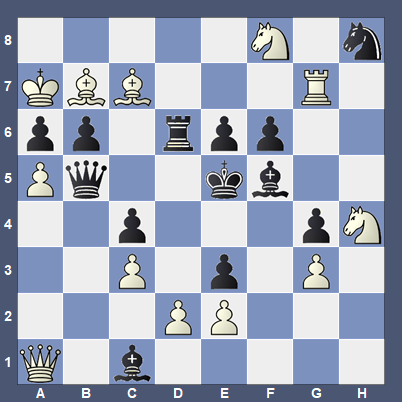
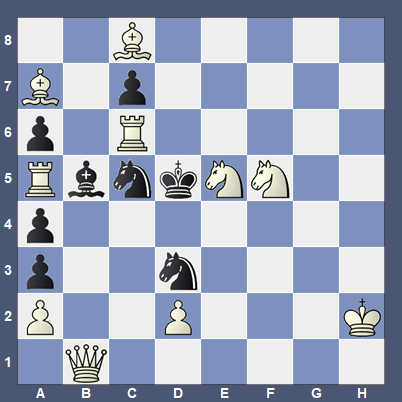
By 1881 Harry was living in London and involved with the City of London Club, taking on the role of librarian. In a match against St George’s he did very well to beat the very strong William Hewison Gunston 2-0. On 31st May the Chess Player’s Chronicle reported that ‘young Mr Jackson (lately Master Jackson of Dewsbury)’ had reached the last three in a handicap tournament before being eliminated.
I haven’t been able to locate him in that year’s census, but the rest of his family were all present and correct back in Dewsbury.
He remained in London for a few more years, playing, alongside his old friend Samuel Walter Earnshaw, in a simul against Mackenzie in 1882, and in 1883 beating Hugh William Sherrard in a match between the City of London 3rd team and Cambridge University, although he seems to have taken a break from composition.
At this point he may have moved back to Yorkshire. A couple of problems appeared in 1885, and then, in 1887, he turned up in York.

Here he is at their 1887 AGM, resigning as secretary and being appointed vice-president, as well as winning their club championship and guaranteeing himself top board for the next year. Although this is the earliest mention I’ve been able to find he must have been there for several months.
Later records give the club venue as at Mr Jackson’s Cocoa House in High Ousegate, suggesting that this was Harry’s occupation at the time.
On 24 April 1889 the local unionist party held a major event. No less than 3000 people sat down for tea, followed by concerts, dancing, and a demonstration of living chess. Although this was not Harry’s party (he also played for York Liberals) he wasn’t above taking part. There was a pre-arranged game between two local dignitaries, and then a more serious game between Charles George Bennett and Harry Jackson.

The game was played to a pretty high standard considering the circumstances.
[Event “Exhibition Game: York”]
[Date “1889.04.24”]
[White “Bennett, Charles George”]
[Black “Jackson, Harry”]
[Result “1/2-1/2”]
1. e4 e5 2. Nf3 Nc6 3. Bb5 a6 4. Ba4 d6 5. c3 g6 6. d3 Bg7 7. O-O Nge7 8. Be3 b5 9. Bc2 O-O 10. h3 Be6 11. Qe2 Kh8 12. Nbd2 Qd7 13. Ng5 Rae8 14. a4 Ra8 15. Ndf3 b4 16. Rad1 a5 17. d4 d5 18. dxe5 Nxe5 19. Bd4 N5c6 20. Qe3 Rad8 21. exd5 Nxd5 22. Qc1 h6 23. Ne4 Kh7 24. Nc5 Qc8 25. Be4 Rfe8 26. Rfe1 Nxd4 27. Nxd4 c6 28. Rd3 bxc3 29. bxc3 Bxd4 30. cxd4 Qb8 31. Rb3 Qf4 32. Rb7 Qf6 33. Qb2 Nb4 34. Rd1 Bd5 35. f3 Qf4 36. Qf2 Rb8 37. Re1 Rxb7 38. Nxb7 Bxe4 39. Rxe4 Rxe4 40. fxe4 Qc7 41. Nxa5 Qxa5 42. Qxf7+ 1/2-1/2
He had returned to the role of secretary of the Ebor Chess Club, but in 1890 he switched to the job of treasurer. The following year he resigned from that role and didn’t enter the club championship because he was away from home. But the 1891 census found him living in lodgings and working as a clerk, which suggests the cocoa house hadn’t been successful.
He continued to be very much involved with the Ebor club: as well as playing in matches he was giving regular simuls and lectures up until November 1894. After that, he seemed to disappear for a year or so.
In 1896 he turned up again – in another country.

Here he is, having moved to Edinburgh. He would stay there some time.
The 1896/97 Scottish Electoral Register gives his address as 47 Comely Bank Place, north west of the city centre and not far from the Royal Botanic Gardens.
In this game from 1899 he overlooked a tactic.
[Event “Richardson Cup: Dundee v Edinburgh”]
[Date “1899.03.??”]
[White “Jackson, Harry”]
[Black “Baxter, Horatio Thomas”]
[Result “0-1”]
1. f4 f5 2. Nf3 Nf6 3. b3 e6 4. Bb2 Nc6 5. e3 Be7 6. Bb5 O-O 7. O-O Ne4 8. Na3 Bf6 9. d4 Ne7 10. Bd3 Nd5 11. Qe1 b6 12. Bxe4 fxe4 13. Nd2 Qe8 14. Nxe4 Qg6 15. Nxf6+ Nxf6 16. Qe2 Bb7 17. Nc4 d6 18. Rac1 a5 19. Nd2 Ng4 20. h3 Nxe3 21. Rf2 Nd5 22. f5 Rxf5 23. Rxf5 exf5 24. Rf1 Ne3 25. Rf2 Re8 26. Nf3 f4 27. Qd2 Qg3 28. d5 Bxd5 29. c4 Bb7 30. Qe2 Re6 31. Bd4 h6 32. Bxe3 Rxe3 33. Qd1 Bxf3 0-1
In 1901 Harry was part of the Edinburgh team which won the Richardson Cup (Scottish KO Championship) for the first time.

And here, thanks to Edinburgh Chess Club, is the winning squad.

Harry Jackson is the burly (like his father) gentleman second from the left.
There’s no sign of Harry in the 1901 Scottish (or even the English) census. However (thanks to Alan McGowan for the information) he was in the 1901 Irish census, in Cork. He gave his occupation as a Commercial Traveller (Glass) and was living in a boarding house along with a number of other commercial travellers. He also said that he was married, but there was no sign of his wife.
In 1902 Edinburgh started two correspondence games against their counterparts in Rome, with Harry being one of the team.
Here’s the game in which Edinburgh played the white pieces, which concluded in early 1905.
[Event “Correspondence 1902-5”]
[Date “1902.??.??”]
[White “Edinburgh”]
[Black “Rome”]
[Result “1-0”]
1. e4 e5 2. Nf3 Nc6 3. Bc4 Bc5 4. b4 Bxb4 5. c3 Ba5 6. O-O d6 7. d4 Bd7 8. Qb3 Qe7 9. dxe5 dxe5 10. Rd1 Rd8 11. Rd5 Bb6 12. Bb5 Na5 13. Bxd7+ Rxd7 14. Qa4 Nc6 15. Nbd2 Qe6 16. c4 Nge7 17. Ba3 O-O 18. Ng5 Qg4 19. h3 Qf4 20. Rxd7 Bxf2+ 21. Kh1 Qxg5 22. Nf3 Qf6 23. Rxc7 g5 24. Bxe7 Nxe7 25. Qd7 Ng6 26. Rf1 Be3 27. g3 Rd8 28. Qf5 Rd6 29. Nd4 exd4 30. Qxf6 Rxf6 31. Rxf6 d3 32. Rfxf7 d2 33. Rfd7 b5 34. cxb5 1-0
Harry’s opponent in this game was an important figure in Scottish chess. The rather unimpressive 1. d4 d5 2. Qd3, which had been tried once by Pollock, seemed to have been his usual choice with White at this time.
[Event “Falkirk v Edinburgh”]
[Date “1905.02.04”]
[White “Jackson, Harry”]
[Black “Neilson, Archibald Johnston”]
[Result “1-0”]
1. d4 d5 2. Qd3 b6 3. Bf4 Nf6 4. Nd2 e6 5. c3 Be7 6. Ngf3 Ba6 7. Qc2 Nbd7 8. g4 c5 9. Rg1 h6 10. Qa4 Qc8 11. Be5 b5 12. Qb3 c4 13. Qc2 Nxe5 14. Nxe5 Nd7 15. Nxd7 Qxd7 16. e4 dxe4 17. Qxe4 Bb7 18. Qe5 Bf6 19. Qg3 Rd8 20. O-O-O a5 21. h4 g5 22. hxg5 hxg5 23. Bg2 Rc8 24. Bxb7 Qxb7 25. Rge1 b4 26. Ne4 Be7 27. d5 bxc3 28. Qxc3 Kd7 29. d6 Bd8 30. Qxh8 c3 31. Nxc3 Qf3 32. Qd4 Bf6 33. Rd3 1-0
Archibald Johnston Neilson might be considered Scotland’s answer to Antony Guest. He contributed an excellent column, usually twice a week, to his local paper, the Falkirk Herald, for 47 years, from 1895 right up to his death in 1942.
Perhaps he chatted with Harry after the game, asking him to contribute some problems. Since his early enthusiasm between 1879 and 1881 he had only composed occasionally, but now he entered the most prolific period of his chess problem career. For the next three years he regularly contributed problems, not just to the Falkirk Herald but also to the Mid-Lothian Journal.
His games from this period shine a light on both Harry’s strengths and weaknesses.
He could lose horribly when his opening went wrong, as in these two games. You’ll see in the first game that, although he was an Edinburgh player, he sometimes represented Glasgow in matches against English clubs. (Coincidentally, a Scotsman with the same name as his English opponent here wrote an excellent book on the King’s Gambit some years ago.)
[Event “Glasgow v Liverpool”]
[Date “1906.04.07”]
[White “Shaw, John Hepburn”]
[Black “Jackson, Harry”]
[Result “1-0”]
1. e4 e5 2. f4 exf4 3. Nf3 d5 4. exd5 Qxd5 5. Nc3 Qa5 6. d4 Bd6 7. Bc4 Ne7 8. O-O O-O 9. Ne4 Bg4 10. Nxd6 cxd6 11. Bxf4 d5 12. Bd3 Nbc6 13. Bxh7+ Kh8 14. c3 g6 15. Qe1 Bxf3 16. Rxf3 Nf5 17. Rh3 Kg7 18. g4 Rae8 19. Qd2 Rh8 20. Bh6+ Kxh7 21. Bf8+ Kg8 22. Rxh8+ Kxh8 23. gxf5 1-0
[Event “NCCU v Scotland: Newcastle”]
[Date “1907.05.??”]
[White “Jackson, Harry”]
[Black “Downey, Frederick Thomas”]
[Result “0-1”]
1. d4 d5 2. Qd3 g6 3. Bf4 Bg7 4. c3 c6 5. f3 Qb6 6. b3 Nd7 7. e4 e5 8. dxe5 Nxe5 9. Bxe5 Bxe5 10. Nd2 Ne7 11. Ne2 Be6 12. Nd4 O-O-O 13. Nxe6 fxe6 14. O-O-O Qa5 15. Kb2 dxe4 16. Qc2 Nd5 17. Nxe4 Nxc3 18. Rxd8+ Rxd8 19. Nxc3 Bxc3+ 20. Qxc3 Rd2+ 21. Qxd2 Qxd2+ 22. Kb1 Qd1+ 0-1
Given the opportunity, Harry could demonstrate skill in the ending: another couple of games.
[Event “Edinburgh v Glasgow Richardson Cup”]
[Date “1905.12.16”]
[White “Jackson, Harry”]
[Black “McKee, James Alexander”]
[Result “1-0”]
1. d4 d5 2. Qd3 Nf6 3. Bg5 e6 4. Nd2 Be7 5. Ngf3 c5 6. c3 Nc6 7. dxc5 Bxc5 8. e4 Be7 9. Bxf6 Bxf6 10. exd5 exd5 11. Qe3+ Be6 12. Nb3 O-O 13. Bd3 Re8 14. O-O Bf5 15. Qd2 Be4 16. Nfd4 Bxd4 17. cxd4 Qb6 18. Be2 Rac8 19. Rfc1 Rc7 20. Rc5 Ne7 21. Rac1 Rxc5 22. Rxc5 Bf5 23. Qe3 Be6 24. Bd3 Qd6 25. f4 Bd7 26. Qe5 Qxe5 27. dxe5 Bc6 28. Nd4 Rc8 29. Kf2 Kf8 30. g4 Bd7 31. Rxc8+ Bxc8 32. g5 Nc6 33. Ke3 Be6 34. Bb5 Ne7 35. Kd3 g6 36. Kc3 Nc8 37. Nxe6+ fxe6 38. Bd7 Nb6 39. Bxe6 Ke7 40. Bg4 Na4+ 41. Kc2 Nc5 42. f5 d4 43. f6+ Kf8 44. e6 d3+ 45. Kd2 Ne4+ 46. Ke3 Nxg5 47. h4 1-0
[Event “NCCU v Scotland: Manchester”]
[Date “1909.06.??”]
[White “Atkinson, Walter”]
[Black “Jackson, Harry”]
[Result “0-1”]
1. e4 d5 2. exd5 Qxd5 3. Nc3 Qa5 4. d4 Bf5 5. Nf3 Nc6 6. Bc4 e6 7. O-O O-O-O 8. Be3 Nf6 9. Qe2 Bg4 10. Rfd1 Qh5 11. a3 Bd6 12. h3 Bxf3 13. Qxf3 Qxf3 14. gxf3 Nh5 15. Ne4 Bf4 16. Kg2 Ne7 17. Ng5 Bxg5 18. Bxg5 Nf6 19. Be2 h6 20. Be3 Nf5 21. c4 Rd7 22. Rd3 Rhd8 23. Rad1 g5 24. Kh2 Nh5 25. b4 c6 26. b5 cxb5 27. cxb5 Nf4 28. Rc3+ Kb8 29. Bf1 Nxd4 30. Bxd4 Rxd4 31. Rdc1 Rd2 32. Kg3 Nh5+ 33. Kg2 Nf4+ 34. Kg3 f6 35. a4 Nd5 36. Rc4 f5 37. R1c2 f4+ 38. Kh2 Ne3 39. Rxd2 Rxd2 40. Rc1 Rxf2+ 41. Kg1 Rxf1+ 42. Rxf1 Nxf1 43. Kxf1 Kc7 44. Ke2 Kb6 0-1
By way of contrast, here’s an exciting game featuring opposite side castling with both kings seemingly in danger.
[Event “Edinburgh v Athenaeum: Richardson Cup”]
[Date “1907.02.16”]
[White “Jackson, Harry”]
[Black “Young, James”]
[Result “1-0”]
1. d4 d5 2. Qd3 g6 3. Bf4 Bg7 4. c3 Nf6 5. Nd2 O-O 6. Ngf3 a6 7. h3 Nh5 8. Bh2 f5 9. Ne5 Nf6 10. f3 Nbd7 11. g4 Nxe5 12. Bxe5 Nd7 13. Bxg7 Kxg7 14. gxf5 Rxf5 15. e4 dxe4 16. fxe4 Rf8 17. O-O-O Nf6 18. Be2 Be6 19. c4 c6 20. Kb1 Bf7 21. Rdg1 b5 22. h4 bxc4 23. Qe3 Qb6 24. h5 Rab8 25. b3 cxb3 26. a3 Rh8 27. Nc4 Bxc4 28. Bxc4 e5 29. Qg5 c5 30. dxe5 1-0
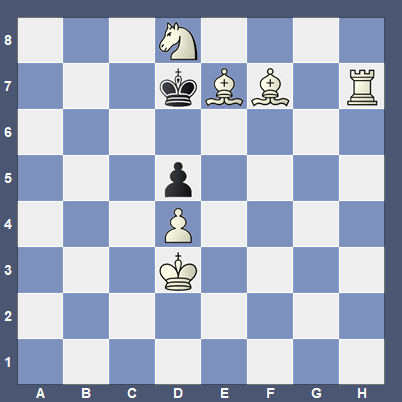
Now for a few of his problems from this period of his life.
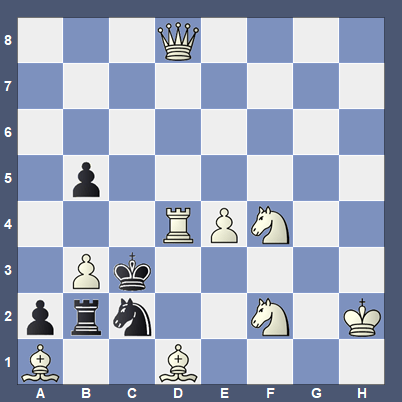
17 May 1905
Problem 4. #3 Falkirk Herald (for Stirling solving contest) 17 May 1905
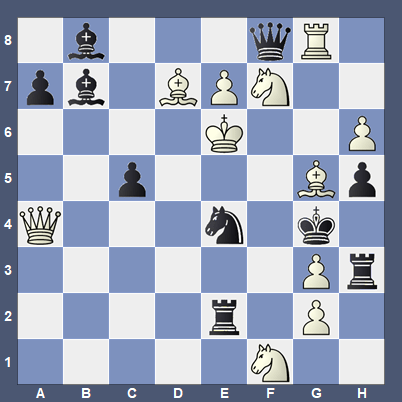
Problem 5. #2 Falkirk Herald 31 May 1906
To conclude, an easy one with a very familiar theme.
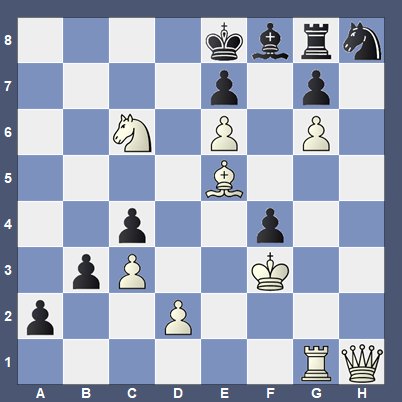
The year 1911 brings us a surprise. Harry isn’t in the Scottish census, but turns up in the English census, in Salford, near Manchester, visiting John Harry Leyland and his family. He’s aged 47 and working on his own account as a dealer in glass bottles. Perhaps there’s some connection there with his brother William, who was also in the glass business. He also has a wife, Ellen, aged 43: they’ve been married 17 years with one child, who is still alive, but not on the census record. Later records will tell us that their child’s name was May.
It’s a reasonable guess that Ellen, also known as Nellie, was related to the Leyland family, and we can locate an 1867 birth record which matches. The family were from Lancashire, but spent the first few years of their marriage in Smethwick. There’s no marriage record for Harry Jackson and Ellen Leyland from round about 1893-94, but there is one from 1902 in Chorlton, not all that far from Salford, so I’d guess that was where and when they married. There’s also a birth record for May Leyland in York in 1895 (no mother’s maiden name given), which was about the time he moved from York to Edinburgh. It seems like Harry and Ellen had had an affair, and perhaps the birth of their daughter prompted them to move to Scotland. They only got round to getting married some years later. Although we know Harry was on the 1901 Irish Census, I haven’t yet been able to find Ellen/Nellie and/or May on any of the England and Wales, Scottish or Irish census for that year.
Harry seems to have been back in Scotland by June, when he was elected one of the vice-presidents of the Scottish Chess Association. He was in august company: one of his fellow VPs was future Prime Minister Andrew Bonar Law.
In February 1912 he returned to the Edinburgh team after an absence, facing Percy Wenman of Glasgow in the Richardson Cup final, the game being drawn on adjudication.
And that he seems to have taken a long break from chess, and it’s not for almost a decade that we pick him up again.
The 1921 Scottish census goes some way to confirming my suspicions.

Here we have Harry, 57, born in Dewsbury, Nellie, 54, born in Smethwick, and May, 26, born in York. Harry was still working as a glass dealer on his own account, while Nellie and May were engaged in household duties. Their address was 13 South Charlotte Street and their residence, right in the city centre, just off Princes Street very close to the castle, had six rooms. Harry’s glass dealing business must have been very successful: not bad for the son of a painter and decorator from Dewsbury.
After an absence of more than a decade Harry returned to the fray in 1923, continuing to play until late the following year, when, perhaps for health reasons, he retired from competitive chess.
Again there was an unexpected move: back to London. They may have been somewhere else first, but in 1927 Harry and Nellie showed up on the electoral roll in Hampton Wick, which is just over Kingston Bridge. Their address was 1 Garden Cottages, Park Road, which, I suspect is where Ingram House is now, just across the road from the Timothy Bennet memorial and a gate into Bushy Park.

This was one of a pair of cottages: number 2 was occupied by John and Unity Chatterton: the unusually named (after her mother) Unity was Nellie’s sister, and it seems the families must have moved there at the same time.
He didn’t stay there very long, though, dying of heart disease just a few months later.

The death record tells us he had been a Medical Bottle Merchant, perhaps acquiring them from his brother William’s company and selling them to hospitals, pharmacies and doctors. His daughter May had travelled down from Scotland where she was living in a remote village on the shore of Loch Tay with her husband, William Eric Graham Wilson.
His old friend Archibald Neilson wrote an obituary.

The British Chess Magazine noted his death in October, and published this obituary in November.

You’ll note that they mistakenly called him Henry rather than Harry, the same error they would make a few years later by calling Fred Yates ‘Frederick’.
“A fine and striking personality, he was of a reserved, if not shy, disposition.” “Generous to a fault, and of a quiet and modest demeanour.” A good way to be remembered by your friends. In the words of the cobbler Timothy Bennet, whose memorial stands opposite where Harry spent his last days, “I am unwilling to leave the world a worse place than I found it”. I’d like to think Harry Jackson would have approved.
Blackburne’s prophecy wasn’t quite fulfilled, but he was still one of the best players around, first in Yorkshire, and then in Scotland. If he hadn’t hampered himself by playing ‘certain bizarre moves in the opening’ he might have ranked higher still. He was also a skilled and, at times, prolific problem composer.
Nellie, John and Unity were still in Garden Cottages in 1928, and by 1929 John and Unity’s son, also John, had reached voting age. By 1930, though, both cottages were in different ownership.
One further thought: in 1928 a new shop opened not very far from there. Perhaps Nellie walked up the road for a few minutes, turned right into Bushy Park Road, crossed the railway line over the level crossing (there’s a footbridge there now) and, coming to the end of the road, visited the Ham and Beef Store owned by the Misses Ada and Louisa Padbury to stock up on provisions. Perhaps she saw a young girl there as well: Ada and Louisa were juggling running the shop with bringing up their irresponsible sister Florence’s illegitimate daughter Betty. (Nellie, the mother of an illegitimate daughter herself, would have been sympathetic.) Perhaps John Chatterton, who was a schoolmaster, taught at the local primary school she attended. Perhaps the family also worshipped at St John the Baptist, Hampton Wick, just a short walk from their homes in the other direction. This was the church where, two decades later, Betty would marry, and where her older son would be baptised. Many years further on, he would tell the story of the chess career of Harry Jackson, the Yorkshire Morphy.
Another coincidence: Unity returned to Lancashire, dying in Ormskirk in 1961. At round about that time, Betty and her family visited Ormskirk, where her favourite cousin Marion, the bridesmaid at her wedding, lived for many years.
It’s another golden thread that binds us all together.
If you’re interested in my file of Jackson family games and problems, let me know and I can send it to you. If you have any more information about this family, I’d love to see it and perhaps incorporate it in this article. And don’t forget to join me again soon for some more Minor Pieces.
Problem solutions
Problem 1:
1.Re7 exd2 (1… Bxd2 2. Qf1 Ng6 3. Qxf5#) (1… bxa5 2. Qxa5 Qxa5 3. Nd7#) (1… Nf7 2. Rxe6+ Bxe6 3. Nfg6#) (1… Bb2 2. Qf1 exd2 3. Qxf5#) (1… Qc6 2. Bxc6 Bxd2 3. Nd7#) 2. Qb1 Bxb1 (2… Qxb1 3. Nd7#) (2… d1=Q 3. Qxf5#) 3. Rxe6#
Problem 2:
1.Ng6 Kc4 (1… Bc4 2. Qh1#) (1… Ne4 2. Nfe7#) (1… Ne6 2. Qh1#) (1… Kxc6 2. Nge7#) (1… Ke4 2. Qh1#) (1… Bxc6 2. Qxd3#) (1… Nc1 2. Rxc5#) (1… Ne5 2. Rxc5#) 2. Be6#
Problem 3:
1. Qg5 Kxd4 (1… Nxd4 2. Nd5#) (1… b4 2. Rd3#) (1… Kxb3 2. Qg3#) (1… Ne3 2. Ne2#) (1… Nxa1 2. Qc5#) 2. Ne2#
Problem 4:
1. Bd6 Kxd6 (1… Kxd8 2. Be6 Ke8 3. Rh8#) (1… Kc8 2. Be6+ Kxd8 3. Rh8#) 2. Bxd5 Kxd5 3. Rd7#
Problem 5:
1.Qd1 Bd5+ (1… Nc3+ 2. Kf6#) (1… Nxg3+ 2. Ne3#) (1… Nxg5+ 2. Kf6#) (1… Nf6+ 2. Kxf6#) (1… Nd6+ 2. Ne5#) (1… Nf2+ 2. Kf6#) (1… Qxg8 2. Qxe2#) (1… Nd2+ 2. Kf6#) (1… Rxg3 2. Nh2#) (1… Qxf7+ 2. Kxf7#) (1… Qxe7+ 2. Kxe7#) 2. Kxd5#
Problem 6:
1. Ra1 b2 (1… Nxg6 2. Qh5 b2 3. Qxg6#) (1… Nf7 2. gxf7#) 2. Qb1 axb1=Q (2… bxa1=Q 3. Qb8#) (2… Nxg6 3. Qxg6#) 3. Ra8#
Sources and Acknowledgements
I thought this might be a quick article to research, but it turned out to be anything but. You have someone with a common name who moved around quite a lot (Yorkshire, London, Edinburgh, Cork) and disappeared from the records for a time. There are a lot of traps for the unwary and I hope I’ve avoided most of them.
Steve Mann’s Yorkshire Chess History is excellent on the Jackson family in Yorkshire, but doesn’t pick up Harry’s time in Scotland. Rod Edwards (EdoChess) picks up most of his English results, including some of his London matches, but attributes at least one to a totally different Jackson, and also doesn’t record his Scottish results. His Scottish problems are not to be found in the online collections I’ve consulted, which sometimes give him a non-existent middle initial: HS Jackson. Confusingly there was also an HB Jackson from, of all places, Fiji, submitting problems to the Illustrated London News in the late 19th century, some of which have been incorrectly attributed to Harry. This was the unrelated Henry Bower Jackson, whose aunt was married to a distant cousin of Edmund and Eliza Thorold. He in turn was seemingly not related to Sir Henry Moore Jackson, who became Governor-General of Fiji in 1902.
ancestry.co.uk
findmypast.co.uk/British Newspaper Library
Scotland’s People
Yorkshire Chess History (Harry Jackson here)
Alan McGowan (Chess Scotland historian/archivist)
New in Chess (Edinburgh CC 200th Anniversary here)
EdoChess (Rod Edwards: Harry Jackson here)
BritBase (John Saunders)
ChessBase/Stockfish 17
Yet Another Chess Problem Database (Harry Jackson here)
MESON chess problem database (Harry Jackson here)
Google Books and Hathi Trust Digital Library (Chess Player’s Chronicle)
British Chess Magazine November 1927
Geoff Steele website

 Minor Pieces
Leave a comment