If you read anything about chess from the late 1880s through to 1909 you’ll often come across the name of FJ (Francis Joseph) Lee, a regular competitor in both national and international events during that period. He played pretty consistently at about 2350 strength, finishing below the genuine masters, but above the amateurs. Yet he had wins against the likes of Steinitz, Pillsbury, Chigorin, Blackburne, Mason and Atkins to his credit.
Here he is, pictured, I think, in 1893.

A decent player, to be sure, but I’ve seen very little written about him. As he might have used my friend Alastair Armstrong’s chess set when taking part in the 1899 London International Congress, I wanted to discover more about his life and games.
Francis Joseph Lee’s birth was registered in the first quarter of 1858 in Hackney. He was baptised at St Matthias Church, Stoke Newington, on 28 April that year. His father, Francis Goodale Lee’s profession was given as architect: as far as I can tell he was a minor church architect. He was also, although he didn’t play publicly, an enthusiastic chess player. His mother, more exotically, was Rosina Pereira Arnand, the daughter of a wine merchant, about whom I can find out very little. Pereira is a Portuguese name, and Arnand sounds French (perhaps it’s a version of Armand, which really is a French name). Many years later, Francis would tell how he was romantically affected by her tales, and also inherited her musical tastes. He had an older sister, Agnes, and two younger brothers, George and Arthur.
There’s no obvious trace of the family in the 1861 census, but in 1871 Francis and his brother George were recorded at Belmont House, Ramsgate, a boarding school for young gentlemen.
At this point we should perhaps mention a couple of other things. In 1874 a 16 year old named Francis Joseph Lee signed up for four years in the Merchant Navy. In an interview many years later he mentioned going to sea and visiting China, so I’d guess this was him. In 1885 a Francis Joseph Lee married Kat(i)e Elizabeth Jenner in Hackney, divorcing a few years later, but we can tell from the church records that this wasn’t our man – both his age and his father’s name were wrong.
By 1881 Lee was boarding in Hackney and working as a stockbroker’s clerk. He may have been playing chess at Purssell’s room by then, but the first time his name appeared in the press was in 1885 at Simpson’s Divan, losing a game against William Henry Krause Pollock, who gave odds of pawn and move. It must be round about this time that he decided the life of a stockbroker’s clerk was not for him, opting instead for the life of a chess professional. He wasn’t a strong enough player to make much money from tournament play.
He was a relatively late starter at this level, then, and, judging from this 1886 game he favoured the gambit style popular at the time.
As usual, you can copy and paste the pgn here to play through the games in this article online.
[Event “Casual game: London”]
[Date “1886.12.10”]
[White “Lee, Francis Joseph”]
[Black “S. E. W.”]
[Result “1-0”]
1. e4 e5 2. Nf3 Nc6 3. Bc4 Bc5 4. b4 Bb6 5. b5 Na5 6. Be2 d6 7. d3 Bd7 8. c4 Qe7 9. O-O Nf6 10. Bg5 h6 11. Bh4 O-O 12. Nc3 c6 13. a4 Rad8 14. Rb1 g5 15. Bg3 Kh8 16. h3 Qe6 17. Nh2 cxb5 18. axb5 Bd4 19. Qd2 Bxc3 20. Qxc3 b6 21. c5 Rc8 22. c6 Rc7 23. Ng4 Rfc8 24. Nxe5 dxe5 25. Bxe5 Nxc6 26. Bxf6+ Kg8 27. Bg4 Qe8 28. bxc6 Rxc6 29. Qa1 Bxg4 30. hxg4 Qe6 31. e5 Qxg4 32. Rbc1 Qe2 33. Rxc6 Rxc6 34. Qxa7 Qc2 35. Qd7 Rc7 36. Qd8+ Kh7 37. Qh8+ Kg6 38. g4 1-0
The following year he beat Pollock 6-1 in an odds match, establishing himself, almost from nowhere, as one of the country’s leading players, and earning an invitation to take part in the 3rd British Chess Association Congress Master Tournament in London in November.

A respectable performance, but it should be pointed out that Zukertort, coming to the end of his life, was in poor health, as, no doubt, was Mason.
Lee won a nice ending against chess journalist Antony Guest, whom you will meet in a future Minor Piece.
[Event “British CA Congress-03 Masters: London R4”]
[Date “1887.12.02”]
[White “Lee, Francis Joseph”]
[Black “Guest, Antony Alfred G”]
[Result “1-0”]
1. e4 e5 2. Nf3 Nc6 3. Bb5 a6 4. Ba4 Nf6 5. d3 d6 6. Nc3 Be7 7. O-O Bg4 8. Be3 O-O 9. Bxc6 bxc6 10. Ne2 Rb8 11. b3 Ne8 12. Ng3 f5 13. Nxf5 Bxf5 14. exf5 Rxf5 15. Qd2 d5 16. d4 e4 17. Ne5 Qd6 18. f3 exf3 19. Rxf3 Rxf3 20. Nxf3 Nf6 21. Bf4 Qd8 22. Qe2 Bd6 23. Bxd6 Qxd6 24. Qxa6 Ne4 25. Ne5 Qh6 26. Qd3 Rf8 27. Nf3 g5 28. Qe3 Qg6 29. Rf1 h6 30. Ne5 Rxf1+ 31. Kxf1 Qf6+ 32. Ke2 c5 33. a4 Kg7 34. Qf3 Qe6 35. Qg4 Qxg4+ 36. Nxg4 cxd4 37. Kd3 c5 38. b4 h5 39. Ne5 cxb4 40. Kxd4 Kf6 41. Nc6 Nc3 42. a5 Ke6 43. Nxb4 Nb5+ 44. Kc5 Nd6 45. a6 Nc8 46. Nc6 g4 47. a7 Nxa7 48. Nxa7 Ke5 49. c3 h4 50. Nc6+ Ke4 51. Ne7 h3 52. gxh3 gxh3 53. Nxd5 Kf3 54. Kd4 Kg2 55. Nf4+ 1-0
Here’s a position from his game against Zukertort.

In this position he missed the rather attractive 23… Rd3!, which would have won Zukertort’s queen (if the queen moves to safety there’s Qxh2+!): perhaps his tendency to make tactical errors led him to follow the increasingly popular trend for closed positions, already in evidence in this tournament.
The following year, the British Chess Association Congress took place outside London for the first time, being held in Bradford. It was a pretty strong event as well, as you’ll see.

Lee’s result was slightly disappointing, but he did have the satisfaction of beating Burn and Blackburne.
Blackburne seemed ill at ease against Lee’s French Defence, and Black was able to liquidate into a winning ending.
[Event “British CA Congress-04 Masters: Bradford R1”]
[Date “1888.08.06”]
[White “Blackburne, Joseph Henry”]
[Black “Lee, Francis Joseph”]
[Result “0-1”]
1. e4 e6 2. d4 d5 3. Nc3 Nf6 4. e5 Nfd7 5. f4 c5 6. dxc5 Bxc5 7. Qg4 g6 8. Nf3 Nc6 9. Bd3 Nb4 10. Bd2 Nb6 11. a3 Nxd3+ 12. cxd3 Bd7 13. Rc1 Rc8 14. Qh3 Na4 15. Nxa4 Bxa4 16. d4 Be7 17. O-O Bc2 18. Bc3 Bf5 19. g4 Bd3 20. Rfe1 Rc6 21. Nd2 Bc4 22. Re3 h5 23. Nf1 Kd7 24. g5 Bxf1 25. Qxf1 Qb6 26. Qd1 Rhc8 27. Qa4 Qa6 28. Qd1 Bd8 29. Qd2 Ba5 30. Kf2 Bxc3 31. Rexc3 Rxc3 32. Rxc3 Rxc3 33. Qxc3 Qc4 34. Qxc4 dxc4 35. Ke3 Kc6 36. Ke4 b5 37. d5+ exd5+ 38. Kd4 h4 39. h3 a5 40. f5 gxf5 41. e6 Kd6 42. exf7 Ke7 43. g6 f4 44. Kc3 b4+ 45. axb4 axb4+ 46. Kd4 Kf8 47. Ke5 Ke7 48. Kxf4 c3 49. bxc3 b3 50. Kg5 b2 51. Kh6 b1=Q 52. Kg7 Qb8 53. Kh7 Kf6 0-1
Burn was also outplayed from a closed position.
[Event “British CA Congress-04 Masters: Bradford R4”]
[Date “1888.08.08”]
[White “Lee, Francis Joseph”]
[Black “Burn, Amos”]
1. e4 e5 2. Nf3 Nc6 3. Nc3 g6 4. Bc4 Bg7 5. d3 Nf6 6. Be3 d6 7. h3 h6 8. Qd2 Qe7 9. O-O g5 10. Nh2 Bd7 11. a3 Nd8 12. d4 Ne6 13. Bxe6 Bxe6 14. b4 Bc4 15. Rfe1 Nd7 16. d5 a6 17. Ne2 Bxe2 18. Rxe2 Nf6 19. Qd3 Qd7 20. g4 Nh7 21. Nf1 Nf8 22. Ng3 Ng6 23. Nf5 Bf6 24. f3 Ne7 25. Ng3 Rh7 26. c4 Ng6 27. Rc1 Kf8 28. c5 dxc5 29. Bxc5+ Kg8 30. Be3 Rh8 31. Rec2 Bd8 32. Qb3 Kh7 33. Nh5 Rc8 34. a4 Rf8 35. d6 c6 36. b5 axb5 37. axb5 Kh8 38. bxc6 bxc6 39. Ra2 Re8 40. Ra7 Qe6 41. d7 Kg8 42. Qxe6 1-0
In January 1889 Lee played a short match against Gunsberg, drawing two and losing three of the five games.
The 1889 British Chess Association Congress returned to London in 1889, with Bird and Gunsberg sharing first place on 7½/10, two points ahead of the field. Lee finished in the middle on 5/10. Very few games from this event seem to have survived.
We do have this one, though, where White moved his king to the wrong square on move 34.
[Event “B.C.A. Masters: London R10”]
[Date “1889.11.18”]
[White “Mueller, Oscar Conrad”]
[Black “Lee, Francis Joseph”]
[Result “0-1”]
1. d4 e6 2. Nf3 b6 3. c4 Bb7 4. e3 Nf6 5. Nc3 Nc6 6. a3 Ne7 7. Bd3 Ng6 8. b4 Be7 9. Bb2 d6 10. Qe2 Nd7 11. Rd1 O-O 12. O-O Qe8 13. Bc2 f5 14. Rfe1 Nf6 15. Ng5 Bd8 16. f3 Nd7 17. Nh3 a6 18. e4 f4 19. e5 dxe5 20. dxe5 Ndxe5 21. Bxg6 Nxg6 22. Qxe6+ Qxe6 23. Rxe6 Bc8 24. Re2 Bxh3 25. gxh3 Bf6 26. Nd5 Bxb2 27. Rxb2 Ne5 28. Nxc7 Nxc4 29. Re2 Rad8 30. Rc1 b5 31. a4 Nd2 32. axb5 axb5 33. Nxb5 Nxf3+ 34. Kf2 Ng5 35. h4 f3 36. Re7 Rd2+ 37. Kf1 Rxh2 38. Rcc7 f2 0-1
1890 was a busy year for Lee. He scored his greatest success to date in the spring handicap tournament at Simpson’s Divan, with a score of 16½/18, well ahead of the likes of Bird, Tinsley and Mason.
This game against a Russian master demonstrates how effective he could be with the French Defence.
[Event “Simpson’s Handicap tournament”]
[Date “1890.04.??”]
[White “Jasnogrodsky, Nicolai”]
[Black “Lee, Francis Joseph”]
[Result “0-1”]
1. e4 e6 2. d4 d5 3. Nc3 Nf6 4. e5 Nfd7 5. Nce2 c5 6. f4 Qb6 7. Nf3 Nc6 8. c3 Be7 9. dxc5 Nxc5 10. Ned4 Bd7 11. Be2 Rc8 12. O-O O-O 13. Kh1 f6 14. Nxc6 bxc6 15. Qd4 Ne4 16. Qxb6 axb6 17. Be3 c5 18. Bd3 f5 19. Rac1 Ra8 20. a3 h6 21. Ra1 Kf7 22. Rfc1 Rfc8 23. Kg1 g6 24. Bc2 Bb5 25. Nd2 Rd8 26. Nf3 Rg8 27. Nd2 g5 28. Nxe4 fxe4 29. Bd1 gxf4 30. Bh5+ Kf8 31. Bxf4 Bg5 32. Bg3 Bxc1 33. Rxc1 Rg5 34. Bd1 Kg7 35. Kf2 Rf8+ 36. Ke3 Rf1 37. Kd2 h5 38. Bb3 h4 39. Rxf1 Bxf1 40. Bxh4 Rxg2+ 41. Ke1 Rxb2 42. Bd1 Bh3 43. Bg3 Kg6 44. a4 d4 45. cxd4 cxd4 46. Bf2 e3 0-1
He spent much of the summer involved in a match against Blackburne, which he lost 5½-8½.
Here’s one of his wins.
[Event “Match Blackburne-Lee Game 12”]
[Date “1890.08.08”]
[White “Lee, Francis Joseph”]
[Black “Blackburne, Joseph Henry”]
[Result “1-0”]
1. Nf3 d5 2. d4 Bg4 3. Ne5 Bh5 4. Qd3 c6 5. Qh3 Nf6 6. g4 Bg6 7. Nxg6 fxg6 8. g5 Ne4 9. Bg2 Nd6 10. Nd2 Qd7 11. Nf3 Qxh3 12. Bxh3 Na6 13. c3 Nc7 14. Ne5 e6 15. Bf4 Be7 16. Bg4 O-O-O 17. h4 Rdf8 18. e3 c5 19. dxc5 Ne4 20. c6 Bd6 21. cxb7+ Kxb7 22. f3 Nc5 23. O-O-O Nb5 24. Kc2 Rc8 25. a4 Nxa4 26. Bxe6 Na3+ 27. bxa3 Rxc3+ 28. Kd2 Rxa3 29. Bxd5+ Kc7 30. Rc1+ Nc5 31. Rxc5+ 1-0
Following on from that match he travelled to Manchester, where the 6th British Chess Association Congress took place. This attracted a strong field of 20 players, including Tarrasch, arguably the world’s best player at the time.

Lee’s result was again respectable, finishing about as expected, but taking points off some of the stronger players, while faring less well against some of the weaker players.
I haven’t been able to find the scores of any of his wins from this event, although he certainly should have won with the black pieces against von Scheve.
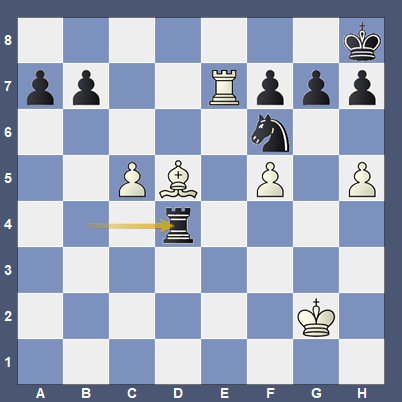
In this position, instead of playing 38. Bxb7 (equal according to Stockfish), von Scheve tried Rxb7?, presumably thinking he was either promoting or mating, but he must have missed something. Undaunted, he played on a piece down in the ending, eventually reaching this position, with Lee to play.

Now 62… Rh2+ is mate in 7, but Lee fell for a stalemate trap by playing 62… Rg2? 63. Ra5+ Kf4 64. Rf5+! with a draw. A familiar enough idea now, but it would have been much less familiar back in 1890.
Lee was unhappy with Gunsberg’s annotations of his loss against Mason from this tournament, and attempted to sue him for libel, but the judge (Roland Vaughan Williams, whose nephew, the composer Ralph Vaughan Williams, is one of my musical heroes) refused to allow a prosecution


Here’s the paragraph from 20 September:

Both Mason and Lee were unhappy with this, Mason writing to the editor of the newspaper.

You can judge for yourself: here’s the critical position after a lot of rather tedious manoeuvring, with Lee (Black) to play his 71st move.
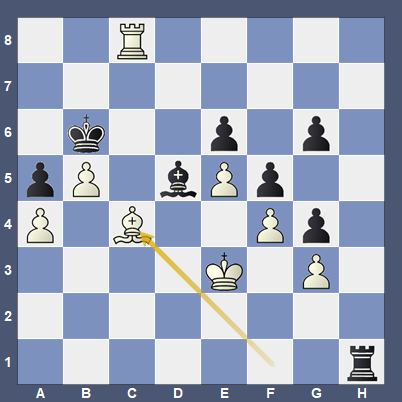
Stockfish suggests 71… Rc1 72. Kd4 Rd1+ 73. Kc3 Kb7, pointing out that 73… Bxc4, for instance, is also a draw. Lee preferred 71… Bxc4? 72. Rxc4 Rf1? (another poor move: Re1+ might have offered some drawing chances) 73. Rc6+, when Mason obtained two passed pawns, soon winning the game.
What do you think? Was Lee tired after a long game and a long tournament? Was the position too hard for him? Was he not trying too hard as there was nothing at stake for him, as Gunsberg thought, or did he deliberately throw the game, as he thought Gunsberg implied?
At the same time, Lee was branching out as a writer, taking over the regular chess column in the Hereford Times in September 1890.
In between tournaments he was travelling throughout the British Isles giving simultaneous displays, often being billed as The Young Master.

Here he is in Belfast in December 1890, feted for his courteous manner as well as his rapid and brilliant play. He had also, in September that year, taken over the chess column in the Hereford Times, which he continued until 1893.
1891 was a quiet year, with no British Chess Association congress for him to take part in. There was a summer tournament at Simpson’s Divan, where he performed disappointingly, finishing in 9th place out of 10. The London based Dutch players Loman and van Vliet took the first two prizes. In August he arranged a match against up and coming German star Emanuel Lasker, drawing the first game, but, with the second game adjourned (Lasker was winning) was obliged to concede the match due to ill health. This may well have been the reason for his poor performance in the earlier tournament.
In the 1891 census he was lodging at 30 Manchester Street (now Argyle Street), St Pancras, giving his occupation as Chess Player and Editor (the word Author was added in) and his place of birth, curiously, as Ingatestone, Essex.
The 1892 edition of the British Chess Association Congress took place in London in March, with Lasker taking part, and, as expected, finishing comfortably ahead of the field. Lee’s 50% score was about what he would have expected.

Here’s his loss against Lasker, who sacrificed some pawns to get to his opponent’s king.
[Event “British CA Congress-07 Masters: London R4”]
[Date “1892.03.10”]
[White “Lasker, Emanuel”]
[Black “Lee, Francis Joseph”]
[Result “1-0”]
1. e4 e5 2. Nc3 Nc6 3. g3 Nf6 4. Bg2 Bc5 5. d3 h6 6. h3 a6 7. Nge2 d6 8. O-O Be6 9. Kh2 g5 10. Nd5 Bxd5 11. exd5 Ne7 12. d4 exd4 13. Nxd4 Qd7 14. Qd3 O-O-O 15. b4 Bxd4 16. Qxd4 Qf5 17. b5 axb5 18. a4 b4 19. Qxb4 Nfxd5 20. Qb3 c6 21. Rb1 Rd7 22. a5 Kd8 23. c4 Nf6 24. Be3 Nc8 25. Rfe1 Rc7 26. Qa3 Re8 27. Bb6 Rxe1 28. Rxe1 Nd7 29. Bxc7+ Kxc7 30. a6 bxa6 31. Qxa6 Ndb6 32. Qa2 Qc5 33. Bf1 Qb4 34. Re3 Nd7 35. Qc2 Ne5 36. c5 Qd4 37. Bg2 dxc5 38. Qf5 Nd7 39. Qxf7 Nd6 40. Qf3 1-0
His win against Bird was a lively affair which won the brilliancy prize.
[Event “British CA Congress-07 Masters: London R8”]
[Date “1892.03.15”]
[White “Bird, Henry Edward”]
[Black “Lee, Francis Joseph”]
[Result “0-1”]
1. f4 d5 2. e3 g6 3. Nf3 Bg7 4. d4 Nd7 5. c4 e6 6. Nc3 Ngf6 7. b3 O-O 8. Bd3 b6 9. O-O Bb7 10. a4 c5 11. Ne5 Ne4 12. Bxe4 dxe4 13. Ba3 Nxe5 14. fxe5 Qg5 15. Qe2 Rfd8 16. Nb5 a6 17. Nd6 Rxd6 18. exd6 cxd4 19. Qf2 f5 20. h4 dxe3 21. Qe2 Qg3 22. Bb2 f4 23. Bxg7 f3 24. Be5 Qg4 25. Qb2 e2 26. Rf2 e3 27. Bh8 exf2+ 28. Kxf2 Qxh4+ 29. g3 Qh2+ 30. Ke3 Qh6+ 31. Kd3 Qf8 32. Be5 Qf5+ 33. Ke3 Qe4+ 34. Kf2 Rd8 35. Qc3 Qc6 36. b4 a5 37. Bf4 axb4 38. Qxb4 Kf7 39. Rb1 Rd7 40. Qc3 Qc5+ 41. Be3 Qh5 42. Bf4 g5 43. g4 Qg6 44. Rxb6 gxf4 45. Rxb7 Rxb7 46. Qxf3 e1=Q+ 47. Kxe1 Qb1+ 48. Qd1 Qxd1+ 49. Kxd1 Rb4 0-1
Next stop was Belfast, for a quadrangular tournament in which he was rather off form, finishing well behind his three rivals. According to a contemporary report he was unwell throughout the event. (One of the games, a featureless draw between Bird and Lee, is missing from MegaBase, but is readily available elsewhere.)

He remained in Ireland for several months after this event, visiting clubs and giving simultaneous displays.
This game, undated in my source, against Mary Rudge, the leading lady chess player of the time, may well have been played in one of these simuls.
[Event “Simultaneous Display: Coffee Palace Dublin”]
[Date “1892.??.??”]
[White “Lee, Francis Joseph”]
[Black “Rudge, Mary”]
[Result “1/2-1/2”]
1. e4 e5 2. Nf3 Nc6 3. Bc4 Be7 4. O-O d6 5. c3 Nf6 6. d3 O-O 7. Be3 Na5 8. Bb3 Nxb3 9. axb3 a6 10. Nbd2 Ne8 11. d4 exd4 12. Nxd4 f5 13. exf5 Bxf5 14. Nxf5 Rxf5 15. Qg4 Rf7 16. Rad1 Nf6 17. Qh3 Qd7 18. Qxd7 Nxd7 19. Nf3 Bf6 20. Rfe1 Re7 21. Bd2 Rae8 22. Rxe7 Rxe7 1/2-1/2
In June he had some important news to announce.

He crossed the Atlantic with his friends Gossip and Jasnogrodsky, but the intended tournament fell through. However, an impromptu tournament was organised as a partial replacement, attracting a lot of press coverage.
According to the Brooklyn Daily Standard Union:
The English player is about 40 years of age, of a German blocky build, which indicates the possession of physical strength to stand the strain of severe chess playing.
(He was actually 35, and I don’t think you’d get away nowadays with ‘German blocky build’, whatever that might mean.)
Reproducing the portrait (probably the one above) from the New York Sun, it added:
… makes him appear stouter than he really is; otherwise the likeness is good.
The Baltimore News provided brief and amusing descriptions of the participants, reprinted here in an English newspaper.

I think all chess columns should be headed by a picture of chess playing kittens. Don’t you?
Here, Lee performed well, sharing third place with two of the top American players, Showalter and Delmar, just behind Albin (of countergambit fame), but they were no match for Lasker, who posted a 100% score.

His Irish opponent in this game essayed the Pirc Defence long before it became popular and acquired a name.
[Event “New York Impromptu R1”]
[Date “1893.09.30”]
[White “Lee, Francis Joseph”]
[Black “Ryan, John S”]
[Result “1-0”]
1. e4 g6 2. d4 d6 3. Bd3 Bg7 4. c3 Nf6 5. f4 c5 6. Nf3 cxd4 7. cxd4 Bg4 8. O-O Qb6 9. Kh1 O-O 10. d5 Na6 11. Nc3 Nc5 12. Qe2 Nfd7 13. Be3 Qb4 14. a3 Qb6 15. Rfc1 Qd8 16. Bc2 b6 17. Rab1 Rc8 18. Nb5 a6 19. Nbd4 Nb8 20. b4 Ncd7 21. Bd3 a5 22. Nc6 Nxc6 23. dxc6 Nb8 24. b5 f5 25. exf5 Bxf5 26. Bxf5 Rxf5 27. Bxb6 Qe8 28. g3 e5 29. Bxa5 Nxc6 30. bxc6 e4 31. Qa2+ Kh8 32. Ng5 h6 33. Ne6 Rxa5 34. Nxg7 Kxg7 35. Rb7+ Kf6 36. g4 e3 37. Qb2+ Ke6 38. Qc3 Rc5 39. Qxe3+ Kf6 40. Qd4+ Re5 41. fxe5+ dxe5 42. Rf1+ Kg5 43. Qe3+ Kxg4 44. Rb4+ 1-0/
Lee is standing fourth from the left in this group photograph from the tournament.

Lee remained in the Americas for two years after this event. In February and March he played a series of exhibition games against some of Cuba’s leading players in Havana.
[Event “Exhibition Game: Havana Chess Club”]
[Date “1894.02.27”]
[White “Lee, Francis Joseph”]
[Black “Ponce, Alberto”]
[Result “1-0”]
1. e4 e5 2. Nf3 Nc6 3. Nc3 Nf6 4. a3 Be7 5. d4 d6 6. dxe5 Nxe5 7. Be2 O-O 8. Bf4 Ng6 9. Bd2 Be6 10. Bd3 Bg4 11. O-O Qd7 12. Be2 Bxf3 13. Bxf3 Rfe8 14. g3 Rad8 15. Qe2 c6 16. Be3 b5 17. Rad1 Qc7 18. Bg2 Ne5 19. h3 Nc4 20. Bc1 Bf8 21. b3 Nb6 22. f4 Nbd5 23. Rd3 Nxc3 24. Rxc3 Nd5 25. Rd3 f5 26. Bb2 fxe4 27. Bxe4 Nf6 28. Bxf6 gxf6 29. Qg4+ Kh8 30. Qf5 d5 31. Bf3 Qg7 32. Bh5 Bc5+ 33. Kg2 Qe7 34. Re1 Qxe1 35. Qxf6+ Kg8 36. Bf7+ 1-0
Later in the year he returned to North America, touring extensively, giving simuls and playing exhibition games.
At the beginning of 1895 The Chess Player’s Mentor was finally published, offering, according to the advertisements, ‘an easy introduction for beginners’, along with ‘analyses of the most popular openings for more advanced players &c’.


The review in the Dundee Advertiser is notable for providing an early example of promoting chess for children for its claimed extrinsic benefits.
It was later republished together with three other books solely written by Gossip. You can read it online here via the Hathi Trust digital library.
Lee returned to England in July that year, but didn’t enter the great Hastings tournament. Perhaps he needed a break after his exertions.

I think it was Albin, rather than Albion, against whom real estate man George C Farnsworth (1852-1896) scored 1½/2
Here’s Lee’s win. Not all that interesting: White chose a poor 5th move and never really stood a chance.
[Event “Casual Game: Buffalo, NY”]
[Date “1894.??.??”]
[White “Farnsworth, George C”]
[Black “Lee, Francis Joseph”]
[Result “0-1”]
1. e4 e5 2. Nf3 Nf6 3. Nc3 Nc6 4. Bc4 Nxe4 5. Bxf7+ Kxf7 6. Nxe4 d5 7. Ng3 e4 8. Ng1 Qh4 9. d4 Bg4 10. Qd2 Bd6 11. c3 e3 12. Qc2 Rae8 13. Bxe3 Rxe3+ 14. fxe3 Bxg3+ 15. hxg3 Qxh1 16. Kf2 Rf8 17. Rf1 Kg8+ 18. Ke1 Rxf1+ 19. Kxf1 Qh5 20. Qf2 Qf5 21. Nf3 Bxf3 22. gxf3 Qb1+ 23. Kg2 Qxa2 24. e4 a5 25. e5 a4 0-1
This game shows Farnsworth in a much better light.
[Event “Casual Game: Buffalo, NY”]
[Date “1894.09.??”]
[White “Farnsworth, George C”]
[Black “Lee, Francis Joseph”]
[Result “1-0”]
1. e4 e5 2. Nf3 Nc6 3. d4 exd4 4. Nxd4 Bc5 5. Be3 Qf6 6. c3 Nge7 7. Qd2 h6 8. Nb5 Bd6 9. Nxd6+ cxd6 10. Na3 Qg6 11. Nb5 O-O 12. Nxd6 f5 13. Bc4+ Kh8 14. exf5 Nxf5 15. Nxf5 Qxf5 16. O-O Ne5 17. Be2 d5 18. Rad1 Be6 19. Bd4 Nf7 20. Bd3 Qg5 21. f4 Qh4 22. f5 Bd7 23. Rf4 Qd8 24. f6 g5 25. Rh4 Kg8 26. Bh7+ Kxh7 27. Qd3+ Kh8 28. Rxh6+ Nxh6 29. f7+ 1-0
He spent the latter part of 1895 touring chess clubs throughout the country, but most of 1896 in London, where he was appointed secretary to the committee organising a tournament at Simpson’s Divan. His administrative role didn’t stop him achieving an excellent result, sharing second place with van Vliet on 8½/11, just half a point behind the winner, Richard Teichmann, who was based in London at the time.
Not many games from this event were published. Here, Dutch organist Rudolf Loman sacrificed a piece unsoundly.
[Event “Simpson’s Tournament: London”]
[Date “1896.??.??”]
[White “Lee, Francis Joseph”]
[Black “Loman, Rudolf Johannes”]
[Result “1-0”]
1. d4 d5 2. c4 e6 3. Nc3 Nf6 4. Nf3 Be7 5. e3 O-O 6. Bd3 dxc4 7. Bxc4 c5 8. O-O Nc6 9. dxc5 Bxc5 10. Bd2 e5 11. h3 e4 12. Ne1 Qe7 13. Ne2 Rd8 14. Qc2 Ne5 15. Bc3 Bf5 16. Bxe5 Qxe5 17. Qb3 Rd7 18. Ng3 Bg6 19. Nc2 h5 20. Rfd1 Rad8 21. Rxd7 Rxd7 22. Ne2 a6 23. Qc3 Qg5 24. Qe1 Bf5 25. Kh1 b5 26. Bb3 Qh4 27. Ng1 Qg5 28. Rd1 Rxd1 29. Qxd1 Ng4 30. hxg4 Qh4+ 31. Nh3 hxg4 32. Qd5 Qh5 33. Qxc5 gxh3 34. g4 Qxg4 35. Ne1 h2 36. Ng2 Qf3 37. Qc7 Bh3 38. Qxh2 1-0
His displays in London included a visit to the Ladies’ Chess Club.

In December, Lee played a short match against Richard Falkland Fenton, winning two games, drawing two and losing one.
1897 was another quiet year spent in London, the only serious chess activity being a match during the summer against enthusiastic veteran Henry Bird, which he won by 8 points to 5.
[Event “Lee v Bird match: London (1)”]
[Date “1897.07.12”]
[White “Lee, Francis Joseph”]
[Black “Bird, Henry Edward”]
[Result “1-0”]
1. e4 e5 2. Nc3 Nf6 3. g3 Nc6 4. Bg2 d6 5. Nge2 Bg4 6. h3 Be6 7. d4 Bd7 8. d5 Nb8 9. f4 Be7 10. Be3 g6 11. Qd2 h5 12. O-O-O a6 13. Ng1 b5 14. Re1 b4 15. Nd1 a5 16. Nf2 Bb5 17. Nf3 Nbd7 18. g4 Qb8 19. g5 Ng8 20. f5 gxf5 21. exf5 f6 22. Ne4 Qb7 23. Nh4 fxg5 24. Ng6 Rh7 25. Nxg5 Bxg5 26. Bxg5 Ngf6 27. Bxf6 Nxf6 28. Qg5 Rf7 29. Nh8 Rf8 30. Qg6+ Kd8 31. Nf7+ Ke7 32. Rxe5+ dxe5 33. d6+ cxd6 34. Bxb7 Ra7 35. Bd5 Be8 36. Qg1 Rd7 37. Be6 Bxf7 38. Bxd7 Nxd7 39. Qa7 Bd5 40. Rg1 1-0
[Event “Lee v Bird match: London”]
[Date “1897.08.??”]
[White “Lee, Francis Joseph”]
[Black “Bird, Henry Edward”]
[Result “1-0”]
1. d4 f5 2. g3 Nf6 3. Bg2 e6 4. Nh3 Bd6 5. O-O O-O 6. c4 c6 7. Nc3 Bc7 8. e4 d5 9. e5 Ne4 10. Ne2 h6 11. b3 c5 12. cxd5 exd5 13. f3 Ng5 14. Nxg5 hxg5 15. f4 cxd4 16. Nxd4 g4 17. Kh1 Nc6 18. Nb5 d4 19. Ba3 Rf7 20. Rc1 Be6 21. Nd6 Bxd6 22. Bxd6 Qa5 23. Rf2 Bd5 24. Rc5 Bxg2+ 25. Rxg2 Qb6 26. Qd3 g6 27. h4 Rd8 28. Qc4 Kg7 29. Kh2 Rh8 30. b4 Qd8 31. b5 Na5 32. Qxd4 Kh6 33. Rgc2 b6 34. Rc8 Qxc8 35. Rxc8 Rxc8 36. e6 Rh7 37. Qf6 Rb7 38. e7 1-0
1898 was even quieter, with just a summer match against Teichmann, which he lost 3½ to 5½. Lee suffered from gastric problems all his life: perhaps this was one reason for his relative lack of activity during this period.
There had been some talk in 1897, and again in 1899, about why Lee wasn’t selected for the Anglo-American Cable Matches. Perhaps the selectors preferred to choose amateurs rather than professionals. Here’s an article from 1899.

Finally, a few months later, he had an opportunity to prove himself at the top level. You will know, if you read my previous Minor Piece, about the great London International Chess Tournament of 1899. Lee was originally selected for the subsidiary single-round event, but when Horatio Caro (of Caro-Kann fame) withdrew at the last minute on health grounds he was promoted to the top section.

As you’ll see he found it hard going, but he did record wins against Steinitz and Chigorin, as well as two victories against Mason.
Let’s have a look at a few of his games from this event.
Playing his favourite Stonewall formation against Mason, his pressure on the half-open g-file was crowned with a sacrificial attack.
[Event “London International R12”]
[Date “1899.06.14”]
[White “Lee, Francis Joseph”]
[Black “Mason, James”]
[Result “1-0”]
1. d4 d5 2. e3 Nf6 3. Bd3 Nc6 4. f4 Bg4 5. Nf3 e6 6. c3 Ne4 7. Nbd2 f5 8. Qb3 Nxd2 9. Bxd2 Bxf3 10. gxf3 Rb8 11. Ke2 Be7 12. Rag1 O-O 13. Rg2 b5 14. Qd1 Na5 15. b3 Rf7 16. h4 c6 17. h5 Nb7 18. Qg1 Kh8 19. e4 Nd6 20. e5 Nb7 21. Rg6 Qd7 22. h6 Rg8 23. Bxf5 exf5 24. e6 Qe8 25. exf7 Qxf7 26. hxg7+ Rxg7 27. Rxg7 Qxg7 28. Kd3 Qf7 29. Qe3 Bf6 30. Re1 Nd8 31. Bc1 Qd7 32. Ba3 Kg7 33. Be7 Kf7 34. Bxf6 Kxf6 35. Qe5+ Kf7 36. Rg1 Qe6 37. Rg7+ Kf8 38. Rxh7 Qxe5 39. fxe5 1-0
Lee’s win against Steinitz was also a Stonewall, but here he was rather lucky.
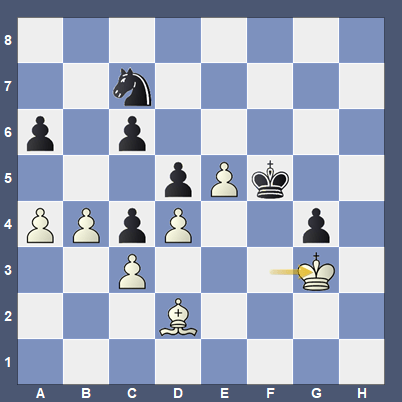
Steinitz had had the better of the opening, but Lee had managed to reach a drawn ending. If Black just waits with his knight White can make no progress, but the ailing former champion, close to the end of his life, seriously misjudged the position, playing 49… Ke4??, after which Lee’s e-pawn wasn’t for stopping.
The following day, black against Chigorin, he faced his opponent’s favourite anti-French move 2. Qe2, gaining a space advantage and giving up the exchange for a passed pawn, and winning one of his finest games.
[Event “London International: R19”]
[Date “1899.06.24”]
[White “Chigorin, Mikhail Ivanovich”]
[Black “Lee, Francis Joseph”]
[Result “0-1”]
1. e4 e6 2. Qe2 Nc6 3. Nc3 e5 4. d3 Nd4 5. Qd1 Bb4 6. Bd2 Nf6 7. Nf3 Nc6 8. a3 Bxc3 9. Bxc3 d6 10. Be2 O-O 11. h3 Re8 12. Nd2 d5 13. b3 d4 14. Bb2 Ne7 15. Nf1 Ng6 16. Qd2 c5 17. g3 b5 18. h4 h6 19. f3 Bd7 20. Bc1 a5 21. Bd1 Qc7 22. Qg2 c4 23. Bd2 Ra6 24. Rg1 cxd3 25. cxd3 Rc6 26. Nh2 Rc3 27. Ra2 Rxd3 28. Qe2 Rc3 29. Bxc3 dxc3 30. Nf1 Nf8 31. g4 Ne6 32. g5 Nf4 33. Qe3 hxg5 34. hxg5 N6h5 35. Rh2 b4 36. a4 Qd6 37. Bc2 Qd4 38. Rgh1 g6 39. Kf2 Kf8 40. Kg1 Bc8 41. Kf2 Ba6 42. Rg1 Rd8 43. Rgh1 Bxf1 44. Qxd4 exd4 45. Rxf1 d3 46. Rd1 dxc2 47. Rxd8+ Ke7 48. Rh1 Kxd8 49. Ke3 Ne2 0-1
At his best, Lee was a formidable positional player who could also, when the occasion demanded, display tactical ability. Someone who has, you might think, been unfairly neglected in chess literature.
As the remainder of the year – and the century, seems to have been uneventful for him, this must be a good place to break off.
Join me again soon to discover what the 1900s had in store for Francis Joseph Lee.
Sources and references:
ancestry.co.uk
findmypast.co.uk/British Newspaper Archive
Wikipedia
chessgames.com: FJ Lee here
ChessBase/MegaBase 2024
Stockfish 16
EdoChess (Rod Edwards): FJ Lee here
Two articles on chess.com from Neil Blackburn (simaginfan):
Lee and Gossip. Three Brilliancies. – Chess.com
Belfast 1892. A Chess Tournament and A Grumpy Bird! – Chess.com
Zan Chess: article on New York 1893 here


 Minor Pieces
Leave a comment